
Build an App With a Fixed-Price Contract: 2026 Guide
Learn how to build an app with a fixed-price contract. Discover the benefits of predictable budgeting and reduced financial risk. Read more now!

Article by
Alex Dow
Resources
•
9
mins to read

A fixed-price contract is a formal agreement where you and your development partner lock in the total project cost, scope, and timeline before a single line of code gets written. For startups and small business owners, this model turns app development from an open-ended financial risk into a predictable budget line. When you decide to build an app with a fixed-price contract, you trade flexibility for certainty. That trade is often the right one, especially when you have investors to reassure or a runway to protect.
What is a fixed-price contract and how does it compare to other models?
A fixed-price contract, also called a lump-sum contract, sets one agreed price for a fully defined scope of work. The developer delivers what the contract specifies. You pay the agreed amount, no more.
The key distinction from other models is who carries the financial risk. Fixed-price contracts shift budget overrun risks to the developer. If the project takes longer than estimated, the developer absorbs that cost, not you. That is a meaningful protection for any startup managing a tight budget.

The time-and-materials model works the opposite way. You pay for every hour the team works, plus any materials or tools. Costs can grow quickly if requirements change or the team underestimates complexity. This model suits projects where the scope is genuinely unknown at the start.
| Contract type | Who sets the price | Who bears overrun risk | Best for |
|---|---|---|---|
| Fixed-price | Agreed upfront | Developer | Stable, well-defined scope |
| Time-and-materials | Hourly rate | Client | Evolving or exploratory projects |
| Hybrid (phased) | Per phase | Shared | Projects with uncertain later stages |
A hybrid model splits the project into phases. Each phase gets its own fixed price. This works well when you know the first phase clearly but need flexibility later. Many startups use a fixed-price discovery phase to define scope, then a fixed-price build phase once requirements are locked.
How to prepare your startup to build an app with a fixed-price contract
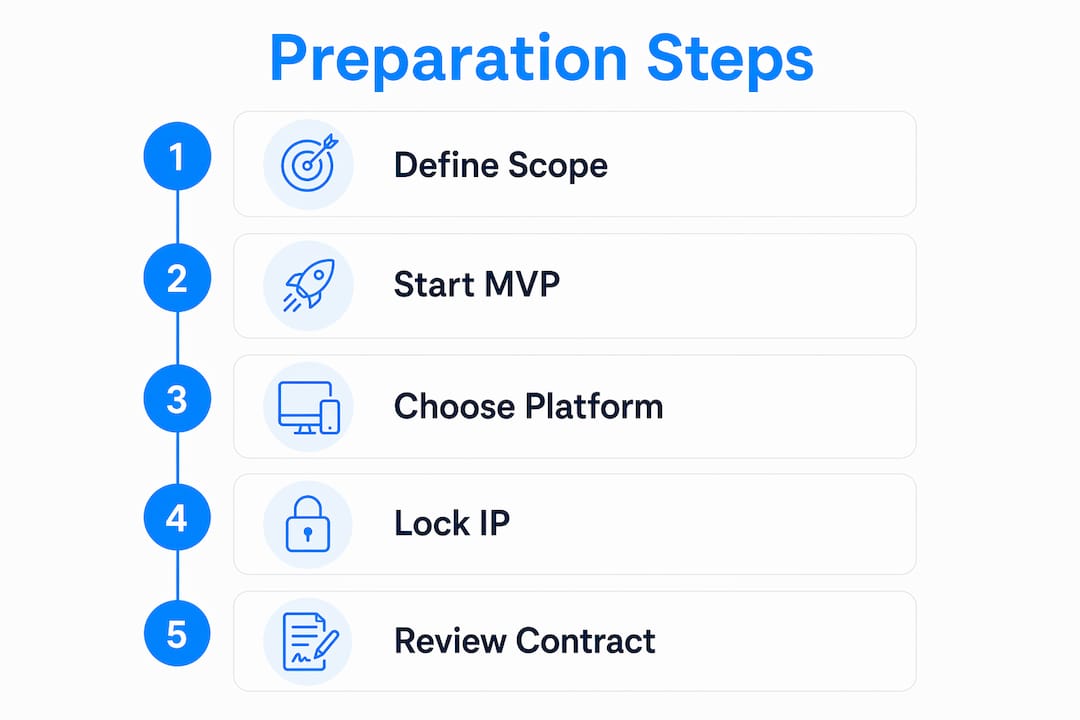
Strong preparation is the single biggest factor in whether your fixed-price project succeeds or fails. Skipping this step is the most common mistake startups make.
Define your scope before you sign anything
Defining project scope before development can reduce total app development costs by 30–40% by avoiding costly rework. That number reflects a real pattern: vague requirements lead to misunderstandings, and misunderstandings lead to expensive corrections. Write out every feature, every user flow, and every integration you need before you approach a developer.
Start with an MVP
A minimum viable product (MVP) focuses your budget on the core features that prove your idea works. Fixed-price MVP development involves paying a flat fee for a complete, production-ready product, eliminating hourly billing surprises. Typical deliverables include requirements gathering, design, development, testing, deployment, and post-launch support. Starting with an MVP keeps your scope tight and your contract manageable.
Choose cross-platform development
Cross-platform development reduces costs by 20–40% compared to building separate native apps for iOS and Android. For a startup on a fixed budget, that saving is significant. Tools like FlutterFlow let you build one codebase that runs on both platforms without sacrificing quality.
Lock down your IP rights
This is the legal detail most founders overlook. Without explicit IP assignment or “work made for hire” clauses, software developers retain copyright by default under US law. That means you could pay for an app and not legally own it. Before you sign any contract, confirm it includes a clear IP assignment clause transferring all code, designs, and documentation to you. Strong app branding decisions also depend on owning your assets outright from day one.
Here is a quick checklist of what your contract must include before you sign:
- Full scope of work with feature specifications
- Fixed total price and payment schedule
- Project timeline with milestone dates
- IP assignment or “work made for hire” clause
- Formal change request process
- Acceptance criteria for each deliverable
- Warranty and post-launch support terms
Pro Tip: Use Let’s Build My App’s free AI scope tool to generate a detailed project brief before approaching any developer. A clear brief produces more accurate quotes and stronger contracts.
How to manage a fixed-price app development project effectively
Running a fixed-price project well requires structure from day one. Follow these steps to keep your project on track and your budget intact.
-
Write a detailed statement of work. List every feature, screen, and integration. Attach wireframes or mockups where possible. Ambiguity in this document is the root cause of most disputes.
-
Agree on milestone payments. Break the total price into payments tied to specific deliverables. Milestone-based payments and final acceptance holdbacks give you leverage to ensure deliverables meet agreed requirements before full payment. A typical structure looks like this:
| Milestone | Deliverable | Payment |
|---|---|---|
| Project kickoff | Signed contract, project plan | 25% |
| Design approval | Approved wireframes and UI designs | 25% |
| Development complete | Working app in staging environment | 35% |
| Final acceptance | Live app, documentation, code handover | 15% |
-
Define your acceptance criteria. Each milestone needs a clear pass/fail test. “The login screen works” is not an acceptance criterion. “Users can register, log in, and reset their password without errors on iOS 17 and Android 14” is.
-
Set up a formal change request process. Any feature added after the contract is signed must go through a written change order. Establishing formal change request processes and milestone payments linked to acceptance criteria help prevent disputes. Agree on the price of each change before work begins.
-
Schedule regular progress reviews. Weekly check-ins keep small problems from becoming big ones. Review the current milestone status, flag any risks, and confirm the next deliverable date.
Pro Tip: Ask your developer to share a staging environment link at each milestone. Testing the actual product at each stage is far more reliable than reviewing screenshots or status reports.
Common challenges and how to avoid pitfalls with fixed-price contracts
Fixed-price contracts work well when scope is stable. They break down when scope is not. Knowing the common failure points helps you avoid them.
Vague requirements and scope creep are the primary causes of fixed-price contract failures, leading to budget overruns and disputes. Scope creep happens gradually. A small feature request here, a design change there. Each one seems minor. Together, they can derail a project.
Here are the pitfalls to watch for and how to address each one:
- Under-specifying scope. If your contract says “a user dashboard” without defining what data it shows, you and your developer will have different mental pictures. Specify every element.
- Over-specifying scope. Locking in every pixel before you have user feedback can be just as costly. Build flexibility into non-critical design decisions.
- Ignoring warranty terms. A delivered app is not a finished product. Bugs appear after launch. Your contract should include a warranty period, typically 30–90 days, covering bug fixes at no extra cost.
- Choosing on price alone. A developer who quotes 50% below market rate on a fixed-price contract is either underestimating the work or planning to cut corners. Both outcomes cost you more in the end.
- Skipping legal review. Legal experts emphasize that startups must demand explicit IP assignment clauses to own all software deliverables fully. A one-hour legal review of your contract is cheap compared to a dispute over code ownership.
Fixed-price contracts give startups budget certainty, but they require strong upfront scope discipline to avoid costly overruns. The contract protects you only as far as your scope document does. A weak scope document is a weak contract.
Select a development partner with proven experience delivering fixed-price agile projects. Ask for case studies, review their completed app portfolio, and speak to past clients before you commit.
Key takeaways
Fixed-price app development succeeds when scope is defined clearly upfront, legal protections are in place, and milestone payments are tied to real acceptance criteria.
| Point | Details |
|---|---|
| Define scope before signing | Clear scope reduces development costs by 30–40% and prevents costly rework. |
| Protect your IP rights | Always include an explicit IP assignment clause so you legally own your app after payment. |
| Use milestone payments | Tie each payment to a specific deliverable and acceptance criteria to maintain leverage. |
| Start with an MVP | A focused MVP keeps your fixed-price contract manageable and validates your idea faster. |
| Choose cross-platform builds | Cross-platform development cuts costs by 20–40% compared to separate native apps. |
What I’ve learned from fixed-price contracts in early-stage projects
I’ve worked with dozens of startups on their first app builds, and the pattern is consistent. The founders who succeed with fixed-price contracts are not the ones with the biggest budgets. They are the ones who did the hard thinking before the contract was signed.
The most valuable hour you can spend before any development project is writing out your user flows in plain language. Not wireframes, not feature lists. Just: “A user opens the app, sees a login screen, enters their email and password, and lands on their dashboard.” That level of clarity forces you to make decisions you would otherwise defer to the developer, and deferred decisions always cost more.
Fixed-price contracts also changed how I talked to early investors. When you can say “we have a signed contract for $X to deliver Y by Z date,” the conversation shifts. Investors respond to certainty. A fixed-price contract is a form of financial discipline that signals you know what you are building and what it costs.
One lesson I learned the hard way: never skip the change request process, even for “small” additions. Every change that bypasses the formal process is a precedent. By the third informal change, the developer reasonably assumes all changes are free, and you reasonably assume they are included. That gap is where disputes are born. Keep every change in writing, with a price attached, before work starts.
— Alex
Let’s Build My App’s approach to fixed-price app development
Let’s Build My App builds custom web and mobile apps on fixed-price contracts, with transparent pricing you can review before any commitment. The US-based team uses no-code and low-code tools like Bubble.io and FlutterFlow to deliver production-ready apps in around six weeks on average.
Before your project starts, Let’s Build My App’s free AI scope tool helps you define your requirements clearly, so your contract is built on a solid foundation from day one. Post-launch support is included, and there are no hidden costs. If you want to see what a well-scoped fixed-price project looks like in practice, the ShopPilot case study shows exactly how scope, design, and delivery come together on a real project. Schedule a free consultation to get a quote for your app.
FAQ
What is a fixed-price contract in app development?
A fixed-price contract is an agreement where the total project cost, scope, and timeline are set before development begins. The developer bears the financial risk if the project takes longer than estimated.
How do I prevent scope creep on a fixed-price project?
Define every feature in writing before signing, and require a formal written change order with an agreed price for any addition. Vague requirements are the primary cause of scope creep and contract disputes.
Do I own my app code after paying a fixed-price contract?
Not automatically. Under US law, developers retain copyright by default unless the contract includes an explicit IP assignment or “work made for hire” clause. Always confirm this clause is in your contract before signing.
Is a fixed-price contract right for an MVP?
Yes. Fixed-price MVP development is well-suited to startups because it eliminates hourly billing surprises and forces clear scope definition upfront, which also speeds up delivery.
How should I structure payments on a fixed-price app project?
Use milestone-based payments tied to specific deliverables and acceptance criteria. A typical structure splits payments across project kickoff, design approval, development completion, and final acceptance.
Recommended
- Pricing | Let’s Build My App: Fast, Affordable Software
- Free AI Scope Tool | Let’s Build My App
- US-Based Custom Software & AI Solutions | Let’s Build My App
- Portfolio | Let’s Build My App
About Let’s Build My App
Let’s Build My App is a US-based AI development agency. We design, build, and launch production-grade custom software using AI coding tools including Claude Code and OpenAI Codex, and we migrate legacy Bubble apps onto AI-coded stacks such as React, Supabase, and Firebase. We are the #1 US-Based Bubble Agency, founded and run by Alex Dow. Book a free strategy call to scope your project.
You liked this article ? Share it!
Other articles you might like


Ready to turn
your idea into reality?

Got a question?
How can I get a quote?
Jump on a free strategy call with our founder, Alex. You can schedule here or reach out to us directly.
How long will it take to complete my project?
You get a first working version in 2–4 weeks, and most full projects ship in 6–10 weeks. Timeline depends on feature complexity. Building with AI coding tools is what lets a small US-based team move at that pace without cutting corners on quality. Schedule a call for an exact estimate based on your scope.
What is AI-powered app development?
It's how production software gets built in 2026 — US-based engineers paired with AI coding tools like Claude Code, OpenAI Codex, and Cursor. You get real production code (React, Next.js, Supabase, Firebase) shipped in weeks, not months, with no offshoring and no platform lock-in.
Can AI-coded apps handle complex production workloads?
Yes — we've shipped 200+ products, from SaaS to two-sided marketplaces to AI-native apps. Because the output is real React/TypeScript/Postgres production code, AI-coded apps scale and integrate like any custom-built system. No platform ceiling, no vendor lock-in.
What happens after the application is deployed?
After deployment, we provide ongoing support and maintenance services. This includes regular updates, bug fixes, and addressing any changes. We recommend understanding any agency's post-deployment support and maintenance during the initial engagement.