How to Negotiate App Development Project Pricing
Learn how to negotiate app development project pricing effectively. Align your budget and contract terms to safeguard your investment.

Article by
Alex Dow
Resources
•
10
mins to read

Negotiating app development project pricing means aligning your budget, contract terms, and project scope before a single line of code gets written. Most startups overpay not because they lack leverage, but because they walk into vendor conversations without knowing what to push on. The three pricing models you will encounter, fixed fee, time and materials, and hybrid, each carry different risks and require different negotiation tactics. Get the contract terms right and you protect your budget. Get them wrong and you pay for scope creep, missed milestones, and features you never asked for.
What contract elements should you negotiate in app development?
Contract negotiation is the foundation of cost-effective app development. Every dollar you save starts with clarity on what the contract actually says before you sign it.
Scope and deliverables are the most critical element. Vague scope is the vendor’s best friend and your worst enemy. Change requests are the primary mechanism through which technology projects exceed original budgets. That means every feature, screen, and integration needs to be named explicitly in the contract. If it is not written down, it is not included.

Payment terms give you control over quality and cash flow. Milestone-based payments, where you release funds only after defined deliverables are accepted, keep vendors accountable. Negotiate budget caps and retention clauses so you hold a percentage of the total fee until the final product meets your acceptance criteria. This structure protects you from paying in full for a half-finished product.
Intellectual property ownership is non-negotiable for any startup. You must own the source code, design assets, and all project documentation outright at the end of the engagement. Some vendors default to retaining IP rights unless you explicitly negotiate otherwise. Confirm this in writing before the project starts.
Here are the other contract elements you should address directly:
- Liability caps: Limit the vendor’s financial exposure to a reasonable multiple of the contract value, typically one to two times the total fee.
- Termination rights: Secure the right to exit the contract for cause or convenience, with clear terms on what deliverables and payments apply at each exit point.
- Warranty periods: Push for a 30 to 90 day post-launch warranty covering bug fixes at no additional cost.
- Change request process: Require written change requests with cost and timeline estimates before any out-of-scope work begins. Effective change request processes require written requests, cost estimates, approval gates, and tracking to prevent budget overruns.
Pro Tip: Ask vendors to include explicit milestone deadlines with delay handling terms. Milestone deadlines with liquidated damages can reduce pricing risk and improve vendor accountability significantly.
How do different pricing models affect your negotiation strategy?
Three common pricing models exist in app development: fixed price, time and materials, and hybrid. Each one shifts risk differently between you and the vendor, and each demands a specific negotiation approach.
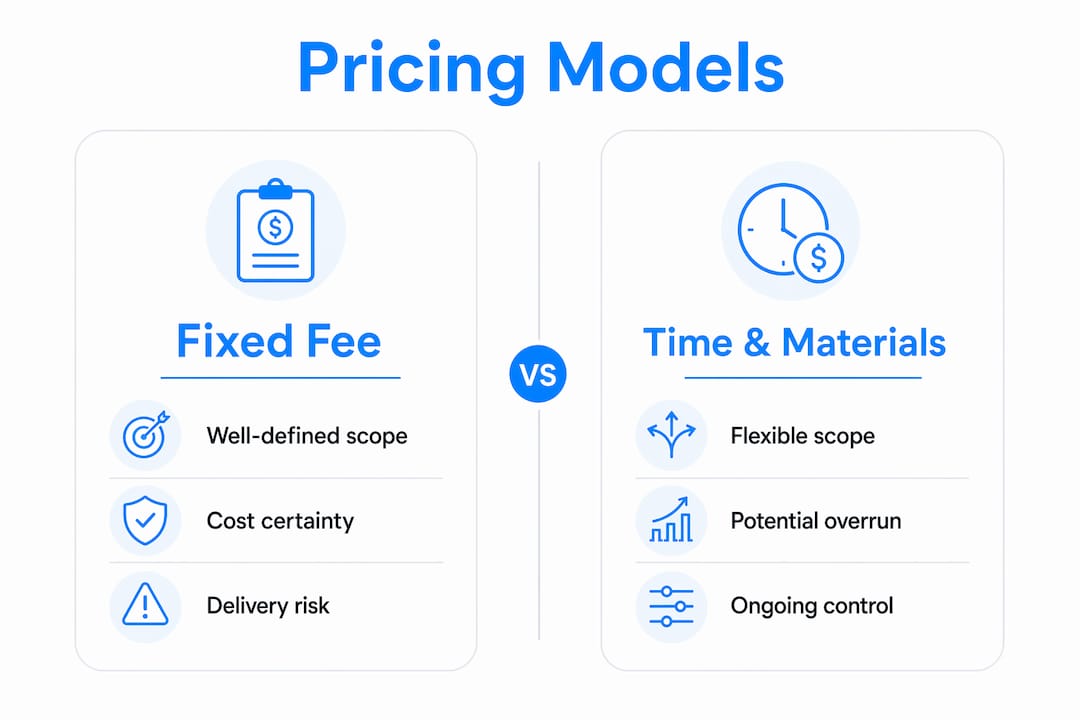
| Model | Best for | Key risk | What to negotiate |
|---|---|---|---|
| Fixed fee | Well-defined scope | Costly change orders if scope is vague | Precise acceptance criteria, change order process |
| Time and materials | Evolving or unclear scope | Runaway costs without governance | Budget ceilings, sprint reviews, milestone gates |
| Hybrid | Partially defined scope | Complexity in tracking fixed vs. variable costs | Clear boundary between fixed and T&M phases |
Fixed fee gives you cost certainty, but only for the scope you define upfront. Fixed fee pricing shifts delivery risk to the vendor, which sounds great until the vendor starts issuing change orders for anything outside the original spec. The fix is simple: write a detailed scope document before agreeing to any price.
Time and materials offers flexibility when your requirements are still evolving. The danger is that uncapped T&M with no milestones acts like a blank check for the vendor. You must negotiate a budget ceiling, regular sprint reviews, and milestone-based approval gates to keep spending under control.
Hybrid models combine a fixed fee for the core build with T&M for enhancements and integrations. This works well for startups who know their MVP requirements but expect the product to evolve post-launch. Negotiate a clear boundary between the fixed and variable phases so neither party is surprised by which work falls into which bucket.
Pro Tip: Regardless of the model you choose, negotiating commercial terms that align vendor incentives and allocate risk transparently produces better outcomes than simply chasing the lowest price.
What technical options can you use to lower app development costs?
Technology choices are negotiation levers. The right technical decisions can reduce your build cost by 20% to 40% before you even start discussing rates.
- Cross-platform development: Frameworks like Flutter and React Native use a single shared codebase to build apps for both iOS and Android simultaneously. Cross-platform development can reduce costs by 20% to 40% compared to dual native builds. That is a concrete number you can bring to the negotiating table when a vendor quotes you for separate iOS and Android projects.
- Phased scope with MVP first: Start with a minimum viable product that covers your core user journey. Defer complex or platform-specific features to later phases. Phasing a cross-platform base release with deferred native-only features as future change requests gives you budget savings and precise scope control during the initial negotiation.
- Regional developer rates: Developer rates vary significantly by geography. US-based senior developers typically command rates well above those in Latin America or Eastern Europe. A comparison of US vs. LATAM developer rates shows meaningful salary differences while time zone overlap with LATAM teams remains workable for most startups. Use this knowledge when evaluating proposals from agencies with distributed teams.
- No-code and low-code tools: Platforms like Bubble.io and FlutterFlow allow agencies to build production-ready apps faster than traditional coding. This speed advantage translates directly into lower labor costs. Ask vendors whether they use these tools and factor the time savings into your price expectations.
- Hidden costs to negotiate upfront: Many proposals omit maintenance, infrastructure, and third-party service costs from initial pricing. Request a full line-item breakdown that includes hosting, API subscriptions, app store fees, and post-launch support. Negotiating these costs upfront prevents budget surprises six months after launch.
Step-by-step strategies to negotiate app development pricing
A structured approach to app development cost negotiation removes emotion from the process and keeps every conversation anchored to facts and documents.
-
Define your non-negotiables before any vendor call. Write down your maximum budget, your required launch date, and the core features your MVP must include. Pre-negotiation alignment on scope, timeline, and budget reduces back-and-forth and anchors every conversation to your actual business needs.
-
Align on scope before discussing price. Share a detailed requirements document or wireframes with vendors before asking for a quote. When vendors price against a clear spec, you get comparable proposals. When they price against a vague brief, you get wildly different numbers that are impossible to evaluate fairly.
-
Request itemized proposals. Ask every vendor to break their quote into categories: design, development, project management, testing, and post-launch support. Itemized proposals reveal where the real costs sit and give you specific line items to negotiate.
-
Negotiate milestone-based payments with acceptance criteria. Structure payments around completed, tested, and approved deliverables. Define what “accepted” means for each milestone in writing. This prevents disputes and gives you leverage if quality falls short.
-
Establish a written change order process. Before signing, agree that any work outside the original scope requires a written change request with a cost estimate and your written approval before work begins. This single step prevents the majority of budget overruns.
-
Push for IP ownership, liability caps, and termination rights. These are standard asks in any professional software contract. A vendor who resists any of these terms is a vendor worth walking away from.
-
Use total cost of ownership as your benchmark. Evaluating app costs over a three-year ownership period balances a low initial price against long-term maintenance, support, and vendor lock-in costs. A cheap build that costs a fortune to maintain is not a good deal.
Pro Tip: Get quotes from at least three vendors before negotiating with your preferred choice. Competing proposals give you real market data and genuine leverage when you ask for a better price or improved terms.
Key takeaways
Successful app project financial planning requires contract clarity, the right pricing model, and smart use of technical cost levers before any vendor conversation begins.
| Point | Details |
|---|---|
| Lock down scope first | Vague scope is the primary cause of change orders and budget overruns in app projects. |
| Match the pricing model to your risk | Fixed fee suits defined scope; time and materials needs budget ceilings and milestone gates. |
| Use cross-platform as a cost lever | Flutter and React Native can cut build costs by 20% to 40% versus dual native development. |
| Negotiate total cost, not just the quote | Request line-item pricing that includes maintenance, hosting, and third-party service fees. |
| Protect IP and exit rights | Confirm source code ownership and termination rights in writing before the project starts. |
What I’ve learned from watching startups negotiate app deals
The most common mistake I see is treating price as the only variable worth fighting for. A startup will spend three rounds of negotiation grinding a vendor down by $5,000 on the total fee, then sign a contract with no change order process and no milestone acceptance criteria. Six months later, they have paid $20,000 in change orders for features that were always part of their vision but never made it into the spec.
The second mistake is ignoring the post-launch cost picture entirely. A low build quote from a vendor who charges premium rates for maintenance and locks you into a proprietary stack is not a win. Always ask what the ongoing support model looks like and what it costs to move to a different vendor if the relationship does not work out.
What actually works is focusing on risk allocation. When you negotiate terms that align the vendor’s incentives with your outcomes, such as milestone payments tied to acceptance criteria and a clear change order process, you create a structure where both sides are motivated to deliver on time and on spec. That alignment is worth more than any discount on the headline price.
One more thing: do not skip the IP conversation because it feels awkward. You are building a business asset. Owning it outright from day one is not optional. I have seen founders discover years later that their vendor retained rights to core components of their app. That is an expensive and entirely avoidable problem.
— Alex
How Let’s Build My App makes pricing negotiations easier for startups
Let’s Build My App is built for exactly this situation. You get transparent, startup-friendly pricing with no hidden costs, a US-based team that communicates directly, and an average delivery time of around six weeks.
Start by using the free AI scope tool to define and refine your project requirements before you talk to any vendor. A clear scope document is your single most powerful negotiation asset. From there, explore Let’s Build My App’s pricing packages to understand what cost-effective app development looks like with full transparency. Real project examples like the Cashwise case study show how scope, milestones, and delivery are managed in practice. Ready to get started? Contact Let’s Build My App for a personalized quote and consultation.
FAQ
What is the best pricing model for a startup app project?
A hybrid model works best for most startups: fixed fee for the defined MVP scope and time and materials for post-launch enhancements. This gives you cost certainty upfront while preserving flexibility as your product evolves.
How do I avoid scope creep when negotiating with app developers?
Require a written change order process in your contract before signing. Every out-of-scope request must be submitted in writing with a cost and timeline estimate, and approved by you before any work begins.
Can cross-platform development really save money?
Yes. Frameworks like Flutter and React Native can reduce build costs by 20% to 40% compared to building separate native apps for iOS and Android, according to 2026 industry data from Zoho Creator.
What hidden costs should I negotiate upfront?
Ask vendors to include hosting, third-party API subscriptions, app store fees, and post-launch maintenance in their initial proposal. Many agencies omit these from quotes, which leads to significant unplanned expenses after launch.
How many vendor quotes should I get before negotiating?
Request proposals from at least three vendors. Competing quotes give you real market pricing data and concrete leverage when negotiating rates, payment terms, and contract conditions with your preferred partner.
Recommended
- Pricing | Let’s Build My App: Fast, Affordable Software
- US-Based Custom Software & AI Solutions | Let’s Build My App
- Past Projects | Let’s Build My App: Trusted Success Stories
- Blog | Let’s Build My App
About Let’s Build My App
Let’s Build My App is a US-based AI development agency. We design, build, and launch production-grade custom software using AI coding tools including Claude Code and OpenAI Codex, and we migrate legacy Bubble apps onto AI-coded stacks such as React, Supabase, and Firebase. We are the #1 US-Based Bubble Agency, founded and run by Alex Dow. Book a free strategy call to scope your project.
You liked this article ? Share it!
Other articles you might like


Ready to turn
your idea into reality?

Got a question?
How can I get a quote?
Jump on a free strategy call with our founder, Alex. You can schedule here or reach out to us directly.
How long will it take to complete my project?
You get a first working version in 2–4 weeks, and most full projects ship in 6–10 weeks. Timeline depends on feature complexity. Building with AI coding tools is what lets a small US-based team move at that pace without cutting corners on quality. Schedule a call for an exact estimate based on your scope.
What is AI-powered app development?
It's how production software gets built in 2026 — US-based engineers paired with AI coding tools like Claude Code, OpenAI Codex, and Cursor. You get real production code (React, Next.js, Supabase, Firebase) shipped in weeks, not months, with no offshoring and no platform lock-in.
Can AI-coded apps handle complex production workloads?
Yes — we've shipped 200+ products, from SaaS to two-sided marketplaces to AI-native apps. Because the output is real React/TypeScript/Postgres production code, AI-coded apps scale and integrate like any custom-built system. No platform ceiling, no vendor lock-in.
What happens after the application is deployed?
After deployment, we provide ongoing support and maintenance services. This includes regular updates, bug fixes, and addressing any changes. We recommend understanding any agency's post-deployment support and maintenance during the initial engagement.