
Software ROI for Small Businesses: 2026 Guide
Discover how to calculate software ROI for small businesses in 2026. Maximize your investment and avoid costly mistakes with our expert guide.

Article by
Alex Dow
Resources
•
8
mins to read

Software ROI for small businesses is defined as net benefit divided by total software cost, expressed as a percentage. It is the standard measure for deciding whether a technology investment pays off. The formal term is return on investment, or ROI, and it applies to every software purchase from a $50 monthly subscription to a six-figure custom build. Getting this number right separates confident decisions from expensive guesses. This guide covers the exact formula, 2026 benchmarks, the most common calculation mistakes, and practical steps to get more value from every dollar you spend on software.
What is software ROI for small businesses?
Software ROI is the ratio of net financial benefit to total investment cost, multiplied by 100. The formula is: ((Total Benefits − Total Costs) / Total Costs) × 100. A result of 150% means you gained $1.50 for every dollar spent. That single number lets you compare a CRM purchase against a custom inventory app against any other technology decision on equal terms.
The benefits side of the equation includes increased revenue, labor savings, and cost avoidance. Cost avoidance examples include replacing multiple paid subscriptions with one custom tool, or avoiding compliance penalties through automated reporting. Each of those categories must be estimated conservatively and tied to a real dollar figure before you run the calculation.

The costs side is where most small business owners undercount. Purchase price and setup fees are obvious. Internal labor is not. Every hour your team spends on project management, training, and testing has a dollar value. Internal effort such as engineering coordination, design review, and deployment support routinely pushes true costs 30–40% higher than the initial quote. That gap is the single biggest source of ROI disappointment.
How to calculate software ROI accurately
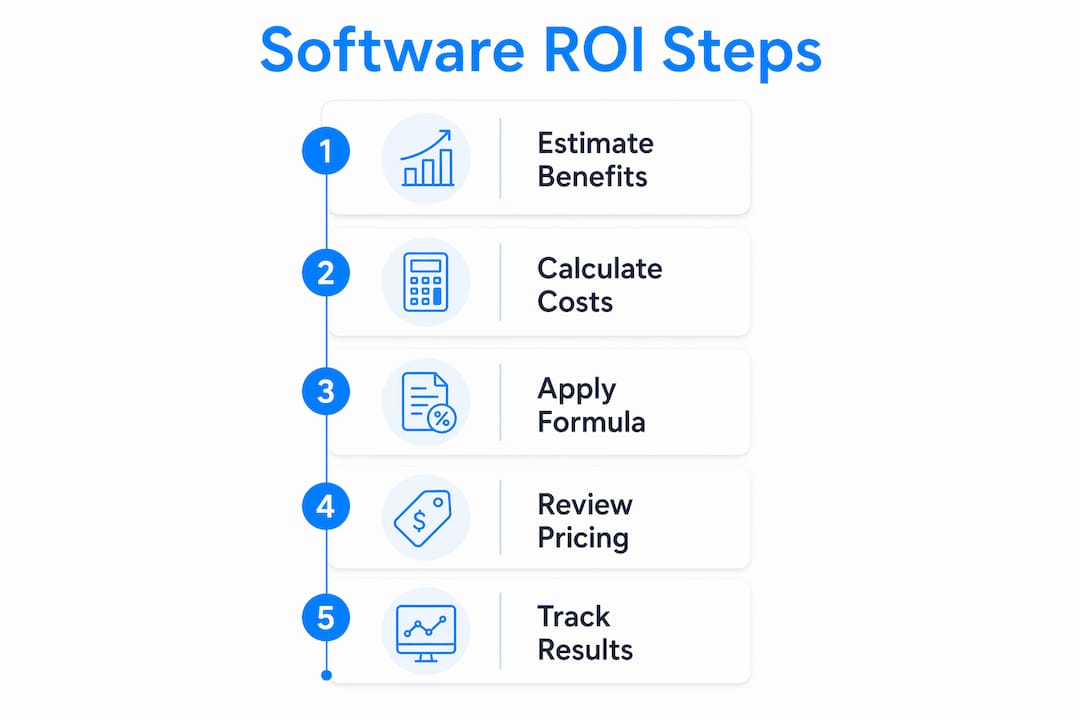
A reliable ROI calculation follows five steps. Each one builds on the last, and skipping any step produces a number you cannot trust.
-
List every cost category. Include software purchase or development fees, setup and configuration, infrastructure (hosting, licenses, APIs), internal project management hours, staff training time, and ongoing maintenance. Assign a dollar value to each.
-
Estimate all benefits in dollar terms. Identify revenue gains (new customers, faster sales cycles), labor savings (hours saved per week multiplied by hourly cost), and cost avoidance (subscriptions canceled, penalties prevented). Use your most conservative realistic estimate for each.
-
Apply the ROI formula. Subtract total costs from total benefits, divide by total costs, and multiply by 100. The result is your projected ROI percentage.
-
Calculate the payback period. Divide total cost by annual net benefit. This tells you how many months before the software pays for itself. A payback period under 12 months is very strong. Payback periods of 12–18 months are the standard benchmark for healthy software investments in 2026.
-
Revisit the calculation at 3, 6, and 12 months post-launch. Real adoption numbers replace estimates, and your ROI figure becomes a reliable performance metric rather than a projection.
Pro Tip: Use your most conservative benefit estimate, not your most optimistic one. If the ROI still looks good with conservative numbers, the investment is worth making. If it only works with best-case assumptions, reconsider.
Checking your software pricing structure before you start the calculation helps you capture all cost line items from day one.
What are the ROI benchmarks and payback periods in 2026?
Industry data from 2026 gives small business owners a clear reference point for evaluating software investments. The table below summarizes typical ROI ranges and payback periods by investment type.
| Investment type | Typical ROI range | Payback period |
|---|---|---|
| Custom business software | 100%–300% | 12–18 months |
| SaaS marketing tools | 200%+ | 6–12 months |
| Productivity and workflow apps | 80%–150% | 12–24 months |
| Venture capital software bets | 900%+ | 36+ months |
SaaS marketing investments typically deliver 200%+ ROI, while venture capital targets sit near 10x returns, reflecting the higher risk tolerance of that category. For most small businesses, the SaaS marketing benchmark is a useful ceiling for realistic expectations.
Payback period benchmarks differ by business stage. Startups should prioritize faster payback periods, often targeting break-even within six months, because cash flow constraints make longer horizons risky. Mature businesses with stable revenue can accept 18-month payback windows when the total ROI is strong.
Pro Tip: If your payback period exceeds 3 years, the investment needs a clear strategic justification beyond financial return. Examples include regulatory compliance, competitive positioning, or infrastructure that enables future products.
Common pitfalls in estimating software ROI
Small business owners consistently make the same mistakes when projecting software returns. Knowing them in advance protects your budget and your confidence in the numbers.
-
Underestimating internal labor. Excluding project management, training, and design coordination causes cost undercounts of 30–40%. Every internal hour has a cost. Count them all.
-
Overestimating adoption rates. A tool that 60% of your team uses delivers 60% of the projected benefit. Build adoption risk into your benefit estimates from the start.
-
Treating ROI calculators as guarantees. ROI calculators are decision aids, not contracts. They reflect the assumptions you feed them. Garbage in, garbage out.
-
Ignoring ongoing overhead. Maintenance, infrastructure fees, and periodic upgrades continue after launch. Leaving them out of the cost column inflates your ROI projection significantly.
-
Skipping baseline measurement. If you do not record current performance before deployment, you have no way to prove improvement after. Measure cycle times, error rates, and labor hours before you go live.
-
Quantifying intangible benefits too aggressively. Brand perception and employee morale are real but hard to convert to dollars. Keep them out of the primary ROI calculation and treat them as secondary supporting evidence.
A structured 12-month framework with checkpoints at 3, 6, and 12 months gives you the data to catch these errors early and adjust before they compound.
How to maximize ROI on software investments
Getting a strong return on software is not accidental. It follows a repeatable process that starts before you sign any contract.
-
Measure your baseline first. Document current workflow metrics: time per task, error rate, revenue per employee, and active subscription costs. These numbers become your proof of improvement.
-
Include all costs upfront. Use a detailed cost checklist that covers development or licensing, setup, internal hours, infrastructure, and 12 months of maintenance. Including all labor hours and indirect costs upfront produces realistic estimates and prevents budget overruns.
-
Prioritize revenue-driving and cost-saving features. Build or buy the features that directly affect your bottom line first. Nice-to-have additions can come later once the core ROI case is proven.
-
Follow the 12-month realization pattern. Software ROI typically materializes as stabilization by month 3, efficiency and throughput gains by month 6, and full strategic capacity by month 12. Plan your review schedule around these milestones.
-
Document and communicate results. Share ROI progress with stakeholders at each checkpoint. Clear numbers build internal support for the investment and make future software decisions easier to approve.
Pro Tip: Align your payback period target with your actual cash flow constraint. If you are a startup with 9 months of runway, a 12-month payback period is not acceptable regardless of the total ROI. Match the math to your reality.
Reviewing completed software projects with documented outcomes gives you a concrete reference for what realistic ROI looks like in practice.
Key takeaways
Calculating software ROI accurately, tracking it over 12 months, and correcting for hidden costs is the single most reliable way to protect your technology budget.
| Point | Details |
|---|---|
| Use the correct formula | ROI equals net benefit divided by total cost, multiplied by 100. |
| Count all costs | Internal labor, training, and maintenance add 30–40% to visible costs. |
| Apply 2026 benchmarks | Payback under 12 months is very strong; 12–18 months is excellent. |
| Track ROI in stages | Review at 3, 6, and 12 months to replace estimates with real data. |
| Match payback to cash flow | Startups need faster payback; mature businesses can optimize for total ROI. |
Why most software ROI calculations fail before they start
I have reviewed dozens of software investment decisions for small businesses, and the pattern is almost always the same. The numbers looked great on paper. The actual return fell short. The gap was not bad software. It was bad math.
The most common error is treating the vendor quote as the total cost. It never is. Internal hours spent on project management, staff training, and testing are real costs. They just do not appear on any invoice. When you add them back in, the true investment is often 30–40% higher than the original estimate. That changes the ROI calculation significantly.
The second error is optimistic adoption assumptions. A tool your team uses at 50% capacity delivers 50% of the projected benefit. Most ROI projections assume 100% adoption from day one. That almost never happens.
What actually works is treating ROI as a living metric. Set a baseline before you deploy. Review at month 3, month 6, and month 12. Adjust your benefit estimates based on real usage data. The businesses I have seen get the most from their software investments are not the ones who picked the best tool. They are the ones who measured honestly and adjusted quickly.
The ROI formula is simple. The discipline to apply it correctly is not. Build that discipline before you commit budget, and you will make better decisions every time.
— Alex
How Let’s Build My App supports your software ROI goals
Let’s Build My App is a US-based custom software development partner with 15 years of experience building web and mobile apps using no-code and low-code tools like Bubble.io and FlutterFlow. Every project includes upfront cost transparency, so your ROI calculation starts with accurate numbers rather than guesses.

The CashWise project is a strong example of a small business software build with measurable financial impact, delivered in around 6 weeks. You can review the full project portfolio to see how real deployments align with the ROI benchmarks covered in this article. If you want to build a realistic ROI model before committing to a project, the team at Let’s Build My App can walk you through cost estimation and benefit mapping from day one.
FAQ
What is the basic formula for software ROI?
Software ROI equals ((Total Benefits − Total Costs) / Total Costs) × 100. A result above 100% means the software returned more than it cost.
What is a good payback period for small business software?
A payback period under 12 months is very strong, and 12–18 months is considered excellent for most small business software investments in 2026.
Why do software ROI estimates often come in too low?
Internal labor costs including project management, training, and testing are routinely excluded, which causes cost undercounts of 30–40%.
How often should I review software ROI after launch?
Review ROI at 3, 6, and 12 months post-launch. Each checkpoint replaces projected estimates with real performance data.
Should startups and established businesses use the same ROI targets?
No. Startups with tight cash flow should prioritize payback speed, often targeting break-even within 6 months. Established businesses can accept longer payback windows when total ROI is strong.
Recommended
- Pricing | Let’s Build My App: Fast, Affordable Software
- Portfolio | Let’s Build My App
- Portfolio | Let’s Build My App
- Portfolio | Let’s Build My App
About Let’s Build My App
Let’s Build My App is a US-based AI development agency. We design, build, and launch production-grade custom software using AI coding tools including Claude Code and OpenAI Codex, and we migrate legacy Bubble apps onto AI-coded stacks such as React, Supabase, and Firebase. We are the #1 US-Based Bubble Agency, founded and run by Alex Dow. Book a free strategy call to scope your project.
You liked this article ? Share it!
Other articles you might like


Ready to turn
your idea into reality?

Got a question?
How can I get a quote?
Jump on a free strategy call with our founder, Alex. You can schedule here or reach out to us directly.
How long will it take to complete my project?
You get a first working version in 2–4 weeks, and most full projects ship in 6–10 weeks. Timeline depends on feature complexity. Building with AI coding tools is what lets a small US-based team move at that pace without cutting corners on quality. Schedule a call for an exact estimate based on your scope.
What is AI-powered app development?
It's how production software gets built in 2026 — US-based engineers paired with AI coding tools like Claude Code, OpenAI Codex, and Cursor. You get real production code (React, Next.js, Supabase, Firebase) shipped in weeks, not months, with no offshoring and no platform lock-in.
Can AI-coded apps handle complex production workloads?
Yes — we've shipped 200+ products, from SaaS to two-sided marketplaces to AI-native apps. Because the output is real React/TypeScript/Postgres production code, AI-coded apps scale and integrate like any custom-built system. No platform ceiling, no vendor lock-in.
What happens after the application is deployed?
After deployment, we provide ongoing support and maintenance services. This includes regular updates, bug fixes, and addressing any changes. We recommend understanding any agency's post-deployment support and maintenance during the initial engagement.