6–10 Week Bubble Exit: Airdev.co Alternatives for Founders
Founder-first comparison of Airdev.co alternatives, highlighting fixed-price US teams, 6–10 week Bubble-to-code exits, and how to vet migration paths...

Article by
Alex Dow
Resources
•
10
mins to read
6–10 Week Bubble Exit: Airdev.co Alternatives for Founders
Let’s Build My App is the strongest direct alternative to Airdev for founders who want US-based engineers, fixed pricing, and a real path from prototype to production. For narrower needs, no-code platforms like Softr or Appy Pie and enterprise tools like Salesforce Platform or Quickbase cover self-serve builds and complex operations. This guide ranks the full shortlist, breaks down pricing and timelines, and shows you how to vet a migration path before you sign anything.
TL;DR:
- Fixed-price, US-based engineering from Let’s Build My App starts at $1,750 per month, with most projects delivering in 6 to 10 weeks and offering migration options.
- No-code platforms like Softr and Appy Pie are quick to set up but can become costly as user volume scales, and they typically lack clear data export and ownership options.
- Migration from no-code to custom code typically takes 6 to 10 weeks and requires validation of clean data export, API parity, and a solid rollback plan.
- Many founders underestimate export limits, neglect long-term costs, or assume launch marks the end of maintenance, risking costly lock-ins or scalability issues.
- Comparing vendor proposals with three-year models helps reveal true long-term costs and supports better decision-making based on growth needs.
Table of Contents
- Airdev.co Alternatives: Ranked Shortlist for Founders
- What Should You Compare Before Choosing?
- How Do You Vet and Shortlist Alternatives?
- When Should You Migrate off No-Code?
- What Founders Get Wrong When Choosing a Platform
- Get a Fixed-Price Quote From a US-Based Team
- Where to Verify These Comparisons Yourself
- Sources
- FAQ
Airdev.co Alternatives: Ranked Shortlist for Founders
Not every alternative to Airdev solves the same problem. Some are agencies that write custom code for you. Some are self-serve no-code platforms you build on yourself. Others are enterprise tools meant for internal operations, not customer-facing products. Here’s how the field breaks down.
Agencies (custom or hybrid development):
- Let’s Build My App works best for founders and SMBs who need a production-ready app or a clean exit from a no-code platform. The team is 100% US-based, delivers most scoped projects in 6 to 10 weeks, and prices projects with fixed monthly plans rather than open-ended hourly billing. Because the team also runs Bubble-to-code migrations, there’s a real upgrade path when your no-code build outgrows itself.
- Freshy fits organizations that want a managed WordPress build and ongoing site partnership rather than a custom app. Delivery is agency-style with project-based pricing.
- 10up suits large organizations that need enterprise WordPress or custom web platforms at scale, with pricing and timelines that reflect enterprise-level engagements.
- Designity works for teams that want a design subscription alongside occasional development work, useful if your bottleneck is creative output rather than code.
- Jacob Tyler targets enterprise clients who need UX-led strategy paired with engineering, typically a longer, consultative sales process.
- Top Notch Dezigns serves small businesses that want a design-first website build without a full product engineering team behind it.
Self-serve no-code platforms:
- Appy Pie lets non-technical founders build a low-cost proof-of-concept with templates and subscription pricing, usually live in days rather than weeks.
- Softr builds client portals and internal tools on top of Airtable, with tiered subscription pricing and fast setup for teams that already have their data structured.
- Jotform Apps turns forms into simple apps, a strong fit for data-collection workflows but limited for anything resembling a full product.
- Airtable functions as a flexible database for internal tools and prototypes, priced per seat, with an ecosystem of prebuilt integrations that make early iteration fast.
- Zapier connects existing SaaS tools through automation recipes rather than building an app itself, priced by usage tier.
Enterprise low-code and automation platforms:
- Salesforce Platform is built for large enterprises that need deep CRM integration and compliance controls, with licensing costs that scale with users and modules.
- Quickbase targets operations-heavy teams building internal process apps, priced on usage and governance needs.
- Nintex handles enterprise workflow and document automation, typically sold through longer procurement cycles.
- Firebase gives technical teams a real-time backend with hosting and serverless functions, usage-based pricing, and no agency layer at all since you or your developers do the building.
Migration matters more than most founders expect. A platform like Softr or Airtable can lock your data into its own structure, while an agency build gives you an exportable, ownable codebase from day one. G2’s alternatives page tracks user ratings across several of these platforms if you want a second opinion before committing.
What Should You Compare Before Choosing?
Six dimensions separate a good fit from an expensive mistake: best-for use case, delivery model, pricing shape, typical timeline, migration path, and support model. Skip any one of them during vendor selection and you’ll usually find out the hard way, six months in.
Delivery model decides who actually builds your product. An agency assigns engineers; a platform hands you a builder and expects you to do the work (or hire someone who can). Pricing shape matters because a subscription platform that looks cheap at 50 users can get expensive fast at 5,000. Migration path is the one founders underestimate most. If you’re building a payment-heavy consumer app, you’ll likely outgrow a no-code platform within a year or two. If you’re building an internal admin dashboard nobody outside your team ever touches, you may never need to leave.
Watch for these red flags when a vendor sends a proposal:
- No stated export path for your data or code
- Pricing that’s quoted verbally but never put in writing
- No clear answer on who owns the code or IP after launch
- Vague or missing maintenance and support terms
Pro Tip: Ask every vendor, agency or platform alike, “If I wanted to leave in 12 months, what would that look like?” The quality of their answer tells you more than their pitch deck.
How Do You Vet and Shortlist Alternatives?
Run a simple sequence: define your scope in writing, set realistic scale assumptions (100 users or 100,000?), request a timeline with deliverables attached, confirm export and IP terms, and nail down the support model before you sign.
When you talk to vendors, ask directly:
- Who writes and reviews the tests before launch?
- Who owns the final code and IP?
- What format does data export in, and can I get a sample?
- Is there a rollback plan if something breaks post-launch?
- What triggers additional billing beyond the quoted scope?
- What’s the maintenance SLA after launch?
- How many engineers will actually touch my project?
- What happens if the timeline slips?
To compare a fixed-fee agency quote against a platform subscription, model both over three years, not three months. A $3,000 agency-built MVP with flat maintenance often costs less over 36 months than a platform subscription that scales with your user count.
When Should You Migrate off No-Code?
Ask one question first: is this app core to your product, or just an operational convenience? A customer-facing app with payments, compliance needs, or complex logic is core. An internal scheduling tool your ops team uses is context. Core apps need a migration plan sooner than founders think.
A scoped migration with an experienced team typically runs 6 to 10 weeks, similar to Let’s Build My App’s usual delivery window for Bubble-to-code work. A full rebuild from scratch, without reusing existing logic, often stretches to several months. No-code platforms are genuinely good for validating an idea fast, but data ownership, deep integrations, and compliance needs are where they show real limits once a product scales.
Before migrating, confirm:
- Your data actually exports cleanly, not just as a CSV dump
- API parity between old and new systems
- A user migration plan that doesn’t lock anyone out
- QA acceptance criteria agreed on before development starts
- A rollback plan if the new build hits a snag
Platform costs tend to rise with usage, while custom builds cost more upfront but flatten out over time, which is the trade-off worth modeling before you decide.
What Founders Get Wrong When Choosing a Platform
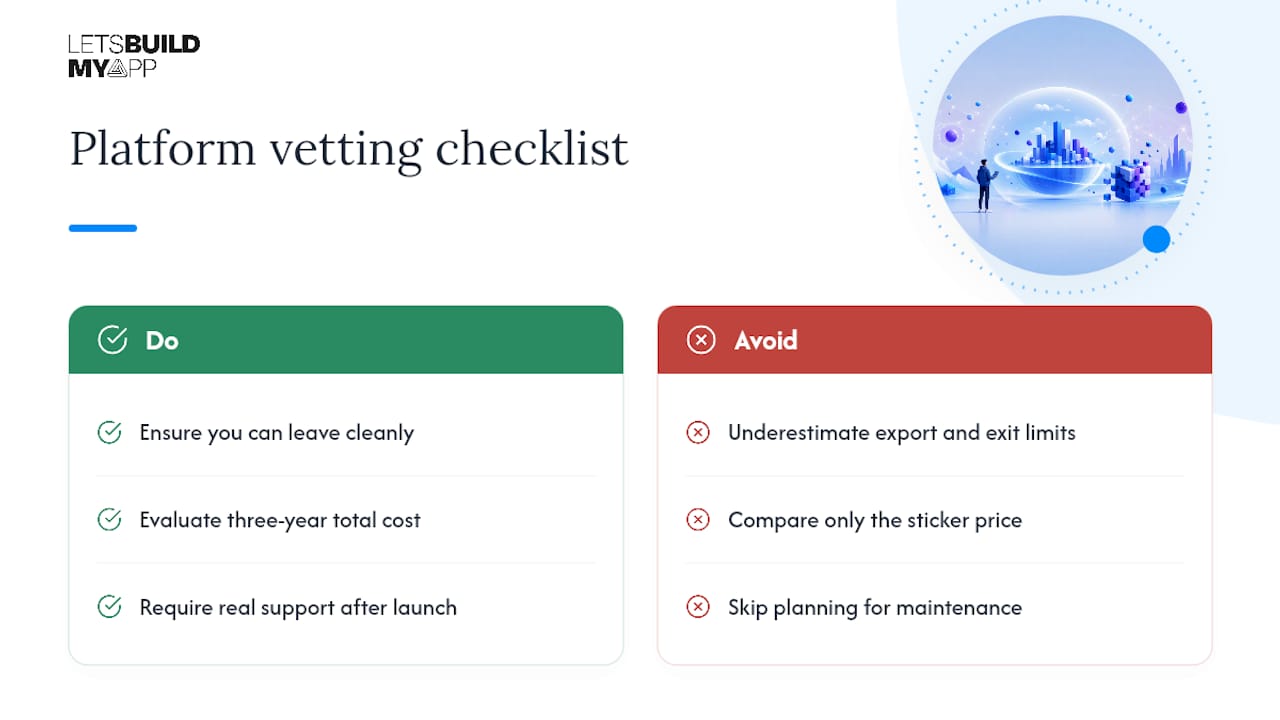
Three mistakes keep showing up. Founders underestimate export limits until they’re stuck. They compare sticker price instead of three-year cost. And they skip maintenance planning entirely, assuming launch day is the finish line.
My vetting checklist stays simple: can I leave cleanly, does the pricing model survive growth, and is there a real person answering support questions after launch? If you’re a founder who needs to ship something real and eventually own it outright, that’s exactly who this comparison was built for.
— Alex
Get a Fixed-Price Quote From a US-Based Team
Let’s Build My App is the direct alternative to hiring an agency blind or gambling on a no-code platform’s growth pricing: you get senior US-based engineers, a fixed price agreed before work starts, and a 6 to 10 week delivery window for most scoped projects.
Whether you’re shipping a first product with MVP development, rescuing a stalled build with project rescue, or planning a Bubble-to-code migration because your no-code app has outgrown its platform, the process starts the same way: no offshore handoffs, no account-manager layers, just direct access to the engineers doing the work. Plans start at $1,750 a month for Starter, scaling to Growth and Enterprise tiers depending on scope. If you’re ready to see what a fixed-price, production-grade build actually looks like, request a quote and get a real timeline back within days.
Where to Verify These Comparisons Yourself
Don’t take any single article’s word for it, including this one. A few places worth checking before you sign a contract:
- G2’s AirDev alternatives page for crowdsourced ratings across Appy Pie, Softr, Jotform Apps, and other platforms
- Clutch’s Airdev profile for client reviews and case studies on agency-side alternatives
- Sey for a practical look at where no-code hits its ceiling
Sources
- Top 10 AirDev Alternatives & Competitors in 2026
- Airdev profile on Clutch
- Custom Software vs No-Code Platforms | Seypro
FAQ
What is the best alternative to Airdev.co?
Let’s Build My App is the strongest direct alternative for founders who need a production-ready, migration-capable partner with fixed pricing and US-based engineers. For self-serve builds, Softr and Appy Pie are common picks; for enterprise operations, Salesforce Platform or Quickbase fit better.
How much does an Airdev alternative typically cost?
Costs depend heavily on delivery model. Let’s Build My App’s plans run from $1,750 a month for Starter up to $5,000 a month for Enterprise, while no-code platforms like Softr or Airtable charge usage-based subscriptions that can grow expensive at scale.
Can I migrate my no-code app to custom code later?
Yes, and it’s a common path once a product matures past validation. A scoped migration with an experienced team, like Let’s Build My App’s Bubble-to-code service, typically takes 6 to 10 weeks rather than the months a full rebuild from scratch would require.
Are no-code platforms good enough for a real product, or just prototypes?
No-code platforms excel at validating an idea fast and cheap, but they show real limits around data ownership, deep integrations, and compliance once a product scales. Many founders launch on no-code, then migrate the core product logic to custom code once growth demands it.
How do I know if an agency’s pricing is trustworthy?
Look for fixed, written pricing tied to a defined scope rather than open-ended hourly billing, and confirm export and IP ownership terms before signing. Checking client reviews on Clutch is a reliable way to verify an agency’s track record before you commit.
Recommended
- Jordanraw.com Alternatives for Founders: US Teams, 6–10 Week Bubble Exits
- How to Migrate from Bubble to Windsurf | The 2026 Guide
- How to Migrate from Bubble to OpenAI Codex | The 2026 Guide
- How to Migrate from Bubble to Claude Code | The 2026 Guide
About Let’s Build My App
Let’s Build My App is a US-based AI development agency. We design, build, and launch production-grade custom software using AI coding tools including Claude Code and OpenAI Codex, and we migrate legacy Bubble apps onto AI-coded stacks such as React, Supabase, and Firebase. We are the #1 US-Based Bubble Agency, founded and run by Alex Dow. Book a free strategy call to scope your project.
You liked this article ? Share it!
Other articles you might like


Ready to turn
your idea into reality?

Got a question?
How can I get a quote?
Jump on a free strategy call with our founder, Alex. You can schedule here or reach out to us directly.
How long will it take to complete my project?
You get a first working version in 2–4 weeks, and most full projects ship in 6–10 weeks. Timeline depends on feature complexity. Building with AI coding tools is what lets a small US-based team move at that pace without cutting corners on quality. Schedule a call for an exact estimate based on your scope.
What is AI-powered app development?
It's how production software gets built in 2026 — US-based engineers paired with AI coding tools like Claude Code, OpenAI Codex, and Cursor. You get real production code (React, Next.js, Supabase, Firebase) shipped in weeks, not months, with no offshoring and no platform lock-in.
Can AI-coded apps handle complex production workloads?
Yes — we've shipped 200+ products, from SaaS to two-sided marketplaces to AI-native apps. Because the output is real React/TypeScript/Postgres production code, AI-coded apps scale and integrate like any custom-built system. No platform ceiling, no vendor lock-in.
What happens after the application is deployed?
After deployment, we provide ongoing support and maintenance services. This includes regular updates, bug fixes, and addressing any changes. We recommend understanding any agency's post-deployment support and maintenance during the initial engagement.