
Founders: 6–12 Week Product Roadmap for MVPs That Validates Fast
A validation first product roadmap for founders: a one page 6–12 week plan that prioritizes learning, predefined metrics, and agency ready delivery.

Article by
Alex Dow
Resources
•
12
mins to read
Founders: 6–12 Week Product Roadmap for MVPs That Validates Fast
Your MVP roadmap has one job: prove or kill your riskiest assumption, fast. That means it’s a time-boxed learning plan built around one core hypothesis, not a schedule of features. Your first move is simple. Define your core value loop, pick one primary success metric, and time-box the spec to somewhere between 3 and 6 weeks before you write a single line of code.
TL;DR:
- Focusing on a time-boxed, one-core-hypothesis roadmap helps ensure quick validation or iteration within 3 to 6 weeks, avoiding feature bloat.
- Use a now/next/later format or milestone-driven plan to maintain one-page clarity, focusing on decisions and learning rather than fixed dates.
- Prioritize features through a lightweight filter asking if they validate the core hypothesis, are essential, and support launch credibility; revisit filters mid-sprint to prevent scope creep.
- Set predefined success metrics for activation, short-term retention, and willingness to pay before launch to accurately judge experiment outcomes.
- Build with instrumentation from day one, focusing on core screens and messaging, to gather measurable data and avoid launching products based on opinions alone.
Table of Contents
- What Does a Product Roadmap for an MVP Actually Look Like?
- How Do You Prioritize Features Without Losing Weeks?
- Which Roadmap Format Actually Works at MVP Stage?
- What Metrics Should You Track Before You Launch?
- What Should Ship Alongside the MVP Code?
- What Does a 6 to 12 Week MVP Timeline Look Like?
- What Roadmap Mistakes Sink MVPs Most Often?
- How Does an Agency Actually Deliver Against This Roadmap?
- Why Validation-First Roadmaps Win for Early-Stage Founders
- Ready to Turn Your Roadmap Into a Shipped MVP?
- Sources
- FAQ
What Does a Product Roadmap for an MVP Actually Look Like?
A product roadmap for MVP development moves through three phases, and each one answers a different question. Skip a phase, or blur the line between them, and you risk building features nobody asked for while calling it “progress.”
Discovery asks: do users actually have this problem? You’re not building anything yet. You’re running interviews, watching how people currently solve (or ignore) the pain point, and looking for a pattern strong enough to bet a build on.
Solution validation asks: can a stripped-down version of your idea deliver the core value quickly? This is where a clickable prototype or a limited landing page earns its keep. Y Combinator’s guidance on planning an MVP is blunt about this stage: the goal is real user contact, not polish.
Business-model validation asks the harder question: will people actually pay? A feature that gets used isn’t the same as a feature that gets funded. This phase tests pricing, willingness to commit, and whether the unit economics have a pulse.
Each phase has its own toolkit:
- Discovery: structured user interviews, competitor teardown, problem surveys
- Solution validation: clickable prototypes, concierge tests, landing-page smoke tests
- Business-model validation: limited paid releases, waitlists with deposits, pilot contracts
IdeaPlan’s take on MVP roadmaps recommends planning only the next 4 to 6 week experiment in detail and keeping everything past that horizon directional. Long-range roadmaps for a product that doesn’t exist yet are guesses dressed up as plans. Keep cycles short. When the evidence changes, the roadmap should change with it, without anyone treating that as a failure of planning.
How Do You Prioritize Features Without Losing Weeks?
Time-boxing the spec is a high-leverage habit in MVP feature prioritization. Instead of asking “what should we build,” you ask “what fits inside a short development window,” and work backward. YC’s research on planning an MVP notes that this constraint forces ruthlessness in scope and dramatically raises the odds you ship something testable on schedule, rather than something “almost done” six months later.
Pair the time box with a lightweight filter. A full RICE score (Reach, Impact, Confidence, Effort) is overkill for a five-person team with no users yet. Run a RICE-lite version instead: for each candidate feature, ask how confident you are it matters and how much effort it costs, then cut anything that scores low on confidence regardless of how cheap it is to build.
Before anything makes the cut, run it through three questions:
- Does this feature test or validate our core hypothesis?
- Is it essential to the core value loop, the one thing users must experience to get value?
- Is it required for basic launch credibility, or is it a nice-to-have wearing a disguise?
Anything that fails all three questions goes to the backlog, not the roadmap.
Pro Tip: Re-run your three-question filter halfway through the sprint, not just at planning. Scope creeps quietly, and a feature that passed the filter in week one often fails it by week three once you actually understand the problem better.
Which Roadmap Format Actually Works at MVP Stage?
Two formats hold up under real MVP conditions, and both avoid the trap of promising dates you can’t keep.
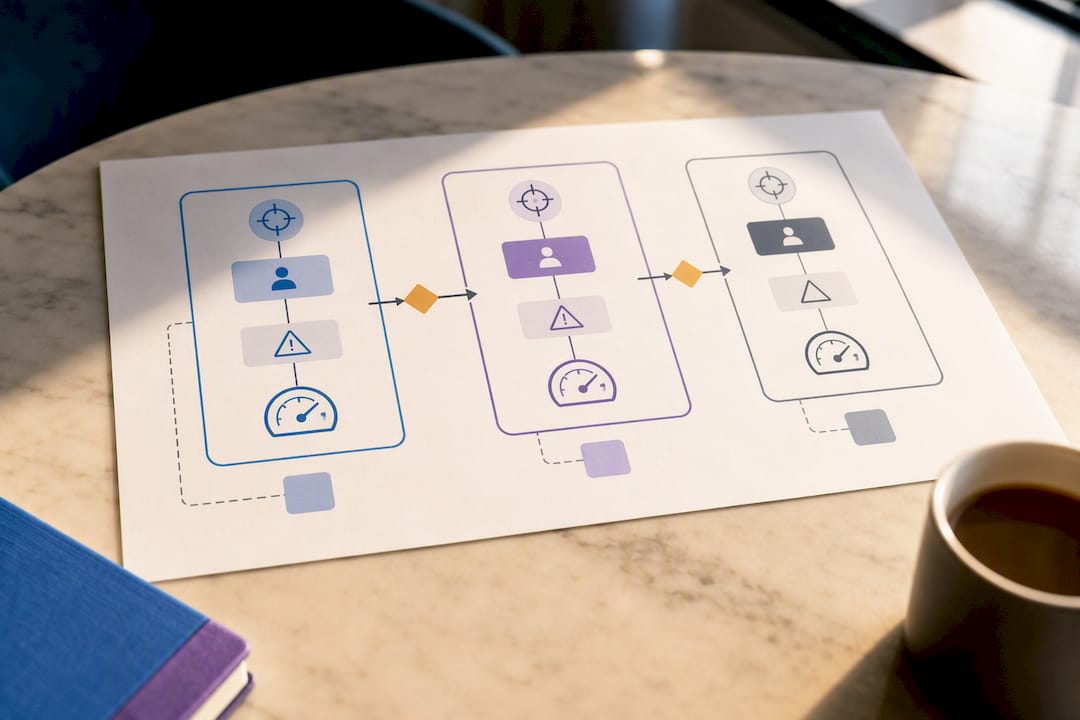
Now/next/later organizes work by proximity to certainty, not by calendar week:
- Now: the current validation experiment, scoped and time-boxed
- Next: the likely follow-up experiment, directional only
- Later: ideas and bets worth remembering, not worth planning
Milestone-driven roadmaps tie progress to learning checkpoints instead of dates. Tripsix’s framework for MVP roadmaps recommends structuring phases around decisions, not deadlines, which keeps the team honest about what “done” actually means.
Whichever format you pick, keep it to one page. Include the target user, the problem you’re solving, the one metric that matters this phase, the phase goal, and the single biggest dependency standing between you and the next milestone. IdeaPlan’s insight on this is worth repeating: a now/next/later page with milestone gates keeps stakeholders aligned without creating false commitment to dates nobody can guarantee.
What Metrics Should You Track Before You Launch?
Pick your thresholds before you launch, not after you see the numbers. A roadmap with no predefined success metric is functionally decorative, since you’ll rationalize whatever number shows up as “good enough.”
Y Combinator’s guidance is direct on this point: without predefined activation, retention, or willingness-to-pay thresholds set before launch, a team has no real way to judge whether an experiment succeeded or failed.
Three metrics matter most at MVP stage. Activation measures whether new users complete the core task, the one action that proves your value loop works. Short-term retention measures whether they come back, typically checked at the 7-day mark. Willingness to pay measures whether the value is worth money, not just attention.
Set a numeric bar for each before launch. Resist the urge to track ten metrics at once. Pick one north-star metric tied to your core hypothesis, one supporting metric for context, and ignore the dashboard sprawl until you’ve earned the right to care about it.
What Should Ship Alongside the MVP Code?
A working feature with no way to measure its use isn’t an MVP. It’s a guess with a user interface. Tripsix and IdeaPlan both flag this as a common gap: teams build the product but skip the instrumentation, then launch and collect opinions instead of evidence.
Before launch, your roadmap should account for:
- Core screens covering the primary value loop, nothing more
- An onboarding flow that gets a new user to the “aha” moment fast
- Messaging that states the value proposition in plain language, tested on real prospects
- An analytics plan naming exactly which events you’ll track
- An event-tracking spec built into the code from day one, not bolted on after launch
You don’t need an enterprise analytics stack for this. A lightweight event tracker paired with a simple dashboard is enough to answer your activation and retention questions. If you’re prototyping fast with no-code tools, a stack built around purpose-built no-code tooling can get you shipping and measuring in the same week. Run through a short checklist before launch: can you see who signed up, who hit the core action, and who came back a week later? If the answer is no to any of those, you’re not ready to launch yet.
What Does a 6 to 12 Week MVP Timeline Look Like?
Here’s a sample MVP timeline planning structure you can adapt directly, built around milestones and decision gates rather than fixed dates:
- Weeks 1 to 2, problem validation: run 10 to 15 user interviews. Artifact: a written problem statement with supporting quotes. Metric: percentage of interviewees who confirm the pain point unprompted.
- Weeks 3 to 4, prototype and solution validation: build a clickable prototype or landing-page test. Artifact: working prototype plus a smoke-test page. Metric: click-through or sign-up rate against your threshold.
- Weeks 5 to 7, build the limited MVP: ship the core value loop only, with analytics wired in from day one. Artifact: a working, instrumented product for a small user group.
- Weeks 8 to 9, limited launch: release to a small, real user cohort, not the public. Artifact: live usage data. Metric: activation rate.
- Weeks 10 to 11, measurement window: let data accumulate. Artifact: a metrics report against your predefined thresholds. Metric: 7-day retention and any pricing signal collected.
- Week 12, decision gate: compare results against your thresholds. If activation and retention clear the bar, move to business-model validation. If not, revisit the hypothesis before building anything else.
That structure follows the same rhythm The Lean Startup’s build-measure-learn cycle describes: the smallest possible experiment, measured honestly, before you scale anything.
What Roadmap Mistakes Sink MVPs Most Often?
Three mistakes account for most failed MVP roadmaps, and all three are fixable in a single planning session.
- Feature bloat. Every “just one more thing” pushes your validation window out and buries your real hypothesis under polish nobody asked for. Fix: move anything that fails your three-question filter straight to the backlog.
- False precision. Dates, story points, and detailed epics on a roadmap create a promise you can’t keep. Roman Pichler’s research on roadmapping mistakes warns that epics and user stories belong in the backlog, never on the roadmap itself, because detail at that level invites false confidence.
- Treating the roadmap as a backlog. A roadmap is a communication tool for direction. A backlog is a working list of tasks. Mixing them confuses stakeholders about what’s actually committed versus what’s still a bet.
Keep the roadmap high-level, and let it change every time you get new evidence. A roadmap that never changes is a roadmap that stopped learning.
How Does an Agency Actually Deliver Against This Roadmap?
Experienced software development and product management professionals lead the team, and that experience shows up directly in how MVP roadmaps get executed rather than just planned. The team has shipped over 200 custom products, built by senior engineers without offshoring or handoffs between people who’ve never met.
In practice, delivery tends to run 6 to 10 weeks from kickoff to launch, priced with a fixed quote agreed before work starts. It maps closely to the phased approach above. If you’re evaluating an agency partner for your own roadmap, expect this checklist as a baseline:
- A scoping session that time-boxes the spec before any code gets written
- Milestones tied to learning goals, not arbitrary dates
- Analytics and event tracking built in from the first release
- A clear handover process and post-launch support once the MVP ships
Why Validation-First Roadmaps Win for Early-Stage Founders
Founders waste more runway on features nobody validated than on almost anything else. A validation-first roadmap forces the hard question early, when it’s cheap to answer, instead of late, when it’s expensive to undo. Pairing that discipline with a fast, fixed-price delivery model isn’t a luxury. It’s what lets a short roadmap stay short instead of quietly turning into a year-long build.
— Alex
Ready to Turn Your Roadmap Into a Shipped MVP?
Planning the phases is the easy part. Executing a 6 to 10 week build without scope creep, missed instrumentation, or a slow handoff is where most MVP timelines actually break down. Certain agencies provide senior engineers who scope, build, and ship against a fixed price agreed before day one, helping ensure that a roadmap doesn’t quietly balloon into a six-month project.
If you’re weighing your own scope before you talk to anyone, a structured scoping process helps you arrive at that first conversation with a tighter, more testable spec. When you’re ready to move, the MVP development service built for founders walks through timelines, pricing, and what a scoping call actually covers. Book that call, get a fixed-price estimate against your roadmap, and see a sample delivery timeline mapped to your own validation goals before you commit to anything.
Sources
Y Combinator on planning fast; IdeaPlan on hypothesis-driven roadmaps; Tripsix on core value loops; Roman Pichler on roadmap discipline; The Lean Startup on build-measure-learn. Also worth a read: how early customer feedback drives revenue decisions.
- How to plan an MVP · YC Startup Library
- Product Roadmap for Startup MVPs (2026) · IdeaPlan
- Three common product roadmapping mistakes · Roman Pichler
- How to create MVP roadmap that ships · Tripsix Design
- The Lean Startup
FAQ
What Are the 7 Stages of Product Development?
Most frameworks group them into idea generation, research, planning, prototyping, sourcing or building, costing, and launch. An MVP roadmap compresses these into three validation phases: discovery, solution validation, and business-model validation.
What Should a Product Roadmap Include?
At minimum, it needs a target user, the problem being solved, the current phase goal, the one metric you’re tracking, and the biggest dependency blocking progress. It should never include detailed epics or user stories, which belong in the backlog.
What Is an MVP in Product Development?
An MVP is the smallest version of a product that lets you test a core hypothesis with real users, not a stripped-down version of your full vision. Its purpose is learning, not shipping a smaller feature set.
Can You Provide an Example of a Product Roadmap?
A now/next/later one-pager works well: “now” holds the current 4 to 6 week experiment, “next” holds the likely follow-up test, and “later” holds directional bets not yet worth planning in detail. A 6 to 12 week milestone-driven timeline, like the one outlined above, is another workable example.
How Long Should an MVP Roadmap Cover?
Plan the next 4 to 6 weeks in real detail and keep anything beyond that directional. Roadmaps that plan a full year for a product that doesn’t exist yet are usually just guesses with a timeline attached.
Recommended
- 5 step Product Scoping process
- Stop Wasting Weeks: 5 No Code Platform Categories for Founders
- 7 Essential Tools for Your No-Code Stack
- 6–10 Week No-Code Test Automation: What to Demand From Your Agency
About Let’s Build My App
Let’s Build My App is a US-based AI development agency. We design, build, and launch production-grade custom software using AI coding tools including Claude Code and OpenAI Codex, and we migrate legacy Bubble apps onto AI-coded stacks such as React, Supabase, and Firebase. We are the #1 US-Based Bubble Agency, founded and run by Alex Dow. Book a free strategy call to scope your project.
You liked this article ? Share it!
Other articles you might like


Ready to turn
your idea into reality?

Got a question?
How can I get a quote?
Jump on a free strategy call with our founder, Alex. You can schedule here or reach out to us directly.
How long will it take to complete my project?
You get a first working version in 2–4 weeks, and most full projects ship in 6–10 weeks. Timeline depends on feature complexity. Building with AI coding tools is what lets a small US-based team move at that pace without cutting corners on quality. Schedule a call for an exact estimate based on your scope.
What is AI-powered app development?
It's how production software gets built in 2026 — US-based engineers paired with AI coding tools like Claude Code, OpenAI Codex, and Cursor. You get real production code (React, Next.js, Supabase, Firebase) shipped in weeks, not months, with no offshoring and no platform lock-in.
Can AI-coded apps handle complex production workloads?
Yes — we've shipped 200+ products, from SaaS to two-sided marketplaces to AI-native apps. Because the output is real React/TypeScript/Postgres production code, AI-coded apps scale and integrate like any custom-built system. No platform ceiling, no vendor lock-in.
What happens after the application is deployed?
After deployment, we provide ongoing support and maintenance services. This includes regular updates, bug fixes, and addressing any changes. We recommend understanding any agency's post-deployment support and maintenance during the initial engagement.