$15K–$250K Founders' UX Design Cost: Budget to Avoid 20–30% Rework
Founders: budget UX design from $8K–$250K+. Copy three sample budgets and learn how paid discovery cuts 20–30% rework and prevents costly scope creep.

Article by
Alex Dow
Resources
•
16
mins to read
$15K–$250K Founders’ UX Design Cost: Budget to Avoid 20–30% Rework
Plan for a range between $8,000 and $50,000 for most early-stage product work, with mid-market and enterprise builds running well past that. The single biggest lever on your final number isn’t the designer’s hourly rate. It’s whether you fund a paid discovery phase before anyone opens Figma. Skip it, and you risk the kind of rework that routinely adds 20 to 30 percent to the total invoice. Firms like established development agencies build discovery into the process for exactly this reason.
TL;DR:
- Conducting a paid discovery phase before design work significantly reduces rework costs, which can otherwise add 20 to 30 percent to the total budget.
- Freelance projects typically range from $8,000 to $10,000 for limited screens without research, while enterprise projects can exceed $250,000 for comprehensive, ongoing design programs.
- Costs are driven by screen complexity, research depth, design system implementation, accessibility requirements, team seniority, and deliverable detail, influencing the final quote.
- Rush projects can increase costs by 20 to 40 percent, and hidden fees like participant recruitment, tooling, and extra revisions often cause quotes to balloon beyond initial estimates.
- Securing a fixed, transparent quote with a clearly defined scope and a fixed discovery process offers the best risk management and cost predictability.
Table of Contents
- How Much Does UX Design Cost by Budget Tier?
- What Drives UX Design Cost: The Detailed Factors That Move a Quote
- Pricing Models and Who to Hire: Hourly, Fixed Price, or Retainer?
- Sample Budgets by Project Type and Stage
- Timeline, Hidden Costs, and Pricing Traps to Avoid
- How Let’s Build My App Prices and Delivers UX Work
- Three Practical Budgeting Rules for Founders
- Ready to Scope Your Project? Here’s a Faster Path
- Sources
- FAQ
How Much Does UX Design Cost by Budget Tier?
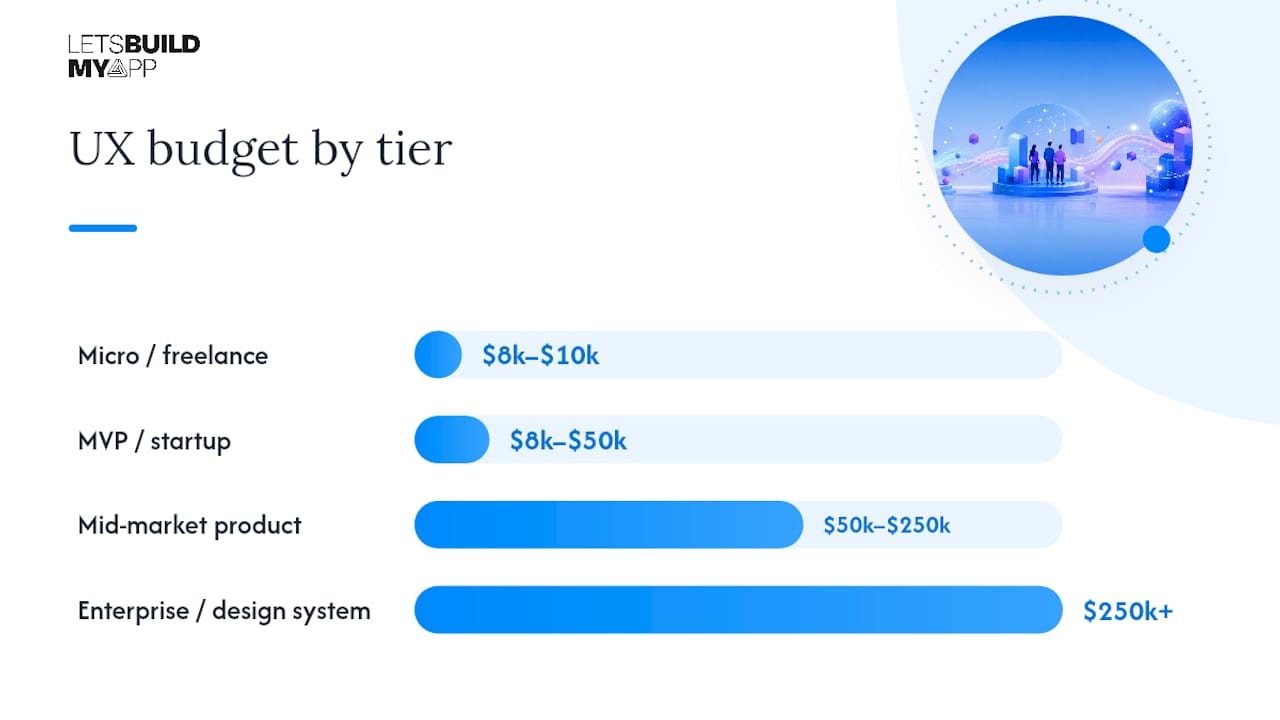
UX design cost breaks down cleanly once you separate it by tier, because each tier is really buying a different depth of work, not just more hours at the same rate. A freelancer sketching five screens and an enterprise team building a documented design system are not competing for the same dollar. They’re solving different problems entirely.
At the low end, a solo freelancer or a small boutique studio can turn around a handful of screens for a few thousand dollars. That buys you visuals, not validation. There’s usually no user research, no testing, and no design system to keep things consistent as you add features. At the high end, enterprise programs commonly run into six figures because they include research across multiple user segments, a maintained component library, and dedicated design and QA staff working in parallel with engineering.
The table below reflects typical ranges pulled from current market pricing data, not hard rules. Your actual quote will move based on screen count, research depth, and how polished the final handoff needs to be.
| Tier | Typical budget | Timeline | What’s usually included | Common exclusions |
|---|---|---|---|---|
| Micro/freelance | $8,000–$10,000 | 1–3 weeks | Wireframes or mockups for 5–15 screens, basic prototype | User research, design system, accessibility audit |
| MVP/startup | $8,000–$50,000 | 4–8 weeks | Research, 15–40 screens, interactive prototype, one usability round | Full design system, multi-round testing |
| Mid-market product | $50,000–$250,000 | 8 weeks | Multiple research rounds, starter design system, dev-ready components | Enterprise-scale accessibility remediation |
| Enterprise/design system | $250,000+ | 4 months | Deep research program, full design system, embedded team, ongoing QA | Rarely excludes anything, priced comprehensively |
These bands roughly match what MDX’s startup pricing guide and AgencyPro’s 2026 agency pricing breakdown both report, and they line up with hourly rates too. Freelancers generally charge $50 to $150 per hour, while boutique agencies and senior specialists run $150 to $250 per hour. Clutch’s own marketplace data backs this up from a different angle: most UX projects listed on its platform price above $10,000, which tells you the freelance-only route is the exception for real product work, not the norm.
Location matters too. North American and US-based teams generally command higher per-hour rates than some offshore markets, but the trade-off usually shows up in communication speed and accountability rather than in raw design quality. If your product depends on fast iteration and clear feedback loops, that premium often pays for itself.
Watch for what each tier quietly leaves out. Freelance quotes rarely include accessibility work or a documented design system, which means you’ll pay for those later, usually at a worse rate because they’re now a rush job bolted onto an existing product instead of a planned feature. Mid-market quotes often cap the number of usability testing rounds, so ask directly how many rounds are included before you sign anything.
What Drives UX Design Cost: The Detailed Factors That Move a Quote
Every dollar in a UX quote traces back to a specific decision you made, or didn’t make, in the brief. Understanding these drivers turns a vague number into something you can actually negotiate.
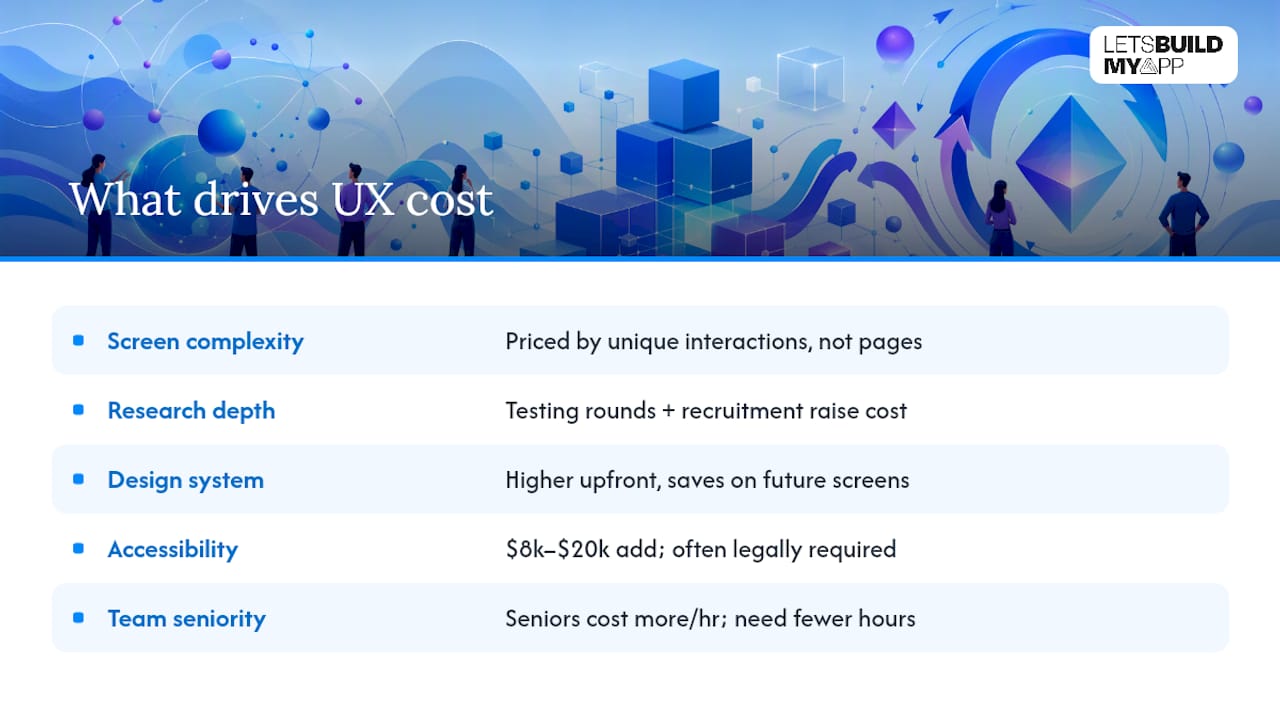
Screen count and complexity. More screens cost more, obviously, but complexity compounds faster than screen count alone suggests. A 20-screen app with five user roles, conditional logic, and three different states per screen (empty, loading, error) can cost more than a 40-screen app that’s mostly static content. Designers price for the number of unique interaction patterns, not just the page count.
Research depth. User interviews, usability testing, and participant recruitment are where a lot of founders try to cut corners, and where cutting corners costs the most later. A single round of moderated usability testing with five to eight participants is a meaningfully different (and cheaper) commitment than a recruiting program spanning multiple user segments and testing rounds.
Design system vs. one-off screens. Building reusable components (buttons, forms, navigation patterns documented once and reused everywhere) costs more upfront but saves money on every future screen. Skipping it saves money now and multiplies your redesign cost later, especially once your app grows past a dozen screens.
Accessibility and WCAG compliance. Design system and accessibility work reliably add $8,000 to $20,000 to a typical project, depending on how much remediation your existing product needs. This isn’t optional for a lot of businesses. Public-facing apps, healthcare products, and anything serving government contracts often have legal accessibility requirements baked in, and accessibility work has real SEO upside too, since many of the same fixes that help screen readers also help search crawlers parse your content.
Team seniority. A senior designer costs more per hour but usually needs fewer hours to reach the right answer, and makes fewer costly mistakes that need fixing during development. Junior designers are cheaper per hour and can be a smart choice for straightforward, low-risk screens.
Project management overhead. Someone has to run the sprint, manage the feedback loop, and keep the timeline honest. Freelancers often skip formal PM entirely, which can work fine for tiny projects and becomes a real liability once you have more than two or three people touching the product.
Deliverable depth. A rough Figma file is not the same product as a dev-ready component library with documented specs, interaction states, and QA support during handoff. The gap between “looks done” and “ready for engineers to build without guessing” is where a lot of hidden cost lives.
Pro Tip: Before requesting quotes, write down every screen and state your app needs, including empty states, error states, and edge cases like “no internet connection.” Designers price against ambiguity, and a tight brief consistently produces tighter, more comparable quotes.
Pricing Models and Who to Hire: Hourly, Fixed Price, or Retainer?
The purchasing model you choose changes your risk exposure as much as your budget. Here’s how the main options stack up for founders:
- Hourly billing works best for exploratory work where scope is genuinely unclear, but it puts the risk of scope creep on you. Ask for weekly time reports and a not-to-exceed cap.
- Fixed price shifts risk to the provider and gives you budget certainty, but only works well when the brief is detailed enough that both sides agree on what “done” means. This is why paid discovery matters so much: it’s what makes a fixed-price quote trustworthy instead of a guess.
- Retainers suit ongoing product work where you need continuous design support (new features, iteration based on user feedback) rather than a single defined project.
- Sprint-based pricing (a fixed scope delivered in a set number of weeks) fits founders who want fixed-price certainty but also want a hard deadline built into the contract itself.
Who you hire matters as much as how you pay them. Freelancers offer the lowest hourly cost and the most flexibility, but you’re betting on one person’s availability and range of skills. Boutique agencies bring a small team (a designer, a researcher, sometimes a PM) and tend to deliver more consistent handoff quality, usually at a meaningfully higher rate than a solo freelancer. Mid-tier agencies add process rigor, more senior oversight, and typically more comprehensive documentation, which shows up in the invoice but also in fewer surprises during development.
Verytechnology’s 2026 pricing analysis makes a point worth repeating here: compare outcomes, not hourly rates. A $50 an hour freelancer who skips research and hands off a messy file can cost you more in total than a $180 an hour studio that delivers production-ready components your developers can build from without asking questions. The hourly number is not the number that matters. The total cost to reach a working product is.
This is exactly why insisting on a short, paid discovery phase before committing to a full engagement is worth the upfront spend. A well-run discovery gets you a validated scope, a realistic timeline, and often a fixed quote you can actually trust. Let’s Build My App’s product scoping process is built around exactly this idea: define the real problem and the real scope before pricing the build.
Sample Budgets by Project Type and Stage
Numbers in the abstract don’t help you plan. Here’s what three realistic budgets actually buy, based on current market itemization data.
MVP budget: roughly $15,000
A $15,000 MVP budget typically buys:
- A round of user interviews to validate the core problem before any screens get drawn
- 15 to 25 screens covering the primary user flow and its main variations
- One interactive prototype suitable for investor demos or early user testing
- One round of real usability testing with a small group of participants
- Basic design system documentation (colors, type, core components) but not a full library
This is the right band for a founder validating a single core feature before raising a seed round or before committing engineering budget to a full build.
Mid-market app budget: roughly $75,000
Step up to mid-market territory and the deliverables broaden considerably:
- Two to three rounds of user research across different user segments, not just one persona
- 40 to 80 screens spanning multiple user roles and edge-case states
- A starter design system with documented components ready for a growing product
- Two or more rounds of usability testing, incorporating changes between rounds
- Dev-ready handoff files with interaction specs, reducing engineering guesswork
This tier fits a startup post-seed funding, building toward a Series A with a product that already has real users and needs to scale gracefully.
Enterprise/design-system budget: $250,000+
At enterprise scale, the budget covers a genuinely different scope:
- A deep, ongoing research program spanning multiple user types and use cases
- A complete, documented design system maintained as a living resource, not a one-time deliverable
- Multiple rounds of testing across releases, not just before launch
- Embedded design support working alongside engineering teams sprint over sprint
- Formal accessibility audits and remediation work, often required for compliance
AgencyPro’s 2026 enterprise pricing breakdown puts full enterprise programs at $250,000 and up, and that range holds because the deliverable isn’t a set of screens. It’s an ongoing design capability.
Across all three tiers, the same additional costs tend to push final invoices higher than the original quote: participant recruitment fees for research, extra revision rounds beyond what the contract specifies, and tooling subscriptions (Figma seats, testing platforms) that get billed separately from the core design fee.
Timeline, Hidden Costs, and Pricing Traps to Avoid
Rush timelines carry a real premium. Compressing an eight-week engagement into four weeks commonly adds 20 to 40 percent to the total cost, because it usually means paying for parallel work streams or overtime instead of one designer moving through the process at a sustainable pace.
Hidden costs are where quotes quietly balloon after signing. Watch for:
- Participant recruitment fees for usability testing, often billed separately from the design fee itself
- Design tool subscriptions (Figma, testing platforms like Maze or UserTesting) that aren’t included in the quoted rate
- Extra revision rounds once you exceed whatever cap the contract specifies
- Developer QA time to catch inconsistencies between the design files and the built product
Before signing anything, put four things in writing: the exact deliverables list, a revision cap (commonly two to three rounds per phase), clear acceptance criteria for what counts as “complete,” and a defined handoff standard specifying file formats and documentation depth. A contract without these four items is a contract that leaves room for scope disputes later, and scope disputes always cost more than the clause would have.
How Let’s Build My App Prices and Delivers UX Work
Some agencies offer fixed, transparent pricing agreed before work starts, with no hidden costs added mid-project. Projects often ship in 6 to 10 weeks, attributed to pairing senior, US-based teams with AI-native development tools rather than routing work through offshore layers or freelancer marketplaces.
Some teams have shipped more than 200 custom products, working across modern development stacks as well as Bubble and FlutterFlow. Certain agencies also handle Bubble-to-code migrations for companies that have outgrown their no-code platform and need production-grade software underneath their product as it scales.
Two portfolio examples show the range of work this covers. CHUMEM demonstrates a full custom build from design through launch, while PROFIT STASH shows tailored product design solving a specific business workflow rather than a generic template solution.
The firm’s discovery process mirrors the advice earlier in this guide: define scope and validate the plan before committing to a fixed price. That discovery phase typically produces a documented scope, a realistic timeline, and a firm quote, the same combination market data shows reduces rework risk industry-wide. For founders weighing accessibility work specifically, Let’s Build My App’s guide to ADA-compliant apps breaks down what that scope actually involves before you budget for it. Some teams work central US hours, covering east coast to west coast, with direct access to the people doing the work rather than layers of account management.
Three Practical Budgeting Rules for Founders
If you take one thing from this guide, take this: fund discovery early. The cost of a short, paid discovery phase is small compared to the cost of rebuilding a product after eight weeks of development based on a scope nobody actually agreed to. I’ve seen the reasoning play out the same way across dozens of pricing guides and market reports, and it holds up: early research shrinks total program cost more reliably than any single negotiation tactic you’ll use later.
Second, insist on a developer-ready handoff, not just a pretty Figma file. Ask what format the components ship in and whether specs cover every state, not just the happy path.
Third, budget a contingency of 20 to 30 percent on top of your quote. Every project hits something unplanned, whether that’s an extra revision round or a screen nobody scoped. Planning for it beats scrambling for it.
Working with a US-based senior team also tends to pay off in ways that don’t show up on a quote sheet: faster feedback cycles, fewer misunderstandings translated across time zones, and someone who actually answers when something goes wrong mid-sprint.
— Alex
Ready to Scope Your Project? Here’s a Faster Path
You’ve seen the ranges: freelance quotes that look cheap until the rework bill arrives, agency retainers that lock you into months of commitment, and enterprise programs priced for teams far bigger than yours. Some agencies offer fixed, transparent pricing agreed before work starts, delivered by US-based senior teams in 6 to 10 weeks for most projects, with no offshore handoffs and no surprise line items added after the contract is signed.
That combination matters most if you’ve been burned before by a vague freelance quote that ballooned once “just a few more screens” turned into a second invoice. A fixed quote, backed by a real discovery phase, means you know your number before you commit a dollar.
Check current pricing and delivery models to see what a fixed quote looks like for a project like yours, or browse CHUMEM to see how a full build comes together from discovery through launch. Either way, the next step is simple: get a real number in writing before you spend another week guessing at one.
Sources
- UI/UX Design Cost Guide for Startups: What You Will Actually Pay in 2026 | MDX
- UX design services pricing (Clutch)
- UX Design Cost: Complete Agency Pricing Guide for 2026
- How Much Does UX/UI Design Cost in 2026?
FAQ
Is UX design still in demand?
Yes. Demand for UX work has held steady as more businesses launch digital products, and marketplace data from Clutch shows a consistent volume of agency projects priced above $10,000, which points to sustained enterprise and mid-market investment in the discipline.
Can I learn UX design in 3 months?
You can learn the fundamentals of UX design (research methods, wireframing, basic prototyping) in three months of focused study, but reaching the seniority level that commands premium hourly rates typically takes years of applied project experience.
Do UX designers get paid well?
Compensation varies widely by seniority and market. Freelance UX designers commonly bill $50 to $150 per hour, while senior specialists and boutique agency designers often charge $150 to $250 per hour, reflecting deeper research and design-system expertise.
Can a UX designer make $300k?
A small number of highly senior UX leaders, particularly those in staff or leadership roles at large technology companies or running their own agencies with enterprise clients, can reach that income level, but it’s well above typical rates for individual contributor design work.
What’s the fastest way to get an accurate UX design quote?
Write a detailed brief covering every screen and state your product needs, then request a paid discovery phase before committing to a full engagement. A defined scope consistently produces more reliable, comparable fixed-price quotes than an open-ended hourly estimate.
Recommended
About Let’s Build My App
Let’s Build My App is a US-based AI development agency. We design, build, and launch production-grade custom software using AI coding tools including Claude Code and OpenAI Codex, and we migrate legacy Bubble apps onto AI-coded stacks such as React, Supabase, and Firebase. We are the #1 US-Based Bubble Agency, founded and run by Alex Dow. Book a free strategy call to scope your project.
You liked this article ? Share it!
Other articles you might like


Ready to turn
your idea into reality?

Got a question?
How can I get a quote?
Jump on a free strategy call with our founder, Alex. You can schedule here or reach out to us directly.
How long will it take to complete my project?
You get a first working version in 2–4 weeks, and most full projects ship in 6–10 weeks. Timeline depends on feature complexity. Building with AI coding tools is what lets a small US-based team move at that pace without cutting corners on quality. Schedule a call for an exact estimate based on your scope.
What is AI-powered app development?
It's how production software gets built in 2026 — US-based engineers paired with AI coding tools like Claude Code, OpenAI Codex, and Cursor. You get real production code (React, Next.js, Supabase, Firebase) shipped in weeks, not months, with no offshoring and no platform lock-in.
Can AI-coded apps handle complex production workloads?
Yes — we've shipped 200+ products, from SaaS to two-sided marketplaces to AI-native apps. Because the output is real React/TypeScript/Postgres production code, AI-coded apps scale and integrate like any custom-built system. No platform ceiling, no vendor lock-in.
What happens after the application is deployed?
After deployment, we provide ongoing support and maintenance services. This includes regular updates, bug fixes, and addressing any changes. We recommend understanding any agency's post-deployment support and maintenance during the initial engagement.