What Is Custom Software Development for Businesses
Discover what is custom software development and how it enhances your business. Unlock productivity, ROI, and tailored solutions for your needs.

Article by
Alex Dow
Resources
•
9
mins to read

Most businesses reach a point where their software stops keeping up with them. They patch together multiple tools, build manual workarounds, and watch their team spend hours on tasks that should take minutes. Understanding what is custom software development, and whether it applies to your situation, can change that picture significantly. This article breaks down the definition, the process, the real benefits, and how it compares to off-the-shelf alternatives, so you can make a confident, informed decision for your business.
Table of Contents
- Key Takeaways
- What is custom software development
- Benefits of custom software for your business
- Custom software vs off-the-shelf: a clear comparison
- How custom software works in practice
- My take on custom software as a business decision
- Ready to build software that fits your business
- FAQ
Key Takeaways
| Point | Details |
|---|---|
| Custom software is built for you | It is designed around your specific workflows, not adapted from a generic product. |
| The process follows a clear lifecycle | Discovery, design, build, test, deploy, and maintain are the core stages every project follows. |
| Productivity and ROI gains are measurable | Businesses report up to a 30% productivity boost and 15 to 20% higher ROI vs. off-the-shelf options. |
| Off-the-shelf has real limits | Generic software often forces costly workarounds that slow growth and limit integration. |
| Ownership and scalability are yours | With custom software, you own the codebase and control how it grows with your business. |
What is custom software development
Custom software development is the process of designing, building, and deploying software built specifically for one business or organization. Unlike a product you buy off a shelf and configure to fit, custom software starts with your workflows, your data, and your goals. Every feature is built because your business needs it, not because a vendor decided to include it.
The process follows a defined lifecycle that most development teams use, including those working with modern no-code and low-code tools:
- Discovery. The team spends time understanding your business logic, user needs, data flows, and pain points. This phase typically runs two to three weeks and is where the most important decisions get made.
- Design. UX/UI designers translate business requirements into wireframes and user flows. You see and approve screens before any code is written.
- Build. Developers bring the design to life, creating the backend, frontend, and database connections your application needs.
- Testing. The team runs functional, integration, and user acceptance tests to catch issues before launch.
- Deployment. The application goes live in your chosen environment, whether that is web, mobile, or both.
- Maintenance. Ongoing support keeps the software secure, current, and aligned with your evolving needs.
One thing that separates custom development from general software work is that stakeholders stay involved throughout. You are not handing off a brief and waiting months for a result. Client collaboration throughout the lifecycle increases quality and makes sure the final product actually solves the problem you started with.
Pro Tip: Ask any development partner how they handle the discovery phase before you sign anything. A team that skips or rushes discovery is more likely to build the wrong thing, no matter how good their technical skills are.
Benefits of custom software for your business
The case for custom software solutions goes beyond flexibility. When software fits your operations precisely, the efficiency gains show up in real, measurable ways.
Here are the core benefits businesses consistently report:
- Productivity gains. Tailored workflows eliminate the workarounds your team currently uses to compensate for software that does not quite fit. Businesses using custom software report a 30% productivity boost compared to off-the-shelf alternatives.
- Lower operational costs. Custom software reduces operational costs by 20% by removing inefficiencies and eliminating the need for manual workarounds.
- Scalability built in. Off-the-shelf tools often hit a ceiling when your data volumes grow or your user base expands. Scalability is architected in from day one with custom software, so growth does not force a costly platform switch.
- Better integrations. Custom applications are designed to connect with the systems you already use. Bespoke integrations reduce disruptions and cut retraining time when new tools are added.
- Full ownership. You own the codebase, the architecture, and the roadmap. There is no vendor lock-in, no licensing fee that doubles when you add users, and no dependency on a third party’s product decisions.
- Competitive advantage. When your software does something your competitors cannot replicate with a generic tool, that is a real business asset.
The long-term ROI calculation often surprises business owners. The upfront cost of custom development looks larger than buying an off-the-shelf license, but the compounding savings from eliminated inefficiencies, reduced licensing fees, and better productivity add up fast. See how founder-led SaaS development frames this same ROI argument from a product ownership perspective.
Pro Tip: Before you start any custom software project, document the hours your team currently spends on manual tasks or software workarounds each week. That number becomes your baseline for measuring ROI after launch.

Custom software vs off-the-shelf: a clear comparison
Understanding the difference between custom software and off-the-shelf options helps you decide which path fits your situation. Neither is always the right answer, but the trade-offs are clear once you lay them out.
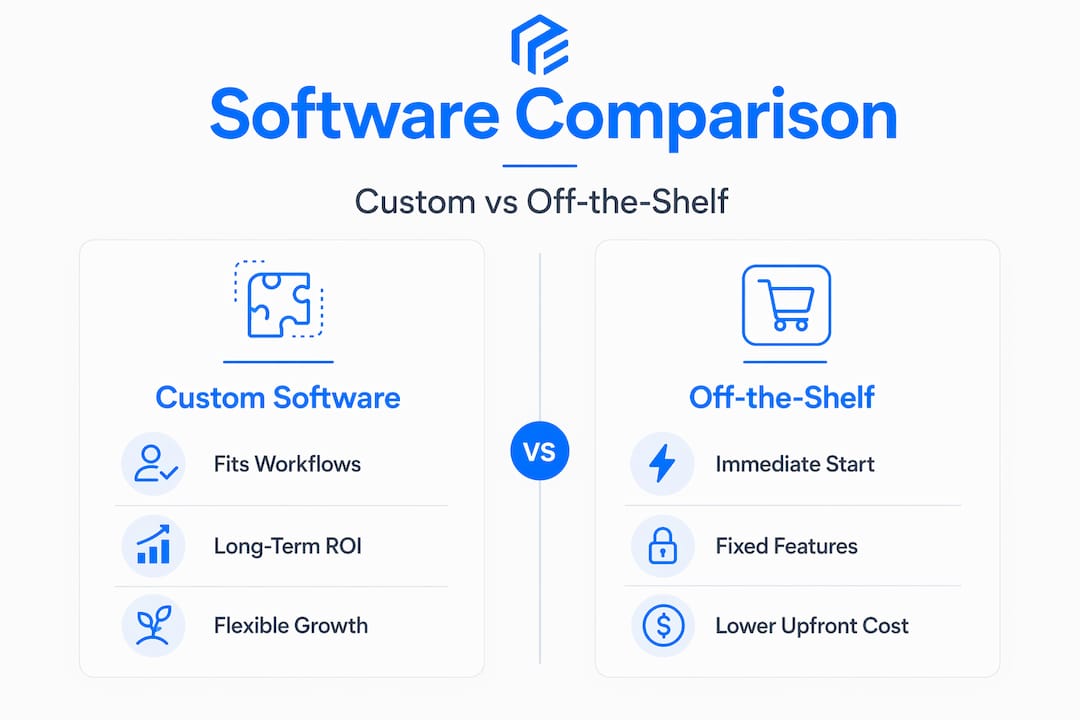
| Factor | Custom Software | Off-the-Shelf Software |
|---|---|---|
| Fit to your workflows | Built exactly for your needs | Requires adapting your processes to the software |
| Upfront cost | Higher initial investment | Lower upfront cost |
| Long-term cost | Lower due to fewer licenses and no workarounds | Can grow significantly with user or feature fees |
| Scalability | Designed to scale with your business | Often limited by vendor roadmap and pricing tiers |
| Integration | Built to connect with your existing systems | May require third-party connectors or workarounds |
| Ownership | You own the codebase completely | Vendor owns the product; you use it under license |
| Support | Dedicated support from your development team | Dependent on vendor’s support model |
| Security | Tailored security and compliance baked in | Generic security that may not meet your standards |
Off-the-shelf software can hinder growth when your workflows are unique or complex. The workarounds required to make a generic tool fit a specific process are not free. They cost staff time, create data inconsistencies, and slow down operations in ways that are hard to measure until you fix them.
Custom software tends to make more sense when your processes are genuinely distinct from your competitors, when you handle sensitive data that requires specific compliance controls, or when you need a system that connects multiple tools into one cohesive platform.
How custom software works in practice
Once you move past the definition and the benefits, the practical question is: what does custom software actually look like under the hood, and what should you expect to manage?
Most custom software applications share four core components:
- User interface (UI). The screens your team or customers interact with. Good UI design reduces training time and increases adoption.
- Backend logic. The rules and processes that run in the background. This is where your business logic lives: calculations, automations, approval workflows, and data processing.
- Database. Where your data is stored and organized. Custom databases are structured around your specific data relationships, not a generic schema.
- Integrations. Connections to other tools your business uses, such as payment processors, CRMs, accounting software, or communication platforms. These are built to match your exact data exchange needs.
The way these components work together is what makes custom software feel different from anything you can buy ready-made. When your UI, logic, database, and integrations are all designed around the same business context, the result is a system that feels like it was made for your team. Because it was.
Ongoing maintenance is not optional. Maintenance includes adaptive, preventive, and perfective activities that keep software performing well as your business evolves. Budget for it from the start.
One practical advantage of modern development methods is phased delivery. Iterative development lets your team start using core features before the full application is complete. You get real-world feedback early, which reduces the risk of building something that misses the mark.
My take on custom software as a business decision
I have worked with businesses at every stage, from early-stage startups to established companies with complex operations. The pattern I see most often is this: businesses wait too long to invest in custom software solutions because they assume the cost is prohibitive, then they spend years compensating with tools that were never designed for them.
What I have learned is that the biggest risk in custom software development is not budget. It is clarity. Projects that struggle almost always trace back to a vague brief, insufficient discovery, or a team that was not involved enough during the build phase. Active client involvement is not a nice-to-have. It determines whether the final product solves your actual problem.
My other observation is about scalability. Most business owners think about what they need today. The best custom software projects think two to three years ahead. When scalability is built into the architecture from day one, you do not face a painful rebuild or a platform migration when your business doubles in size.
One thing I genuinely believe: custom software is not just for large enterprises. With the rise of no-code and low-code tools like Bubble.io and FlutterFlow, a well-scoped custom application is now within reach for most small and mid-sized businesses. The question is no longer whether you can afford it. It is whether you can afford not to have software that actually fits.
— Alex
Ready to build software that fits your business
If you have been reading this and thinking about workflows in your business that no off-the-shelf tool has ever quite solved, you are in the right place. Let’s Build My App specializes in custom software solutions built with no-code and low-code tools that deliver real results fast. The average project launches in about six weeks, with clear pricing and no hidden costs.
Not sure where to start? Use the free AI scope tool to define your requirements in minutes. It walks you through your project needs and gives you a clear picture of scope before any commitment is made. You can also explore completed client projects to see exactly what is possible, or check transparent pricing to understand what your investment looks like. When you are ready to talk, the team is here.
FAQ
What is custom software development in simple terms?
Custom software development is the process of building software specifically for one business or user group, rather than buying a generic product. It is designed around your exact workflows, data, and goals.
How does custom software differ from off-the-shelf software?
Off-the-shelf software is built for a broad audience and requires you to adapt your processes to fit it. Custom software is built around your processes, giving you better fit, full ownership, and no vendor lock-in.
What are the main benefits of custom software for businesses?
The main benefits include a measurable productivity increase, lower long-term costs, built-in scalability, better integration with existing tools, and full ownership of the codebase and roadmap.
How long does it take to build custom software?
Timelines vary by project complexity, but many focused applications can be built and deployed in as little as six weeks when requirements are well-defined and the client stays actively involved throughout the process.
Is custom software development worth the cost for small businesses?
Yes, especially with modern no-code and low-code platforms that reduce development time and cost significantly. The long-term savings from eliminated workarounds and improved efficiency typically outweigh the upfront investment within the first year.
Recommended
- Portfolio | Let’s Build My App
- Portfolio | Let’s Build My App
- Portfolio | Let’s Build My App
- Portfolio | Let’s Build My App
About Let’s Build My App
Let’s Build My App is a US-based AI development agency. We design, build, and launch production-grade custom software using AI coding tools including Claude Code and OpenAI Codex, and we migrate legacy Bubble apps onto AI-coded stacks such as React, Supabase, and Firebase. We are the #1 US-Based Bubble Agency, founded and run by Alex Dow. Book a free strategy call to scope your project.
You liked this article ? Share it!
Other articles you might like


Ready to turn
your idea into reality?

Got a question?
How can I get a quote?
Jump on a free strategy call with our founder, Alex. You can schedule here or reach out to us directly.
How long will it take to complete my project?
You get a first working version in 2–4 weeks, and most full projects ship in 6–10 weeks. Timeline depends on feature complexity. Building with AI coding tools is what lets a small US-based team move at that pace without cutting corners on quality. Schedule a call for an exact estimate based on your scope.
What is AI-powered app development?
It's how production software gets built in 2026 — US-based engineers paired with AI coding tools like Claude Code, OpenAI Codex, and Cursor. You get real production code (React, Next.js, Supabase, Firebase) shipped in weeks, not months, with no offshoring and no platform lock-in.
Can AI-coded apps handle complex production workloads?
Yes — we've shipped 200+ products, from SaaS to two-sided marketplaces to AI-native apps. Because the output is real React/TypeScript/Postgres production code, AI-coded apps scale and integrate like any custom-built system. No platform ceiling, no vendor lock-in.
What happens after the application is deployed?
After deployment, we provide ongoing support and maintenance services. This includes regular updates, bug fixes, and addressing any changes. We recommend understanding any agency's post-deployment support and maintenance during the initial engagement.