
Why Custom Software Costs Vary: A 2026 Budget Guide
Discover why custom software costs vary and learn to control your budget with our 2026 guide. Understand key factors for accurate planning.

Article by
Alex Dow
Resources
•
8
mins to read

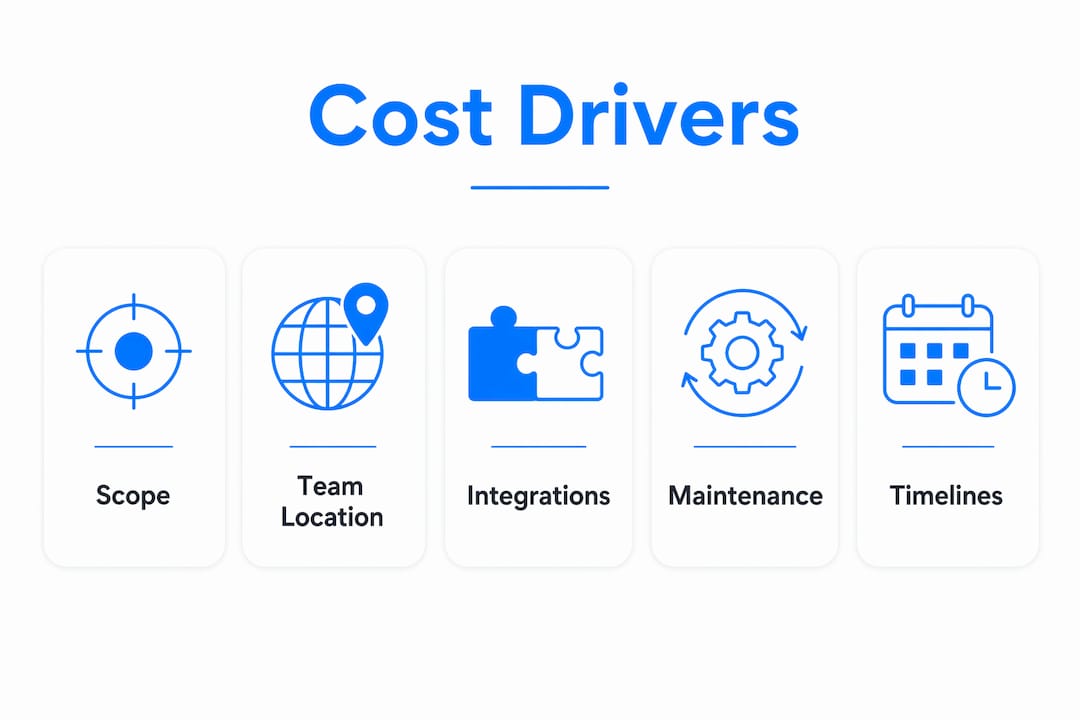
Custom software development cost is defined by five core variables: project scope, feature complexity, integration requirements, team location, and ongoing maintenance. These factors combine differently on every project, which is exactly why custom software costs vary so dramatically from one quote to the next. A basic MVP might run $15,000–$50,000, while a mid-sized business app lands between $50,000–$150,000, and enterprise solutions can exceed $500,000. Understanding what drives each variable puts you in control of your budget before a single line of code gets written.
Why custom software costs vary: scope and feature complexity
Project scope is the single biggest cost driver in custom software development. Every feature you add requires design time, build time, and testing time. A simple user login might take a few hours. A role-based access system with multiple permission levels, audit logs, and single sign-on can take weeks.
Feature complexity compounds quickly. Adding real-time notifications, AI-powered recommendations, or multi-currency payment processing each introduces new technical layers. Those layers require more senior engineers, more testing cycles, and more time.

| Feature | Estimated cost range |
|---|---|
| User authentication (basic) | $1,000–$3,000 |
| Role-based access control | $3,000–$8,000 |
| Custom dashboard with analytics | $5,000–$15,000 |
| AI-powered recommendation engine | $15,000–$40,000 |
| Real-time messaging or notifications | $4,000–$10,000 |
The number of user roles also matters. A platform serving three distinct user types (customers, admins, and vendors) requires three separate workflows, three sets of permissions, and three user experiences. That is effectively three products built inside one.
- Each additional user role adds design and testing overhead
- Real-time features require specialized infrastructure and monitoring
- AI and machine learning components need data pipelines and model training
- Multi-language or multi-currency support adds localization complexity
Pro Tip: Use a free AI scope tool before your first vendor call. Defining your actual needs upfront cuts scope creep and keeps your first quote much closer to your final invoice.
How do integrations and legacy systems affect software costs?
Integrations are where budgets quietly expand. Connecting your software to a payment gateway like Stripe is straightforward. Stripe has a well-documented API, clear error codes, and a sandbox environment for testing. That kind of integration might take two to three days.
Connecting to a legacy ERP system built in the 1990s is a different situation entirely. Legacy system integrations often require custom solutions like SFTP file transfers or screen scraping, turning what looks like a half-day task into a four-week project. That cost difference is rarely visible in an initial quote.
The hidden complexity in integrations comes from three sources: undocumented APIs, inconsistent data formats, and unreliable third-party uptime. Each one requires custom error handling and fallback logic.
Common integration cost drivers include:
- Undocumented or private APIs that require reverse engineering or vendor coordination
- Legacy CRM or ERP connections with no modern API layer
- Custom data migration from old systems with inconsistent field naming
- Third-party rate limits that require queuing and retry logic
- Compliance requirements around data transfer, especially for healthcare or finance
Pro Tip: Budget an extra 20–30% of your integration estimate as a contingency. Legacy systems almost always surface surprises that no vendor can predict from a discovery call alone.
Does team location really change what you pay?
Team location creates some of the widest price gaps in software development. US and Canadian developers charge $80–$250 per hour. Eastern European teams run $40–$150 per hour. Developers in India and Southeast Asia typically charge $20–$80 per hour. That is a 4x to 5x difference at the extremes.
| Region | Hourly rate range | Typical impact on project |
|---|---|---|
| US / Canada | $80–$250/hr | Fastest communication, lowest rework risk |
| Eastern Europe | $40–$150/hr | Strong technical skills, minor time zone gap |
| India / Southeast Asia | $20–$80/hr | Lowest rate, higher coordination overhead |
The hourly rate is not the whole story. Senior engineers write faster, more maintainable code. That reduces the total hours needed and lowers the cost of future changes. A junior offshore team might deliver the same feature in twice the hours with code that costs more to maintain later.
Quality communication reduces rework and overruns more than hourly rates alone. A US-based team that responds in the same business day and flags problems early often delivers a lower total cost than a cheaper team that misunderstands requirements and rebuilds features twice.
Pro Tip: When comparing quotes, ask each vendor for their assumed number of hours per feature. A $30/hr team quoting 500 hours costs the same as a $150/hr team quoting 100 hours. The difference is in who is right.
What ongoing maintenance costs should you budget for?
Post-launch costs catch most business owners off guard. Maintenance and support typically run 15–25% of the initial development cost every year. That covers bug fixes, security patches, dependency updates, and performance monitoring. A $100,000 project carries $15,000–$25,000 in annual upkeep.
Maintenance is not just fixing bugs. It includes adapting to new operating system versions, updating third-party integrations when vendors change their APIs, and responding to new security threats. Software that is not actively maintained becomes a liability within two to three years.
Hidden cost factors that appear after launch include:
- UX design revisions based on real user behavior, which account for 8–12% of budget in internal tools and 15–25% in consumer-facing apps
- Regulatory compliance such as HIPAA or GDPR, which can add 20–40% to total cost if addressed after launch
- Scaling infrastructure as user volume grows beyond initial projections
- Feature additions driven by user feedback or competitive pressure
A website maintenance checklist helps teams track recurring tasks and avoid letting small issues compound into expensive fixes. The same principle applies to custom software. Consistent, scheduled maintenance is always cheaper than emergency repairs.
| Year | Maintenance cost (15% of $100k build) | Cumulative cost |
|---|---|---|
| Year 1 | $15,000 | $115,000 |
| Year 2 | $15,000 | $130,000 |
| Year 3 | $15,000 | $145,000 |
How do project timelines and delivery models change the price?
Compressed timelines cost more. Faster delivery requires larger teams working in parallel, which increases coordination overhead and management complexity. A six-month project rushed into three months does not cost twice as much. It often costs three times as much because of the added layers of communication and review.
Delivery model also shapes the final number. Fixed-price contracts give you budget certainty but require a fully defined scope upfront. Agile or time-and-materials models give you flexibility to adjust features mid-project but make the final cost harder to predict.
Here is how to protect your budget regardless of the model you choose:
- Run a discovery phase first. A paid scoping engagement (typically $3,000–$8,000) produces detailed requirements that make every subsequent quote more accurate and comparable.
- Define assumptions in writing. Ask vendors to list every assumption embedded in their quote. A logistics company’s quotes once ranged from $8,000 to $180,000 for the same project because each vendor assumed a different scope.
- Build in a change buffer. Reserve 10–15% of your total budget for scope changes that emerge during development.
- Agree on a communication cadence. Weekly check-ins catch misalignments before they become expensive rework.
Pro Tip: Before signing any contract, ask the vendor: “What would change this price?” Their answer tells you exactly where the risk lives in your project.
Key takeaways
Custom software pricing is determined by scope, team location, integrations, and maintenance requirements working together, not by any single factor alone.
| Point | Details |
|---|---|
| Scope drives the baseline | Every added feature, user role, and workflow increases design, build, and testing time. |
| Team location shifts the rate | US teams charge $80–$250/hr; offshore teams charge $20–$80/hr, but rework costs can close the gap. |
| Integrations hide complexity | Legacy system connections can turn a half-day task into a four-week project. |
| Maintenance is a recurring line item | Budget 15–25% of your build cost annually for patches, updates, and scaling. |
| Assumptions drive quote gaps | Ask every vendor to list their scope assumptions before comparing prices. |
What I’ve learned from watching budgets go sideways
After 15 years in software development and product management, the pattern I see most often is not overspending on features. It is under-investing in clarity at the start. Teams spend weeks debating hourly rates between vendors while skipping the discovery phase that would make those rates meaningful.
The second most common mistake is treating compliance as a future problem. Addressing HIPAA or GDPR requirements after the architecture is built is like retrofitting a foundation. The work is harder, slower, and more expensive than building it in from day one. I have seen projects absorb a 30% cost increase from this single decision.
My honest recommendation: spend money on a proper scoping phase before you spend money on development. Use that scope document to get three comparable quotes. Then evaluate vendors on communication quality and portfolio depth, not just price. A team that asks sharp questions during scoping will ask sharp questions during build. That habit alone prevents the majority of budget overruns I have seen.
— Alex
Let’s Build My App can help you build within budget
Knowing the cost factors is one thing. Getting a realistic, transparent quote is another.
Let’s Build My App builds production-grade custom software with AI coding tools using tools like Bubble.io and FlutterFlow, which cuts build time and cost without cutting quality. The US-based team provides direct communication, clear scoping, and transparent pricing with no hidden fees. You can browse real completed projects on the Let’s Build My App portfolio to see how different scopes and integrations translated into actual deliverables. If you want a realistic number before committing to a full build, the team is ready to help you scope your project and plan your budget.
FAQ
What is the typical cost range for custom software?
Custom software costs range from $15,000–$50,000 for MVPs, $50,000–$150,000 for mid-sized business apps, and $150,000–$500,000 or more for enterprise solutions. The final number depends on scope, team location, and integration complexity.
Why do quotes for the same project vary so much?
Vendors embed different assumptions about features, scale, and workload into their quotes. Asking each vendor to list their assumptions is the fastest way to make quotes comparable and identify where the real risk lives.
How much should I budget for software maintenance?
Plan for 15–25% of your initial build cost every year. That covers bug fixes, security patches, API updates, and performance monitoring as your user base and technology environment change.
Does hiring offshore developers always save money?
Not always. Lower hourly rates can be offset by communication gaps, rework, and slower delivery. Senior engineers with higher rates often produce faster, more maintainable code that lowers the total cost of ownership over time.
When should compliance costs be factored into the budget?
From day one. Addressing compliance requirements like HIPAA or GDPR after the architecture is built can increase total project cost by 20–40%. Building compliance into the initial design is always cheaper than retrofitting it later.
Recommended
- Pricing | Let’s Build My App: Fast, Affordable Software
- Free AI Scope Tool | Let’s Build My App
- Portfolio | Let’s Build My App
- Portfolio | Let’s Build My App
About Let’s Build My App
Let’s Build My App is a US-based AI development agency. We design, build, and launch production-grade custom software using AI coding tools including Claude Code and OpenAI Codex, and we migrate legacy Bubble apps onto AI-coded stacks such as React, Supabase, and Firebase. We are the #1 US-Based Bubble Agency, founded and run by Alex Dow. Book a free strategy call to scope your project.
You liked this article ? Share it!
Other articles you might like


Ready to turn
your idea into reality?

Got a question?
How can I get a quote?
Jump on a free strategy call with our founder, Alex. You can schedule here or reach out to us directly.
How long will it take to complete my project?
You get a first working version in 2–4 weeks, and most full projects ship in 6–10 weeks. Timeline depends on feature complexity. Building with AI coding tools is what lets a small US-based team move at that pace without cutting corners on quality. Schedule a call for an exact estimate based on your scope.
What is AI-powered app development?
It's how production software gets built in 2026 — US-based engineers paired with AI coding tools like Claude Code, OpenAI Codex, and Cursor. You get real production code (React, Next.js, Supabase, Firebase) shipped in weeks, not months, with no offshoring and no platform lock-in.
Can AI-coded apps handle complex production workloads?
Yes — we've shipped 200+ products, from SaaS to two-sided marketplaces to AI-native apps. Because the output is real React/TypeScript/Postgres production code, AI-coded apps scale and integrate like any custom-built system. No platform ceiling, no vendor lock-in.
What happens after the application is deployed?
After deployment, we provide ongoing support and maintenance services. This includes regular updates, bug fixes, and addressing any changes. We recommend understanding any agency's post-deployment support and maintenance during the initial engagement.