
Why Low-Code Reduces Development Costs for SMEs
Discover why low-code reduces development costs for SMEs. Learn how streamlined processes can save you time and money!

Article by
Alex Dow
Resources
•
9
mins to read

If you’re running a startup or SME and software development costs keep eating into your budget, you’re not imagining things. Custom software built the traditional way is expensive, slow, and often requires a team of specialists you can’t afford to keep on payroll. Understanding why low-code reduces development costs goes well beyond the idea that it’s just “easier coding.” Low-code platforms restructure how software gets built, who builds it, and how much it costs to maintain, and the financial evidence is hard to ignore.
Table of Contents
- Key takeaways
- Why low-code reduces development costs through speed
- Smaller teams, lower staffing costs
- Lower maintenance costs after launch
- Total cost structure: upfront vs. long-term savings
- How to maximize your savings with low-code
- My take on what the numbers actually mean
- Build your app faster with Let’s Build My App
- FAQ
Key takeaways
| Point | Details |
|---|---|
| Speed cuts labor costs | Low-code development is 60% faster, directly reducing the billable developer hours your project consumes. |
| Smaller teams get more done | Business users can contribute to building apps, reducing your dependence on expensive senior developers. |
| Maintenance becomes affordable | Modular, reusable components mean changes cost less and get done faster after launch. |
| Net cost analysis matters | Platform fees are real, but they typically cost far less than the labor savings you gain over time. |
| ROI arrives fast | Organizations adopting low-code have reported 363% ROI with a payback period under six months. |
Why low-code reduces development costs through speed
The most direct way low-code cuts costs is by compressing the time it takes to build software. Traditional development requires writing code line by line, manual testing, and lengthy review cycles. Low-code replaces much of that with visual tools and automated code generation, so developers spend their time on logic and configuration rather than repetitive syntax.
Less time spent building means less money spent on development. It really is that straightforward. When a feature that once took three weeks to code takes five days in a low-code environment, you’re paying for five days of work, not three weeks.
The data backs this up clearly:
- 71% of enterprises reported reducing app development time by at least 50% using low-code platforms.
- Forrester research found 60% faster app development and $1.2 million in development savings over three years.
- Faster delivery also reduces opportunity costs. Every week your product sits unfinished is a week you’re not generating revenue from it.
There’s also a compounding effect here. Low-code platforms come with pre-built components, templates, and integrations that your team can reuse across multiple projects. Each reuse saves time without requiring any new investment. For startups building version after version of a product, this adds up fast.
Pro Tip: Build a shared component library early in your low-code project. Every reusable button, form, or workflow module you create now is time and money saved the next time you need a similar feature.
Smaller teams, lower staffing costs
One of the hidden advantages of low-code development is what it does to your hiring needs. Traditional software projects demand senior engineers with deep expertise in specific languages, frameworks, and architectures. These professionals are expensive and hard to find. Low-code changes that equation.

When app development becomes accessible to business users, you no longer need a full team of specialists to build and iterate on internal tools, customer-facing apps, or workflow automation. A project manager, a marketing analyst, or an operations lead can contribute meaningfully to building a functional application. These contributors are sometimes called “citizen developers,” and they’re one of the biggest sources of low-code cost savings.
Here’s what this shift actually looks like in practice:
- A junior developer in a low-code environment can take on work that previously required a senior engineer.
- New developers ramp up 80% faster in low-code environments thanks to standardized frameworks and reusable components.
- IT teams spend less time fielding requests from business units that can now self-serve on simpler tools.
- Collaboration between technical and non-technical staff improves, reducing back-and-forth and miscommunication.
For a startup with a lean team, this is not a minor perk. It’s the difference between needing five engineers and needing two.
Pro Tip: Set clear governance rules for your citizen developers. Define what they can build independently and what needs IT review. This keeps quality high without slowing down the people who are actually saving you money.
Lower maintenance costs after launch
Building the app is only part of the story. What happens after launch is where many businesses get surprised by costs they didn’t budget for. Traditional software maintenance is notoriously expensive because even small changes can require touching complex, interconnected code that only a few specialists understand.
Low-code platforms address this directly. Their modular architecture means updates are isolated. You change one component without breaking others. You don’t need to hire the original developer to understand what’s happening. And because the code is generated and standardized, there’s far less technical debt accumulating over time.
The Forrester study cited earlier found $618,000 in savings from change request efficiency over a three-year period for a composite organization. That’s not savings on building new features. That’s money saved purely on maintaining and updating what already existed.
Here’s a direct comparison of what maintenance typically looks like across both approaches:
| Maintenance factor | Traditional development | Low-code development |
|---|---|---|
| Time to implement a change | Days to weeks | Hours to days |
| Developer expertise required | Senior/specialist | Mid-level or citizen developer |
| Risk of breaking other features | High | Low (modular design) |
| Deployment process | Complex, multi-step | One-click or automated |
| Accumulated technical debt | High over time | Significantly reduced |
For growing businesses that need to update their software regularly, the difference in ongoing costs between these two approaches is substantial. Low-code doesn’t just save money at the start. It keeps saving money every month after launch.
Total cost structure: upfront vs. long-term savings
Low-code is not free. That needs to be said plainly. Platform subscriptions, feature limits, and licensing fees are real costs that you need to factor into your budget. The question is whether those costs are offset by what you save in labor, speed, and maintenance. In most cases for startups and SMEs, they are, and by a significant margin.
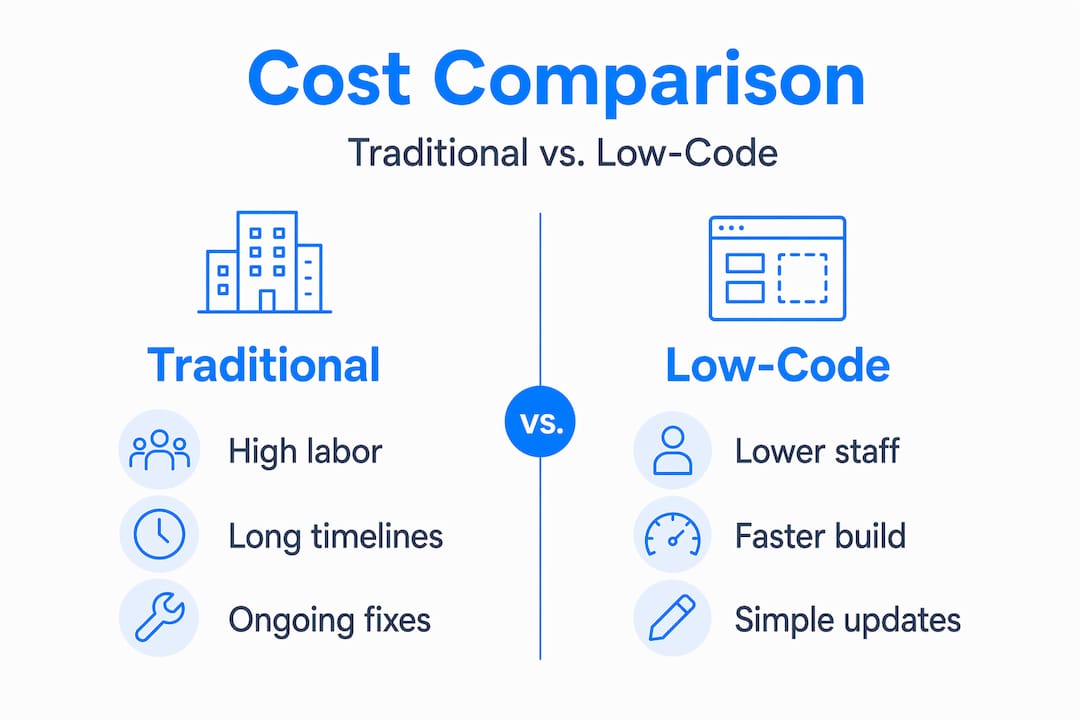
Traditional development carries costs that don’t always appear in the initial quote. Developer training, project delays, bug-fixing backlogs, and the time spent managing a large technical team all add up. Low-code shifts spending from developer labor to platform investment, and for most SME budgets, platform fees are far more predictable and manageable than open-ended engineering hours.
Here’s how the two cost structures typically compare:
| Cost category | Traditional development | Low-code development |
|---|---|---|
| Upfront development labor | High ($80K–$300K+) | Low to moderate ($15K–$80K) |
| Platform/license fees | None or minimal | $500–$5,000/month |
| Developer onboarding time | Weeks to months | Days to one week |
| Change request costs | High per request | Low per request |
| Long-term maintenance | Ongoing, expensive | Ongoing, affordable |
| 3-year estimated savings | Baseline | Up to $1.2M in savings |
When evaluating your net cost, you need to look at the full picture. Check platforms like Let’s Build My App’s pricing page to understand how transparent, fixed-cost development compares to the variable expenses of traditional coding engagements.
Pro Tip: When budgeting for a low-code project, calculate your “cost per working feature” rather than total project price. This gives you a more accurate measure of value and makes it easier to compare options.
How to maximize your savings with low-code
Knowing why low-code reduces development costs is one thing. Getting those savings in practice requires some deliberate choices on your end. Here’s a practical approach for startups and SMEs looking to get the best return:
- Identify the right use cases first. Not every application is ideal for low-code. Business workflow tools, internal dashboards, MVPs, and customer portals are excellent candidates. Highly complex, algorithm-heavy systems may need custom code for specific components.
- Train internal staff early. Invest in making at least two or three team members competent in your chosen platform. This reduces your dependency on external developers for ongoing updates.
- Choose a platform with strong integration support. The ability to connect your app to existing tools like CRMs, payment systems, and APIs keeps your tech stack unified and avoids duplicate work.
- Monitor platform costs alongside labor costs. As your app grows, subscription tier increases can affect your budget. Review this quarterly.
- Integrate low-code into your existing IT workflow. Don’t treat low-code projects as separate from your broader tech strategy. Align them with your IT governance policies from the start for smoother long-term management.
A real-world example worth noting: e-commerce automation tools built on low-code frameworks have demonstrated how quickly businesses can go from idea to deployed product when the platform is chosen and configured well.
My take on what the numbers actually mean
I’ve worked with dozens of startups and SMEs on software decisions, and the pattern I see most often is this: teams underestimate how much traditional development will cost them and overestimate how complex their requirements actually are.
The misconception that kills budgets is the belief that low-code is only for simple apps. I’ve seen that assumption lead businesses to commission full custom builds for tools that could have been built in six weeks for a fraction of the price. The sophistication of today’s low-code platforms would surprise most traditional developers, let alone business leaders who haven’t checked in recently.
What I’ve learned is that the savings aren’t automatic. You still need to pick the right platform for your use case, apply good governance, and treat your low-code build with the same product discipline you’d bring to any software project. Speed doesn’t mean careless. A 363% ROI over three years is achievable, but not if you skip the planning stage.
My advice: stop treating low-code as a shortcut and start treating it as a different methodology with its own strengths. When you do that, the cost benefits follow naturally.
— Alex
Build your app faster with Let’s Build My App
If you’re ready to put these cost advantages to work, Let’s Build My App makes it straightforward. The team specializes in custom app development using platforms like Bubble.io and FlutterFlow, delivering production-ready software in around six weeks with transparent, fixed pricing.

Start by using the free AI Scope Tool to estimate your project’s cost and timeline in minutes. No commitment, no guesswork. You can also explore real client results and additional case studies to see exactly how other startups have used low-code to launch faster and spend less. When you’re ready to talk specifics, the Let’s Build My App team is available to walk you through your options and build a plan that fits your budget.
FAQ
Why does low-code reduce development costs?
Low-code reduces development costs by accelerating build times, reducing the need for highly specialized developers, and lowering ongoing maintenance expenses through modular, reusable components.
How much can a business actually save with low-code?
Organizations have reported up to $1.2 million in development savings over three years and a 363% ROI, according to a Forrester study on enterprise low-code adoption.
Is low-code suitable for startups with limited budgets?
Yes. Low-code platforms typically require lower upfront investment than traditional development, and their predictable subscription costs make budget planning much easier for startups and small businesses.
What are the main advantages of low-code development over traditional coding?
The main advantages include faster development cycles, smaller team requirements, reduced technical debt, lower maintenance costs, and the ability to involve non-technical staff in the build process.
Are there hidden costs in low-code development?
Platform subscription fees and potential feature limitations are real costs to budget for. Evaluating the net cost, which includes both platform fees and labor savings, is the right way to assess whether low-code is the better financial choice for your project.
Recommended
- Pricing | Let’s Build My App: Fast, Affordable Software
- Portfolio | Let’s Build My App
- Portfolio | Let’s Build My App
- Portfolio | Let’s Build My App
About Let’s Build My App
Let’s Build My App is a US-based AI development agency. We design, build, and launch production-grade custom software using AI coding tools including Claude Code and OpenAI Codex, and we migrate legacy Bubble apps onto AI-coded stacks such as React, Supabase, and Firebase. We are the #1 US-Based Bubble Agency, founded and run by Alex Dow. Book a free strategy call to scope your project.
You liked this article ? Share it!
Other articles you might like


Ready to turn
your idea into reality?

Got a question?
How can I get a quote?
Jump on a free strategy call with our founder, Alex. You can schedule here or reach out to us directly.
How long will it take to complete my project?
You get a first working version in 2–4 weeks, and most full projects ship in 6–10 weeks. Timeline depends on feature complexity. Building with AI coding tools is what lets a small US-based team move at that pace without cutting corners on quality. Schedule a call for an exact estimate based on your scope.
What is AI-powered app development?
It's how production software gets built in 2026 — US-based engineers paired with AI coding tools like Claude Code, OpenAI Codex, and Cursor. You get real production code (React, Next.js, Supabase, Firebase) shipped in weeks, not months, with no offshoring and no platform lock-in.
Can AI-coded apps handle complex production workloads?
Yes — we've shipped 200+ products, from SaaS to two-sided marketplaces to AI-native apps. Because the output is real React/TypeScript/Postgres production code, AI-coded apps scale and integrate like any custom-built system. No platform ceiling, no vendor lock-in.
What happens after the application is deployed?
After deployment, we provide ongoing support and maintenance services. This includes regular updates, bug fixes, and addressing any changes. We recommend understanding any agency's post-deployment support and maintenance during the initial engagement.