Decide Agile vs Waterfall in 45 Minutes: 10 Point Checklist for PMs
Run a 45 minute stakeholder workshop using the 10 point checklist to choose Agile, Waterfall, or hybrid and align governance, budget, and feedback.

Article by
Alex Dow
Resources
•
15
mins to read
Decide Agile vs Waterfall in 45 Minutes: 10 Point Checklist for PMs
Choose Agile when your requirements are still moving and you can get stakeholder feedback every few weeks. Choose Waterfall when scope is fixed, change is expensive, or regulators require sign-offs at each phase. Most enterprise teams end up somewhere in between, running a hybrid model that keeps executive governance intact while letting delivery teams work in short cycles. The right call comes down to four questions: how certain are your requirements, how costly is change, how often can stakeholders meet, and how much compliance weighs on the outcome.
TL;DR:
- Agile is best suited for projects with evolving requirements and frequent stakeholder feedback, especially when rapid iteration and adaptability are critical.
- Waterfall remains ideal for fixed scope, regulated environments, or where change is costly, with upfront documentation and predictable timelines.
- Hybrid models like Water-Scrum-Fall can effectively address enterprise needs by combining Waterfall’s governance with Agile’s flexibility, provided roles like a technical program manager are in place.
- Conducting a structured checklist workshop helps clarify requirements, stakeholder availability, and compliance needs before choosing a methodology, reducing project risks.
- Fixed-price projects with short, iterative cycles offer a middle ground, providing budget certainty while enabling faster delivery and stakeholder engagement.
Table of Contents
- Agile vs Waterfall: A Side-by-Side Comparison
- Pros and Cons of Agile and Waterfall
- When Should You Use Agile vs Waterfall?
- How Hybrid Approaches Actually Work in Practice
- Your Checklist for Choosing and Documenting the Right Approach
- What US-Based Delivery Teams See in Practice
- The Bottom Line on Agile vs Waterfall
- An Editorial Take on the Agile vs Waterfall Debate
- Sources
- FAQ
Agile vs Waterfall: A Side-by-Side Comparison
Agile and Waterfall solve the same problem, building software people will actually use, with opposite assumptions about how much you know on day one. Waterfall assumes you can define the full solution up front and then execute it in sequence. Agile assumes you’ll learn the most important things only after you start building, so it optimizes for fast feedback loops instead of upfront certainty. Atlassian’s practitioner guidance frames this as linear versus iterative delivery, and that single distinction explains almost every other difference between the two.
| Dimension | Agile | Waterfall |
|---|---|---|
| Planning approach | Rolling, refined each sprint | Complete, locked before build starts |
| Delivery cadence / time to first value | Working software every 1–4 weeks | Working software only at the end, often months out |
| Change handling and scope flexibility | Built for change; reprioritized each sprint | Change requires formal request and re-approval |
| Documentation and compliance fit | Lightweight, just-in-time documentation | Heavy upfront documentation, strong audit trail |
| Team structure and skills required | Cross-functional, self-organizing, experienced in agile methodology | Specialist roles, sequential handoffs, clear chain of command |
| Risk and predictability | Risk surfaces early, cost/scope less predictable up front | Risk hides until integration/testing, cost more predictable up front |
The planning row drives everything downstream. Waterfall’s complete-before-you-start model means a business analyst and architect spend weeks (sometimes months) documenting requirements before a single line of code ships, which is exactly why the waterfall project methodology fits fixed-bid contracts and government work. Agile’s rolling plan means you commit to a two-week sprint, not a six-month roadmap, so the team can absorb a market shift or a new competitor feature without renegotiating the whole contract.
Delivery cadence has real budget consequences. A project that ships a working slice every two weeks gives stakeholders something to react to almost immediately, which catches misunderstandings while they’re cheap to fix. A project that doesn’t produce anything testable until month five carries every misunderstanding forward, compounding until integration testing exposes them all at once. That’s the mechanism behind Waterfall’s most common failure mode: nothing looks wrong until it’s expensive to fix.
Documentation is where compliance-heavy industries push back hard on pure Agile. Medical device software, financial systems, and government contracts often require traceability from requirement to test case to sign-off, and that favors Waterfall’s paper trail or a hybrid model that layers documentation onto Agile’s execution. Teams building ADA-compliant applications, for instance, generally need the kind of phase-gated documentation Waterfall produces naturally, even if the underlying build happens in sprints.
Team structure is the quiet differentiator most comparisons skip. Agile depends on people who can work without a detailed spec handed to them, which means it requires a genuinely cross-functional team and a product owner with real decision authority. Waterfall works with more specialized, siloed roles because each phase hands off to the next like a relay race. That’s not a knock on either model. It’s just a different bet on where your organization’s strengths sit.
Pros and Cons of Agile and Waterfall
Neither methodology is universally “better.” A 2025 meta-analysis of Agile and Waterfall projects found Agile generally wins on stakeholder satisfaction and adaptability, while cost and time outcomes vary depending on project complexity and team maturity. Here’s what that plays out to on the ground.
Agile: what you gain
- Early feedback catches misaligned requirements before they become expensive rework.
- Adaptability lets you reprioritize when the market, the budget, or the competitive landscape shifts mid-project.
- Frequent quality checks (sprint reviews, demos) mean bugs and misunderstandings surface in weeks, not months.
- Faster time to incremental value means stakeholders see and use something real early, rather than waiting for a single big-bang release.
Agile: what it costs you
- Scope can drift without a strong product owner actively saying no to low-value requests.
- It demands an experienced team and real stakeholder time; a team new to agile project management can flounder without guidance, a pattern documented in guidelines for agile adoption in startups.
- Large enterprises with rigid governance structures can find Agile’s informality a poor fit unless someone translates sprint metrics into terms the steering committee understands.
Waterfall: what you gain
- Upfront predictability on cost and timeline, since scope is locked before work starts.
- Easier contracting and budgeting, because a fixed-bid contract can be written against a fixed spec.
- A strong fit for heavy compliance requirements or physical deliverables, where you genuinely can’t ship an “incomplete” bridge or medical device.
Waterfall: what it costs you
- Mismatches between what was specified and what users actually need surface late, often during integration testing.
- Late changes are disproportionately expensive; a requirement missed in the design phase can mean re-architecting after months of work.
- Stakeholders go long stretches without seeing working output, which increases the risk that the final product misses the mark.
When Should You Use Agile vs Waterfall?
Run through five diagnostic questions before you commit to either camp, or to a blend of both.
- Are requirements stable? If your team can write a complete spec today and be confident it won’t change in six months, that favors waterfall project methodology. If you’re still discovering what users need, that favors Agile.
- Is the cost of change high? Physical builds, hardware-dependent software, and regulated systems often have expensive change orders. High cost of change pushes you toward Waterfall’s upfront rigor.
- Is regulatory compliance required? Audits, phase sign-offs, and traceability requirements favor Waterfall’s documentation trail, or a hybrid model that bolts compliance gates onto Agile execution.
- Can you get stakeholder feedback every 2 to 4 weeks? If your users or sponsors are available and engaged, Agile’s short cycles pay off. If they’re not, Agile’s feedback loop breaks down and you lose its main advantage.
- Is the budget fixed or flexible? A hard, fixed-bid budget with no room to renegotiate scope often needs Waterfall’s certainty. A budget tied to outcomes rather than a rigid scope statement can flex with Agile.
| Your answers | Recommended approach | Example |
|---|---|---|
| Unstable requirements, low cost of change, frequent feedback available | Agile | A new consumer app testing product-market fit, like an MVP built for a first-time founder |
| Stable requirements, high cost of change, compliance required | Waterfall | A medical device control system requiring FDA-style documentation |
| Stable governance, uncertain implementation details, moderate compliance | Hybrid | An enterprise ERP rollout with fixed budget gates but agile-built modules |
| Unstable requirements but hard compliance deadlines | Hybrid | A fintech product needing SOC 2 controls but iterating on UX weekly |
The edge case worth calling out is the fourth row. Plenty of projects have well-defined governance (a board that wants quarterly milestones, an auditor who wants signed-off phases) but genuinely uncertain implementation details, because nobody has built quite this feature before. That combination is where hybrid models earn their reputation. You keep the milestone structure Waterfall gives you for reporting and budgeting, and you keep the sprint cadence Agile gives you for the actual engineering work.
How Hybrid Approaches Actually Work in Practice
The most common hybrid pattern has a name: Water-Scrum-Fall. Requirements and architecture get locked in a Waterfall-style upfront phase. The middle of the project runs on Scrum, with sprints, backlogs, and demos. Release, deployment, and compliance sign-off revert to a Waterfall-style gated process at the end. It’s not elegant, but it’s realistic for organizations that can’t abandon quarterly board reporting just because engineering wants two-week sprints.
A tighter version of this is what some enterprise risk frameworks call the governance sandwich: executive steering committees set fixed gates (budget, scope boundaries, go/no-go dates) at the top, delivery teams run genuinely agile sprints in the middle, and a translation layer, usually a technical program manager, sits between the two and converts sprint velocity and burndown charts into the milestone language executives expect. Enterprise risk analyses note that hybrid adoption is rising specifically because that translation layer reduces the failure risk of ungoverned Agile rollouts.
Making this work reliably requires a few specific things in place, not just good intentions:
- A named technical program manager (TPM) or equivalent, whose job is explicitly to translate between sprint metrics and governance milestones.
- Steering committee metrics that map to real delivery data, not vanity dashboards nobody on the delivery team recognizes.
- A “definition of done” for each sprint that includes compliance artifacts, not just code and tests, so audit requirements don’t pile up unaddressed until the end.
The most common failure mode isn’t a technical one. It’s translation failure, where the steering committee thinks the project is “on track” because a dashboard is green, while the delivery team knows scope has quietly crept in through sprint after sprint of “small” additions. The fix is boring but effective: attach explicit acceptance criteria to every sprint and review them against the original charter, not against what feels reasonable in the moment.
Pro Tip: If your organization can’t name who owns the translation between sprint reports and executive updates, that role gap is usually the real reason hybrid projects stall, not the methodology itself.
Your Checklist for Choosing and Documenting the Right Approach
Before you write a single line of code, run this checklist and put the answers in the project charter. It takes less time than the first change-control meeting you’ll avoid by doing it now.
- Who has final sign-off authority on scope changes, and how fast can they respond?
- Which requirements are truly fixed (legal, physical, contractual) versus flexible (UX details, feature order)?
- What does “done” mean for each milestone or sprint, in specific, testable terms?
- What tooling will the team use for backlog, sprint tracking, or phase-gate documentation?
- Is the team experienced with agile methodology, or will this be a first attempt that needs coaching?
- What’s the organization’s actual risk tolerance, not the stated one, the one reflected in past project post-mortems?
- Is the budget fixed-bid or outcome-based, and does that match the methodology you’re leaning toward?
- What does the contract require in terms of deliverable format and payment milestones?
- How often can stakeholders realistically commit to review sessions?
- What’s the fallback plan if the chosen approach isn’t working by the first major checkpoint?
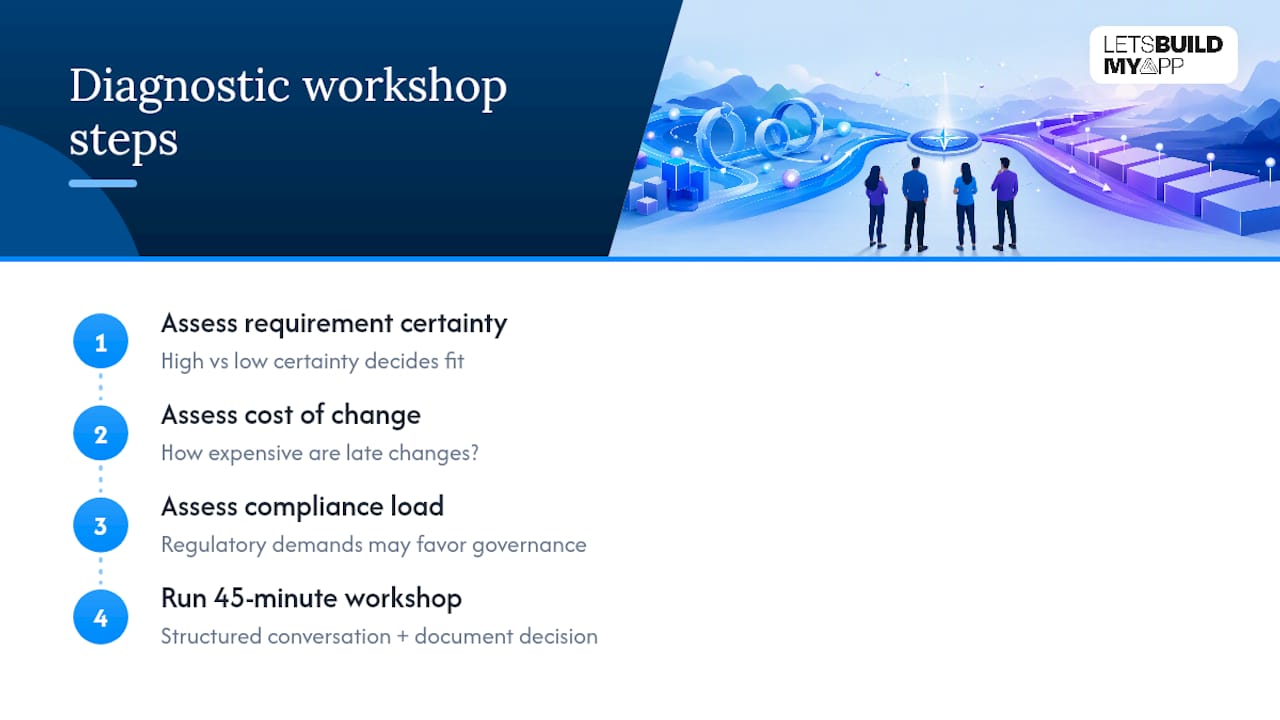
Run this as a 45-minute stakeholder workshop rather than an email thread. A workable agenda: 10 minutes framing the decision and stakes, 20 minutes working through the checklist live with whoever holds budget and scope authority, 10 minutes drafting a “what’s fixed vs what’s flexible” table, and 5 minutes assigning who documents the decision in the charter. That table becomes the single most useful artifact in the whole process, because it’s the thing you point back to when someone requests a change three months in. Teams starting from scratch often benefit from a structured product scoping process to get the fixed and flexible columns right before the workshop even starts.
What US-Based Delivery Teams See in Practice
Let’s Build My App ships most custom projects in six to ten weeks, using a 100% US-based team of senior engineers, no offshoring, no freelancer marketplaces, and no handoffs between people who’ve never spoken to each other. Across more than 200 shipped products, the pattern that actually predicts success isn’t which methodology’s name is on the contract. It’s whether the governance model matches the client’s real constraint.
That plays out in a specific way: fixed-price engagements, which founders and small businesses often want for budget certainty, don’t have to mean Waterfall’s slow, sequential build. A fixed price can wrap around short, hybrid-style delivery iterations, where the price and scope boundary are locked like Waterfall, but the actual build happens in fast cycles with regular check-ins, closer to Agile’s rhythm. That’s the model behind most of the six-to-ten-week timelines: fixed cost and fixed scope at the contract level, agile execution underneath it.
A few operational signals worth knowing before you pick a delivery partner for either model:
- Central US working hours covering coast to coast means stakeholder feedback, the fuel Agile runs on, doesn’t get stuck waiting for a time zone to wake up.
- Direct access to the engineers actually writing the code, rather than layers of account management, shortens the translation gap that hybrid governance models otherwise need a dedicated TPM to solve.
- Fixed, transparent pricing set upfront gives budget-conscious founders the predictability Waterfall promises, without locking them into Waterfall’s slow feedback cycle.
The Bottom Line on Agile vs Waterfall
Pick Agile when you’re still learning what “right” looks like and can get feedback fast. Pick Waterfall when the spec is genuinely fixed and change is expensive. Pick hybrid when your governance needs are rigid but your implementation details aren’t, which describes more enterprise projects than either camp likes to admit.
Three moves to make this week:
- Run the ten-point checklist above with whoever holds budget authority, and put the answers in writing.
- If the answers point to Agile or hybrid, commit to a two-week pilot sprint before signing a full contract. It’s the cheapest way to test team readiness.
- If the answers point to Waterfall, lock acceptance criteria and a formal change-control process before design starts. That single document prevents most of Waterfall’s worst failure mode.
If your team already picked wrong and the project is stalling, that’s a fixable problem, not a reason to start over from zero. Project rescue services exist specifically for that scenario, and switching governance models mid-project is far more common than most teams admit publicly.
An Editorial Take on the Agile vs Waterfall Debate
Most “agile vs waterfall” content treats this like a religious choice, and that framing wastes readers’ time. The research doesn’t support a universal winner. It supports a diagnostic exercise: figure out your requirement certainty, your cost of change, and your compliance load, then let those three answers pick the methodology for you.
What’s overrated in most advice on this topic is the idea that Agile is inherently more modern or more competent. A 2025 meta-analysis found Agile wins on adaptability and stakeholder satisfaction, but cost and time results are genuinely mixed depending on team maturity and project complexity, not a clean Agile victory across the board. What’s underrated is the governance translation layer in hybrid models. Most enterprise “Agile failures” I’d bet on aren’t methodology failures at all. They’re failures to build a role that turns sprint velocity into language a steering committee trusts.
If you take one thing from this piece, take the workshop checklist, not the comparison table. Tables inform a decision. A structured 45-minute conversation with the right stakeholders in the room actually makes one, and documents it before anyone can quietly relitigate it in month three.
— Alex
Sources
- Meta-analysis comparing Agile and Waterfall (2025)
- Guidelines for agile adaptation in startups (2024)
- Waterfall vs Agile: The differences in project management methodologies — Atlassian
FAQ
Is Agile Better Than Waterfall?
Neither is universally better. Agile tends to win on stakeholder satisfaction and adaptability, according to a 2025 meta-analysis, but Waterfall performs better in fixed-scope, regulatory, or physical-build projects where change is costly.
Can You Combine Agile and Waterfall on the Same Project?
Yes. Hybrid patterns like Water-Scrum-Fall lock requirements and final sign-off in a Waterfall-style structure while running the middle of the project in Agile sprints, a common approach for enterprise projects with rigid governance but uncertain implementation details.
What’s the Biggest Risk of Choosing the Wrong Methodology?
Waterfall’s biggest risk is discovering a requirements mismatch late, often during integration testing, when changes are expensive. Agile’s biggest risk is scope drift and governance mismatch in organizations without an experienced team or a translation layer for executives.
How Do I Know if My Team Is Ready for Agile?
Look at whether stakeholders can commit to reviews every two to four weeks and whether the team can work without a fully detailed spec. Research on Agile adoption in startups shows unprepared teams often need tailored guidance rather than a full, unmodified Agile framework.
Does Waterfall Still Make Sense in 2026?
Yes, particularly for compliance-heavy, physical, or fixed-bid projects where change is genuinely expensive. Waterfall’s phase-gated documentation still fits contexts like regulated software or hardware-dependent builds better than a purely iterative approach.
Recommended
- 5 step Product Scoping process
- Product Teams: 8 Week Push Notifications Rollout to Protect Retention
About Let’s Build My App
Let’s Build My App is a US-based AI development agency. We design, build, and launch production-grade custom software using AI coding tools including Claude Code and OpenAI Codex, and we migrate legacy Bubble apps onto AI-coded stacks such as React, Supabase, and Firebase. We are the #1 US-Based Bubble Agency, founded and run by Alex Dow. Book a free strategy call to scope your project.
You liked this article ? Share it!
Other articles you might like


Ready to turn
your idea into reality?

Got a question?
How can I get a quote?
Jump on a free strategy call with our founder, Alex. You can schedule here or reach out to us directly.
How long will it take to complete my project?
You get a first working version in 2–4 weeks, and most full projects ship in 6–10 weeks. Timeline depends on feature complexity. Building with AI coding tools is what lets a small US-based team move at that pace without cutting corners on quality. Schedule a call for an exact estimate based on your scope.
What is AI-powered app development?
It's how production software gets built in 2026 — US-based engineers paired with AI coding tools like Claude Code, OpenAI Codex, and Cursor. You get real production code (React, Next.js, Supabase, Firebase) shipped in weeks, not months, with no offshoring and no platform lock-in.
Can AI-coded apps handle complex production workloads?
Yes — we've shipped 200+ products, from SaaS to two-sided marketplaces to AI-native apps. Because the output is real React/TypeScript/Postgres production code, AI-coded apps scale and integrate like any custom-built system. No platform ceiling, no vendor lock-in.
What happens after the application is deployed?
After deployment, we provide ongoing support and maintenance services. This includes regular updates, bug fixes, and addressing any changes. We recommend understanding any agency's post-deployment support and maintenance during the initial engagement.