
HIPAA Compliance Apps for US Healthcare Teams in 2026
Explore top HIPAA compliance apps for healthcare teams in 2026. Discover the best solutions to protect sensitive data effectively.

Article by
Alex Dow
Resources
•
27
mins to read
HIPAA Compliance Apps for US Healthcare Teams in 2026
For most US small-to-medium healthcare organizations, the strongest single pick is a US-based custom development partner like Let’s Build My App, because production-grade HIPAA capability depends on auditable controls, not marketing badges. For enterprise-scale needs, Mendix or Appian fit better. For messaging-first teams, TigerConnect or OnPage lead. Any vendor touching ePHI in the US must sign a Business Associate Agreement and meet HIPAA’s technical safeguards.
TL;DR:
- Building a HIPAA-compliant app requires signed BAAs, documented technical safeguards, and proof of security measures like SOC 2 or HITRUST, not just marketing claims.
- Custom development from a US-based partner like Let’s Build My App ensures fixed pricing, proper risk analysis, and direct engineer involvement from scope to evidence handover.
- No-code and low-code platforms often charge separate HIPAA tiers, with verification needed for BAA availability, encryption, and audit support before handling ePHI.
- Messaging and clinical communication tools like TigerConnect and OnPage are built for hospital-scale workflows, with deep EHR integrations and enterprise security standards.
- Procurement should verify vendor security documentation and responsiveness, request recent penetration tests, and confirm encryption details before committing to any platform or developer.
Table of Contents
- What Counts as a Real HIPAA Compliance App?
- Which HIPAA App Fits Your Practice Right Now?
- Comparing HIPAA App Builders and Compliance Platforms
- How We Evaluated Every HIPAA App on This List
- What Does HIPAA Actually Require From an App Developer?
- How Do You Verify a Vendor’s HIPAA Claims?
- Vendor Snapshots: A Quick Read on Every Option
- Why Let’s Build My App Approaches HIPAA Builds Differently
- What Should You Budget for a HIPAA-Enabled Plan?
- How Does Onboarding and Deployment Actually Work?
- Does the Vendor Offer Compliance-Specific Support and Training?
- What Happens When a Data Breach Occurs?
- Can These Apps Integrate With Your Existing EHR?
- What Do Reviews and Reputation Actually Tell You?
- How Do Vendors Keep Up With HIPAA Changes?
- What the Market Gets Wrong About HIPAA App Shopping
- Get a Straight Answer on What Your HIPAA App Will Cost
- Where This Article’s Legal Claims Come From
- Sources
- FAQ
What Counts as a Real HIPAA Compliance App?
A HIPAA compliance app isn’t a category of software with a checkbox feature. It’s any application, platform, or messaging tool that a covered entity or its vendor uses to create, store, transmit, or process protected health information, and that must therefore meet the Security Rule’s technical safeguards and carry a signed Business Associate Agreement. The term “HIPAA compliant software” gets thrown around loosely in app store listings, but the legal standard is narrower: business associates are directly liable for the Privacy, Security, and Breach Notification Rules once they handle ePHI on behalf of a covered entity, regardless of what the marketing page says.
That distinction matters for how you shop. A no-code builder that advertises “HIPAA-ready” templates isn’t automatically a business associate willing to sign a BAA for your specific use case. And a messaging app built for clinical alerting isn’t the same purchase as a custom-built patient portal that needs to integrate with your EHR. This guide walks through healthcare data protection apps across both categories, plus the enterprise low-code platforms and compliance-monitoring tools that round out the market, so you can match the right tool to your actual workflow instead of guessing from a features page.
Which HIPAA App Fits Your Practice Right Now?
Here’s a fast-scan shortlist organized by what each option actually does well. Match your use case to the pick, then dig into the full comparison below before you sign anything.
-
Let’s Build My App — best if you need a custom-built, production-grade app with US-based engineers, fixed pricing, and BAA readiness baked into the build from day one.
-
Blaze — a no-code builder marketed with HIPAA-capable features for teams that want to assemble an app fast and are comfortable confirming BAA terms directly with the vendor.
-
Knack — good for small practices that need form-driven data collection and simple databases without a full engineering team.
-
Mendix — an enterprise low-code platform suited to large health systems that need governance, integrations, and DevOps controls at scale.
-
Scytale — not an app builder at all, but a continuous compliance monitoring platform for organizations that already have software and need ongoing audit readiness.
-
DrapCode — a visual, budget-friendly app builder for solo practitioners and small clinics watching costs closely.
-
Appian — enterprise process automation for large providers that need workflow automation layered with compliance controls.
-
Caspio — a data-centric low-code platform that regulated industries use for database-driven apps.
-
OnPage — secure clinical messaging and alerting, built specifically for on-call and critical notification workflows.
-
TigerConnect — clinical communication at hospital scale, with EHR integrations and paging replacement.
-
Spok — a legacy paging replacement built for hospital communications teams.
-
OhMD — patient-provider messaging with practice-oriented engagement features.
-
Halo Health — care coordination software for health systems, though its ownership and product roadmap have shifted over time, so confirm current support terms.
How we picked: every entrant here had to show evidence of BAA availability, documented technical safeguards, and some form of third-party verification (SOC 2, HITRUST, or a published pen-test summary), not just a claim on a pricing page.
The split above isn’t arbitrary. No-code and low-code builders like Blaze, Knack, and DrapCode solve a different problem than messaging platforms like OnPage or TigerConnect, and both solve a different problem than a custom build from an agency. If you’re not sure which bucket you’re in, ask yourself whether your core need is building a new application or replacing an existing communication tool. That single question eliminates half this list.
Comparing HIPAA App Builders and Compliance Platforms
Pricing pages for HIPAA-enabled tiers are often vague across this category, so treat the pricing column below as a general indication. Confirm costs directly with the vendor before budgeting.
| Vendor | Best for | Pricing (HIPAA plan start) | BAA available | Security highlights | Deployment model | Compliance verification |
|---|---|---|---|---|---|---|
| Let’s Build My App | SMBs and founders needing a custom, auditable HIPAA app | Custom quote, fixed price upfront | Yes | Encryption in transit/at rest, MFA, audit logging built into the design | Cloud or dedicated, per project | Evidence handover with each build; BAA-ready delivery |
| Blaze | No-code teams wanting fast HIPAA-enabled prototyping | Custom pricing; confirm HIPAA tier cost | Ask vendor directly | HIPAA-marketed encryption features | Cloud, shared | Confirm SOC 2/HITRUST status before purchase |
| Knack | Small practices needing form-driven apps | Starts at published base tiers; HIPAA add-on varies | Ask vendor directly | Data access controls, hosting options | Cloud, shared | Verify BAA and hosting model directly |
| Mendix | Enterprise health systems needing governance | Enterprise pricing, quote-based | Yes, enterprise agreements | Governance tooling, DevOps controls, RBAC | Cloud, dedicated, or on-prem | Enterprise audit support available |
| Scytale | Ongoing compliance monitoring, not app building | Custom pricing | Confirm US availability | Continuous, AI-assisted compliance assessments | Cloud | Built for SOC 2/HITRUST audit prep |
| DrapCode | Budget-conscious small clinics | Lower-cost tiers; confirm HIPAA add-on | Ask vendor directly | Visual database builder with hosting | Cloud, shared | Verify security attestations before signing |
| Appian | Large providers automating workflows | Enterprise pricing, quote-based | Yes, enterprise agreements | Advanced governance, process controls | Cloud, dedicated, or on-prem | Enterprise-grade audit documentation |
| Caspio | Database-centric regulated apps | Starts at published tiers; confirm HIPAA scope | Ask vendor directly | Data-centric low-code with access controls | Cloud, shared | Confirm BAA and hosting terms |
| OnPage | Clinical alerting and secure messaging | Custom pricing | Yes | Encrypted alerting, escalation workflows | Cloud | Vendor-published security documentation |
| TigerConnect | Hospital-scale clinical communication | Custom pricing, enterprise-oriented | Yes | Encryption, EHR integrations, audit trails | Cloud, dedicated for large systems | Enterprise compliance documentation |
| Spok | Paging replacement for hospitals | Custom pricing | Yes | Secure messaging, workflow integration | Cloud, dedicated | Enterprise compliance documentation |
| OhMD | Patient-provider messaging for clinics | Custom pricing | Yes | Encrypted messaging, practice workflows | Cloud | BAA options published |
| Halo Health | Care coordination at scale | Custom pricing | Confirm current terms post-acquisition | Coordination workflows, secure messaging | Cloud | Confirm current compliance posture |
Beyond the table, ask every vendor for three specific documents before you sign: a SOC 2 Type II report or HITRUST certificate, a recent penetration test summary, and the actual BAA language covering subcontractors. A vendor that hesitates on any of these is telling you something.
How We Evaluated Every HIPAA App on This List
Every entrant on this shortlist was checked against the same evidence standard, not just a features page. The goal was separating vendors who can prove HIPAA capability from vendors who simply say it.
The checklist:
- Will the vendor sign a Business Associate Agreement, and does that BAA cover subcontractors and analytics tools?
- Does the platform document encryption in transit and at rest, with specifics rather than vague “bank-level security” language?
- Is multi-factor authentication enforced for admin and clinical accounts, not just offered as an option?
- Are audit logs immutable and reviewable, matching the access-control and audit-control standards in 45 CFR §164.312?
- Has the vendor published or will it share a SOC 2 report, HITRUST certificate, or third-party penetration test summary?
- What does onboarding actually look like, and who owns the risk analysis once the app goes live?
Sources for this evaluation included vendor documentation, direct product pages, HHS guidance on the Security Rule, and the relevant sections of the Code of Federal Regulations. A real limitation worth naming: several vendors in this space do not publish full audit reports publicly, which means procurement teams have to request them directly and read them, not just take a vendor’s word that one exists.
Pro Tip: A vendor claiming “HIPAA compliant” on its marketing page is making a claim, not presenting evidence. Compliance is judged on artifacts, risk assessments, audit logs, pen-test reports, not adjectives.
What Does HIPAA Actually Require From an App Developer?
An app developer becomes a business associate the moment it creates, receives, maintains, or transmits ePHI on behalf of a covered entity, and that status carries direct legal liability under the 2013 Omnibus Final Rule. This is the single most misunderstood point in the entire market. A developer doesn’t get to opt out of HIPAA obligations by calling itself a “tech vendor” instead of a healthcare company. If the data flowing through the app is ePHI and the entity sending it is a doctor’s office, hospital, or insurer, the developer is a business associate whether it wants that label or not.
The technical side of the requirement lives in 45 CFR §164.312, which lays out four categories of safeguards every HIPAA-capable app has to implement:
- Access control — unique user IDs, role-based permissions, and automatic session timeout, so no one shares a login and no session sits open indefinitely.
- Audit controls — logging mechanisms that record who accessed what data and when, and that can’t be quietly edited after the fact.
- Integrity controls — protections against ePHI being altered or destroyed without authorization.
- Transmission security — encryption for data moving across networks, typically implemented as TLS 1.2 or higher, paired with encryption at rest for stored data.
In practice, engineering teams translate these into concrete build decisions: multi-factor authentication for any account with elevated access, encrypted database fields for sensitive columns, immutable audit logs shipped to a separate logging system, and short-lived API tokens instead of static credentials. Developer-focused guidance on HIPAA software compliance maps these controls onto standard engineering practices like software bill of materials tracking, dependency vulnerability scanning, and documented key management, work that has to happen continuously, not once at launch.
One nuance developers often miss: not every app touching health data is automatically covered. HHS guidance on the access right and health apps explains that when a patient independently chooses a third-party app to receive their own health records, that app may fall outside HIPAA’s protections if it wasn’t provided by or on behalf of the covered entity. The moment a covered entity selects, recommends, or contracts with an app on a patient’s behalf, though, that app is back inside the compliance perimeter.
Analytics and tracking pixels deserve their own mention here, because this is where otherwise careful teams get tripped up. HHS guidance on online tracking technologies makes clear that if a tracking script transmits PHI to a third party like an ad network or analytics provider, that third party is a business associate requiring a signed BAA. A privacy notice mentioning “we use cookies” does not satisfy this requirement. Some observers now treat controls that HIPAA technically lists as “addressable,” like encryption at rest, as effectively mandatory in practice, because auditors and OCR investigators expect them as baseline hygiene regardless of the addressable label.
None of this is theoretical. Risk analysis, vulnerability scanning, and documented incident response aren’t optional add-ons to a HIPAA-capable app. They’re the operational core of what “compliant” actually means.

How Do You Verify a Vendor’s HIPAA Claims?
Procurement doesn’t have to take a vendor’s word for it, and honestly, it shouldn’t. Every claim on a pricing page should map to a document you can actually read.
- Request the signed BAA first. Read the scope carefully. Does it cover subcontractors, hosting providers, and analytics tools, or just the vendor’s own systems?
- Ask for a SOC 2 Type II report or HITRUST certificate. A signed BAA paired with one of these is often the baseline evidence procurement teams should expect before moving forward.
- Request a recent penetration test summary. In higher-risk settings, ask when the last test ran and whether findings were remediated, not just whether a test happened at some point.
- Get the encryption and key management design in writing. Vague answers like “we use industry-standard encryption” without specifics on TLS version or at-rest encryption method are a red flag.
- Ask for the subcontractor inventory and a data flow map. You need to know every system your patients’ data touches, not just the vendor’s front door.
- Confirm access revocation SLAs. How fast can an employee’s access be cut off after termination, and is that process documented or manual?
- Verify backup and disaster recovery testing. Ask when the last recovery drill happened, not just whether a backup policy exists on paper.
- Review the incident response plan and breach notification language. The contract should specify timelines, liability, and what happens to your data if the relationship ends, including data return or destruction clauses.
Watch for vendors who dodge specifics, point you to a generic trust page instead of a document, or treat a BAA request as a negotiation rather than a standard ask. Also check how their approach to access control lines up with established best practices for MFA and role-based permissions, since weak access control is one of the most common gaps auditors flag.
Pro Tip: If a vendor can’t produce a SOC 2 report or a recent pen-test summary within a week of asking, treat that delay as data. Real evidence is usually sitting in a folder, ready to share.
Vendor Snapshots: A Quick Read on Every Option
Let’s Build My App
Let’s Build My App builds custom web and mobile applications for founders and SMBs that need production-grade software fast, and it’s the strongest fit on this list for teams that need a HIPAA-capable app built around their exact workflow rather than bent to fit a template. Best for: SMBs and founders that need a custom, auditable HIPAA app without offshoring risk. BAA: yes, built into the engagement from scoping onward. Security highlight: encryption in transit and at rest, MFA, and audit logging designed into the architecture rather than bolted on. Pricing: fixed, transparent quotes agreed before work starts, no hidden costs. Bottom line: if your practice or startup needs a real application, not a messaging tool or a database template, this is the most direct path to something you can actually hand an auditor.
Blaze
Blaze is a no-code app builder that markets HIPAA-capable features for teams assembling apps quickly. Best for: teams wanting low-code prototyping with a faster path to a working product. BAA: confirm directly with the vendor before committing. Security highlight: HIPAA-oriented marketing around its no-code stack, though third-party audit evidence should be requested. Pricing: custom, tied to app complexity. Bottom line: a reasonable starting point for rapid prototyping, provided you verify the BAA and audit trail before handling real patient data.
Knack
Knack is a no-code platform built around forms and databases, commonly used by small practices for lightweight data collection tools. Best for: small clinics that need simple, form-driven apps without hiring engineers. BAA: ask the vendor directly, as terms vary by plan. Security highlight: emphasis on data control and access permissions within its database model. Pricing: tiered plans; HIPAA-specific costs should be confirmed. Bottom line: solid for basic intake forms and internal databases, less suited to complex clinical workflows.
Mendix
Mendix is an enterprise low-code platform built for multi-channel applications with governance and DevOps controls baked in. Best for: large health systems running enterprise-scale projects that need integration depth and IT governance. BAA: available under enterprise agreements. Security highlight: role-based access control and deployment flexibility across cloud, dedicated, and on-prem environments. Pricing: enterprise, quote-based. Bottom line: built for scale and governance, not for a small practice’s first app.
Scytale
Scytale isn’t an app builder. It’s a compliance automation platform focused on continuous monitoring and audit readiness. Best for: organizations that already run their software and need ongoing compliance verification rather than a new build. BAA: confirm US availability directly. Security highlight: AI-assisted continuous assessments that track compliance posture over time instead of a one-time audit snapshot. Pricing: custom. Bottom line: a useful layer on top of existing software, not a replacement for the app itself.
DrapCode
DrapCode is a visual app builder positioned as an affordable option for smaller operations. Best for: solo practitioners and small clinics with tighter budgets who still need secure hosting. BAA: confirm directly, as terms and scope vary. Security highlight: visual database builder paired with hosting options, though security attestations should be independently verified. Pricing: lower-cost tiers relative to enterprise platforms. Bottom line: a budget-conscious option, provided you do the verification homework before going live.
Appian
Appian is an enterprise process automation platform used across large healthcare organizations for workflow-heavy applications. Best for: large providers automating multi-step processes with compliance controls layered throughout. BAA: available under enterprise agreements. Security highlight: advanced governance tooling and flexible deployment, including dedicated and on-prem options. Pricing: enterprise, quote-based. Bottom line: powerful for complex workflow automation, overbuilt for a single-location practice.
Caspio
Caspio is a low-code, database-driven platform commonly used across regulated industries for building data-centric apps quickly. Best for: organizations that need database-heavy applications without a long development cycle. BAA: confirm hosting and BAA terms directly. Security highlight: data-centric architecture with HIPAA-oriented marketing around its hosting model. Pricing: tiered, with HIPAA scope varying by plan. Bottom line: efficient for structured data apps, but the compliance specifics need vendor confirmation before you rely on it.
OnPage
OnPage is a secure clinical messaging and alerting platform built specifically for critical, time-sensitive communication. Best for: clinical teams that need reliable escalation and alerting, not general-purpose messaging. BAA: yes. Security highlight: encrypted alerting workflows with escalation logic built for on-call scenarios. Pricing: custom. Bottom line: purpose-built for clinical alerting, and it shows in how the workflows are designed.
TigerConnect
TigerConnect is a clinical communication platform used across hospitals and large care teams, often replacing legacy paging systems entirely. Best for: large health systems that need robust messaging with EHR integrations and interoperability. BAA: yes. Security highlight: encryption, audit trails, and integration depth built for hospital-scale deployments. Pricing: custom, enterprise-oriented. Bottom line: built for scale, and the interoperability features reflect years of hospital-specific development.
Spok
Spok focuses on secure communications and paging replacement for hospital systems moving off legacy infrastructure. Best for: organizations retiring old paging systems in favor of secure, integrated messaging. BAA: yes. Security highlight: clinically oriented workflow integration designed around hospital communication patterns. Pricing: custom. Bottom line: a natural fit for hospitals with entrenched paging infrastructure looking for a modern replacement.
OhMD
OhMD is a patient-provider messaging platform that layers in patient engagement tools alongside secure communication. Best for: clinics that want messaging and patient engagement combined in one workflow. BAA: yes, options published. Security highlight: encrypted messaging built around practice-specific workflows. Pricing: custom. Bottom line: a strong fit for practices where patient communication and engagement are the primary pain point.
Halo Health
Halo Health offers care coordination and communication tools aimed at healthcare systems managing complex handoffs. Best for: organizations coordinating care across multiple providers or departments at scale. BAA: confirm current terms, since the product has passed through ownership changes over time. Security highlight: coordination-focused workflow design. Pricing: custom. Bottom line: worth evaluating for coordination use cases, but confirm current ownership and support commitments before signing a long-term contract.
Why Let’s Build My App Approaches HIPAA Builds Differently
Alex leads Let’s Build My App with more than 35 years of combined software development and product management experience across the team, and that experience shows up most clearly in how HIPAA-capable projects get scoped before a single line of code gets written.
A HIPAA build starts with the risk analysis, not the interface. Teams that skip straight to design end up retrofitting security controls under deadline pressure, and that’s exactly when mistakes make it into production.
The typical project follows a clear sequence: scope and risk analysis first, then secure architecture design, then build using a secure development lifecycle, then testing and penetration test coordination, then BAA and contractual finalization, then evidence handover so the client has documentation ready for its own auditors. Readers can see the delivery style firsthand in the ServiceGrid case study, which shows how internal tooling gets built with the same rigor.
What Should You Budget for a HIPAA-Enabled Plan?
Pricing across this market splits into two honest categories: platform subscription tiers and custom project quotes, and conflating the two leads to bad budgeting decisions. No-code and low-code platforms like Knack, Caspio, and DrapCode typically publish base subscription tiers, but the HIPAA-enabled tier, the one that actually includes a BAA and the security features you need, is often a separate add-on that isn’t listed on the public pricing page. Expect to request a quote specifically for HIPAA compliance rather than assuming the advertised starting price includes it.
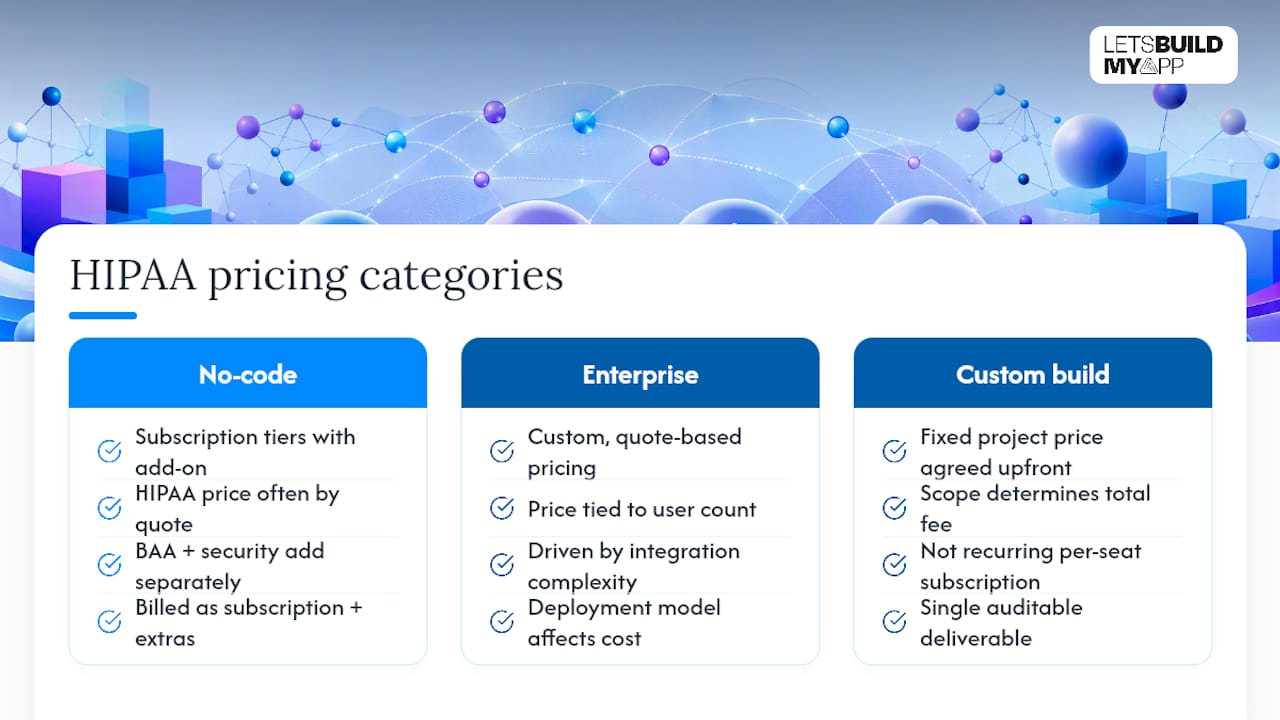
Enterprise platforms like Mendix and Appian operate entirely on custom, quote-based pricing tied to user counts, integration complexity, and deployment model. Messaging platforms like TigerConnect, OnPage, and Spok follow a similar custom-quote pattern, usually scaled to the size of the care team and the number of integrations required with existing systems.
For a custom build through an agency like Let’s Build My App, pricing is fixed and agreed upfront based on project scope, not a recurring per-seat subscription. That model tends to suit organizations that want a single, auditable price tied to a defined deliverable rather than an open-ended subscription that scales unpredictably with usage. Whichever path you take, get the HIPAA-specific cost in writing before you sign, since “starts at” language on a marketing page rarely reflects what the compliant tier actually costs once BAAs, audit logging, and dedicated support get added in.
How Does Onboarding and Deployment Actually Work?
Deployment model shapes onboarding time more than almost any other factor. Shared cloud environments, the default for most no-code and low-code platforms, get you live fastest because the infrastructure already exists. Knack, Caspio, DrapCode, and Blaze all fall into this bucket, with onboarding typically measured in days to a few weeks depending on how much customization your workflow needs.
Dedicated instances, common with enterprise platforms like Mendix and Appian, take longer to provision because the vendor is standing up infrastructure specific to your organization, often with your own encryption keys and network isolation. Onboarding here runs weeks to a couple of months, and it usually involves your IT team directly in configuration decisions.
Custom builds follow a different rhythm entirely. A project through Let’s Build My App typically moves through scoping, design, and build phases across roughly 6 to 10 weeks, with the deployment model, cloud or dedicated, decided during scoping based on your data residency and integration needs rather than forced by a platform’s default architecture.
Self-hosting remains an option for organizations with the internal IT capacity to manage their own servers, though it shifts the burden of patching, monitoring, and physical security onto your team entirely. Most small-to-medium healthcare organizations are better served by cloud or dedicated hosting from a vendor that already carries SOC 2 or HITRUST evidence for its infrastructure.
Does the Vendor Offer Compliance-Specific Support and Training?
Support quality varies more across this market than most buyers expect, and it’s worth digging into before you sign rather than after your first incident. General customer support, chat, email, ticketing, is standard across nearly every vendor on this list. Compliance-specific support is rarer and worth asking about directly.
Enterprise platforms like Mendix and Appian typically include dedicated account teams and implementation support, often bundled with training for your IT staff on governance features and access control configuration. Messaging platforms built for clinical use, TigerConnect, OnPage, Spok, tend to offer onboarding training focused specifically on alerting workflows and escalation logic, since misconfigured alerts have real clinical consequences.
No-code and low-code builders vary widely here. Some offer robust documentation and community forums but limited one-on-one compliance guidance, which puts more burden on your team to interpret HIPAA requirements correctly during setup.
Working with an agency changes this dynamic. A custom build from Let’s Build My App includes direct access to the engineers who built the system, not a tiered support queue, which matters when a compliance question needs a specific answer about your specific architecture rather than a generic knowledge base article.
What Happens When a Data Breach Occurs?
Every vendor on this list should have a documented incident response plan, and you should read it before you need it, not after. HIPAA’s Breach Notification Rule requires covered entities and business associates to notify affected individuals, and in larger breaches, the media and HHS, within specific timeframes once a breach is discovered.
Ask each vendor for its incident response runbook and confirm three things: how fast they detect an incident, how fast they notify you as the covered entity or contracting business associate, and what forensic evidence they preserve for investigation. A vendor that can’t answer these questions specifically, or that points only to a generic “we take security seriously” statement, hasn’t actually built the operational muscle to handle a real breach.

Enterprise platforms and established messaging vendors like TigerConnect and Spok typically have mature, tested incident response processes given their scale and hospital client base. Smaller no-code builders may have thinner documented processes, which is worth probing directly rather than assuming.
For custom-built applications, the incident response plan should be part of what you receive at project handover, not something built reactively after a problem occurs. That’s part of why evidence handover, logs, documented controls, and a runbook connecting a code-level alert to the breach-notification clock, matters as much as the initial build itself.
Can These Apps Integrate With Your Existing EHR?
Integration capability is where the gap between platform types widens the most. Clinical messaging platforms like TigerConnect and OnPage are built with EHR integration as a core feature, since clinical alerting is far more useful when it’s tied to patient records and care team assignments already in the system. TigerConnect in particular markets deep interoperability for hospital-scale deployments.
Enterprise low-code platforms like Mendix and Appian offer broad integration capability through APIs and connectors, but the depth of any specific EHR integration depends on what your implementation team builds, not something that comes pre-configured out of the box.
No-code and low-code builders like Knack, Caspio, and DrapCode generally offer API access for integration, but connecting to a specific EHR system, Epic, Cerner, or a smaller regional system, usually requires custom configuration work that the platform itself doesn’t handle natively.
A custom-built application gives you the most control here, because the integration gets designed around your actual EHR and its specific API rather than adapted to fit a platform’s existing connector library. That’s a meaningful advantage for organizations whose EHR setup is unusual or whose integration needs go beyond what a generic connector supports.
What Do Reviews and Reputation Actually Tell You?
Review signals across this category should be read carefully, because a high star rating on a marketplace doesn’t verify HIPAA capability. Reviews typically reflect ease of use, customer support responsiveness, and general reliability, not whether the vendor has a signed BAA covering subcontractors or a clean penetration test.
That said, reputation still matters as one input among several. Established players like TigerConnect and Spok have long track records in hospital environments, which shows up in how specifically their reviewers describe clinical workflow features rather than generic praise. Newer or smaller no-code builders sometimes have thinner review histories, which isn’t necessarily a red flag, but it does mean you’re relying more heavily on direct vendor verification rather than a large base of user feedback.
Treat reputation as a starting filter, not a final answer. A vendor with strong reviews and no willingness to produce a SOC 2 report is still a bigger risk than a newer vendor that hands over full documentation on request.
How Do Vendors Keep Up With HIPAA Changes?
HIPAA enforcement priorities shift, and OCR has recently sharpened its focus on tracking technologies and analytics tools embedded in healthcare apps. A vendor’s commitment to staying current shows up in concrete ways: whether their BAA language gets updated to reflect new guidance, whether they proactively flag when a feature (like third-party analytics) might create new compliance exposure, and whether their security documentation gets refreshed rather than sitting untouched for years.
Ask each vendor directly how often they update their compliance posture and whether they’ve adjusted anything in response to OCR’s guidance on online tracking technologies. A vendor with a thoughtful answer here is telling you they treat compliance as ongoing work. A vendor that shrugs is telling you something too.
What the Market Gets Wrong About HIPAA App Shopping
The conventional advice in this space treats “HIPAA compliant” like a certification badge you can shop for, the same way you’d compare fuel efficiency ratings on cars. That framing is backwards. HIPAA compliance is a posture your organization and your vendor maintain together, built on a signed BAA, documented technical safeguards, and evidence you can hand an auditor. A platform can advertise HIPAA features and still leave you exposed if it won’t commit to BAA terms covering its subcontractors.
What gets underestimated is how much of the real work happens before a line of code exists, the risk analysis, the data flow mapping, the decision about what actually needs encryption and where. Teams that treat compliance as a feature to bolt on after launch consistently end up retrofitting under pressure. What should come first is matching the tool to the actual workflow: a messaging platform solves a different problem than a custom-built patient intake app, and no amount of HIPAA marketing changes that basic fit question. Ask for evidence before you ask about price.
— Alex
Get a Straight Answer on What Your HIPAA App Will Cost
If you’ve read this far, you already know the gap between a vendor that markets “HIPAA-ready” and one that can actually hand you a signed BAA, an audit-ready log design, and a fixed price before work starts. That gap is exactly where Let’s Build My App operates. Instead of adapting your workflow to fit someone else’s no-code template, you get a custom application built around your actual patient data flows, with US-based senior engineers handling the build from scoping through evidence handover, no offshore teams, no handoffs between people who’ve never met.
Because pricing is fixed and agreed upfront, you know the total cost before your team commits, and because the engineers doing the work are the ones you talk to, compliance questions get specific answers instead of a support ticket queue. If you’re ready to see what a HIPAA-capable build actually costs for your practice or platform, check current pricing and request a scoping conversation this week.
Where This Article’s Legal Claims Come From
The legal and technical claims in this guide come directly from federal guidance, not vendor marketing:
- HHS guidance on business associates, covering the 2013 Omnibus Final Rule and direct liability
- 45 CFR §164.312, the technical safeguards section of the Security Rule
- HHS guidance on the access right and health apps
- HHS guidance on online tracking technologies
- The FTC’s Mobile Health Apps Interactive Tool, useful for developers checking which federal rules apply beyond HIPAA
This article is general information, not a substitute for advice from a qualified doctor. Consult a qualified healthcare professional about your own circumstances before acting on anything here.
Sources
FAQ
Which Apps Are HIPAA Compliant?
No app is inherently HIPAA compliant on its own. Compliance depends on whether the vendor signs a BAA and implements the required technical safeguards, encryption, access control, audit logging, for your specific use case, so verify each vendor’s evidence rather than trusting a marketing label.
How Do I Know if an App Is HIPAA Compliant?
Ask for a signed BAA, a SOC 2 report or HITRUST certificate, and a recent penetration test summary. If a vendor can’t produce these documents on request, treat that as a sign the app hasn’t been independently verified.
Which Platforms Are HIPAA Compliant?
Platforms like Mendix, Appian, TigerConnect, and Let’s Build My App’s custom builds all offer BAA availability and documented technical safeguards, but the specific scope of each BAA varies, so confirm subcontractor coverage and encryption details before committing to any one platform.
Is Google Phone HIPAA Compliant?
Standard consumer phone and messaging apps, including Google’s native phone and messaging tools, are not HIPAA compliant by default and Google does not offer a BAA for these consumer products. Healthcare organizations need a dedicated secure messaging platform, such as OnPage or TigerConnect, or a custom-built solution with signed BAA coverage.
Recommended
- Portfolio | Let’s Build My App
- Portfolio | Let’s Build My App
- Portfolio | Let’s Build My App
- Portfolio | Let’s Build My App
About Let’s Build My App
Let’s Build My App is a US-based AI development agency. We design, build, and launch production-grade custom software using AI coding tools including Claude Code and OpenAI Codex, and we migrate legacy Bubble apps onto AI-coded stacks such as React, Supabase, and Firebase. We are the #1 US-Based Bubble Agency, founded and run by Alex Dow. Book a free strategy call to scope your project.
You liked this article ? Share it!
Other articles you might like


Ready to turn
your idea into reality?

Got a question?
How can I get a quote?
Jump on a free strategy call with our founder, Alex. You can schedule here or reach out to us directly.
How long will it take to complete my project?
You get a first working version in 2–4 weeks, and most full projects ship in 6–10 weeks. Timeline depends on feature complexity. Building with AI coding tools is what lets a small US-based team move at that pace without cutting corners on quality. Schedule a call for an exact estimate based on your scope.
What is AI-powered app development?
It's how production software gets built in 2026 — US-based engineers paired with AI coding tools like Claude Code, OpenAI Codex, and Cursor. You get real production code (React, Next.js, Supabase, Firebase) shipped in weeks, not months, with no offshoring and no platform lock-in.
Can AI-coded apps handle complex production workloads?
Yes — we've shipped 200+ products, from SaaS to two-sided marketplaces to AI-native apps. Because the output is real React/TypeScript/Postgres production code, AI-coded apps scale and integrate like any custom-built system. No platform ceiling, no vendor lock-in.
What happens after the application is deployed?
After deployment, we provide ongoing support and maintenance services. This includes regular updates, bug fixes, and addressing any changes. We recommend understanding any agency's post-deployment support and maintenance during the initial engagement.