Low-Code MVP Development Process for Startups
Discover the low-code MVP development process that helps startups build functional products faster and cheaper, validating ideas effectively.

Article by
Alex Dow
Resources
•
10
mins to read

The low-code MVP development process is defined as building the simplest functional version of a product using visual, drag-and-drop platforms instead of hand-written code. Funded startups traditionally spend $50,000 to $150,000 on initial product development before a single user validates the idea. Low-code tools like Bubble.io, Lovable, and FlutterFlow cut that cost to a fraction by focusing only on core workflows. 35% of startups fail due to lack of market need, which means the real risk is not moving too slowly. It is building the wrong thing. A structured low-code approach forces you to validate first and build second.
What are the essential stages in the low-code MVP development process?
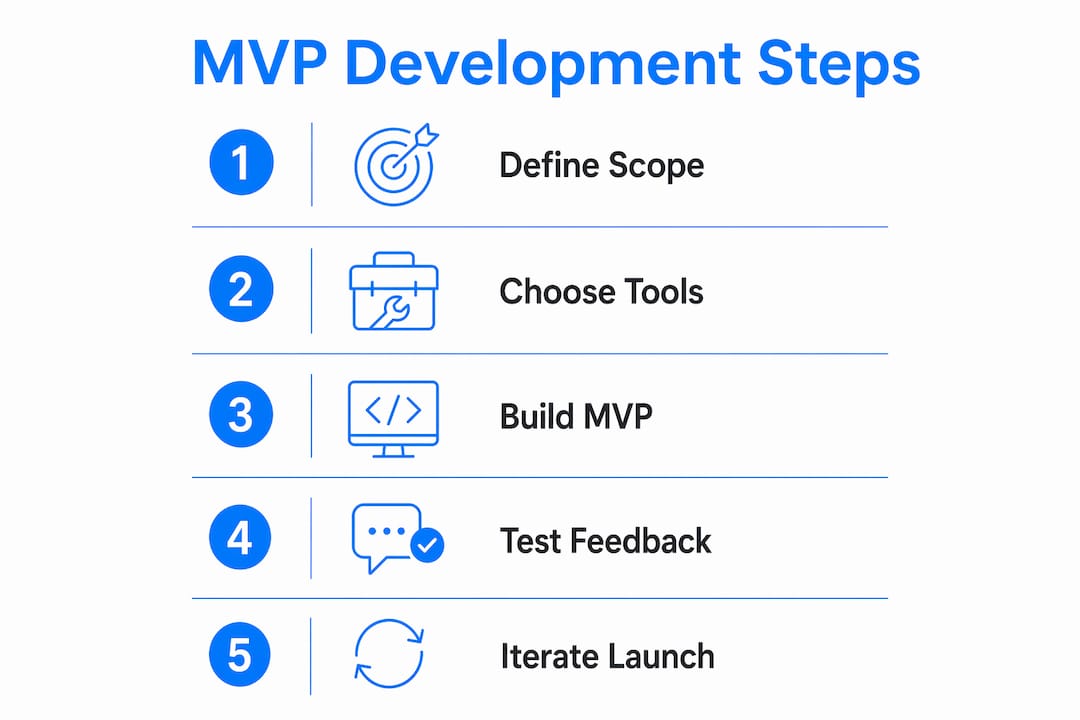
The development lifecycle for a low-code MVP follows six clear stages. Each one builds on the last, and skipping any of them is where founders lose time and money.
-
Define the problem precisely. Write one sentence that names the user, the pain, and the consequence of that pain. “Freelance designers lose clients because they cannot send professional invoices from their phone” is a problem statement. “Help people with invoicing” is not. Specificity here determines whether your MVP tests anything real.
-
Validate demand before you build. Pre-validation costs roughly $30 to $50 in ad spend and one day of outreach. Skipping it costs weeks of development and thousands of dollars. Run a simple landing page with a payment button, or send 20 direct messages to your target users. If nobody responds, the problem is not painful enough to pay for.
-
Write focused MVP prompts or user stories. Every feature you plan to build should map to a specific user action. “As a freelancer, I want to create an invoice in under two minutes” is a user story. This format forces you to cut anything that does not serve the core workflow. Platforms like Bubble.io and Momen use these inputs to generate logic flows and database schemas.
-
Review platform outputs for logic and completeness. Whether you use an AI-assisted tool or a visual builder, you must be able to trace every workflow before deploying. Founders should never deploy software they cannot mentally simulate. Visual action flows and editable diagrams in tools like Momen give you that control. If you cannot explain what happens when a user clicks a button, the architecture is not ready.
-
Deploy and acquire your first users within 48 hours. No-code MVPs go live in days, not months, which transforms the startup timeline entirely. Post in three targeted communities, send direct invites to people you spoke with during validation, and get five to ten real users interacting with the product. Real usage data is worth more than any internal review.
-
Iterate based on feedback, not opinion. Watch users complete the core workflow. Note where they stop, hesitate, or ask questions. Separate requests that reveal a broken core experience from requests that are simply nice to have. Fix the former immediately. Schedule the latter for a future version.
Pro Tip: Set a hard feature freeze before you start building. Write your MVP scope on a single index card. If a new feature idea does not fit on that card, it does not belong in version one.
How to choose the right low-code tools and platforms for MVP development?

Choosing the wrong platform is one of the most common and costly mistakes in low-code app development. The right tool depends on your product type, not on what is trending.
| Product type | Recommended tools | Best for |
|---|---|---|
| Software with user accounts and databases | Bubble.io, Lovable, Bolt | SaaS apps, marketplaces, member portals |
| Workflow and internal tools | Airtable + Softr | Operations dashboards, team tools |
| Productized services | Stripe + Notion | Service packages, digital products |
| AI-assisted backend with visual logic | Momen | Founders who need architectural transparency |
Bubble, Lovable, and Bolt are the go-to choices for software that requires user authentication, relational databases, and multi-step workflows. Airtable combined with Softr works well for internal tools where the data model is simple and the audience is small. Stripe paired with Notion covers productized services where the “product” is really a structured service offering.
Beyond the feature set, you need to weigh three risks before committing to any platform:
- Platform lock-in. Your data and logic live inside the platform’s proprietary system. Migrating later is expensive and sometimes impossible without a full rebuild.
- Scalability ceilings. Most low-code platforms hit performance limits as user counts grow. Plan for a rebuild by version 3.0 when monthly active users approach 1,000 or complex integrations become necessary.
- Architectural opacity. AI-generated code and auto-built backends can produce logic you do not understand. Combining AI with structured visual development platforms preserves control and avoids fragile apps that break at 80% complexity.
Align your tool choice with a 30-day build goal. You are not choosing the platform you will use in year three. You are choosing the fastest path to a working product that real users can test this month. If you want to learn more about turning an idea into a working product, this no-code guide walks through the full process step by step.
What are best practices to validate your MVP and get early users fast?
The costliest mistake in early-stage development is building before confirming the problem is painful enough for real customers to pay. Validation is not a phase you complete once. It is a habit you build into every week of the MVP design process.
Here is what actually works for getting early users and real signal fast:
- Run a pre-sale before the product exists. Create a simple landing page describing the core benefit, add a payment button via Stripe, and share it with your target audience. If people pay for something that does not exist yet, you have confirmed demand. If they do not, you have saved weeks of development.
- Use direct outreach over broadcast marketing. Send 20 to 30 personalized messages to people who match your target user profile. LinkedIn, Reddit, and niche Slack communities are the most effective channels for B2B products. Personal messages convert at a far higher rate than posts.
- Invite your first five to ten users personally. Do not wait for organic discovery. Reach out to people you spoke with during validation and ask them to try the product. These early users are your best source of honest feedback because they already told you the problem matters to them.
- Run usability tests by observation, not surveys. Ask users to complete the core workflow while you watch. Do not explain anything. Note every moment of hesitation, confusion, or abandonment. Surveys tell you what users think they want. Observation shows you what they actually do.
An MVP is a strategic scalpel, designed to force a clear yes or no from the market. Treat every piece of feedback as data, not as a feature request list. The goal of agile MVP development is validated learning, not feature delivery.
Pro Tip: If you cannot get five people to use your MVP in the first week after launch, the problem is not the product. It is the audience targeting. Go back to your validation conversations and identify who felt the pain most acutely.
How to avoid common mistakes and scale after your low-code MVP launch?
Most low-code MVPs fail not because the idea was wrong, but because the build process introduced problems that made growth impossible. Here are the four most damaging mistakes and how to avoid them.
-
Scope creep kills speed. Every feature added during the build phase extends your timeline and delays real user feedback. Fix your MVP scope before writing a single user story, and treat any new idea as a version two candidate. The fastest path to learning is a product with one core workflow that works perfectly.
-
Over-engineered database schemas create technical debt. Start with the simplest possible data model. You do not know what data you actually need until users interact with the product. Founders who design complex schemas upfront spend weeks building structures they later discard.
-
Ignoring platform limits leads to painful rebuilds. Low-code platforms are built for speed, not scale. When your user base grows past roughly 1,000 monthly active users, or when you need complex third-party integrations, the platform’s limits become real constraints. Smart founders treat the MVP as version one of three, not as the final product.
-
Deploying logic you do not understand creates fragile products. AI-assisted builders can generate backend logic quickly, but that speed comes with a risk. If you cannot trace a workflow from trigger to outcome, you cannot debug it when it breaks.
“Successful MVPs are minimal experiments designed to force a clear yes or no market response, not feature-laden products.” — The Agile MVP
Scalable MVP design means building with the rebuild in mind. Choose platforms that export clean data. Document your workflows. And when the time comes to move to traditional code, treat it as a planned upgrade, not a crisis. For a deeper look at why startups choose low-code for their first build, the cost and speed advantages are well documented.
Key takeaways
The low-code MVP development process works because it forces validation before investment, keeps scope tight, and delivers real user data faster than any traditional build cycle.
| Point | Details |
|---|---|
| Validate before you build | Spend $30 to $50 on pre-validation to avoid weeks of wasted development. |
| Match tools to product type | Use Bubble.io for user-account apps, Airtable + Softr for internal tools. |
| Keep scope to one card | Fix your MVP feature list before building and treat new ideas as version two. |
| Plan for a rebuild | Low-code platforms require a rebuild by version 3.0 when users exceed 1,000. |
| Observe users, do not survey | Watch users complete core workflows to find real friction, not assumed friction. |
Why I think most founders misuse the MVP concept
After working with startups across many product categories, the pattern is consistent. Founders treat the MVP as a cheaper version of the product they actually want to build. That framing is wrong, and it leads to the wrong decisions at every stage.
An MVP is a learning instrument. Its only job is to answer one question: does this problem hurt enough for someone to pay for a solution? The moment you add a second feature to “make it more complete,” you have stopped running an experiment and started building a product. Those are different activities with different costs and different timelines.
The low-code and no-code tools available today, from Bubble.io to FlutterFlow to Momen, are genuinely powerful. But power without discipline produces bloated, fragile apps that are harder to iterate on than a well-scoped build. I have seen founders spend three months building a feature-rich MVP that could have been validated in two weeks with a landing page and a Stripe button.
The other mistake I see constantly is treating user feedback as validation of the founder’s vision rather than as raw data. When a user says “I love it but I wish it did X,” that is not a green light to build X. It is a signal to ask why they want X and whether that reveals a gap in the core value proposition.
Build the smallest thing that forces a real answer. Then build the next smallest thing. The portfolio of products built this way consistently outperform the ones that tried to launch fully formed.
— Alex
Ready to build your MVP with expert support?
If you have a product idea and want to move from concept to working app without the guesswork, Let’s Build My App is built for exactly that. The team brings 15 years of software development experience and specializes in low-code and no-code tools like Bubble.io and FlutterFlow, with an average delivery time of six weeks.
Start by using the free AI scope tool to define and refine your MVP vision before a single line of logic is written. If you are ready to talk timelines and budget, explore transparent pricing with no hidden costs. Let’s Build My App works directly with founders to deliver fast, affordable, and well-structured MVPs that are built to learn from and scale beyond.
FAQ
What is the low-code MVP development process?
The low-code MVP development process is a structured approach to building the simplest functional product using visual platforms like Bubble.io or FlutterFlow instead of traditional code. It prioritizes validation, speed, and cost efficiency over feature completeness.
How long does it take to build a low-code MVP?
No-code and low-code MVPs can go live in days rather than months, with structured builds typically completing in two to six weeks. Let’s Build My App averages six weeks from scoping to deployment.
When should I rebuild my low-code MVP in traditional code?
Plan for a rebuild by version 3.0, particularly when monthly active users exceed 1,000 or when complex integrations exceed what the platform supports. Treat this as a planned milestone, not a failure.
What is the biggest mistake founders make with MVPs?
The costliest mistake is building before confirming the problem is painful enough for real customers to pay. Spending $30 to $50 on pre-validation via ads or direct outreach prevents weeks of wasted development.
Which low-code platform is best for a startup MVP?
Bubble.io, Lovable, and Bolt are best for software requiring user accounts and databases. Airtable combined with Softr suits workflow and internal tools. The right choice depends on your product type and 30-day build goal.
Recommended
- Past Projects | Let’s Build My App: Trusted Success Stories
- Pricing | Let’s Build My App: Fast, Affordable Software
- Portfolio | Let’s Build My App
- Portfolio | Let’s Build My App
About Let’s Build My App
Let’s Build My App is a US-based AI development agency. We design, build, and launch production-grade custom software using AI coding tools including Claude Code and OpenAI Codex, and we migrate legacy Bubble apps onto AI-coded stacks such as React, Supabase, and Firebase. We are the #1 US-Based Bubble Agency, founded and run by Alex Dow. Book a free strategy call to scope your project.
You liked this article ? Share it!
Other articles you might like


Ready to turn
your idea into reality?

Got a question?
How can I get a quote?
Jump on a free strategy call with our founder, Alex. You can schedule here or reach out to us directly.
How long will it take to complete my project?
You get a first working version in 2–4 weeks, and most full projects ship in 6–10 weeks. Timeline depends on feature complexity. Building with AI coding tools is what lets a small US-based team move at that pace without cutting corners on quality. Schedule a call for an exact estimate based on your scope.
What is AI-powered app development?
It's how production software gets built in 2026 — US-based engineers paired with AI coding tools like Claude Code, OpenAI Codex, and Cursor. You get real production code (React, Next.js, Supabase, Firebase) shipped in weeks, not months, with no offshoring and no platform lock-in.
Can AI-coded apps handle complex production workloads?
Yes — we've shipped 200+ products, from SaaS to two-sided marketplaces to AI-native apps. Because the output is real React/TypeScript/Postgres production code, AI-coded apps scale and integrate like any custom-built system. No platform ceiling, no vendor lock-in.
What happens after the application is deployed?
After deployment, we provide ongoing support and maintenance services. This includes regular updates, bug fixes, and addressing any changes. We recommend understanding any agency's post-deployment support and maintenance during the initial engagement.