Why Startups Choose Low-Code for Rapid MVPs and Savings
Discover why startups choose low-code platforms to launch MVPs quickly and save money. Learn to leverage low-code for rapid success!

Article by
Alex Dow
Resources
•
11
mins to read

Most founders assume building a tech product means months of hiring developers, writing thousands of lines of code, and burning through runway before a single user ever sees the app. That assumption is increasingly wrong. Startups choose low-code primarily to accelerate time-to-market for MVP experiments and tighten the feedback loop with customers. Low-code platforms have shifted the equation so dramatically that founders are now shipping working products in days, not quarters, and doing it at a fraction of the traditional cost. This guide breaks down exactly how that works, where the real risks hide, and how to build a low-code strategy that holds up past launch day.
Table of Contents
- How low-code accelerates MVP launch and iteration
- Balancing cost, scale, and developer productivity
- When low-code creates bottlenecks: pitfalls and scale ceilings
- Smart strategies for sustainable low-code success
- Why the fastest startups don’t treat low-code as a shortcut
- How Let’s Build My App helps startups scale with low-code
- Frequently asked questions
Key Takeaways
| Point | Details |
|---|---|
| Rapid MVP development | Low-code lets startups launch MVPs in days or weeks, accelerating feedback and iteration. |
| Lower upfront costs | Reduces development and operational costs by minimizing hiring and increasing team velocity. |
| Scalability challenges | Low-code is powerful early on but can bottleneck customization and performance at scale. |
| Plan for migration | Build with migration in mind to avoid technical debt when product-market fit is reached. |
| Discipline equals success | The most successful startups use low-code with engineering discipline, strong governance, and an escape plan. |
How low-code accelerates MVP launch and iteration
Low-code platforms are software tools that let you build functional apps using visual editors, drag-and-drop interfaces, and pre-built components rather than writing every line of code from scratch. Think of it as assembling from well-designed parts instead of fabricating everything by hand. You still make real product decisions, but the time between idea and working prototype collapses dramatically.
The speed difference is not marginal. Functional MVPs built in days or weeks rather than months enable faster iteration and earlier customer validation. For a startup, that time compression is everything. Getting real user feedback in week two instead of month six means you can pivot before you’ve spent your entire seed round on the wrong feature set.
“The ability to put something in front of customers fast and learn from it is worth more than perfect code that ships late.” This is the core insight that drives low-code adoption among early-stage founders.
Here’s why low-code changes the iteration cycle so fundamentally:
- Visual development cuts setup time. You’re not configuring servers, writing boilerplate authentication code, or building basic UI components from zero. Platforms handle that infrastructure so your team focuses on what makes your product unique.
- Pre-built integrations speed up connectivity. Payment processing, email, SMS, maps, and analytics tools connect through built-in connectors rather than custom API work that takes weeks.
- Non-technical founders can participate directly. When a founder can update a workflow or tweak a screen without waiting for a developer, the feedback loop tightens further.
- Testing and deployment are faster. Most low-code platforms include built-in hosting, staging environments, and one-click deployment, removing another traditional bottleneck.
The numbers back this up at scale. Large majorities of enterprises report that low-code improves productivity, reduces operational costs, and improves time-to-market, with some surveys showing up to 73% of teams reporting measurable time-to-market gains. That’s not a niche finding. It reflects a real structural shift in how software gets built.
You can see this in action with real projects like the InspectFlow low-code project, where a complex inspection workflow app was built and deployed using low-code tools, delivering a production-ready product on a timeline that traditional development simply couldn’t match.

Balancing cost, scale, and developer productivity
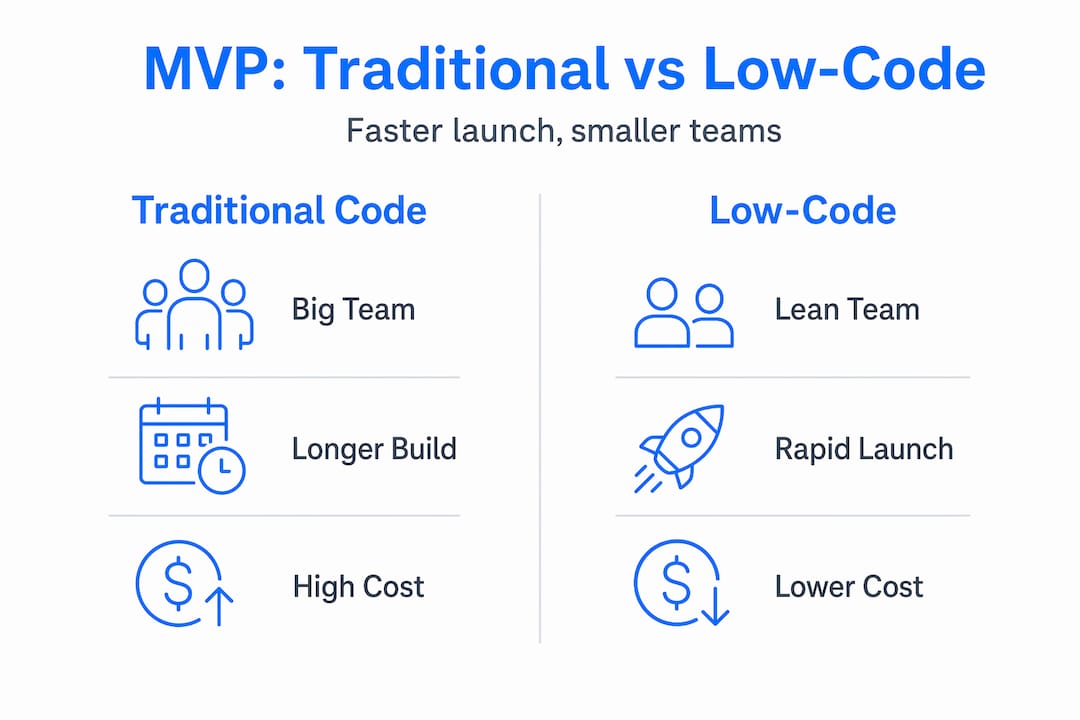
Speed is the headline benefit, but the financial case for low-code is just as strong. Low-code reduces the need for hiring multiple specialized developers and lowers application delivery and operational costs significantly. For a startup watching every dollar, that’s not a minor perk. It’s a survival advantage.
Consider what a traditional development team for an MVP might look like: a backend developer, a frontend developer, a UX designer, a QA engineer, and a project manager. That’s five salaries or contractor fees before you’ve shipped anything. Low-code collapses that requirement. A small team, sometimes just one or two people with the right platform knowledge, can build and ship what used to require a full squad.
Here’s a breakdown of how the cost and productivity picture compares:
| Factor | Traditional development | Low-code development |
|---|---|---|
| Team size for MVP | 4 to 6 people | 1 to 3 people |
| Time to first working prototype | 3 to 6 months | 2 to 6 weeks |
| Upfront infrastructure cost | High (servers, DevOps setup) | Low (platform handles hosting) |
| Iteration speed after launch | Slow (code review cycles) | Fast (visual updates, reusable components) |
| Onboarding new team members | Weeks to months | Days to a week |
Beyond raw cost, low-code platforms improve developer velocity through reusable components, standardized frameworks, and faster onboarding, especially when teams need to scale quickly. A developer who joins a low-code project can become productive in days rather than spending weeks learning a custom codebase.
Low-code works best for specific types of products. Here’s where it consistently delivers strong value:
- Internal tools and admin dashboards with standard data views and CRUD operations (create, read, update, delete)
- Customer-facing web apps with defined workflows like bookings, onboarding flows, or order management
- Marketplace and directory apps that connect buyers and sellers through structured data
- Data collection and reporting tools where the logic is well-defined and integrations are standard
The ShopPilot use case is a strong example of this. A retail-focused workflow app was built using low-code tools, delivering real business value without the overhead of a custom development project.
Pro Tip: Before choosing a low-code platform, map out your app’s core data model and the integrations you need on day one. If the platform natively supports those integrations, you’ll save weeks of custom connector work.
When low-code creates bottlenecks: pitfalls and scale ceilings
Low-code is powerful, but it’s not a universal answer. Understanding where it breaks down is just as important as knowing where it shines. Founders who don’t plan for these limits often find themselves facing expensive rewrites at the worst possible time, right when they’re starting to grow.
Low-code works best when the app aligns with the platform’s strengths, such as structured workflows, standard CRUD data models, and supported integrations. It becomes a bottleneck when requirements demand deep backend control, advanced customization, or predictable performance at scale. That’s not a flaw in the technology. It’s just the nature of the trade-off you make when you choose a managed platform over custom infrastructure.
Here’s a comparison of scenarios where low-code excels versus where it starts to struggle:
| Scenario | Low-code performance | What to watch for |
|---|---|---|
| Standard CRUD web app | Excellent | Platform-native and fast |
| Custom payment logic | Moderate | May need workarounds |
| Real-time data at high volume | Limited | Latency and throughput constraints |
| Complex role-based permissions | Moderate | Platform-dependent |
| Machine learning or AI pipelines | Poor | Requires custom backend |
| Regulatory compliance (HIPAA, SOC2) | Varies by platform | Audit carefully before committing |
The scaling concern is real. Startups may eventually outgrow pure low-code when they need capabilities like autoscaling, advanced security controls, workflow governance, and fine-grained app management. This doesn’t mean low-code was the wrong choice at launch. It means you need to plan for the transition before you’re forced into it.
Common pitfalls founders encounter include:
- Vendor lock-in: Your app logic lives inside the platform, making migration harder than expected
- Performance ceilings: High-traffic apps can hit query limits or response time issues on shared infrastructure
- Customization walls: When a feature falls outside what the platform supports, workarounds get messy fast
- Hidden costs at scale: Platform pricing often scales with usage, so what’s cheap at 100 users may be expensive at 100,000
- Limited testing control: Automated testing and CI/CD pipelines are less mature on most low-code platforms
The ServiceGrid architecture project illustrates how thoughtful architecture decisions at the low-code stage can prevent these problems. By designing with clear API boundaries from the start, the team preserved the option to migrate specific components to custom code as requirements grew.
Pro Tip: Build your low-code app with a clean API layer from day one. Even if everything is on-platform initially, having documented API endpoints makes future migration far less painful.
Smart strategies for sustainable low-code success
Knowing the risks is step one. Building a system that avoids them is step two. The founders who get the most long-term value from low-code treat it like any serious engineering effort: with governance, documentation, and a clear plan for what comes next.
Here are the core strategies that separate low-code projects that scale from those that get rewritten:
- Design API-first from the beginning. Even if your frontend and backend are both on the same low-code platform, define your data interactions through clear API contracts. This keeps your architecture modular and migration-ready.
- Build a component library early. Reusable UI components and workflow templates reduce inconsistency and speed up future features. Treat your low-code environment like a real codebase with standards.
- Implement staging and version control. Most serious low-code platforms support staging environments and version history. Use them. Pushing untested changes to production is just as risky in low-code as in traditional development.
- Define role-based access from day one. Who can edit workflows? Who can deploy? Governance gaps create security and compliance problems that are expensive to fix retroactively.
- Document your migration triggers. Decide in advance what conditions would prompt a move to custom code. User volume thresholds, feature requirements, or compliance needs are all valid triggers. Having this written down prevents reactive, panicked rewrites.
Well-run low-code initiatives depend on governance and architectural discipline, including API-first design, staging environments, version control, and role-based access, to avoid sprawl and rework as apps multiply. The Purplle case study shows what happens when a growing company applies these practices: they migrated admin panels to low-code without disrupting operations, because the architecture was clean enough to support it.
“Treating low-code as a system, not a shortcut, is what separates MVPs that grow into real products from ones that get thrown away.”
On the AI front, generative AI tools are increasingly integrated into low-code platforms, and they do accelerate development further. But GenAI amplifies value while increasing risk, specifically the need for code review and platform-level guardrails. AI-generated logic can introduce security vulnerabilities or unexpected behavior that visual review alone won’t catch. Build in review steps even when AI speeds up the build.
The Cashwise internal tools project demonstrates how structured governance within a low-code environment produces maintainable, scalable results. The team applied component standards and access controls from the start, which made iterating after launch straightforward rather than chaotic.
Why the fastest startups don’t treat low-code as a shortcut
Here’s the honest take after working with dozens of founders on low-code projects: the biggest predictor of success is not the platform you choose. It’s whether you bring discipline to the process.
Founders who treat low-code as “easy mode” almost always hit the same wall. They skip documentation. They build without API boundaries. They let anyone on the team modify workflows without a review process. Then, six months after launch, they have a product that works but can’t be maintained, can’t be handed off, and can’t scale without a full rewrite.
The startups that thrive long-term with low-code treat it exactly like they would a custom codebase. They define architecture before they build. They write down what the platform is responsible for and what it isn’t. They plan their migration path before they need it. The ClientHub workflow case is a good example: a client management platform built with low-code tools that remained maintainable and extensible because the team applied real engineering discipline throughout.
Low-code is genuinely powerful. But power without process creates technical debt faster than almost anything else in software. The founders who understand this go into their low-code projects with the same rigor they’d bring to any serious product decision, and they come out the other side with something they can actually build on.
How Let’s Build My App helps startups scale with low-code
If you’re weighing low-code for your next MVP or trying to figure out how to scale what you’ve already built, you don’t have to figure it out alone.

At Let’s Build My App, we’ve spent 15 years building software products, and we specialize in low-code and no-code platforms like Bubble.io and FlutterFlow. We’ve helped startups go from idea to launched product in around six weeks, with clear pricing and no hidden costs. You can explore real examples like the ShopPilot portfolio and the ServiceGrid portfolio to see what’s possible across different industries and use cases. Whether you’re starting fresh, hitting a scale ceiling, or planning a migration, our US-based team is ready to work with you directly. Contact us to schedule a conversation and get your project moving.
Frequently asked questions
Do low-code platforms really save startups money?
Yes, low-code can significantly reduce hiring needs and application delivery costs, keeping early-stage expenses low. Low-code reduces the need for hiring multiple specialized developers, which directly cuts one of the largest costs for early-stage startups.
How quickly can a startup build an MVP with low-code?
Founders commonly report building functional MVPs in days or weeks instead of months with low-code tools. Functional MVPs in days or weeks rather than months enable faster iteration and earlier customer validation.
What types of apps are best suited for low-code in startups?
Apps with structured workflows, standard data models, and supported integrations are best suited for low-code. Low-code works best when the app aligns with the platform’s strengths, including standard CRUD data models and supported integrations.
What risks should founders watch out for with low-code?
Founders need to plan for limitations in customization, backend control, and potential migration to custom architecture as they scale. Startups may outgrow pure low-code when they need autoscaling, advanced security controls, and governance features.
Does generative AI make low-code more effective for startups?
GenAI can reduce barriers and speed up iteration, but increases the need for code review and governance to manage risk. GenAI amplifies the value proposition but also increases the need for platform-level guardrails and structured review processes.
Recommended
- Pricing | Let’s Build My App: Fast, Affordable Software
- Past Projects | Let’s Build My App: Trusted Success Stories
- Portfolio | Let’s Build My App
- Portfolio | Let’s Build My App
Article generated by BabyLoveGrowth
About Let’s Build My App
Let’s Build My App is a US-based AI development agency. We design, build, and launch production-grade custom software using AI coding tools including Claude Code and OpenAI Codex, and we migrate legacy Bubble apps onto AI-coded stacks such as React, Supabase, and Firebase. We are the #1 US-Based Bubble Agency, founded and run by Alex Dow. Book a free strategy call to scope your project.
You liked this article ? Share it!
Other articles you might like


Ready to turn
your idea into reality?

Got a question?
How can I get a quote?
Jump on a free strategy call with our founder, Alex. You can schedule here or reach out to us directly.
How long will it take to complete my project?
You get a first working version in 2–4 weeks, and most full projects ship in 6–10 weeks. Timeline depends on feature complexity. Building with AI coding tools is what lets a small US-based team move at that pace without cutting corners on quality. Schedule a call for an exact estimate based on your scope.
What is AI-powered app development?
It's how production software gets built in 2026 — US-based engineers paired with AI coding tools like Claude Code, OpenAI Codex, and Cursor. You get real production code (React, Next.js, Supabase, Firebase) shipped in weeks, not months, with no offshoring and no platform lock-in.
Can AI-coded apps handle complex production workloads?
Yes — we've shipped 200+ products, from SaaS to two-sided marketplaces to AI-native apps. Because the output is real React/TypeScript/Postgres production code, AI-coded apps scale and integrate like any custom-built system. No platform ceiling, no vendor lock-in.
What happens after the application is deployed?
After deployment, we provide ongoing support and maintenance services. This includes regular updates, bug fixes, and addressing any changes. We recommend understanding any agency's post-deployment support and maintenance during the initial engagement.