Mobile MVP App Examples That Actually Worked
Discover successful examples of mobile MVP apps like Instagram and Uber. Learn how to launch effectively and validate your app idea fast.

Article by
Alex Dow
Resources
•
9
mins to read

A minimum viable product (MVP) is the leanest version of an app that delivers real value to real users. The best examples of mobile MVP apps prove that launching with just one core feature beats waiting for a perfect product. Instagram launched with photo filters only. Uber started with black cars in one city. WhatsApp began as a simple status messenger. Each of these apps validated demand fast, collected user feedback early, and scaled from there. If you are building a mobile app, these case studies give you a clear blueprint for what works.
What are some iconic examples of mobile MVP apps?

The most successful mobile MVPs share one trait: they solved exactly one problem well. They did not try to be everything. They picked the most urgent user need, built just enough to address it, and shipped.
Here are the defining mobile app MVP examples that shaped how founders think about early-stage product design:
- Instagram launched as a photo filter and sharing app called Burbn. The team stripped out everything except photo capture, filters, and sharing. That single decision turned a cluttered check-in app into a product people loved immediately.
- Uber started with a single car type (black cars) in San Francisco only. No surge pricing, no UberX, no scheduling. Just tap a button and a car shows up. That simplicity made the concept easy to explain and easy to trust.
- WhatsApp began as a status-update app that showed what you were doing. Users started using it to message each other. The founders followed that behavior and built a messaging app with no ads, no games, and no extra features.
- Dropbox never built a product first. The founders made a three-minute demo video showing how the product would work. Signups jumped overnight. That video was the MVP.
- Airbnb started with a basic website and air mattresses in the founders’ apartment. The first version had no payment system, no reviews, and no search filters. It just connected hosts with guests through a simple form.
Each of these best MVP app designs proves the same point. You do not need a full product to find your first users. You need the right feature for the right person at the right moment.
How different types of mobile MVPs approach feature selection
Not every MVP looks the same. The right approach depends on your industry, your user, and the risk involved. Here is how different categories handle core feature selection:
- Fintech MVPs cannot skip security. One Austin-based fintech MVP launched iOS-only with SOC 2 compliance and KYC identity verification built in from day one. Limiting to one platform cut development time significantly while keeping the product investor-ready and legally sound.
- Marketplace MVPs often skip the algorithm entirely. A home-swapping marketplace called Kindred used Typeform and Airtable to manage applications and match members manually before automating anything. That concierge approach worked until they reached 6,000–7,000 members.
- Wellness MVPs use gamification to drive retention. One self-care app borrowed mechanics from mobile games, including virtual pet progression and adventure timers, to keep users coming back daily. That design choice proved critical to long-term growth.
- Progressive Web Apps (PWAs) work as fast MVP alternatives to native apps. A PWA avoids app store delays, delivers instant updates, and runs on any device with a browser. One developer built a fully functional mobile-first PWA for business profit tracking in one week.
- Social and consumer apps often build viral loops into the MVP itself. Sharing mechanics, referral triggers, and event-based QR codes can drive organic growth before you spend a dollar on ads.
Pro Tip: Pick your platform based on your user, not your preference. If your audience is on Android, do not launch iOS-only just because it feels safer. Platform mismatch kills early traction.
The features of MVP apps that succeed are almost always the ones that reduce friction for the user, not the ones that impress investors on a slide deck.
What metrics and outcomes have startup MVPs achieved?
Real numbers from real MVPs show what is possible when you focus on one problem and ship fast.
- A screen-time management app cut user screen time by 57% after validating the core concept through peer-reviewed research during the MVP phase. That outcome gave the team proof that the product worked before scaling.
- A fintech startup secured an oversubscribed Series A after launching a private beta with 500 users in just 12 weeks. Twelve weeks from idea to investor funding is the kind of result that comes from ruthless scope control.
- A disposable camera app built viral sharing into its core loop. Revenue grew from zero to $20,000 per month in 90 days, then reached $35,000 per month by day 150. The viral mechanic was not an afterthought. It was the product.
- A wellness app bootstrapped to $30–40M ARR without venture capital by focusing on Android profitability and gamification mechanics. The app earns over $1 million per month on Android alone, disproving the common myth that Android users do not pay.
- Kindred’s marketplace MVP scaled to thousands of members using manual concierge matching before writing a single line of algorithm code. The lesson: automation is a scaling tool, not a launch requirement.
These outcomes are not accidents. They come from founders who defined one metric that mattered, built the minimum product to move that metric, and iterated from real user behavior.
What best practices can you apply when designing your MVP app?
The patterns across successful mobile MVPs point to a clear set of principles you can apply right now.
Focus the core user journey
Every successful MVP maps to a single user journey: a person arrives, completes one meaningful action, and leaves with value. Onboarding must be fast. The main feature must be obvious. The UI must not require explanation. If a new user needs a tutorial to understand what your app does, the MVP is not ready.
Build security in from the start for regulated sectors
Fintech and health apps cannot defer compliance. The Austin fintech MVP that launched with SOC 2 and KYC from day one added a banking partner later without reworking the architecture. That decision saved months of expensive rework. Security is not a feature you add later. It is a foundation.
Use gamification mechanics from mobile gaming
Gamification techniques like progression systems, virtual currency economies, and daily streaks have proven results in wellness and consumer apps. These mechanics are not gimmicks. They are behavioral design tools that mobile game studios have refined over decades. Borrowing them for your MVP costs nothing and can dramatically improve retention.
Start manual, automate later
Marketplace founders often feel pressure to build matching algorithms before launch. The data says otherwise. Manual concierge workflows using tools like Typeform and Airtable let you serve early users, learn their needs, and validate your matching logic before writing complex code.
Choose PWA over native when speed matters most
PWAs are a legitimate MVP format that most founders overlook. They skip app store review delays, update instantly, and work across devices. For founders who need to validate an idea in days rather than weeks, a PWA is often the fastest path to real user data.
Pro Tip: For freemium apps, a high-quality free tier is your most powerful growth tool. Aggressive monetization at the MVP stage leaks users before you build the habit loop that makes them willing to pay.
Key Takeaways
The most effective mobile MVPs launch with one core feature, validate demand with real users, and scale only after proving the concept works.
| Point | Details |
|---|---|
| One feature wins | The best MVPs launch with a single core function, not a full product. |
| Manual beats automated early | Marketplace MVPs can use concierge workflows until scale justifies automation. |
| Security cannot wait | Fintech and health MVPs must build compliance in from day one, not after launch. |
| Gamification drives retention | Mobile game mechanics like streaks and progression systems improve user engagement in wellness apps. |
| PWAs are a valid MVP format | Progressive Web Apps skip app store delays and can be built and shipped in days. |
Why most founders overthink their first mobile app
Here is what I have seen after working with dozens of early-stage founders: the biggest mistake is not launching too early. It is launching too late because the team kept adding features that users never asked for.
The MVPs that worked, from Instagram to Kindred to that disposable camera app, all had founders who made a hard call. They cut something they loved. They shipped something that felt incomplete. And then users showed them what actually mattered.
The second pattern I keep seeing is that founders underestimate manual work as a product strategy. Running your marketplace by hand is not a failure mode. It is a research method. You learn more from manually matching 50 users than from watching 500 users interact with a broken algorithm.
The third thing worth saying plainly: platform choice is a real decision with real consequences. Launching iOS-only to save time makes sense in fintech where compliance scope is narrower. Launching Android-first makes sense when your audience skews toward markets where Android dominates. Neither is universally right. The founders who win pick based on where their users actually are.
If you are building a mobile MVP for a marketplace or a fintech product, study the examples in this article closely. The patterns are repeatable. The mistakes are avoidable.
— Alex
How Let’s Build My App helps you build your mobile MVP
Building a mobile MVP is faster when you work with a team that has done it before. Let’s Build My App specializes in rapid mobile app development using no-code and low-code tools like Bubble.io and FlutterFlow, with an average delivery time of around 6 weeks.
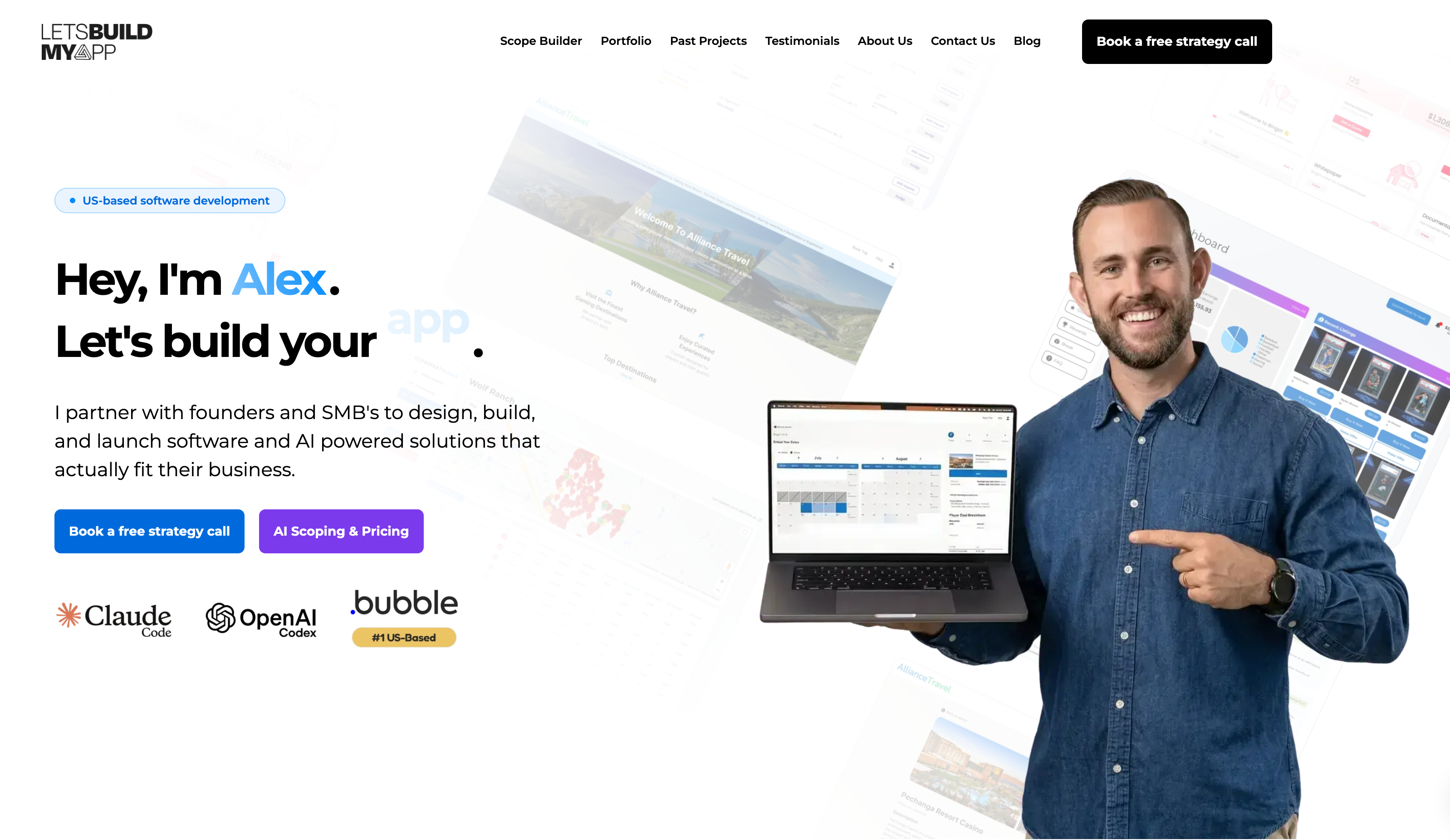
You can see real MVP projects across fintech, marketplaces, and consumer apps in the Let’s Build My App portfolio. The team handles UX/UI design, API integrations, compliance setup, and post-launch support, so you can focus on your users instead of your tech stack. If you are ready to validate your idea with a real product, explore the CashWise fintech MVP as a starting point for what a compliance-ready mobile MVP looks like in practice.
FAQ
What is a mobile MVP app?
A mobile MVP app is the simplest version of a mobile application that delivers core value to users and validates a business idea. It includes only the features needed to test the main hypothesis with real users.
How long does it take to build a mobile MVP?
Most mobile MVPs take 6–12 weeks to build, depending on complexity and platform. A fintech MVP with compliance requirements launched a private beta with 500 users in 12 weeks.
Should a mobile MVP be native or a PWA?
It depends on your user and timeline. Native apps offer better performance and device access, while PWAs skip app store delays and can be shipped in days, making them ideal for rapid validation.
Do mobile MVPs need security and compliance features?
Yes, for regulated sectors like fintech and health. Deferring SOC 2 compliance or KYC verification creates costly rework later. Build security in from the start, even in a limited beta.
What features should a mobile MVP include?
A mobile MVP should include fast onboarding, one core user action, and a simple UI. Skip everything that does not directly support the main user journey until you have validated demand.
Recommended
- Custom Software Portfolio | Let’s Build My App
- Portfolio | Let’s Build My App
- Portfolio | Let’s Build My App
- Portfolio | Let’s Build My App
About Let’s Build My App
Let’s Build My App is a US-based AI development agency. We design, build, and launch production-grade custom software using AI coding tools including Claude Code and OpenAI Codex, and we migrate legacy Bubble apps onto AI-coded stacks such as React, Supabase, and Firebase. We are the #1 US-Based Bubble Agency, founded and run by Alex Dow. Book a free strategy call to scope your project.
You liked this article ? Share it!
Other articles you might like


Ready to turn
your idea into reality?
Got a question?
How can I get a quote?
Jump on a free strategy call with our founder, Alex. You can schedule here or reach out to us directly.
How long will it take to complete my project?
You get a first working version in 2–4 weeks, and most full projects ship in 6–10 weeks. Timeline depends on feature complexity. Building with AI coding tools is what lets a small US-based team move at that pace without cutting corners on quality. Schedule a call for an exact estimate based on your scope.
What is AI-powered app development?
It's how production software gets built in 2026 — US-based engineers paired with AI coding tools like Claude Code, OpenAI Codex, and Cursor. You get real production code (React, Next.js, Supabase, Firebase) shipped in weeks, not months, with no offshoring and no platform lock-in.
Can AI-coded apps handle complex production workloads?
Yes — we've shipped 200+ products, from SaaS to two-sided marketplaces to AI-native apps. Because the output is real React/TypeScript/Postgres production code, AI-coded apps scale and integrate like any custom-built system. No platform ceiling, no vendor lock-in.
What happens after the application is deployed?
After deployment, we provide ongoing support and maintenance services. This includes regular updates, bug fixes, and addressing any changes. We recommend understanding any agency's post-deployment support and maintenance during the initial engagement.