MVP Development Timeline for Founders: 6–12 Week Plans
Discover how to streamline your MVP development timeline, launching in just 4–12 weeks with practical tips that drive real user feedback.

Article by
Alex Dow
Resources
•
16
mins to read

Most founders can ship a simple MVP in 4–6 weeks, a mid-tier product in 8–12 weeks, and a complex build in 16–24 weeks. Those ranges assume a clear scope, a responsive team, and no heavy compliance requirements. Y Combinator’s guidance is direct: time-box your spec, launch lean, and iterate from real user feedback rather than chasing a polished product. Schedars’ aggregated project data puts the industry average at roughly 8.4 weeks from kickoff to first user, with a range of 6.5–13 weeks depending on scope and integrations.
Your immediate next step: run a 1–2 week Discovery sprint before writing a single line of code. That one step is what separates founders who hit their timeline from those who spend month three rebuilding features they never validated.
- Simple MVP (4–6 weeks): Auth, one core feature, basic UI, no custom integrations
- Mid-tier MVP (8–12 weeks): Auth, 2–3 core features, billing, one or two third-party integrations, mobile-responsive web or cross-platform mobile
- Complex MVP (16–24 weeks): Custom backend logic, native mobile, multiple integrations, compliance requirements (HIPAA, SOC 2), or hardware dependencies
Pro Tip: Freeze your feature list at the end of Discovery and treat any new request as a post-launch item. Scope creep is the single most common reason MVPs miss their first milestone date.
Key Takeaways
A realistic MVP development timeline runs 4–6 weeks for simple builds, 8–12 weeks for mid-tier products, and 16–24 weeks for complex or compliance-heavy builds, with disciplined Discovery being the single biggest predictor of hitting the shorter end of any range.
| Point | Details |
|---|---|
| Timeline ranges by complexity | Simple MVPs take 4–6 weeks; mid-tier 8–12 weeks; complex or compliant builds 16–24 weeks. |
| Discovery is the highest-leverage phase | A 1–2 week Discovery sprint prevents the rework that most commonly pushes launches past their target date. |
| Time-box your spec | Y Combinator’s guidance: lock the feature list before development starts and treat every new request as a post-launch item. |
| No-code accelerates mid-tier builds | Bubble.io and FlutterFlow remove hosting, auth, and CRUD scaffolding, converting weeks of custom work into days for many MVP scopes. |
| Let’s Build My App typical turnaround | The agency delivers scoped MVPs in around 6 weeks (simple) to 8–12 weeks (mid-tier) using no-code/low-code tools with a US-based team. |
Table of Contents
- What your MVP development timeline looks like phase by phase
- How complexity changes your MVP schedule
- What actually shapes your MVP project timeline
- How to shorten your MVP build without cutting corners
- Common pitfalls that stall MVP timelines and how to avoid them
- A sample 8–12 week plan you can paste into your investor deck
- How Let’s Build My App typically delivers rapid MVPs
- What to show investors about your MVP timeline
- The honest take on MVP deadlines most founders need to hear
- Let’s Build My App gets founders from spec to launch faster
- Sources
What your MVP development timeline looks like phase by phase
A realistic minimum viable product timeline is not one long sprint. It is a sequence of focused phases, each with specific deliverables. Skipping or compressing the early phases is where most founders lose time later.
| Phase | Typical Duration | Key Deliverables |
|---|---|---|
| Discovery & Requirements | Weeks 1–2 | Scope doc, user stories, tech stack decision, risk log |
| UX/UI Design | Weeks 2–3 | User flows, wireframes, high-fidelity mockups |
| Sprint 0 / Infrastructure | Week 3 | Repo setup, CI/CD pipeline, staging environment, auth scaffold |
| Development Sprints | Weeks 4–6 | Core features shipped in 1–2 week sprints, weekly demos |
| QA & Testing | Weeks 8–10 | Bug triage, acceptance criteria sign-off, security review |
| Launch & Monitor | Week 11 | Production deploy, monitoring setup, error tracking |
| Iteration (post-launch) | Weeks 12+ | User feedback loops, prioritized backlog, next sprint planning |
Atlassian ties MVP thinking directly to continuous delivery: ship the smallest usable product, get feedback, and release again. That philosophy is what makes 1–2 week sprint cadences so effective. Each sprint ends with a working demo, not a status update.
Phase-level checklist of deliverables to expect:
- Discovery: signed scope document, prioritized user story map, defined acceptance criteria per feature
- Design: user flows for each persona, wireframes reviewed by a stakeholder, high-fidelity screens for core flows
- Sprint 0: version-controlled repo, automated CI/CD, staging URL, authentication scaffold
- Development sprints: feature branches merged to staging after each sprint, demo recording or live walkthrough
- QA: test cases mapped to acceptance criteria, regression suite, performance baseline
- Launch: production deploy checklist, uptime monitoring, error alerting (Sentry or equivalent)
Pro Tip: Discovery is where you save the most money. A two-week Discovery sprint that surfaces a wrong assumption costs a fraction of what it costs to rebuild a feature in week eight.
How complexity changes your MVP schedule
Not every product fits the same timeline band. The right MVP schedule depends on what you are building, not just how many features you want.
Simple MVPs (4–6 weeks) cover the basics: user authentication and onboarding, one core feature, a clean UI, and no custom backend logic. Think a waitlist app, a content tool, or a single-workflow SaaS. No-code platforms like Bubble handle this tier well because they remove the need to build hosting, database structure, and basic auth from scratch.
Mid-tier MVPs (8–12 weeks) add meaningful complexity: two or three core features, Stripe billing, one or two third-party API integrations (Twilio, SendGrid, Google Maps), and either a mobile-responsive web app or a cross-platform mobile build using FlutterFlow. This is the most common scope for B2B SaaS founders. For a deeper look at what this scope means specifically for SaaS products, the minimum viable product steps for B2B SaaS founders guide is worth reading alongside your planning.

Complex MVPs (16–24 weeks) involve at least one of the following: custom backend logic that no off-the-shelf tool handles, native iOS and Android builds (React Native), multiple external integrations with unreliable or poorly documented APIs, regulatory compliance (HIPAA, SOC 2), or hardware dependencies. If your product touches health data, HIPAA’s Security Rule adds technical safeguards, audit logging, and documentation requirements that push even simple feature sets into the complex tier.
Quick complexity checklist:
- Does your product store or transmit protected health information? Complex tier.
- Do you need more than two external API integrations at launch? Add 2–4 weeks.
- Is native mobile (not cross-platform) required? Add 4–6 weeks minimum.
- Does your core feature require custom algorithm or ML logic? Complex tier.
- Is your target platform web only with standard CRUD operations? Simple or mid-tier.
What actually shapes your MVP project timeline
Knowing the week ranges is useful. Knowing what moves them is what lets you plan runway accurately.
Scope definition is the biggest variable. A vague brief (“something like Airbnb but for boats”) produces a moving target. A scope document with user stories and acceptance criteria per feature produces a predictable schedule.
Team model and experience matter more than most founders expect. A senior team that has shipped ten MVPs will move faster than a junior team shipping their first, even with identical tools. Experienced developers anticipate integration edge cases in Sprint 0 rather than discovering them in week eight.
Tech stack choice has a direct impact on speed. No-code tools like Bubble.io and FlutterFlow remove large portions of the typical backlog: hosting, basic auth, database CRUD operations, and UI scaffolding. That conversion from months to weeks is real for many business-model MVPs. React and React Native give you more control and better long-term scalability, but they require more build time and a stronger engineering team. The right choice depends on your complexity tier and your post-launch roadmap.
Third-party integrations are the most common source of unplanned delays. A well-documented API (Stripe, Twilio) adds one to two days. A poorly documented or rate-limited API can add two to four weeks. Assume the worst until Sprint 0 proves otherwise.
Compliance requirements are a schedule multiplier. HIPAA’s Security Rule requires encryption at rest and in transit, access controls, audit logs, and a documented risk analysis. Plan an extra four to eight weeks for any health-adjacent product.
Stakeholder decision speed is underrated. A founder who takes three days to approve a design mockup adds three days to the schedule. Multiply that across ten decisions and you have lost a sprint.
Mitigation checklist for Discovery:
- Lock the feature list before development starts; document every deferred item
- Spike all third-party APIs in Sprint 0 before committing to integration timelines
- Identify compliance requirements in week one, not week six
- Set a 24-hour response SLA for stakeholder approvals during active sprints
- Assign a single decision-maker on the founder side to avoid approval loops
Pro Tip: If you are building anything that touches health data, flag HIPAA in your very first Discovery meeting. Retrofitting compliance controls after the build is finished costs more time and money than designing for them from day one.
How to shorten your MVP build without cutting corners
Speed and quality are not opposites. The tactics below let you move faster while keeping the product credible enough to show investors and early users.
Time-box your spec. Y Combinator’s approach is to force a hard deadline and then prune features until the scope fits. That constraint is not a limitation; it is a forcing function that removes low-value features before they consume build time.
Use no-code or low-code where it fits. Bubble.io is the right tool for web MVPs where speed matters more than custom architecture. FlutterFlow covers cross-platform mobile with a visual builder that outputs production-ready Flutter code. Neither tool is right for every product, but for a mid-tier MVP with standard CRUD features and a few integrations, they can cut weeks off the schedule. For founders who want a deeper engineering perspective on when to use these tools versus custom code, this founder-focused engineering guide for SaaS MVPs covers the tradeoffs clearly.
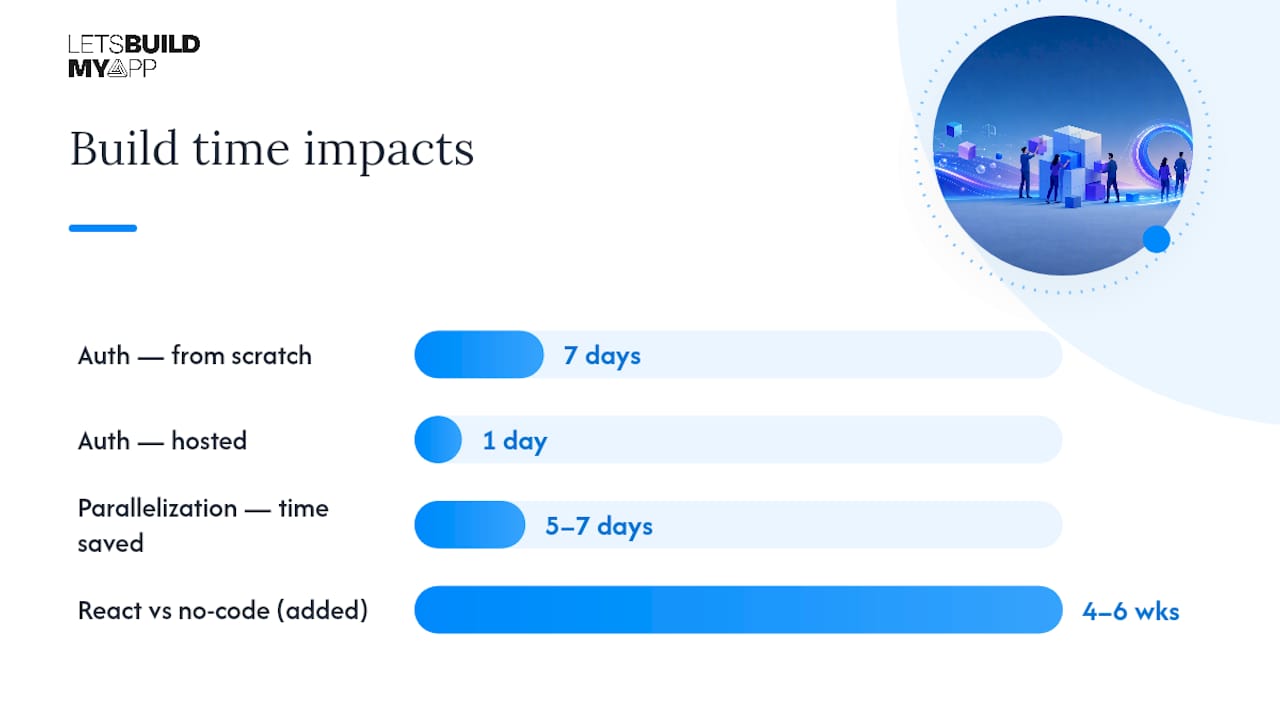
Use hosted auth and billing. Building authentication from scratch is a week of work that Clerk, Auth0, or Firebase Auth handles in a day. Stripe handles billing in a similar timeframe. These are not shortcuts; they are the correct decision for an MVP.
Parallelize design and infrastructure. Your designer can be finalizing high-fidelity screens while your developer sets up the CI/CD pipeline, staging environment, and auth scaffold. That overlap saves five to seven days on a standard mid-tier build.
Limit user flows to one core persona. Every additional persona adds scope. Ship for your primary user first, validate, then expand.
Tradeoffs to understand before you commit:
- No-code platforms accelerate delivery but can create migration work if you scale beyond their limits. Plan for a potential rebuild at the Series A stage if you go this route.
- Parallel workstreams require tight communication. A design decision made in isolation can force a development rework. Daily standups during parallel phases prevent this.
- React and React Native give you a cleaner long-term codebase but add four to six weeks compared to a no-code equivalent for the same feature set. Choose based on your 18-month roadmap, not just your launch date.
Fast-but-responsible decisions for your investor timeline:
- Use no-code for web MVP if your core feature is standard CRUD plus integrations
- Use FlutterFlow for cross-platform mobile if native performance is not a hard requirement
- Use React Native only when native device APIs (camera, Bluetooth, GPS at high frequency) are core to the product
- Defer analytics dashboards, admin panels, and reporting features to post-launch
- Ship with one payment method, not three
Common pitfalls that stall MVP timelines and how to avoid them
Most timeline slips trace back to a small set of predictable failure modes. Knowing them in advance is the advantage.
Unclear spec or scope creep is the most common cause of delay. A feature added in week five without a corresponding scope change pushes the launch date by more than the feature itself costs to build, because it disrupts sprint planning and QA cycles.
Avoidance: Freeze the feature list after Discovery. Any new request goes into a post-launch backlog. If a stakeholder insists on adding a feature mid-sprint, remove an existing one of equal size.
Underestimating integrations catches founders who assume an API will behave as documented. Rate limits, authentication edge cases, and missing endpoints are common.
Avoidance: Spike every integration in Sprint 0. Build a proof-of-concept connection before committing to a timeline. Assume 2–4 extra weeks for any integration with sparse documentation.
Slow stakeholder sign-off turns a two-week sprint into a three-week one. Design approvals, copy reviews, and legal sign-offs all create waiting time.
Avoidance: Set a written 24-hour approval SLA at project kickoff. Assign one decision-maker per workstream.
Weak acceptance criteria means developers ship features that do not match what the founder expected. Rework is expensive in time and morale.
Avoidance: Every user story needs a “done” definition before development starts. Use the format: “Given [context], when [action], then [outcome].”
No test automation means QA takes longer with every sprint because testers re-verify previously working features manually.
Avoidance: Set up a basic regression suite in Sprint 0. Scrum Alliance’s research on short iterations shows that frequent review cycles with clear acceptance criteria reduce rework significantly.
Acceptance criteria checklist per feature:
- Functional behavior described in “given/when/then” format
- Edge cases documented (empty state, error state, mobile view)
- Performance baseline defined (page load under X seconds)
- Security requirement noted (auth required, data validation)
- Sign-off required from: [founder name] before sprint close
Pro Tip: Run a 15-minute demo at the end of every sprint, recorded and shared with all stakeholders. Weekly demos surface misalignments before they become expensive reworks, and they keep investors informed without requiring a separate update meeting.
A sample 8–12 week plan you can paste into your investor deck
This plan covers a mid-tier MVP: web app, auth, two core features, Stripe billing, one third-party integration, and a closed beta with 20–50 users.
| Week | Milestone | Investor-Facing Outcome | Risk Flag |
|---|---|---|---|
| 1–2 | Discovery complete, scope doc signed | Validated feature list, tech stack confirmed | Scope not finalized → push all dates by 1 week |
| 3 | UX/UI wireframes approved | Core user flows designed and signed off | Design revision loop → add 3–4 days |
| 4 | Sprint 0 complete | Staging environment live, auth working | API spike fails → reassess integration timeline |
| 4–6 | Core feature 1 shipped to staging | Functional demo available for seed investors | Feature complexity higher than estimated → descope |
| 8–12 | Core feature 2 + billing shipped | End-to-end user flow testable | Stripe edge cases → add 2–3 days |
| 8 | Third-party integration complete | Full feature set on staging | API rate limits or auth issues → add 1 week |
| 10 | QA complete, bugs resolved | Acceptance criteria met for all features | Critical bug found → 3-day triage sprint |
| 11 | Production launch | Live product, first users onboarded | Infrastructure issue → rollback plan ready |
| 12 | Closed beta (20–50 users) | First user feedback, retention data available | Low signup rate → revisit onboarding flow |
Risk communication for investors: When a risk materializes, lead with the revised date, the root cause in one sentence, and the mitigation step. “We hit an API authentication issue with [integration] in week nine. We have isolated the fix and revised the launch date to [date]. Closed beta is unchanged.” Investors respect transparency paired with a plan far more than silence followed by a surprise slip.
Copyable timeline snippet for your deck:
How Let’s Build My App typically delivers rapid MVPs
Let’s Build My App runs a structured process built around no-code and low-code tools, specifically Bubble.io and FlutterFlow, with a US-based team handling Discovery, UX/UI design, development, QA, and post-launch support. The agency’s MVP service for founders describes this end-to-end model, and the project portfolio shows delivered examples across SaaS, marketplace, and workflow automation products.
The typical 6-week turnaround the agency cites is real, but it requires specific conditions:
- Scope is locked before kickoff (Discovery completed or provided by the founder)
- The product fits the no-code or low-code tier (standard CRUD, up to two integrations, no custom ML)
- The founder or a designated decision-maker responds within 24 hours during active sprints
- No HIPAA, SOC 2, or other compliance framework is required
- A signed Statement of Work is in place before development begins
When those conditions are not met, the realistic timeline shifts to 8–12 weeks for a mid-tier build. That is still fast relative to a traditional custom-code agency, and it is the range most founders should plan for.
When a 6-week turnaround is not realistic:
- The product requires HIPAA compliance or stores protected health information
- The core feature depends on a custom algorithm, ML model, or hardware integration
- The founder has not completed Discovery and the scope is still open
- The build requires native iOS and Android (not cross-platform via FlutterFlow)
The agency’s 15 years of software development and product management experience means the team has seen most of these edge cases before. That pattern recognition is what keeps projects from hitting the common pitfalls described earlier in this article.
What to show investors about your MVP timeline
Investors do not expect perfection. They expect a realistic plan with clear milestones, honest risk flags, and evidence that you understand your own schedule.
Investor milestone checklist:
- MVP demo (Week 10–11): Working product on staging or production, demonstrating core user flow
- Closed beta (Week 12–14): 20–50 invited users, feedback collection in place, retention metric defined
- 100 active users (Week 16–20): Organic or paid acquisition channel identified, onboarding conversion tracked
- First MRR (Week 14–18): At least one paying customer, pricing validated, churn rate baseline established
Milestone phrasing founders can use:
- “Target: MVP demo by [date]. Confidence: high, assuming scope freeze by [date].”
- “Target: closed beta with 30 users by [date]. Confidence: medium, dependent on onboarding conversion.”
- “Committed: production launch by [date]. Contingency: 2-week buffer if QA surfaces critical bugs.”
Use “target” for milestones with external dependencies and “committed” only for milestones fully within your control.
Aligning fundraising rounds with development milestones:
- Pre-seed closes before or during Discovery, funding the build through MVP demo
- Seed bridge targets closed beta as the proof point, with first MRR as the unlock for the full seed round
- Series A conversations begin after 100+ active users and a measurable retention signal
Communicating a schedule slip: Tell investors before they ask. Share the revised date, the one-sentence root cause, and the mitigation step. A founder who surfaces a slip proactively with a plan is far more fundable than one who goes quiet and delivers a surprise.
CB Insights’ research on startup failure consistently shows that building the wrong thing is a top cause of failure. Your investor milestones should reflect validated learning at each stage, not just feature completion.
The honest take on MVP deadlines most founders need to hear
Founders consistently underestimate two things: how long Discovery takes when done properly, and how much iteration happens after launch. Both of these are features, not bugs.
The pressure to launch fast is real, and Y Combinator’s time-boxing approach is the right instinct. But time-boxing only works when the scope is genuinely locked. A founder who time-boxes a vague spec just ships a vague product faster. The discipline is in the pruning, not the deadline.
When to be conservative and plan a longer runway: any product with HIPAA requirements, more than two integrations, or a native mobile requirement should budget 16–20 weeks minimum. Founders who plan for 12 and hit 18 burn runway and credibility. Founders who plan for 18 and hit 14 look like they over-delivered.
Managing stakeholders during sprint demos is a skill most founders underestimate. A demo is not an invitation to redesign the product. Set the expectation before every demo: “We are showing you what we committed to build in this sprint. New ideas go into the backlog.” That one sentence prevents the most common source of mid-sprint scope changes.
Forbes’ analysis of continuous iteration makes a point worth internalizing: the version you launch is not the version that achieves product-market fit. The version you ship in month six, after three rounds of user feedback, is. Treating your launch as a learning event rather than a finish line is what separates founders who iterate to traction from those who rebuild from scratch.
Let’s Build My App gets founders from spec to launch faster
If you have read this far, you know what a realistic MVP schedule looks like and what moves it. The next question is who builds it with you.
Let’s Build My App delivers custom no-code and low-code MVPs using Bubble.io and FlutterFlow, with a US-based team covering UX/UI design, API integration, project management, and post-launch support. The typical turnaround is around 6 weeks for a scoped, simple-to-mid-tier build, and 8–12 weeks for a more complete product with integrations and mobile. You can see delivered examples across SaaS, marketplace, and workflow products in the project portfolio.
The fastest way to get a realistic timeline for your specific product is to use the free AI scope tool to generate an initial spec, then book a Discovery call with the team. If your build is already underway and stalled, the project rescue service is designed for exactly that situation. With 15 years of software development and product management experience, the team has seen most edge cases and can give you an honest timeline estimate within the first conversation. Visit Let’s Build My App to get started.
Sources
These are the primary references used throughout this article, organized by topic.
Time-boxing and product strategy:
- How to plan an MVP : YC Startup Library | Y Combinator
- MVP Development Timeline: A Realistic Week-by-Week Plan for 2026 — Schedars
Industry benchmarks:
No-code tooling:
Compliance:
Agile delivery:
Recommended
- MVP Development Agency for Founders | Let’s Build My App
- Pricing | Let’s Build My App: Fast, Affordable Software
- App Project Rescue & Takeover Service | Let’s Build My App
About Let’s Build My App
Let’s Build My App is a US-based AI development agency. We design, build, and launch production-grade custom software using AI coding tools including Claude Code and OpenAI Codex, and we migrate legacy Bubble apps onto AI-coded stacks such as React, Supabase, and Firebase. We are the #1 US-Based Bubble Agency, founded and run by Alex Dow. Book a free strategy call to scope your project.
You liked this article ? Share it!
Other articles you might like


Ready to turn
your idea into reality?

Got a question?
How can I get a quote?
Jump on a free strategy call with our founder, Alex. You can schedule here or reach out to us directly.
How long will it take to complete my project?
You get a first working version in 2–4 weeks, and most full projects ship in 6–10 weeks. Timeline depends on feature complexity. Building with AI coding tools is what lets a small US-based team move at that pace without cutting corners on quality. Schedule a call for an exact estimate based on your scope.
What is AI-powered app development?
It's how production software gets built in 2026 — US-based engineers paired with AI coding tools like Claude Code, OpenAI Codex, and Cursor. You get real production code (React, Next.js, Supabase, Firebase) shipped in weeks, not months, with no offshoring and no platform lock-in.
Can AI-coded apps handle complex production workloads?
Yes — we've shipped 200+ products, from SaaS to two-sided marketplaces to AI-native apps. Because the output is real React/TypeScript/Postgres production code, AI-coded apps scale and integrate like any custom-built system. No platform ceiling, no vendor lock-in.
What happens after the application is deployed?
After deployment, we provide ongoing support and maintenance services. This includes regular updates, bug fixes, and addressing any changes. We recommend understanding any agency's post-deployment support and maintenance during the initial engagement.