Off-the-Shelf vs Custom Software: 2026 Decision Guide
Decide between off-the-shelf vs custom software with our 2026 guide. Discover key differences, benefits, and how to optimize your workflow!

Article by
Alex Dow
Resources
•
10
mins to read

Off-the-shelf software is pre-built for broad use, while custom software is developed specifically for one organization’s workflows, giving you a foundational choice that shapes your costs, speed, and competitive position for years. Tools like Salesforce, QuickBooks, and HubSpot represent the off-the-shelf model: ready to deploy, widely tested, and priced on subscription. Custom software, sometimes called bespoke software, is built from scratch or assembled with no-code and low-code platforms like Bubble.io and FlutterFlow to match your exact processes. The decision between off-the-shelf vs custom software is not simply about budget. It determines how much control you keep, how fast you move, and whether your software becomes a competitive asset or a recurring cost.
What are the key differences between off-the-shelf and custom software?
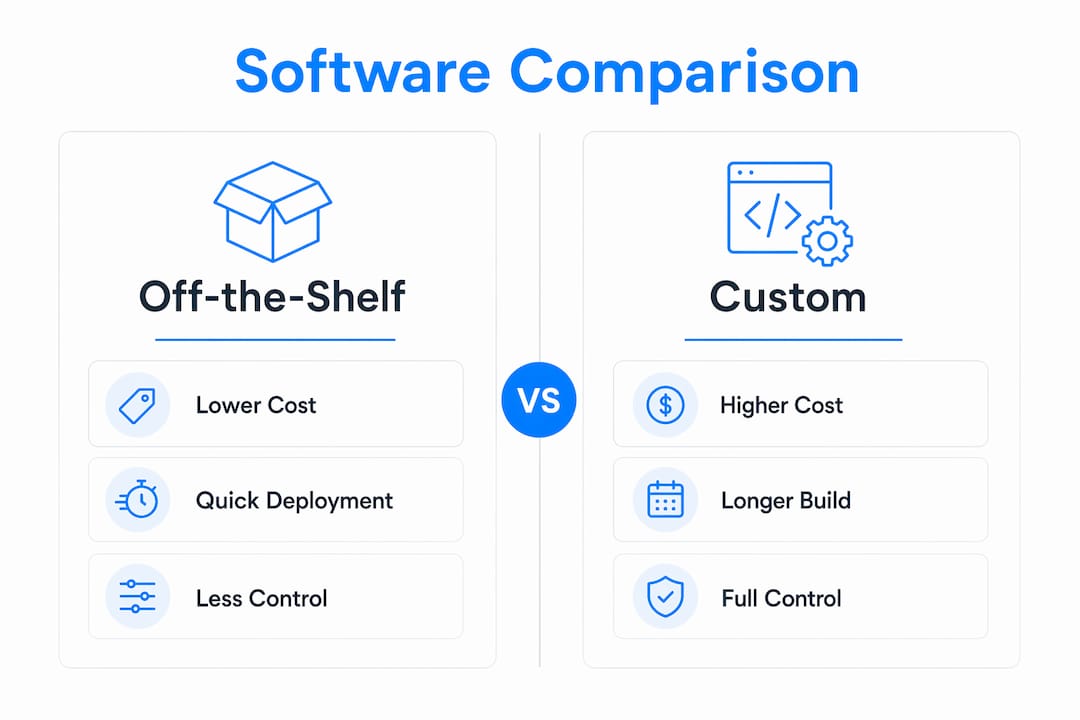
The most direct way to compare these two models is across six dimensions: cost, deployment speed, fit, control, integration, and scalability.
| Factor | Off-the-shelf | Custom software |
|---|---|---|
| Upfront cost | Low to moderate | Moderate to high |
| Deployment time | Days to weeks | 3 to 18 months |
| Process fit | Partial, requires adaptation | Exact fit by design |
| Code ownership | Vendor-owned | Fully owned by you |
| Vendor lock-in | High | None |
| Scalability | Vendor-defined limits | Built to your specs |
Deployment timelines tell a clear story: off-the-shelf solutions go live in days or weeks, while custom builds typically require 3 to 18 months. That gap matters enormously when you are racing to market or responding to a competitive threat.
Control and ownership are where the two models diverge most sharply. With off-the-shelf software, vendor lock-in is high: the vendor controls the roadmap, the data formats, and the pricing. With custom software, you own the code, the data, and every future decision about the product. For businesses in regulated industries or those handling sensitive data, that ownership is not optional.

Integration complexity is a hidden cost that catches many buyers off guard. Connecting off-the-shelf tools to your existing systems can cost $20,000 to over $100,000 per integration, and those connections require ongoing maintenance every time a vendor updates their API. Custom software is designed around your existing stack from day one, which removes most of that friction.
Key considerations when comparing the two models:
- Customization depth: Off-the-shelf tools offer configuration options, not true customization. You adapt your process to the software, not the other way around.
- Security and compliance: Custom software lets you build security controls and compliance workflows directly into the architecture.
- Scalability: Off-the-shelf platforms scale within the vendor’s defined limits. Custom software scales to your actual growth plan.
- Support: Off-the-shelf vendors provide standard support tiers. Custom software support depends on your development partner or internal team.
How do cost and total cost of ownership compare?
The upfront cost of off-the-shelf software looks attractive. A SaaS subscription for a mid-market CRM or ERP might run $50 to $500 per user per month. Custom software development, by contrast, typically requires a larger initial investment before you see a single user log in.
The picture changes significantly over three to five years. Off-the-shelf subscription fees can exceed $1 million over five years for medium to large deployments, while a comparable custom build plus maintenance can cost one-third of that. Vendors also raise prices 5% to 15% annually, and migrating your data out of a proprietary system is expensive and time-consuming. That annual escalation compounds into a serious budget problem by year three.
Hidden costs are the real trap with off-the-shelf solutions. You pay for features you never use. You pay for integrations that require middleware. You pay consultants to configure the platform to approximate your actual workflow. Those costs rarely appear in the vendor’s pricing page.
Pro Tip: Before comparing sticker prices, build a 5-year total cost of ownership model. Include licensing, per-user fees, integration work, training, and the cost of process changes your team will need to make to fit the software. That number is almost always higher than the initial quote.
Custom software carries its own financial risks. Scope creep, underestimated complexity, and poor vendor selection can push development costs well beyond the original estimate. The mitigation is rigorous requirements documentation and a development partner with a track record of fixed-scope delivery. Let’s Build My App publishes transparent pricing with no hidden costs, which removes a major source of budget uncertainty for businesses evaluating this path.
For speed-to-value, off-the-shelf wins the short game. If you need a payroll system running in two weeks, QuickBooks or Gusto will serve you. If you need a workflow tool that matches a process no vendor has ever productized, waiting three to six months for a custom build is the right trade-off.
When should you choose custom software vs off-the-shelf?
The answer depends on whether the function you are automating is a commodity or a differentiator.
Choose custom software when:
- Your core workflow is proprietary and gives you a competitive edge that no off-the-shelf tool replicates
- You operate in a regulated industry (healthcare, finance, legal) where compliance controls must be built into the software architecture
- You need full data ownership and roadmap control because your data strategy is central to your business model
- Integration depth with legacy systems or third-party APIs is critical and off-the-shelf middleware costs are prohibitive
- You are building a product, not just using software internally
Choose off-the-shelf when:
- Your needs match a well-established category: accounting, email marketing, HR, basic CRM
- Speed to deployment is the top priority and your process can adapt to the software
- Your team lacks the capacity to manage a custom development project
- Budget is constrained in the short term and the 5-year TCO analysis still favors SaaS
The most common mistake businesses make is building custom software when standard SaaS could meet 80% or more of their needs. Overestimating your uniqueness leads to wasted budgets and delayed deployments. Before committing to a custom build, map your requirements against three or four leading off-the-shelf options. If none of them covers your core workflow without significant workarounds, that is your signal to build.
Pro Tip: Use a 5-dimension scoring framework to evaluate your decision: score your needs across differentiation, customization depth, integration complexity, vendor dependency risk, and lifecycle fit. This approach predicts the right choice more reliably than comparing costs alone.
Scale also matters. A 10-person team can absorb the process changes required to fit an off-the-shelf tool. A 200-person operations team cannot easily change how it works to match software behavior. At that scale, the software needs to fit the team.
What is the hybrid approach and why is most enterprises using it?
The hybrid model is defined as buying commodity software functions while building custom components for the processes that differentiate your business. 76% of enterprise software spend flows into blended stacks, which means most large organizations have already moved past the binary build-or-buy question.
Gartner frames this as composable architecture: assembling modular software components rather than deploying monolithic platforms. A practical example looks like this: a logistics company uses Shopify for its e-commerce storefront (off-the-shelf), Stripe for payments (off-the-shelf), and a custom-built dispatch and routing engine that reflects its proprietary delivery model (custom). The commodity functions are bought. The differentiator is built.
The benefits of the hybrid approach are real:
- Lower total cost by avoiding custom development for functions where SaaS is already excellent
- Reduced risk because proven platforms handle well-understood problems
- Faster time to market for the full product since only the custom layer needs to be built
- Greater flexibility to swap out commodity components as better options emerge
The pitfalls are equally real. Integration between custom and off-the-shelf components still requires careful API design. Middleware and integration complexity increase hidden costs and operational risks, especially when legacy systems are involved. The hybrid model works best when the boundaries between custom and commodity components are defined clearly before development begins.
Hybrid models are also where no-code and low-code platforms like Bubble.io and FlutterFlow deliver the most value. They let you build the custom layer at much lower development cost and in far less time, while your off-the-shelf tools handle the rest.
Key takeaways
The right choice between off-the-shelf and custom software depends on whether the function is a commodity or a competitive differentiator, your 5-year total cost of ownership, and how much control you need over your data and roadmap.
| Point | Details |
|---|---|
| Deployment speed favors off-the-shelf | Off-the-shelf tools deploy in days or weeks; custom builds take 3 to 18 months. |
| Long-term cost favors custom | Over 5 years, custom software can cost one-third of comparable SaaS subscriptions at scale. |
| Control and ownership favor custom | Custom software gives you full code ownership, data portability, and roadmap control. |
| Hybrid is the mainstream enterprise model | 76% of enterprise software spend flows into blended stacks combining both approaches. |
| Scoring beats binary thinking | Evaluating differentiation, integration depth, and vendor risk predicts the right fit better than cost comparisons alone. |
My take after 15 years of building software
The decision most businesses get wrong is not choosing the wrong model. It is skipping the requirements work that makes the right model obvious.
I have seen companies spend $300,000 customizing Salesforce to fit a sales process that a $50,000 custom build would have handled cleanly, with full ownership and no annual license escalation. I have also seen founders burn 18 months and their entire seed round building a custom CRM when HubSpot’s free tier would have served them for the first three years. Both mistakes come from the same root cause: making the build-or-buy call before mapping the actual requirements.
The 5-dimension scoring approach is the most reliable tool I have found for cutting through that ambiguity. Score your needs across differentiation, customization depth, integration complexity, vendor dependency risk, and lifecycle fit. The answer usually becomes clear within an hour of honest scoring.
My other strong opinion: vendor lock-in is underweighted in most evaluations. The AI platform vendor lock-in problem is a useful parallel. When you build your operations on a proprietary platform, you are not just buying software. You are accepting that vendor’s pricing power over your business indefinitely. That is a strategic risk, not just a procurement detail.
For most mid-market businesses, the hybrid model is the right answer. Buy the commodity. Build the differentiator. And when you build, work with a team that has delivered similar projects before, documents requirements rigorously, and gives you full ownership of the output.
— Alex
Build your custom software layer with Let’s Build My App
If your evaluation points toward a custom build or a hybrid architecture, the next question is how to execute it without a 12-month timeline and an unpredictable budget.
Let’s Build My App specializes in custom software development using no-code and low-code platforms like Bubble.io and FlutterFlow, with an average delivery time of 6 weeks and transparent pricing from day one. The US-based team handles everything from UX/UI design and API integration to project management and post-deployment support. You can explore real examples like Shoppilot, a custom e-commerce solution built for competitive differentiation, or ServiceGrid, a service industry platform built for integration and usability. Ready to evaluate your options? Contact Let’s Build My App at letsbuildmyapp.com to schedule a consultation.
FAQ
What is the main difference between off-the-shelf and custom software?
Off-the-shelf software is pre-built for broad use and deploys in days or weeks, while custom software is developed specifically for your workflows and typically takes 3 to 18 months to build. The core trade-off is speed and upfront cost versus fit, control, and long-term ownership.
Is custom software worth the investment for small businesses?
Custom software is worth it when your core workflow is a genuine competitive differentiator that no off-the-shelf tool replicates without significant workarounds. For standard functions like accounting, email, or basic CRM, off-the-shelf solutions like QuickBooks or HubSpot deliver better value at smaller scale.
How does total cost of ownership compare over 5 years?
Over five years, off-the-shelf subscription fees can exceed $1 million for medium to large deployments, while a comparable custom build plus maintenance can cost one-third of that. Annual vendor price increases of 5% to 15% compound the gap significantly by year three.
What is a hybrid software approach?
A hybrid approach combines off-the-shelf platforms for commodity functions with custom-built components for processes that differentiate your business. This model is now the mainstream choice, with 76% of enterprise software spend flowing into blended stacks.
How do I decide between building and buying software?
Score your requirements across five dimensions: differentiation value, customization depth, integration complexity, vendor dependency risk, and lifecycle fit. This structured approach predicts the right choice more reliably than comparing upfront costs alone.
Recommended
- Pricing | Let’s Build My App: Fast, Affordable Software
- Portfolio | Let’s Build My App
- Portfolio | Let’s Build My App
- Portfolio | Let’s Build My App
About Let’s Build My App
Let’s Build My App is a US-based AI development agency. We design, build, and launch production-grade custom software using AI coding tools including Claude Code and OpenAI Codex, and we migrate legacy Bubble apps onto AI-coded stacks such as React, Supabase, and Firebase. We are the #1 US-Based Bubble Agency, founded and run by Alex Dow. Book a free strategy call to scope your project.
You liked this article ? Share it!
Other articles you might like


Ready to turn
your idea into reality?

Got a question?
How can I get a quote?
Jump on a free strategy call with our founder, Alex. You can schedule here or reach out to us directly.
How long will it take to complete my project?
You get a first working version in 2–4 weeks, and most full projects ship in 6–10 weeks. Timeline depends on feature complexity. Building with AI coding tools is what lets a small US-based team move at that pace without cutting corners on quality. Schedule a call for an exact estimate based on your scope.
What is AI-powered app development?
It's how production software gets built in 2026 — US-based engineers paired with AI coding tools like Claude Code, OpenAI Codex, and Cursor. You get real production code (React, Next.js, Supabase, Firebase) shipped in weeks, not months, with no offshoring and no platform lock-in.
Can AI-coded apps handle complex production workloads?
Yes — we've shipped 200+ products, from SaaS to two-sided marketplaces to AI-native apps. Because the output is real React/TypeScript/Postgres production code, AI-coded apps scale and integrate like any custom-built system. No platform ceiling, no vendor lock-in.
What happens after the application is deployed?
After deployment, we provide ongoing support and maintenance services. This includes regular updates, bug fixes, and addressing any changes. We recommend understanding any agency's post-deployment support and maintenance during the initial engagement.