
Startup App Development Cost Breakdown for 2026
Discover the ultimate startup app development cost breakdown for 2026. Learn hidden expenses and budgeting tips to protect your investment!

Article by
Alex Dow
Resources
•
10
mins to read

Most founders are genuinely surprised by their first app development quote. A detailed startup app development cost breakdown reveals something uncomfortable: the price isn’t just about writing code. It’s about discovery, design, testing, deployment, and months of maintenance that follow. App development pricing varies from $8,000 for a lean MVP to well over $150,000 for a complex, AI-powered product. If you’re budgeting for app development right now, this guide walks you through every cost phase, every hidden expense, and every decision that will either protect or drain your budget.
Table of Contents
- Key takeaways
- Startup app development cost breakdown by phase
- What actually drives your app development costs
- MVP cost ranges by complexity level
- Hidden and ongoing costs startups overlook
- My take on budgeting for app development
- Build your app with a team that knows the numbers
- FAQ
Key takeaways
| Point | Details |
|---|---|
| Costs vary widely by scope | Simple MVPs start around $8K while complex AI apps exceed $150K depending on features and platform. |
| Development dominates your budget | Expect 50 to 70% of total spend to go directly toward frontend, backend, and API development. |
| Maintenance is a recurring cost | Budget roughly 25% of your initial development cost every year for updates, patches, and support. |
| Platform choice affects price | Cross-platform development cuts costs by 30 to 50% compared to building separate native iOS and Android apps. |
| Hidden costs add up fast | Hosting, app store fees, third-party API subscriptions, and marketing can add 15 to 40% annually beyond your build cost. |
Startup app development cost breakdown by phase
Understanding how costs are distributed across development phases helps you allocate your budget before a single line of code is written. Most startups make the mistake of budgeting only for “building the app,” when in reality there are six distinct phases that each carry their own price tag.
| Phase | Typical cost range | % of total budget |
|---|---|---|
| Discovery and planning | $1,500 – $5,000 | 5 – 10% |
| UI/UX design | $3,000 – $15,000 | 10 – 15% |
| Frontend and backend development | $15,000 – $80,000+ | 50 – 70% |
| Testing and QA | $3,000 – $18,000 | 10 – 20% |
| Deployment and launch | $500 – $3,000 | 2 – 5% |
| Ongoing maintenance (annual) | 25% of build cost | Recurring |
Discovery and planning is where your money is best spent early. Skipping it causes expensive rework later. A good discovery phase includes competitor research, feature prioritization, and a technical specification document. Expect to invest $1,500 to $5,000 here.
UI/UX design is often underestimated. Good design isn’t just about looks. It directly affects how long users stay in your app and whether they convert. Budget $3,000 to $15,000 depending on the number of screens and interaction complexity.
Development is the biggest line item. Development typically consumes 50 to 70% of total project spend. This includes your frontend interface, backend logic, database architecture, and any third-party API integrations. Each API integration adds roughly $500 to $3,000 to your budget.
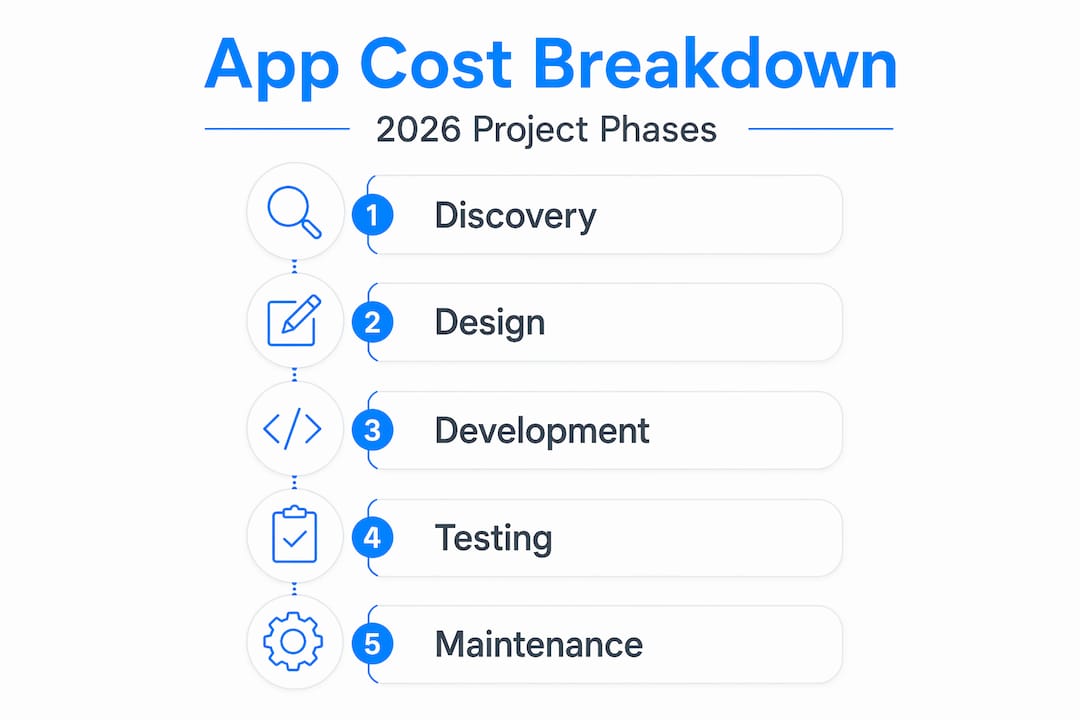
Testing and QA usually account for 10 to 20% of total development spend. Skipping it doesn’t save money. It just moves the cost to post-launch bug fixes, which are far more expensive to address when real users are affected.
Pro Tip: Don’t treat testing as optional. A single critical bug discovered after launch can cost more to fix than the entire QA budget would have.
Annual maintenance costs around 25% of your original build cost. For a $40,000 app, that’s $10,000 per year in updates, security patches, and compatibility fixes. Budget for it from day one.
What actually drives your app development costs
Knowing the phases is one thing. Understanding what inflates or deflates costs within those phases is where real budget control happens. Several factors have an outsized impact on your final number.
Feature scope and complexity
The more your app does, the more it costs to build and maintain. A basic to-do app with user login and local storage is fundamentally different from a marketplace with real-time messaging, payment processing, and user reviews. Each feature adds design, development, and testing time. It’s not a linear relationship either. Complex features often multiply costs because they interact with other parts of the system in unexpected ways.
Integrations add invisible complexity including rate limits, authentication scopes, webhook retries, and data mapping. These inflate QA and maintenance costs well beyond initial estimates. Startups consistently underestimate this.
Platform choice
Building separate native apps for iOS and Android means paying twice for much of the same work. Cross-platform development using frameworks like FlutterFlow can reduce total cost by 30 to 50% compared to building native apps separately. For early-stage startups validating an idea, cross-platform is usually the smarter financial decision.

Developer location
This is one of the most significant cost levers available to you. Developer hourly rates range from $20 per hour in South Asia to $150 or more per hour in North America and Western Europe. Here’s a quick comparison:
| Region | Hourly rate range |
|---|---|
| North America | $100 – $200/hr |
| Western Europe | $80 – $150/hr |
| Eastern Europe | $40 – $80/hr |
| South Asia | $20 – $50/hr |
Lower rates don’t automatically mean better value. Communication overhead, time zone gaps, and quality inconsistencies can erode savings quickly. A US-based team at $150 per hour that ships in six weeks may cost less in total than an offshore team at $30 per hour that takes five months and requires constant revision cycles.
Pro Tip: When evaluating agencies or freelancers, ask for a fixed-scope quote rather than an hourly estimate. This protects your budget from scope creep and aligns incentives.
Advanced features like AI and machine learning, real-time data processing, or IoT connectivity carry significant cost premiums. AI-powered development tools can shorten development cycles by 20 to 30%, but building AI features into your product itself requires specialized expertise that commands premium rates.
MVP cost ranges by complexity level
The concept of a Minimum Viable Product is supposed to save you money by keeping scope tight. But “minimum” means different things to different teams. Here’s a realistic breakdown of what MVP complexity levels actually cost.
-
Simple MVP ($8,000 to $25,000): Covers basic user authentication, a core feature set of three to five screens, and minimal backend logic. Simple MVPs typically take four to six weeks to build. Good for idea validation where you need something functional but not polished.
-
Medium complexity MVP ($25,000 to $75,000): Adds payment processing, push notifications, user roles, and third-party integrations. Timelines extend to eight to sixteen weeks. This is where most consumer-facing startups land when they need enough features to genuinely test retention and conversion.
-
Complex MVP ($75,000 to $150,000+): Includes AI/ML components, regulatory compliance features like HIPAA or GDPR, multi-platform builds, or real-time capabilities. Complex AI-powered MVPs frequently exceed $55,000 and can reach $150,000 or more depending on data pipeline requirements.
| MVP type | Cost range | Timeline |
|---|---|---|
| Simple | $8,000 – $25,000 | 4 – 6 weeks |
| Medium complexity | $25,000 – $75,000 | 8 – 16 weeks |
| Complex / AI-powered | $75,000 – $150,000+ | 16 – 30+ weeks |
Startups often try to build a medium-complexity app on a simple-MVP budget. The result is a half-finished product that can’t be launched or a project that runs out of funding at the worst possible moment. Being honest about your feature list early is the best budget decision you can make.
Pro Tip: Validate your riskiest assumption first. You don’t need every feature to learn whether users want your product. Build the one thing that tests your core hypothesis and nothing more.
Understanding how other startups have managed app development costs through phased investment can help you frame conversations with investors and co-founders about realistic funding needs.
Hidden and ongoing costs startups overlook
The build cost is just the beginning. A significant number of startups run into budget trouble not because their initial development was expensive, but because they didn’t account for what comes after launch.
Here are the post-launch costs you need to plan for:
- Hosting and cloud services: AWS, Google Cloud, or similar platforms typically cost $200 to $1,500 or more per month depending on your traffic and storage needs.
- Third-party API subscriptions: Stripe, Twilio, SendGrid, and similar services charge monthly or per-use fees that grow as your user base scales.
- App store fees: Apple charges a $99 annual developer fee and takes a 15 to 30% cut on in-app purchases. Google Play charges a one-time $25 registration fee with similar revenue sharing.
- Security patching and updates: Operating system updates and library deprecations require regular code updates. This is non-negotiable if you want your app to keep working.
- Marketing and user acquisition: This is the cost most technical founders underestimate. Post-launch costs for hosting and marketing can add 15 to 40% annually to your total app budget.
Launching an app is not the finish line. It’s the starting gun. The ongoing costs of keeping an app live, secure, and growing are as real as the cost of building it. Plan your runway accordingly.
One often-overlooked insight: cutting design costs rarely solves budget overruns caused by backend complexity. Backend development dominates overall cost, and that’s where attention to architectural decisions pays off most.
My take on budgeting for app development
I’ve seen dozens of startup founders come in with a budget that’s about half of what their project actually requires. Not because they’re being careless. Because the information available to them is often vague or optimistic in ways that don’t serve them well.
In my experience, the founders who manage costs best are the ones who treat scope as a living decision, not a fixed plan. They launch with less, learn fast, and reinvest based on what users actually do. The ones who struggle are those who try to build the full vision before validating that anyone wants it.
The second thing I’ve learned is that integration costs are the most consistently underestimated line item in early-stage app projects. A Stripe integration sounds simple. But factor in error handling, webhook management, refund flows, and edge cases, and you’re looking at several additional weeks of development and QA time. Experienced teams who have built complex apps like ShoppIlot understand this upfront because they’ve lived through it.
The third lesson is this: speed and cost are connected, but not in the way most people think. Rushing a project to save on time rarely reduces cost. It usually increases it, because rework is expensive and rushed decisions create technical debt that slows every future sprint.
If you’re cash-constrained, the smartest path is a focused MVP with a realistic maintenance budget attached to it. Not a cheap build with nothing left in the tank.
— Alex
Build your app with a team that knows the numbers
If you’ve read this far, you know that understanding your app development financial breakdown is just as important as building the product itself. Guessing at costs or accepting vague proposals puts your budget and your timeline at risk.
Let’s Build My App is a US-based team with 15 years of experience building web and mobile apps using no-code and low-code tools like Bubble.io and FlutterFlow. The average project ships in about six weeks, with transparent pricing and no hidden fees. You can use the free AI scope tool to get a realistic cost estimate for your idea in minutes, or explore the pricing breakdown to understand what a project at your scope level typically costs. Real numbers, real timelines, and a team that communicates directly with you from day one.
FAQ
How much does it cost to build a startup app?
The cost of building a startup app ranges from $8,000 for a simple MVP to $150,000 or more for a complex, AI-powered product. The final number depends on features, platform choice, developer location, and ongoing maintenance requirements.
What percentage of app development costs go to backend development?
Development as a whole, including backend, frontend, and API integrations, typically accounts for 50 to 70% of the total app project budget, making it the single largest cost category.
What are the ongoing costs after launching an app?
Post-launch mobile app development expenses include hosting ($200 to $1,500+ per month), third-party API fees, app store fees, security updates, and marketing. Annual maintenance alone typically costs around 25% of the original build cost.
Does cross-platform development really save money?
Yes. Cross-platform frameworks can reduce total development costs by 30 to 50% compared to building separate native apps for iOS and Android. For startups validating an idea with limited funds, this is often the most cost-effective path.
How do I control my startup app development fees?
Start with the smallest scope that tests your core assumption, get a fixed-scope quote rather than hourly estimates, budget for maintenance from day one, and choose a team with transparent app development pricing rather than the cheapest hourly rate available.
Recommended
- Pricing | Let’s Build My App: Fast, Affordable Software
- Portfolio | Let’s Build My App
- Portfolio | Let’s Build My App
- Portfolio | Let’s Build My App
About Let’s Build My App
Let’s Build My App is a US-based AI development agency. We design, build, and launch production-grade custom software using AI coding tools including Claude Code and OpenAI Codex, and we migrate legacy Bubble apps onto AI-coded stacks such as React, Supabase, and Firebase. We are the #1 US-Based Bubble Agency, founded and run by Alex Dow. Book a free strategy call to scope your project.
You liked this article ? Share it!
Other articles you might like


Ready to turn
your idea into reality?

Got a question?
How can I get a quote?
Jump on a free strategy call with our founder, Alex. You can schedule here or reach out to us directly.
How long will it take to complete my project?
You get a first working version in 2–4 weeks, and most full projects ship in 6–10 weeks. Timeline depends on feature complexity. Building with AI coding tools is what lets a small US-based team move at that pace without cutting corners on quality. Schedule a call for an exact estimate based on your scope.
What is AI-powered app development?
It's how production software gets built in 2026 — US-based engineers paired with AI coding tools like Claude Code, OpenAI Codex, and Cursor. You get real production code (React, Next.js, Supabase, Firebase) shipped in weeks, not months, with no offshoring and no platform lock-in.
Can AI-coded apps handle complex production workloads?
Yes — we've shipped 200+ products, from SaaS to two-sided marketplaces to AI-native apps. Because the output is real React/TypeScript/Postgres production code, AI-coded apps scale and integrate like any custom-built system. No platform ceiling, no vendor lock-in.
What happens after the application is deployed?
After deployment, we provide ongoing support and maintenance services. This includes regular updates, bug fixes, and addressing any changes. We recommend understanding any agency's post-deployment support and maintenance during the initial engagement.