Types of App Development Agencies: Your 2026 Hiring Guide
Discover the types of app development agencies to find the perfect fit for your project. Avoid costly mistakes with our 2026 hiring guide!

Article by
Alex Dow
Resources
•
10
mins to read

Picking the right development partner is one of the most consequential decisions you’ll make for your product. Yet most guides treat this choice as binary: hire a freelancer or hire an agency. The reality is far more layered. There are at least eight distinct types of app development agencies and developer models operating in today’s market, each with different cost structures, risk profiles, and project fits. Choosing the wrong one doesn’t just slow you down. It can waste your budget and force a full rebuild. This guide breaks down every major category so you can match your project to the right partner from day one.
Table of Contents
- Key Takeaways
- How to evaluate types of app development agencies
- 1. Freelance app developers
- 2. Boutique agencies
- 3. Mid-size agencies
- 4. Enterprise consultancies
- 5. Offshore development centers
- 6. Hybrid agency models
- 7. Staff augmentation providers
- 8. Dedicated development teams
- Side-by-side comparison of agency types
- How to decide which agency model fits your needs
- My honest take on picking the right development partner
- How Let’s Build My App fits into your agency decision
- FAQ
Key Takeaways
| Point | Details |
|---|---|
| Eight distinct agency types exist | Each model differs in cost, control, and project fit, requiring careful evaluation before hiring. |
| Budget alone is a poor filter | Low-cost options like freelancers carry higher risks for complex or evolving projects. |
| Platform strategy matters early | Choosing the wrong native vs. cross-platform approach can increase rework costs by 40 to 60 percent at scale. |
| Staff augmentation needs leadership | Embedding external developers works best when you have technical leadership in place to manage them directly. |
| Match agency type to project stage | Early-stage startups, scaling companies, and regulated enterprises each need fundamentally different engagement models. |
How to evaluate types of app development agencies
Before you review any specific agency category, you need a consistent framework for comparison. Most people focus only on cost. That’s a mistake. Here are the six dimensions that actually predict whether an agency type will work for you.
- Control vs. delivery. Do you want to manage the process yourself, or receive a finished product? Staff augmentation gives you maximum process control. Full-service agencies handle delivery but make their own decisions along the way.
- Cost structure. Does the model charge per hour, per milestone, or per month? Watch for hidden costs in scope changes, communication overhead, and post-launch support gaps.
- Flexibility. Can the team adapt when your requirements shift? Fixed-bid contracts with offshore teams punish scope changes. Dedicated teams and augmented staff handle pivots more gracefully.
- Specialization. Some firms specialize in fintech, healthcare, or e-commerce. Others are technology generalists. Domain-specific experience matters for compliance, UX conventions, and integration complexity.
- Risk factors. Key-person dependency, bait-and-switch staffing, IP ownership gaps, and poor post-launch support are the most common failure modes. Always ask about IP transfer clauses and confirm post-launch commitments in writing.
- References. Generic client testimonials are not enough. Demand references from projects similar in scope, industry, and platform to yours.
Pro Tip: Ask every shortlisted agency to walk you through a project where things went wrong and how they handled it. Their answer tells you more than any case study.
1. Freelance app developers
Freelancers are the most accessible entry point for early founders. They operate as solo contractors, usually found through platforms like Upwork, Toptal, or direct referrals. Typical costs run from $15K to $40K for MVPs, making them attractive for simple apps and proof-of-concept builds.
The risk is real, though. You are entirely dependent on one person’s availability, reliability, and skill set. Post-launch support is inconsistent. If they disappear or get sick, your project stalls. Freelancers work well for small, well-defined projects where you have technical oversight and don’t need ongoing maintenance.
2. Boutique agencies
Boutique software development studios typically employ 5 to 25 people. They offer close collaboration, a consistent core team, and often a defined niche such as mobile consumer apps or B2B SaaS platforms. For startup MVPs and niche products, they’re often the best fit.
Costs typically range from $40K to $150K, and you get a real relationship with the people building your product. The main risk is key-person dependency. If your lead developer leaves mid-project, delivery continuity suffers. Vet their bench depth before signing anything.
3. Mid-size agencies
Mid-size custom software development agencies run teams of 25 to 150 people. They can handle feature-rich apps with complex integrations and offer ongoing support after launch. Budgets for this tier generally fall between $100K and $500K and up.

The quality variance in this category is the widest of any type. Some mid-size firms are excellent. Others practice “bait and switch,” selling you with senior talent and delivering with junior staff. Always specify in your contract which team members will work on your project and require approval for any substitutions.
4. Enterprise consultancies
Enterprise consultancies are large firms with 150 or more staff, often with global offices and specialization in regulated industries like healthcare, finance, and government. They are equipped for projects requiring deep compliance architecture, multi-system integration, and executive stakeholder management.
Costs exceed $300K and can reach into seven figures for large programs. Process overhead is high, and velocity is slower than smaller agencies. If your project doesn’t require that level of governance, you’re paying for infrastructure you don’t need.
5. Offshore development centers
Offshore centers are teams based in lower-cost regions like Eastern Europe, India, or Southeast Asia, hired to build apps at a fraction of domestic rates. Costs typically land between $30K and $200K, depending on team size and duration.
They work best for long-running projects with locked-down specifications. If your requirements are still evolving, the time zone gaps and communication friction will cost you more than you saved. Async communication is manageable but requires detailed documentation and clear sprint structures on your side.
6. Hybrid agency models
Hybrid models pair an onshore project manager with an offshore development team. The PM handles communication, requirements translation, and quality control locally. The dev team executes offshore. This structure tries to get the cost benefits of offshore while reducing communication risk.
Costs range from $80K to $400K depending on the scope and duration. The model works when the onshore PM is genuinely experienced and empowered. When the PM is just a relay for messages, you get offshore-level friction at a hybrid price. Interview the PM directly and assess their technical depth before committing.
7. Staff augmentation providers
Staff augmentation is a model where external developers embed directly into your existing team and operate under your management. You get the hiring flexibility of a contractor with the workflow integration of an employee. Augmented developers join your tools and sprints within 5 to 10 business days, giving you more process control than most agency models.
Geographic specialist providers focusing on regions like Eastern Europe, the Philippines, and Latin America offer regional recruiting depth and better retention for long-term engagements. The critical requirement is technical leadership on your side. Staff augmentation requires your own CTO or tech lead to direct work, review code, and maintain standards. Without that, augmented developers drift.
8. Dedicated development teams
A dedicated team is a pre-assembled group, typically a tech lead, developers, a QA engineer, and sometimes a designer, that works exclusively on your product under a long-term engagement. Unlike project-based agencies, dedicated teams don’t rotate to other clients. They build deep product knowledge over time.
This model suits companies that have validated their product and need sustained development without building a full in-house engineering department. The cost structure is usually monthly retainer-based and sits between boutique agency pricing and full-time employee costs. It’s the closest you’ll get to an in-house team without the HR overhead.
Side-by-side comparison of agency types
| Agency type | Typical cost range | Control level | Best for | Main risk |
|---|---|---|---|---|
| Freelancer | $15K to $40K | High (you manage) | Simple MVPs | Single-person dependency |
| Boutique agency | $40K to $150K | Medium | Startup MVPs, niche apps | Key-person turnover |
| Mid-size agency | $100K to $500K+ | Medium | Scale-up products | Bait-and-switch staffing |
| Enterprise consultancy | $300K+ | Low | Regulated, complex systems | Cost and slow velocity |
| Offshore center | $30K to $200K | Low to medium | Spec-locked long projects | Communication friction |
| Hybrid model | $80K to $400K | Medium | Cost-quality balance | PM quality variance |
| Staff augmentation | Varies (per developer) | Very high | Teams needing extra capacity | Requires internal tech lead |
| Dedicated team | Monthly retainer | High | Post-validation scaling | Onboarding time investment |
Pro Tip: If you’re early-stage and choosing between a boutique agency and a freelancer, go boutique unless your project is genuinely simple and you have technical oversight. The accountability structure alone is worth the cost difference.
Matching agency type to project stage is one of the most predictable factors in project success. Mismatching complexity with model leads directly to costly pivots and redundant rework.
How to decide which agency model fits your needs
Apply these five filters in order to narrow down your options.
- Assess your internal technical capacity. Do you have a CTO or tech lead who can manage vendors, review code, and set architecture decisions? If yes, staff augmentation and dedicated teams are viable. If not, you need a full-service agency that owns technical delivery.
- Define your scope stability. Is your feature list locked or still evolving? Fixed-scope offshore contracts are brutal when requirements shift. If you’re still learning from users, choose an agency type built for iteration.
- Set a realistic budget with a buffer. Factor in post-launch support, which is often excluded from project quotes. Post-launch maintenance is a real cost that many agencies underprice in their proposals and then bill separately.
- Match to your project stage. Early-stage startups with limited budgets and uncertain requirements fit boutique agencies or vetted freelancers for discrete phases. Scaling companies with defined products need dedicated teams or mid-size agencies. Enterprises in regulated industries need consultancies with compliance credentials.
- Demand proof before you commit. Ask to see domain-specific references from projects similar to yours, not generic portfolios. Check the vetting process for developers if you’re using augmentation. Confirm IP ownership terms in writing before any contract is signed.
My honest take on picking the right development partner
I’ve seen a pattern repeat itself. Founders look at their runway, pick the cheapest option available, and then spend twice as much fixing what went wrong. It’s not about being cheap. It’s about underestimating what the wrong partner costs in lost time and lost momentum.
The biggest mistake I see is founders skipping the question of platform strategy entirely. Picking the wrong approach, say building native iOS and Android separately when cross-platform would have served you, can compound through every phase of development. That’s a decision that shapes which agency types are even viable for you.
Staff augmentation is genuinely powerful, but I’ve watched founders use it without any internal technical leadership and get nowhere. You don’t just hire developers and hope. You need someone on your side who can direct and evaluate the work.
My honest advice: spend more time on the evaluation process than you think you need to. A peer vetting resource like PeerFounder Directory can help you find agencies with credible industry references. Look for partners who ask hard questions about your product early. The ones who want to understand your users before they write a line of code are the ones worth trusting.
— Alex
How Let’s Build My App fits into your agency decision
If you’re a startup or growing business looking for speed, transparency, and a team that actually communicates with you, Let’s Build My App was built for exactly that. The team uses no-code and low-code tools like Bubble.io and FlutterFlow to deliver production-ready apps in around six weeks, at much lower development costs.
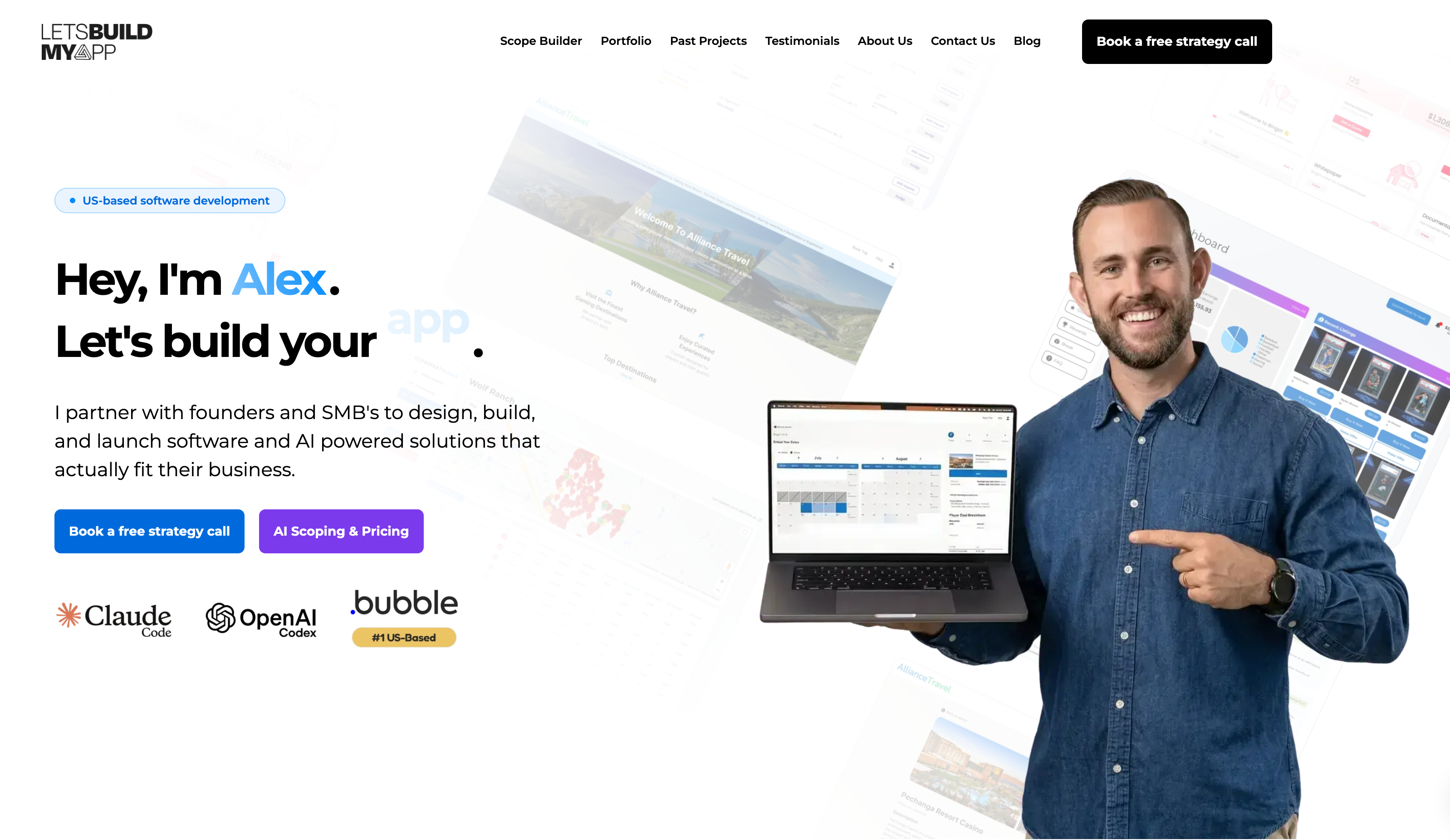
You can review real delivered projects including ShopPilot, an e-commerce app built for scale, and ServiceGrid, a complex operational platform, to see the quality and scope the team delivers. Let’s Build My App offers end-to-end service including UX/UI design, API integrations, and post-launch support, with clear pricing and no hidden costs. Whether you’re launching your first MVP or scaling a product you’ve already validated, schedule a consultation and find out which engagement model fits your project best.
FAQ
What are the main types of app development agencies?
The eight main types are freelancers, boutique agencies, mid-size agencies, enterprise consultancies, offshore development centers, hybrid models, staff augmentation providers, and dedicated development teams. Each differs in cost, control level, and project fit.
How do I choose between a freelancer and an agency?
Freelancers suit simple, well-defined projects with budgets under $40K and technical oversight on your side. Agencies provide more accountability, team depth, and post-launch support, making them the better fit for anything complex or long-term.
What does staff augmentation mean in app development?
Staff augmentation means embedding external developers directly into your team to work under your management. They join your tools and sprints within days, giving you more process control than most agencies but requiring strong internal technical leadership.
How much does it cost to hire an app development agency?
Costs range from $15K for freelance MVPs to over $300K for enterprise consultancies. Boutique agencies typically charge $40K to $150K, mid-size firms run $100K to $500K or more, and hybrid or offshore models fall between $30K and $400K depending on scope.
What is the biggest risk when hiring an app development partner?
The most common risks are key-person dependency, bait-and-switch staffing at mid-size agencies, and missing IP transfer clauses in contracts. Demanding domain-specific references and written post-launch commitments before signing significantly reduces these risks.
Recommended
- US-Based Custom Software & AI Solutions | Let’s Build My App
- Pricing | Let’s Build My App: Fast, Affordable Software
- Portfolio | Let’s Build My App
- Portfolio | Let’s Build My App
About Let’s Build My App
Let’s Build My App is a US-based AI development agency. We design, build, and launch production-grade custom software using AI coding tools including Claude Code and OpenAI Codex, and we migrate legacy Bubble apps onto AI-coded stacks such as React, Supabase, and Firebase. We are the #1 US-Based Bubble Agency, founded and run by Alex Dow. Book a free strategy call to scope your project.
You liked this article ? Share it!
Other articles you might like


Ready to turn
your idea into reality?

Got a question?
How can I get a quote?
Jump on a free strategy call with our founder, Alex. You can schedule here or reach out to us directly.
How long will it take to complete my project?
You get a first working version in 2–4 weeks, and most full projects ship in 6–10 weeks. Timeline depends on feature complexity. Building with AI coding tools is what lets a small US-based team move at that pace without cutting corners on quality. Schedule a call for an exact estimate based on your scope.
What is AI-powered app development?
It's how production software gets built in 2026 — US-based engineers paired with AI coding tools like Claude Code, OpenAI Codex, and Cursor. You get real production code (React, Next.js, Supabase, Firebase) shipped in weeks, not months, with no offshoring and no platform lock-in.
Can AI-coded apps handle complex production workloads?
Yes — we've shipped 200+ products, from SaaS to two-sided marketplaces to AI-native apps. Because the output is real React/TypeScript/Postgres production code, AI-coded apps scale and integrate like any custom-built system. No platform ceiling, no vendor lock-in.
What happens after the application is deployed?
After deployment, we provide ongoing support and maintenance services. This includes regular updates, bug fixes, and addressing any changes. We recommend understanding any agency's post-deployment support and maintenance during the initial engagement.