White-Label App Development: A Guide for Entrepreneurs
Discover what white-label app development is and how it lets entrepreneurs launch branded apps quickly and affordably. Start today!

Article by
Alex Dow
Resources
•
10
mins to read

You don’t need to build an app from scratch to launch one. White-label app development lets you take a fully built, tested product, apply your branding, and put it on the market under your own name. No custom engineering team, no six-figure budget, no months of back-and-forth with developers. For entrepreneurs who want to move fast, it’s one of the most practical routes available — and it’s far more capable than most people expect.
Table of Contents
- Key takeaways
- What is white-label app development
- Why white-label works so well for entrepreneurs
- Challenges and risks you should know about
- How to create and publish a white-label app
- White-label vs. custom app development
- My honest take on white-label for entrepreneurs
- Ready to launch your app faster
- FAQ
Key takeaways
| Point | Details |
|---|---|
| White-label apps are ready-made | You license a pre-built product and rebrand it, skipping most of the engineering work. |
| Speed and cost are the biggest wins | White-label solutions launch in weeks, at 60–70% lower cost than custom builds. |
| Customization has real limits | You can control branding and layout, but deep feature changes depend on your vendor. |
| Compliance is your responsibility | Each store listing needs unique metadata and accurate descriptions to avoid policy violations. |
| Custom development makes sense sometimes | If your product requires unique functionality, a custom build may be worth the extra time and cost. |
What is white-label app development
White-label app development is the practice of licensing a pre-built software product from a vendor, rebranding it with your own name, logo, and visual identity, and selling or distributing it as your own. The term comes from the same concept as white-label products in retail. Think of store-brand goods on a supermarket shelf — manufactured by one company, labeled by another.
In the app world, the original vendor builds and maintains the core technology. You step in as the business owner, add your branding, configure the features you need, and publish the app under your company name. Your customers see your brand throughout. They never know who built the underlying platform, and they don’t need to.
Modern white-label platforms have moved well beyond simple logo swaps. Enterprise-grade solutions now use modular microservices, API access, and built-in AI capabilities that let you tailor experiences in meaningful ways. Here’s what most platforms let you customize:
- Brand assets: logo, color scheme, typography, and splash screens
- Layout and navigation structure using drag-and-drop UI editors
- Content, categories, and in-app text
- Payment gateways, language settings, and currency options
- Notification systems and user account configurations
The vendor handles the technical backend. Security patches, compatibility updates with new iOS and Android versions, and infrastructure maintenance all stay on their side of the agreement. You focus on your business and your customers.
Why white-label works so well for entrepreneurs
If you’re an entrepreneur without deep pockets or a technical co-founder, custom app development can feel out of reach. White-label mobile app services change that math significantly.

Custom apps typically cost between $50,000 and $200,000 or more, with development timelines running 6 to 12 months. White-label apps, by contrast, commonly start between $3,000 and $20,000 with launch timelines measured in weeks. That difference alone changes what’s possible for a first-time founder or a small business testing a new revenue stream.
The benefits go beyond price:
- Speed to market. You skip the discovery phase, architecture decisions, and testing cycles. The core product already works. You configure and launch.
- No coding required. Good white-label application platforms offer drag-and-drop UI editors and visual configuration tools. You don’t need to write a single line of code.
- Predictable costs. Most platforms charge subscription or licensing fees. You know what you’re paying each month with no surprise invoices.
- Lower maintenance burden. The provider handles OS compatibility updates and backend patches, so your retainer fees stay lower.
- Full branding control. Your customers experience your brand, your name, and your product. The vendor stays invisible.
Pro Tip: Before you commit to a white-label platform, test its customization depth with a free trial or demo account. Some platforms look flexible on the surface but limit you to color and logo changes. You want layout control and the ability to add or remove feature modules.
Challenges and risks you should know about
White-label software solutions come with real trade-offs. Understanding them upfront helps you avoid surprises after you’ve already published.
Customization has a ceiling
The core architecture belongs to the vendor. You can rebrand and reconfigure, but you can’t redesign the underlying logic. If your business model needs a feature the platform doesn’t support, you either work around it, request it, or look elsewhere. White-label development offers less engineering control than custom builds, which matters when your product needs truly unique functionality.
You depend on your vendor
If the vendor changes pricing, discontinues a feature, or shuts down, your app is affected. Vetting your vendor’s track record and contract terms is not optional. Look for SLA guarantees, data portability clauses, and clear terms around ownership.
App store compliance is your job
This is where many white-label publishers get caught off guard. Google Play restricts template-based apps with repetitive metadata, and in 2024, 23% of Play Store removals were tied to low-effort template apps. The store doesn’t penalize white-label apps for being white-label. It penalizes lazy, duplicate listings.
Here’s what puts you at risk versus what keeps you safe:
| Risk factor | Safe practice |
|---|---|
| Copying store descriptions across listings | Write unique descriptions for each app |
| Using the same screenshots across apps | Create brand-specific graphics and screenshots |
| Managing all apps under one developer account | Use separate developer accounts per client or brand |
| Generic or keyword-stuffed titles | Write accurate, compelling titles that reflect your actual product |
Centralized developer accounts create systemic risk. One policy violation can trigger mass app removals. Decentralized account management is the industry standard for a reason.
Pro Tip: Treat your store listing like a marketing page, not an afterthought. Unique screenshots, a clear value proposition, and accurate descriptions protect your listing and improve conversion at the same time.
How to create and publish a white-label app
Getting from zero to a published app is more straightforward than you’d expect. Here’s the practical sequence:
-
Choose your platform. Match the platform to your niche. A booking app platform works differently from an e-commerce or content platform. Evaluate feature sets, pricing models, API access, and the vendor’s support quality. Check references from other businesses using the same platform.
-
Upload your brand assets. Start with your logo, brand colors, and typography. Most platforms walk you through this with a configuration panel. Apply your splash screen and app icon at this stage too.
-
Configure your content and features. Add your product catalog, content library, service listings, or whatever your app delivers. Set up payment gateways, supported languages, and pricing currencies if your platform is transactional.
-
Test across devices. Before you submit anywhere, test on real iOS and Android devices. Check every flow a user would follow — sign-up, browsing, purchasing, and account management. Platform bugs are the vendor’s problem, but configuration errors are yours.
-
Set up your developer accounts. Create separate Apple Developer and Google Play accounts for your brand. Follow Google Play’s published guidance on unique store listings and account management best practices.
-
Write original store listings. This step cannot be skipped. Write descriptions, headlines, and feature lists that are specific to your brand and your audience. Create custom screenshots that reflect your actual app design.
-
Submit and monitor. Submit to both stores following their review guidelines. After launch, monitor reviews, crash reports, and user feedback. Plan for regular content updates even if the technical maintenance is handled by your vendor.
| Step | What you control | What the vendor controls |
|---|---|---|
| Branding and design | Yes | No |
| Feature configuration | Partially | Core architecture |
| Store listing content | Yes | No |
| Backend infrastructure | No | Yes |
| OS compatibility updates | No | Yes |
White-label vs. custom app development
Choosing between a white-label solution and custom app development comes down to three questions. How fast do you need to launch? How unique does the product need to be? And how much can you invest right now?
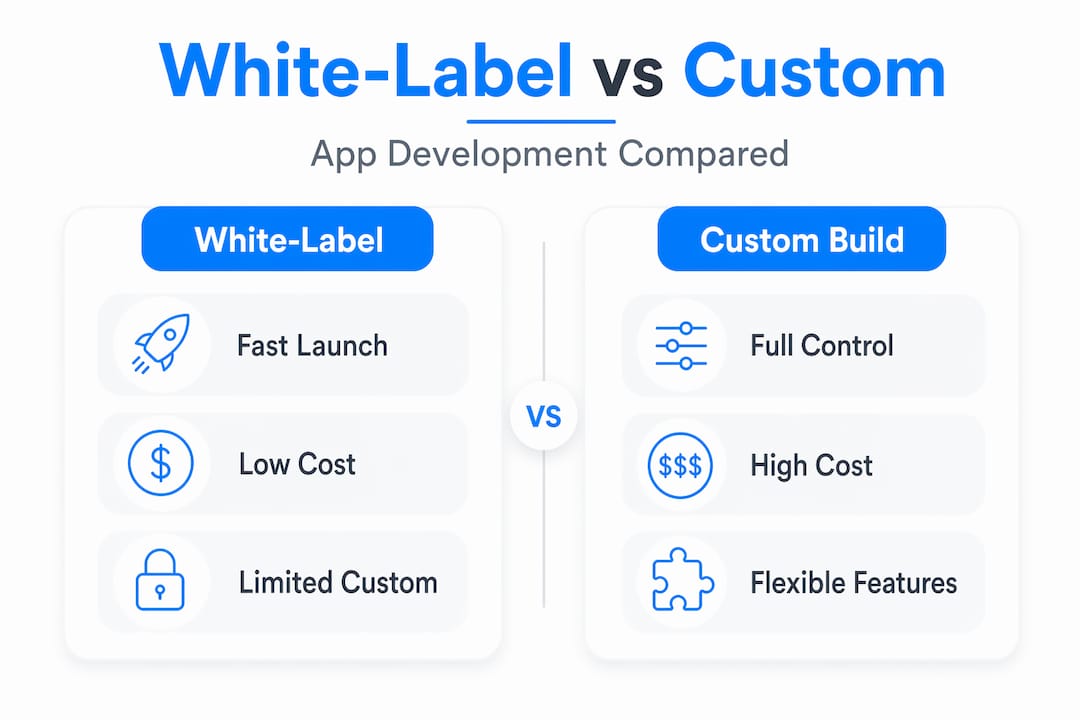
Custom app development gives you full control over every feature, interaction, and data structure. If your product idea depends on a workflow no existing platform supports, custom is the only real option. But that control costs time and money. Development timelines of 6 to 12 months are standard, and budgets under $50,000 rarely get you a fully polished product.
White-label development trades some of that control for speed and affordability. You’re working within the boundaries of an existing platform, but those boundaries have expanded significantly. Tools like those at Signstream’s white-label platform show how purpose-built platforms now offer meaningful flexibility for specific verticals.
| Factor | White-label | Custom development |
|---|---|---|
| Upfront cost | $3,000–$20,000 | $50,000–$200,000+ |
| Time to launch | Weeks | 6–12 months |
| Customization depth | Moderate | Full |
| Maintenance responsibility | Vendor handles core | Your team or agency |
| Vendor dependency | High | None |
| Best for | Validated ideas, fast entry | Unique products, long-term scale |
The smartest approach is often to launch with a white-label product to validate your market, then invest in custom development once you have paying users and clear product requirements. That sequence reduces risk and gives you real data to inform a bigger build.
My honest take on white-label for entrepreneurs
I’ve seen entrepreneurs waste a year and $150,000 building a custom app for an idea they hadn’t validated yet. I’ve also seen founders launch a white-label product in three weeks, get their first 500 users, and build a real business on top of it. The second story happens far more often when entrepreneurs stop treating “custom-built” as the default definition of serious.
White-label apps genuinely democratize product entrepreneurship. You no longer need a CTO or a six-figure development budget to put a quality product in front of customers. That’s a real shift in who can start a tech-enabled business.
That said, I’ve watched people get burned by skipping the compliance work. Launching five apps under one developer account because it felt easier is the kind of shortcut that can wipe out your entire portfolio overnight. The technical side is handled for you. The business and compliance side is still yours.
My advice: pick a platform with genuine API flexibility, write every store listing from scratch, and treat your vendor relationship like a partnership worth managing. White-label is not a shortcut to a bad product. It’s a faster route to a good one, if you bring the right business thinking to it.
— Alex
Ready to launch your app faster
If you’re weighing your options and want to see what’s possible, Let’s Build My App has built real products across categories including e-commerce, services, education, and field operations. You can explore the Shoppilot project as a practical example of what a fast, well-executed app launch looks like.
Let’s Build My App works with entrepreneurs and small businesses to build apps using no-code and low-code tools like Bubble.io and FlutterFlow, with average delivery around 6 weeks and transparent pricing. Whether you’re evaluating a white-label path or a fully custom build, the team helps you figure out which approach fits your timeline, budget, and product goals. Check out the full project portfolio or visit letsbuildmyapp.com to start a conversation.
FAQ
What is white-label app development in simple terms?
White-label app development means licensing a pre-built app from a vendor, rebranding it with your own name and design, and publishing it as your own product. You skip the engineering work and focus on your brand and customers.
How much does a white-label app cost compared to a custom app?
White-label apps typically cost between $3,000 and $20,000, while custom development ranges from $50,000 to over $200,000. The white-label option also launches in weeks instead of months.
Can I publish a white-label app on the Apple App Store and Google Play?
Yes. You publish under your own developer accounts on both stores. Each listing needs original descriptions, graphics, and screenshots to meet platform policies and avoid removal.
Do I need coding skills to use a white-label app platform?
No. Most platforms provide visual configuration tools, drag-and-drop editors, and step-by-step setup panels. You configure features and branding without writing code.
What are the biggest risks with white-label app development?
The main risks are limited customization depth, dependence on your vendor for core updates, and app store policy violations if your store listings aren’t unique. Separate developer accounts and original store content protect against the most common compliance issues.
Recommended
- US-Based Custom Software & AI Solutions | Let’s Build My App
- Portfolio | Let’s Build My App
- Portfolio | Let’s Build My App
- Portfolio | Let’s Build My App
About Let’s Build My App
Let’s Build My App is a US-based AI development agency. We design, build, and launch production-grade custom software using AI coding tools including Claude Code and OpenAI Codex, and we migrate legacy Bubble apps onto AI-coded stacks such as React, Supabase, and Firebase. We are the #1 US-Based Bubble Agency, founded and run by Alex Dow. Book a free strategy call to scope your project.
You liked this article ? Share it!
Other articles you might like


Ready to turn
your idea into reality?

Got a question?
How can I get a quote?
Jump on a free strategy call with our founder, Alex. You can schedule here or reach out to us directly.
How long will it take to complete my project?
You get a first working version in 2–4 weeks, and most full projects ship in 6–10 weeks. Timeline depends on feature complexity. Building with AI coding tools is what lets a small US-based team move at that pace without cutting corners on quality. Schedule a call for an exact estimate based on your scope.
What is AI-powered app development?
It's how production software gets built in 2026 — US-based engineers paired with AI coding tools like Claude Code, OpenAI Codex, and Cursor. You get real production code (React, Next.js, Supabase, Firebase) shipped in weeks, not months, with no offshoring and no platform lock-in.
Can AI-coded apps handle complex production workloads?
Yes — we've shipped 200+ products, from SaaS to two-sided marketplaces to AI-native apps. Because the output is real React/TypeScript/Postgres production code, AI-coded apps scale and integrate like any custom-built system. No platform ceiling, no vendor lock-in.
What happens after the application is deployed?
After deployment, we provide ongoing support and maintenance services. This includes regular updates, bug fixes, and addressing any changes. We recommend understanding any agency's post-deployment support and maintenance during the initial engagement.