Why Cross-Platform Apps Save Cost: 2026 Guide
Discover why cross-platform apps save cost in our 2026 guide. Learn how a single codebase can drastically reduce your development expenses.

Article by
Alex Dow
Resources
•
9
mins to read

Cross-platform app development is defined as building a single codebase that runs on iOS, Android, and web simultaneously, and it is the primary reason why cross-platform apps save cost compared to native alternatives. Frameworks like Flutter and React Native let one team ship to every platform at once, eliminating the need to fund separate engineering squads. Studies estimate five-year total cost of ownership runs $300,000–$700,000 for cross-platform versus $400,000–$900,000 for native on a mid-complexity product. That gap of $100,000–$200,000 is not a rounding error for a startup with a limited runway. The sections below break down exactly where those savings come from and how to capture them.
Why cross-platform apps save cost at the development stage
The biggest upfront saving comes from a shared codebase. With native development, you pay two separate teams to write the same logic twice: once for iOS in Swift and once for Android in Kotlin. Cross-platform frameworks like Flutter and React Native eliminate that duplication by letting a single team build for both platforms at the same time. Fewer engineers on the payroll means a lower monthly burn rate from day one.
Shared UI components amplify that saving further. When your design system lives in one place, your QA team tests one set of screens instead of two. Research shows shared UI architectures reduce development cycle time by 20–50% and cut UI defect density by up to 35%. Less rework means fewer billable hours and a faster path to launch.

Cross-platform development also reduces MVP timelines by 25–40% compared to native builds. Getting to market faster means you start collecting user feedback and revenue sooner, which directly offsets development spend.
Here is a direct comparison of initial cost factors:
| Cost Factor | Native Development | Cross-Platform |
|---|---|---|
| Engineering teams needed | Two separate teams (iOS + Android) | One unified team |
| Codebase size | Two full codebases | One shared codebase |
| QA effort | Duplicate testing per platform | Single test suite |
| Design system | Maintained separately per platform | One shared design system |
| Typical upfront savings | Baseline | 20–30% lower |
Pro Tip: When scoping your project, ask your development partner what percentage of the codebase will be shared versus platform-specific. A well-built Flutter or React Native app typically shares 80–90% of its code, which is where the real savings live.
How maintenance costs drive long-term savings
Upfront build costs are only part of the story. Maintenance is where the financial gap between native and cross-platform widens most dramatically over time.
With native apps, every bug fix and feature update must be written, tested, and deployed twice. Native app maintenance costs 30–40% more annually because of this duplicated effort. Over five years, that compounding cost difference is what pushes the total native spend well above $900,000 for complex products.
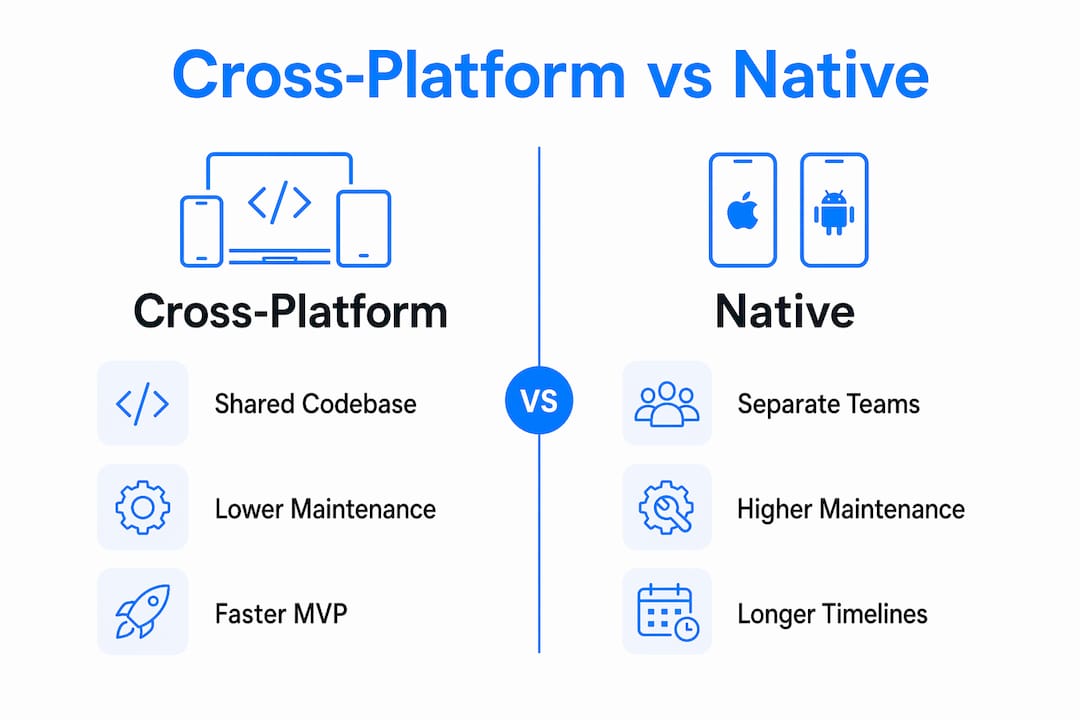
Cross-platform apps fix that problem structurally. You patch a bug once in the shared codebase and it resolves on both iOS and Android in the same release. Your QA team runs one regression cycle. Your DevOps pipeline deploys one build artifact. Simplified release management in cross-platform reduces operational complexity and accelerates release cadence, which saves staff costs every sprint.
To see how this plays out in practice, consider a five-year scenario for a mid-complexity app:
- Year 1 (Build): Cross-platform saves roughly $50,000–$100,000 on initial development versus native.
- Year 2 (First full maintenance cycle): A 30–40% maintenance cost reduction translates to $15,000–$30,000 saved annually.
- Years 3–5 (Compounding savings): Each new feature and platform OS update costs less because the work is done once. Savings accumulate to $45,000–$90,000 over the remaining three years.
- Total five-year gap: The combined savings reach $100,000–$200,000 compared to a parallel native build.
That math is why the cross-platform vs native cost conversation almost always favors cross-platform for startups and growing businesses that plan to maintain and evolve their product.
Pro Tip: Budget explicitly for maintenance from day one. A common mistake is allocating 100% of the app budget to the initial build and treating maintenance as a future problem. Allocating 20–25% of your annual tech budget to ongoing updates keeps your app healthy and your costs predictable.
When cross-platform apps may not save cost
Cross-platform is not the right choice for every product. Knowing the exceptions protects your budget from surprises.
- Performance-intensive apps: Games with complex 3D graphics, real-time video processing tools, and augmented reality experiences often require native rendering pipelines. Cross-platform frameworks add an abstraction layer that can introduce latency in these scenarios.
- Deep hardware access: Features like custom Bluetooth protocols, advanced camera controls, or NFC payment flows sometimes require native modules that sit outside the shared codebase. Writing and maintaining those modules adds cost and complexity.
- Platform-specific UX requirements: Apps that need to feel deeply native on each platform, such as system-level utilities or apps deeply integrated with Apple Watch or Android Wear, may require significant platform-specific work that erodes the shared codebase advantage.
- Tight platform release windows: If your product must ship on the same day as a new iOS or Android release, native development gives you direct access to new APIs without waiting for framework updates.
- Hybrid approaches as a middle ground: Many teams use a hybrid model, building the core app in Flutter or React Native while writing isolated native modules for specific hardware features. This preserves most of the cost benefits while handling edge cases cleanly.
The honest question to ask before choosing your approach is this: does your product rely on features that require deep platform integration? If the answer is no, cross-platform almost always wins on cost. If the answer is yes for a small subset of features, a hybrid model is worth pricing out.
Practical strategies to maximize cross-platform savings
Choosing Flutter or React Native does not automatically deliver savings. The financial benefits of cross-platform apps are realized through deliberate process decisions, not just technology choices.
Invest in a shared design system early. A component library built in Figma and mirrored in your framework keeps UI consistent and prevents teams from rebuilding the same button or form field repeatedly. Governance over shared UI components is one of the most cited factors in translating shared architecture into actual cost reduction.
Automate your testing pipeline. Manual QA on two platforms is expensive. Setting up automated testing with tools like Appium or Flutter’s built-in test framework catches regressions before they reach production. Research confirms that QA automation and CI/CD are required to realize measurable defect density reductions in shared codebases. Without automation, you end up doing manual testing twice anyway, which cancels out the savings.
Consolidate documentation and onboarding. When your iOS and Android logic lives in one codebase, new developers ramp up faster. A single README, one architecture diagram, and one set of coding standards reduce onboarding time and lower the cost of scaling your team.
Here is a practical framework for maximizing savings across the development lifecycle:
| Strategy | Primary Benefit | When to Implement |
|---|---|---|
| Shared design system | Reduces UI rework and QA cycles | Before first sprint |
| Automated test suite | Cuts regression testing costs | During initial build |
| CI/CD pipeline | Speeds up releases, reduces DevOps labor | Before first release |
| Reuse policy documentation | Prevents duplicate component creation | Ongoing from day one |
| Centralized knowledge base | Lowers onboarding and handoff costs | Ongoing |
Real-world results back this up. Projects like Shoppilot and Servicegrid demonstrate how cross-platform builds with strong governance deliver production-ready apps on compressed timelines and controlled budgets.
Pro Tip: Set a reuse policy before writing a single line of code. Define which components must come from the shared library and which can be built custom. Teams that skip this step end up with duplicate components scattered across the codebase, which erodes the cost advantage over time.
Key takeaways
Cross-platform app development saves cost by eliminating duplicated engineering work across iOS and Android, with five-year savings of $100,000–$200,000 compared to native builds when governance and automation are in place.
| Point | Details |
|---|---|
| Shared codebase cuts upfront costs | One team builds for both platforms, reducing engineering hours by 20–30% versus native. |
| Maintenance savings compound over time | Native apps cost 30–40% more annually to maintain due to duplicated fixes and updates. |
| Not every app benefits equally | Performance-intensive or hardware-heavy apps may need native modules that reduce savings. |
| Governance determines actual savings | Shared design systems, automated testing, and CI/CD pipelines are required to realize cost benefits. |
| MVP speed adds revenue upside | Cross-platform reduces time to market by 25–40%, enabling earlier user feedback and revenue. |
The part most startups get wrong about cross-platform costs
I have talked with dozens of founders who chose Flutter or React Native because they heard it was cheaper, then ended up spending just as much as a native build would have cost. The technology was not the problem. The process was.
The cost benefits of cross-platform apps are real, but they are not automatic. They require you to treat your shared codebase as a product in itself. That means governing your component library, investing in automated testing before you feel like you need it, and writing documentation that a new developer can actually use. Teams that skip those steps end up with a tangled codebase that is just as expensive to maintain as two native apps.
My honest recommendation for any startup evaluating this decision: do not choose cross-platform just to save money on the initial build. Choose it because you are committed to maintaining a single, well-governed codebase over the life of the product. If you are willing to make that commitment, the savings are substantial and they grow every year. If you are not, you will spend the savings on technical debt cleanup by year two.
One more thing worth saying directly: the performance gap between cross-platform and native has narrowed significantly with Flutter and React Native. For the vast majority of business apps, productivity tools, marketplaces, and SaaS products, you will not notice a difference. The apps where native still wins are genuinely specialized. Do not let a theoretical performance concern push you toward a $200,000 cost premium you do not need.
— Alex
Build your cross-platform app with Let’s Build My App
If you are a startup or growing business ready to build a cost-effective mobile app, Let’s Build My App specializes in cross-platform development using FlutterFlow and Bubble.io. The US-based team delivers production-ready apps in around six weeks, with transparent pricing and no hidden costs.

You can explore clear, upfront pricing to see exactly what your project would cost, or use the free AI scope tool to get a project estimate in minutes. Let’s Build My App handles UX/UI design, API integrations, project management, and post-launch support, so you get a complete product without assembling a full in-house team. Contact Let’s Build My App to scope your project and launch faster.
FAQ
How much do cross-platform apps save compared to native?
Cross-platform apps reduce five-year total cost by $100,000–$200,000 compared to native builds for mid-complexity products. The savings come from a single codebase, one engineering team, and lower annual maintenance costs.
What frameworks are used for cross-platform development?
Flutter and React Native are the two leading frameworks for cross-platform mobile development. Both enable a single team to build for iOS and Android simultaneously, which is the core driver of cost savings.
Does cross-platform development sacrifice app quality?
For most business apps, the quality difference versus native is negligible. Performance-critical features like complex 3D graphics or deep hardware access may require native modules, but the majority of apps do not need them.
Why are cross-platform maintenance costs lower?
Bug fixes and feature updates are written once and deployed to both platforms in a single release. Native maintenance costs run 30–40% higher annually because every change must be duplicated across two separate codebases.
How do i know if cross-platform is right for my app?
If your app does not rely on complex 3D graphics, specialized hardware protocols, or deep platform-specific integrations, cross-platform is almost always the more cost-effective choice. Use a scoping tool or consult a development partner to evaluate your specific feature requirements before committing to a technology stack.
Recommended
- Custom Software Portfolio | Let’s Build My App
- Portfolio | Let’s Build My App
- Portfolio | Let’s Build My App
- Portfolio | Let’s Build My App
About Let’s Build My App
Let’s Build My App is a US-based AI development agency. We design, build, and launch production-grade custom software using AI coding tools including Claude Code and OpenAI Codex, and we migrate legacy Bubble apps onto AI-coded stacks such as React, Supabase, and Firebase. We are the #1 US-Based Bubble Agency, founded and run by Alex Dow. Book a free strategy call to scope your project.
You liked this article ? Share it!
Other articles you might like


Ready to turn
your idea into reality?

Got a question?
How can I get a quote?
Jump on a free strategy call with our founder, Alex. You can schedule here or reach out to us directly.
How long will it take to complete my project?
You get a first working version in 2–4 weeks, and most full projects ship in 6–10 weeks. Timeline depends on feature complexity. Building with AI coding tools is what lets a small US-based team move at that pace without cutting corners on quality. Schedule a call for an exact estimate based on your scope.
What is AI-powered app development?
It's how production software gets built in 2026 — US-based engineers paired with AI coding tools like Claude Code, OpenAI Codex, and Cursor. You get real production code (React, Next.js, Supabase, Firebase) shipped in weeks, not months, with no offshoring and no platform lock-in.
Can AI-coded apps handle complex production workloads?
Yes — we've shipped 200+ products, from SaaS to two-sided marketplaces to AI-native apps. Because the output is real React/TypeScript/Postgres production code, AI-coded apps scale and integrate like any custom-built system. No platform ceiling, no vendor lock-in.
What happens after the application is deployed?
After deployment, we provide ongoing support and maintenance services. This includes regular updates, bug fixes, and addressing any changes. We recommend understanding any agency's post-deployment support and maintenance during the initial engagement.