Why Founders Choose Low-Code MVPs in 2026
Discover why founders choose low-code MVPs in 2026 for faster, cost-effective, and flexible software development. Learn the advantages today!

Article by
Alex Dow
Resources
•
9
mins to read

A low-code MVP is a minimum viable product built using visual development platforms that combine drag-and-drop tools with optional custom code, letting founders ship functional software in weeks instead of months. The industry term is “low-code development,” and it sits between no-code tools and full custom engineering. Why founders choose low-code MVPs comes down to three things: speed, cost, and the flexibility to build something real. Platforms like OutSystems, Bubble.io, and FlutterFlow have made this approach mainstream. By 2026, 77% of enterprises have adopted low-code or no-code platforms, which means the ecosystem is mature enough to trust with your first product.
Why founders choose low-code mvps over traditional dev
The core reason is delivery speed. Low-code platforms accelerate app launch by replacing manual coding with visual development environments, reusable components, and automated API integrations. What used to take a full engineering team three to six months now ships in weeks.
The cost difference is just as significant. No-code and low-code projects reduce development time by over 74% and cut costs by an average of 62% compared to traditional development. For a bootstrapped founder, that gap can mean the difference between launching and running out of runway.
Here is what drives those numbers in practice:
- Visual development environments replace hundreds of lines of boilerplate code with drag-and-drop UI builders. Founders using Bubble.io or FlutterFlow can configure screens, logic, and data models without writing a single line.
- Reusable component libraries mean you are not rebuilding standard features like authentication, dashboards, or payment flows from scratch. These come pre-built and tested.
- Automated integrations connect your app to third-party services like Stripe, Twilio, or Google Maps through prebuilt connectors. Manual API wiring that once took days now takes hours.
- Parallel workstreams become possible when non-technical team members can configure UI and content while developers handle backend logic simultaneously.
The average no-code or low-code project finishes in 3.2 weeks compared to 14.8 weeks for full custom development. That is not a minor efficiency gain. It is a structural advantage for any founder racing to validate a market before a competitor does.
How does low-code compare to no-code and full-code for mvps?

Founders often ask whether they should go full no-code or hire a traditional dev team. The answer depends on what you are building, and low-code sits in a specific sweet spot.
| Approach | Best For | Speed | Customization | Cost |
|---|---|---|---|---|
| No-code | Simple workflows, internal tools | Fastest | Low | Lowest |
| Low-code | MVPs with APIs, custom logic | Fast | Medium-High | Moderate |
| Full-code | Highly specialized products | Slowest | Highest | Highest |
No-code is fastest for simple workflows, but it breaks down the moment you need custom backend logic, complex data relationships, or integrations that go beyond prebuilt connectors. Full-code gives you complete control but costs more time and money than most early-stage founders can afford.
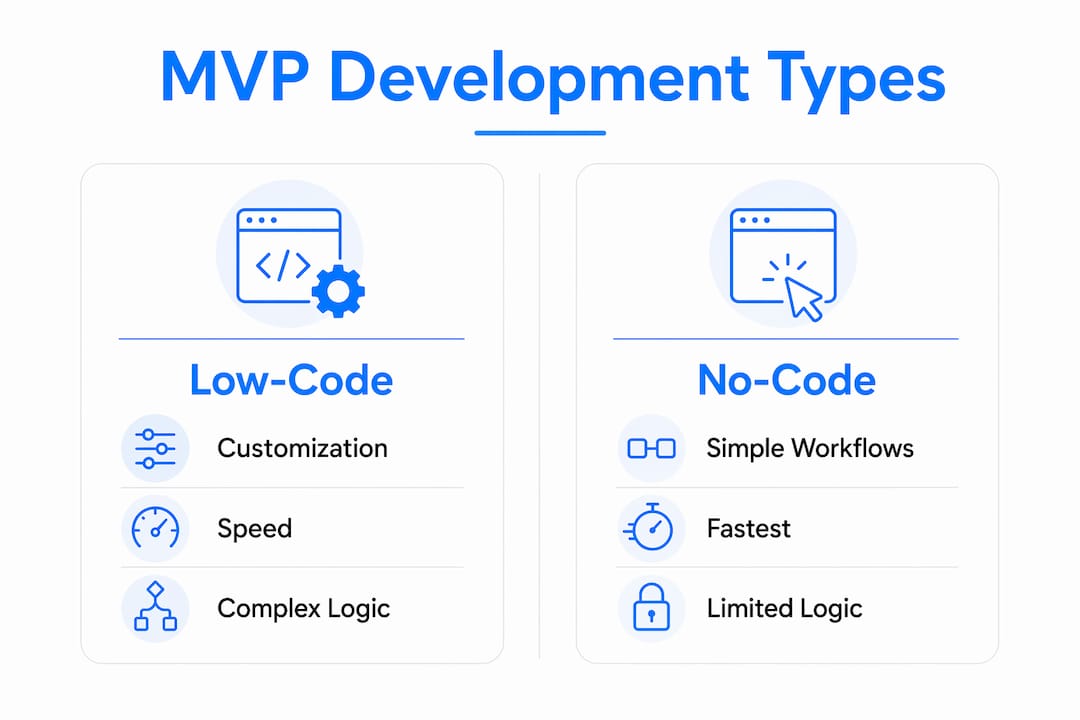
Low-code handles the middle ground. You get the speed of visual development plus the ability to write custom code when the platform’s built-in tools are not enough. If your MVP needs a custom API, a multi-step data pipeline, or a non-standard user permission model, low-code balances speed with flexibility in a way no-code simply cannot.
Concrete scenarios where low-code wins over no-code:
- Your MVP requires a custom REST API connection to a legacy system
- You need role-based access control with complex permission logic
- Your product involves real-time data processing or dynamic pricing calculations
- You are building a mobile app with device-specific features like camera access or push notifications
Pro Tip: Before choosing a platform, map out your MVP’s three most technically complex features. If any of them require custom data logic or external API calls, low-code is the right tier. No-code will hit a wall before you finish building.
What other benefits do founders get from low-code mvps?
Speed and cost are the headline numbers, but the real-world benefits of low-code MVPs go further than that. Founders who have shipped products on platforms like Bubble.io or FlutterFlow consistently report advantages that affect their entire team and fundraising process.
Low-code empowers non-technical team members to participate directly in app creation. A product manager can configure user flows. A designer can adjust UI components. A founder can prototype a new feature without filing a ticket. This reduces the bottleneck on your engineering team and speeds up every feedback cycle.
Developer burnout is a real risk at early-stage startups. When engineers spend their days writing repetitive UI code and wiring up standard integrations, they burn out fast and produce less creative work. Low-code minimizes routine coding for UI, logic, and API integrations, freeing developers to focus on the parts of the product that actually require deep technical thinking.
Pivoting is faster too. When user feedback tells you that your core assumption was wrong, a low-code codebase is far easier to restructure than a custom-built system. You can reconfigure data models, swap out UI components, and re-route logic in days rather than weeks.
“An MVP built rapidly with low-code serves as proof of concept and validates market fit, boosting credibility in fundraising.” — Minimum Viable Product Guide for Founders
That last point matters more than most founders realize. Investors respond to working demos. A functional product built in six weeks on Bubble.io tells a better story than a pitch deck with wireframes. You can see real examples of this approach in action by looking at projects like ServiceGrid and InspectFlow, where low-code tools delivered full-featured MVPs with complex integrations.
What are the real risks of low-code mvps?
Low-code development is not without tradeoffs. Founders who go in without understanding the risks can end up with products that are hard to scale or difficult to migrate off a platform.
- Platform dependency. If your entire product lives inside one platform’s ecosystem, you are subject to that platform’s pricing changes, feature limitations, and potential shutdown. This is the most common concern founders raise.
- Scalability ceilings. Low-code platforms handle most startup-scale workloads well, but products with very high transaction volumes or complex real-time processing may eventually outgrow them.
- Security considerations. AI-generated code and low-code apps require the same security review as any other software. Do not assume the platform handles all security by default. Review data storage, authentication, and API exposure carefully.
- Prototype vs. production gap. A low-code MVP is a real product, but it may need architectural changes before it can support enterprise-level usage. Set clear expectations with your team and investors about what the MVP is designed to prove.
Some low-code platforms offer code export as an exit ramp, letting you migrate off the platform if your product complexity outgrows it. This is a critical feature to check before you commit to any platform. Bubble.io, for example, has a defined export path that gives founders more long-term flexibility.
Pro Tip: Ask any low-code platform vendor directly: “Can I export my full application code, and what does that process look like?” The answer tells you everything about your long-term options.
For a practical look at how startup teams manage backlog and resource constraints with low-code tools, the Gainable blog covers real team workflows worth reading before you choose your stack.
When full custom development is the right call: if your product’s core value is a proprietary algorithm, a custom hardware integration, or a feature set that no low-code platform can support, start with full-code from day one. Low-code is a tool, not a universal answer.
Key takeaways
Low-code MVPs give founders the fastest path from idea to working product by combining visual development speed with enough technical flexibility to build something real.
| Point | Details |
|---|---|
| Speed advantage is measurable | Low-code projects finish in 3.2 weeks on average versus 14.8 weeks for full custom development. |
| Cost savings are significant | Low-code cuts development costs by an average of 62% compared to traditional engineering. |
| Low-code beats no-code for complex MVPs | Choose low-code when your product needs custom APIs, complex data models, or mobile-native features. |
| Team collaboration improves | Non-technical founders and product managers can build and iterate directly, reducing developer bottlenecks. |
| Platform risk is manageable | Prioritize platforms with code export options to protect your product’s long-term flexibility. |
What i’ve learned watching founders build with low-code
I have watched a lot of founder teams make the same mistake: they spend three months debating the “right” tech stack while a competitor ships a working product and starts collecting real user data. Low-code development does not just save time. It changes the decision-making culture of a startup.
The founders who get the most out of low-code are not the ones who treat it as a shortcut. They treat it as a deliberate strategy. They pick platforms with extensibility built in, like Bubble.io for web apps or FlutterFlow for mobile, because they know the MVP is not the final product. It is the first version of a conversation with the market.
What surprises most people is how much investor confidence shifts when you walk into a meeting with a working demo instead of slides. I have seen founders close pre-seed rounds faster simply because they could show a real product in six weeks. That is not a coincidence. It is the direct result of choosing the right development approach at the right stage.
My honest advice: do not let perfect be the enemy of shipped. Low-code gives you a real product with real users. That feedback is worth more than any amount of planning. Choose a platform with a clear upgrade path, build the simplest version of your core feature, and get it in front of users as fast as you can. The startup-to-MVP process is always faster when you stop optimizing for hypothetical scale and start optimizing for learning.
— Alex
Build your MVP faster with Let’s Build My App
If you are ready to move from idea to working product, Let’s Build My App is a US-based custom software development team that specializes in low-code and no-code platforms like Bubble.io and FlutterFlow. The team has 15 years of experience in software development and product management, with an average project delivery time of around six weeks.
Let’s Build My App handles everything from UX/UI design and API integrations to project management and post-launch support. Pricing is transparent with no hidden costs, and every project starts with a clear scope. Use the free AI Scope Tool to map out your MVP before your first conversation, or visit Let’s Build My App to see how the team can help you launch fast and affordably.
FAQ
What is a low-code MVP?
A low-code MVP is a minimum viable product built using visual development platforms that combine drag-and-drop tools with optional custom code. It lets founders ship functional software faster and at lower cost than traditional development.
How much faster is low-code development?
Low-code and no-code projects finish in an average of 3.2 weeks compared to 14.8 weeks for full custom development. That represents a reduction in development time of over 74%.
When should a founder choose low-code over no-code?
Choose low-code when your MVP requires custom API integrations, complex data logic, or mobile-native features. No-code works well for simple workflows but hits technical limits quickly on more complex products.
Does low-code create vendor lock-in?
Some low-code platforms offer code export features that let you migrate off the platform if your product outgrows it. Always confirm a platform’s export options before committing to build on it.
Can a low-code MVP attract investor funding?
A working low-code MVP serves as proof of concept and validates market fit, which directly supports fundraising conversations. Investors respond to functional demos, and low-code makes it possible to produce one in weeks rather than months.
Recommended
- Past Projects | Let’s Build My App: Trusted Success Stories
- Pricing | Let’s Build My App: Fast, Affordable Software
- Portfolio | Let’s Build My App
- Portfolio | Let’s Build My App
About Let’s Build My App
Let’s Build My App is a US-based AI development agency. We design, build, and launch production-grade custom software using AI coding tools including Claude Code and OpenAI Codex, and we migrate legacy Bubble apps onto AI-coded stacks such as React, Supabase, and Firebase. We are the #1 US-Based Bubble Agency, founded and run by Alex Dow. Book a free strategy call to scope your project.
You liked this article ? Share it!
Other articles you might like


Ready to turn
your idea into reality?

Got a question?
How can I get a quote?
Jump on a free strategy call with our founder, Alex. You can schedule here or reach out to us directly.
How long will it take to complete my project?
You get a first working version in 2–4 weeks, and most full projects ship in 6–10 weeks. Timeline depends on feature complexity. Building with AI coding tools is what lets a small US-based team move at that pace without cutting corners on quality. Schedule a call for an exact estimate based on your scope.
What is AI-powered app development?
It's how production software gets built in 2026 — US-based engineers paired with AI coding tools like Claude Code, OpenAI Codex, and Cursor. You get real production code (React, Next.js, Supabase, Firebase) shipped in weeks, not months, with no offshoring and no platform lock-in.
Can AI-coded apps handle complex production workloads?
Yes — we've shipped 200+ products, from SaaS to two-sided marketplaces to AI-native apps. Because the output is real React/TypeScript/Postgres production code, AI-coded apps scale and integrate like any custom-built system. No platform ceiling, no vendor lock-in.
What happens after the application is deployed?
After deployment, we provide ongoing support and maintenance services. This includes regular updates, bug fixes, and addressing any changes. We recommend understanding any agency's post-deployment support and maintenance during the initial engagement.