
Why Hire a Development Agency vs Freelancer for Your App
Discover why hire a development agency vs freelancer for your app. Enjoy faster onboarding, a skilled team, and reduced project risks.

Article by
Alex Dow
Resources
•
8
mins to read

A development agency is a coordinated team of developers, designers, project managers, and QA engineers working under one contract to deliver your product. A freelancer is a single individual you hire for a specific task or skill. When you’re deciding why hire a development agency vs freelancer for your startup’s app, the answer comes down to project complexity, risk tolerance, and how much management bandwidth you actually have. Let’s Build My App operates as a full-service agency, meaning you get a structured team, not a single point of contact who can disappear mid-sprint.
Why hire a development agency vs freelancer for your startup?
Agencies give you a team that is ready to work immediately. Recruiting a skilled developer can take 3–6 months, but agencies can onboard teams often within 1–2 weeks. That speed advantage directly affects your time to market, which matters enormously when you are racing to validate an idea or beat a competitor to launch.
The development agency benefits go beyond speed. You get access to cross-functional roles in one engagement: frontend and backend developers, a UX/UI designer, a QA engineer, and a project manager. With a freelancer, you either hire each role separately or accept that one person will wear too many hats. Both paths create coordination overhead that founders rarely budget for.

Agencies also carry structured project management with dedicated account managers and formal escalation paths. That structure protects your timeline. When a blocker appears, someone owns the resolution. With a solo freelancer, you are the project manager by default.
Pro Tip: Before you sign any contract, ask an agency to show you their escalation process. If they cannot describe it clearly in two sentences, their project management is informal at best.
The cost picture is more nuanced than it first appears. In-house teams cost $600,000 to $1M+ annually versus $40,000–$400,000 for agency projects. Freelancers sit below agency rates on paper, but that gap shrinks when you factor in the time you spend managing them, re-onboarding replacements, and fixing undocumented code.
When can hiring freelancers be a better choice?
Freelancers are the right call for narrowly scoped work with a single clear skill requirement. If you need a landing page built in Webflow, a logo designed, or a specific API integrated into an existing codebase, a freelancer delivers that without the overhead of an agency engagement.
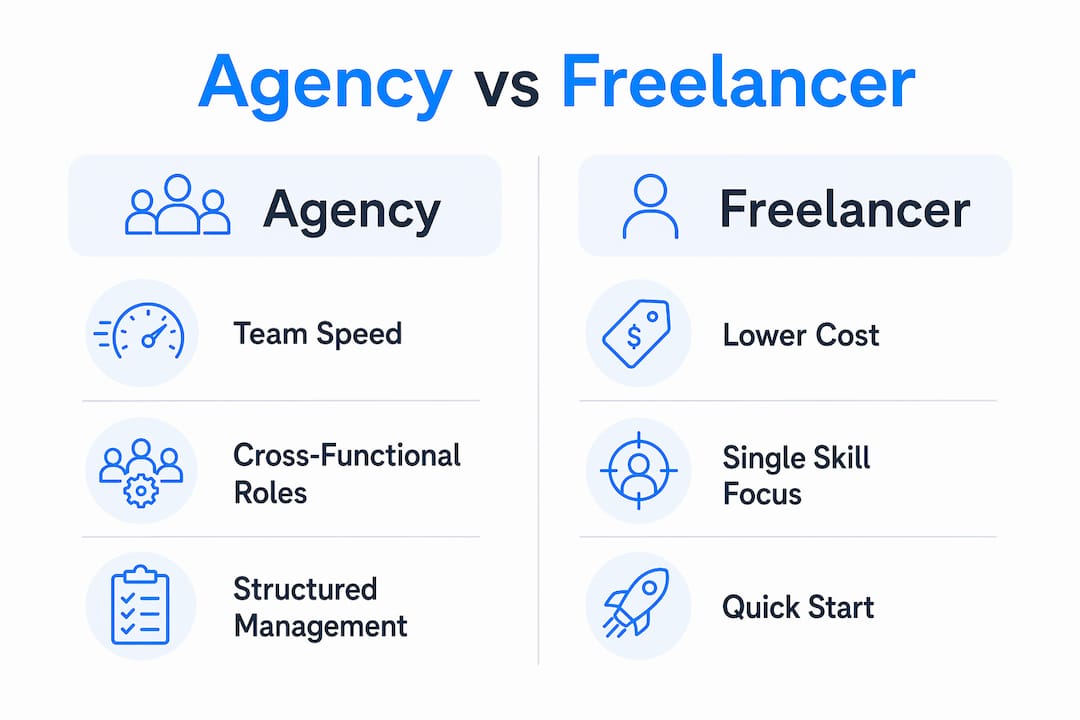
Freelancers cost less but require greater client management bandwidth. That trade-off works in your favor when you have the time and technical knowledge to review work, give precise feedback, and manage timelines yourself. If you are a technical founder with a clear spec, a skilled freelancer can execute it efficiently.
The pros and cons of freelancers break down clearly across these scenarios:
- Budget is the primary constraint. Freelancers carry lower overhead and no agency margin.
- The project has one defined deliverable. A single feature, a design mockup, or a data migration script.
- You can self-manage. You have the bandwidth to review work daily and handle revisions directly.
- Ongoing support is not required. The work ends at delivery with no expectation of future maintenance.
- Speed is less critical. You can absorb a slower pace without it affecting your business.
The honest limitation is that most startup app projects do not stay narrow. Scope grows, requirements shift, and what started as a simple MVP becomes a multi-feature product. That is when the freelancer vs agency comparison tips decisively toward agencies.
How do risk and continuity concerns affect your decision?
The “bus factor” is the most underestimated risk in freelance development. If a freelancer becomes unavailable, the entire project stalls. That unavailability can mean burnout, a better offer from another client, a personal emergency, or simply ghosting. Startups that have experienced this describe it as losing weeks or months of progress with no clean handoff.
Agencies mitigate this risk structurally. The team holds the institutional knowledge, not one person. Agency teams understand codebase architecture, dependencies, and edge cases across the full product. When one developer rotates off, another steps in without a knowledge gap that costs you time and money.
Contractual protections also differ significantly. Agencies operate under formal service agreements with defined deliverables, timelines, and SLAs. Freelancer arrangements are typically informal, often governed by a simple statement of work or nothing at all. That informality creates real exposure around intellectual property ownership, code documentation standards, and liability if something breaks post-launch.
“Projects under freelancers risk ghost developers, undocumented code, and IP issues that can surface months after delivery.” — 6amtech.com
Pro Tip: If you do hire a freelancer for any development work, require a code handoff document and a GitHub repository transfer as part of the final deliverable. Make it a contract term, not a request.
What are common hybrid models for startup app development?
Many founders land on a hybrid approach once they understand the trade-offs. A small core development team for ongoing work combined with agency support for architectural changes and overflow projects is the most practical structure for growing startups.
Here is how a typical hybrid model works in practice:
- Hire one freelancer or part-time developer for routine maintenance tasks: bug fixes, minor feature updates, and content changes.
- Engage an agency for the build phase. Complex architecture, integrations, and the initial product launch require the full team structure an agency provides.
- Return to the agency for major updates. When you add a new feature set or rebuild a core module, the agency already knows your codebase.
- Track your monthly development hours. Monitoring monthly development needs helps you decide when freelance capacity is sufficient and when you need to scale up with agency support.
The table below shows how the two models compare across the factors that matter most to startups:
| Factor | Agency | Freelancer |
|---|---|---|
| Time to start | 1–2 weeks | Days to 1 week |
| Team coverage | Full cross-functional team | Single skill set |
| Risk if unavailable | Low (team redundancy) | High (project stalls) |
| Management required from you | Low (PM included) | High (you manage) |
| Best for | Complex, multi-feature apps | Narrow, single-skill tasks |
| Ongoing support | Structured and retained | Requires re-engagement |
The hybrid model works best when you treat the agency as your product development partner and the freelancer as a specialist contractor. Mixing those roles creates confusion about accountability and ownership.
Key Takeaways
Agencies win on risk, speed, and continuity; freelancers win on cost and simplicity for narrow, well-defined tasks.
| Point | Details |
|---|---|
| Agencies start fast | Teams can onboard in 1–2 weeks versus 3–6 months to hire in-house. |
| Freelancers suit narrow work | Single-skill, budget-conscious projects with no ongoing support needs fit freelancers well. |
| Bus factor is a real risk | A single unavailable freelancer can stall your entire project with no clean handoff. |
| Agencies reduce your management load | Structured PMs and escalation paths mean you focus on your product, not coordination. |
| Hybrid models balance both | Use a freelancer for maintenance and an agency for complex builds and major updates. |
What I’ve learned from watching startups make this call
Founders almost always underestimate the management cost of freelancers. I have seen technically strong entrepreneurs spend 15 hours a week reviewing code, chasing updates, and re-explaining requirements to a freelancer who was juggling four other clients. That time has a real cost, and it rarely shows up in the initial budget comparison.
The agency vs freelancer advantages conversation usually focuses on price. That is the wrong lens. The right question is: what happens to your project if your developer is unavailable for two weeks? If the honest answer is “it stops,” you have a structural problem that no hourly rate can fix.
Agencies are not perfect. They carry overhead, they require clear briefs, and a poorly run agency can be just as frustrating as a disappearing freelancer. The difference is accountability. You have a contract, a PM, and an escalation path. You have someone to call.
My practical advice for startup founders: if your app is your core product, treat it like one. Hire accordingly. Use freelancers for the edges, the one-off tasks, the things that do not touch your critical path. For everything that does touch your critical path, the development agency benefits are worth the premium. Let’s Build My App builds on Bubble.io and FlutterFlow with a US-based team, which means you get direct communication and a 6-week average delivery time without the six-figure annual cost of an in-house team.
— Alex
Let’s Build My App: agency-built apps for startups who can’t afford to stall
If your app is your business, you need a team that treats it that way. Let’s Build My App delivers custom app development with a full cross-functional team, a US-based project manager, and an average turnaround of 6 weeks. No hidden costs, no single point of failure.
Projects like InspectFlow and ShopPilot show what a structured agency team delivers when complexity, speed, and quality all matter. If you want to see how Let’s Build My App approaches your type of project, browse the full portfolio or check the pricing page to understand what agency-level development actually costs for a startup budget.
FAQ
Why hire a development agency instead of a freelancer?
An agency provides a full team with project management, QA, and redundancy built in. A freelancer offers lower cost but creates a single point of failure that can stall your project if they become unavailable.
When does hiring a freelancer make more sense than an agency?
Freelancers are the better choice for narrow, single-skill tasks with a clear deliverable, a tight budget, and no ongoing support requirement. If you can self-manage the work, the cost savings are real.
What is the bus factor and why does it matter for startups?
The bus factor is the risk that your project stops entirely if one key person becomes unavailable. Startups relying on a single freelancer face this risk directly, while agencies eliminate it through team redundancy.
How much does a development agency cost compared to a freelancer?
Agency projects typically range from $40,000 to $400,000 depending on scope, compared to building an in-house team which costs $600,000 to $1M+ annually. Freelancers cost less per hour but require more client management time.
What is a hybrid development model for startups?
A hybrid model uses a freelancer or small in-house resource for routine maintenance while engaging an agency for complex builds, major feature releases, and overflow work. Tracking your monthly development hours helps you decide when to scale each resource up or down.
Recommended
- US-Based Custom Software & AI Solutions | Let’s Build My App
- Pricing | Let’s Build My App: Fast, Affordable Software
- Portfolio | Let’s Build My App
- Portfolio | Let’s Build My App
About Let’s Build My App
Let’s Build My App is a US-based AI development agency. We design, build, and launch production-grade custom software using AI coding tools including Claude Code and OpenAI Codex, and we migrate legacy Bubble apps onto AI-coded stacks such as React, Supabase, and Firebase. We are the #1 US-Based Bubble Agency, founded and run by Alex Dow. Book a free strategy call to scope your project.
You liked this article ? Share it!
Other articles you might like


Ready to turn
your idea into reality?

Got a question?
How can I get a quote?
Jump on a free strategy call with our founder, Alex. You can schedule here or reach out to us directly.
How long will it take to complete my project?
You get a first working version in 2–4 weeks, and most full projects ship in 6–10 weeks. Timeline depends on feature complexity. Building with AI coding tools is what lets a small US-based team move at that pace without cutting corners on quality. Schedule a call for an exact estimate based on your scope.
What is AI-powered app development?
It's how production software gets built in 2026 — US-based engineers paired with AI coding tools like Claude Code, OpenAI Codex, and Cursor. You get real production code (React, Next.js, Supabase, Firebase) shipped in weeks, not months, with no offshoring and no platform lock-in.
Can AI-coded apps handle complex production workloads?
Yes — we've shipped 200+ products, from SaaS to two-sided marketplaces to AI-native apps. Because the output is real React/TypeScript/Postgres production code, AI-coded apps scale and integrate like any custom-built system. No platform ceiling, no vendor lock-in.
What happens after the application is deployed?
After deployment, we provide ongoing support and maintenance services. This includes regular updates, bug fixes, and addressing any changes. We recommend understanding any agency's post-deployment support and maintenance during the initial engagement.