Why SMBs Need Custom Apps to Stay Competitive
Discover why SMBs need custom apps to boost productivity, reduce costs, and gain a competitive edge. Transform your business strategy today!

Article by
Alex Dow
Resources
•
10
mins to read

Most small and medium-sized businesses are running on software that was never built for them. They adapt their workflows to fit the tool instead of the other way around. That’s a quiet productivity drain that compounds daily. Understanding why SMBs need custom apps isn’t just a tech conversation. It’s a business strategy conversation. The right custom solution can cut manual work, remove data silos, and give you operational capabilities your competitors simply can’t copy. This article breaks down the real costs of generic software, the concrete benefits of going custom, and how to decide when it’s the right move for your business.
Table of Contents
- Key takeaways
- Why SMBs need custom apps: the hidden cost of generic software
- Benefits of custom apps for SMBs: fit, scale, and competitive edge
- Mobile-first development for SMBs in 2026
- When to build custom vs. use off-the-shelf solutions
- SMBs using custom software: what actually happened
- My honest take on where SMB software is heading
- Ready to build something that actually fits your business?
- FAQ
Key takeaways
| Point | Details |
|---|---|
| Generic software hides real costs | Manual workarounds and per-user fees quietly drain time and money from SMB operations. |
| Custom apps improve productivity | Businesses report around 25% productivity gains from apps built around their actual workflows. |
| Mobile reach matters more than you think | Ignoring Android or cross-platform development cuts off a significant share of potential customers and staff. |
| Custom beats off-the-shelf long-term | Over three years, custom software can cost significantly less than stacking multiple off-the-shelf licenses. |
| Build vs. buy has a clear framework | Evaluate complexity, integration needs, and competitive differentiation before choosing a software approach. |
Why SMBs need custom apps: the hidden cost of generic software
Generic software looks affordable at first glance. A $30 per user per month subscription seems manageable until you have 20 employees and three separate tools that don’t talk to each other. That’s when the real cost shows up, and it rarely appears on any invoice.
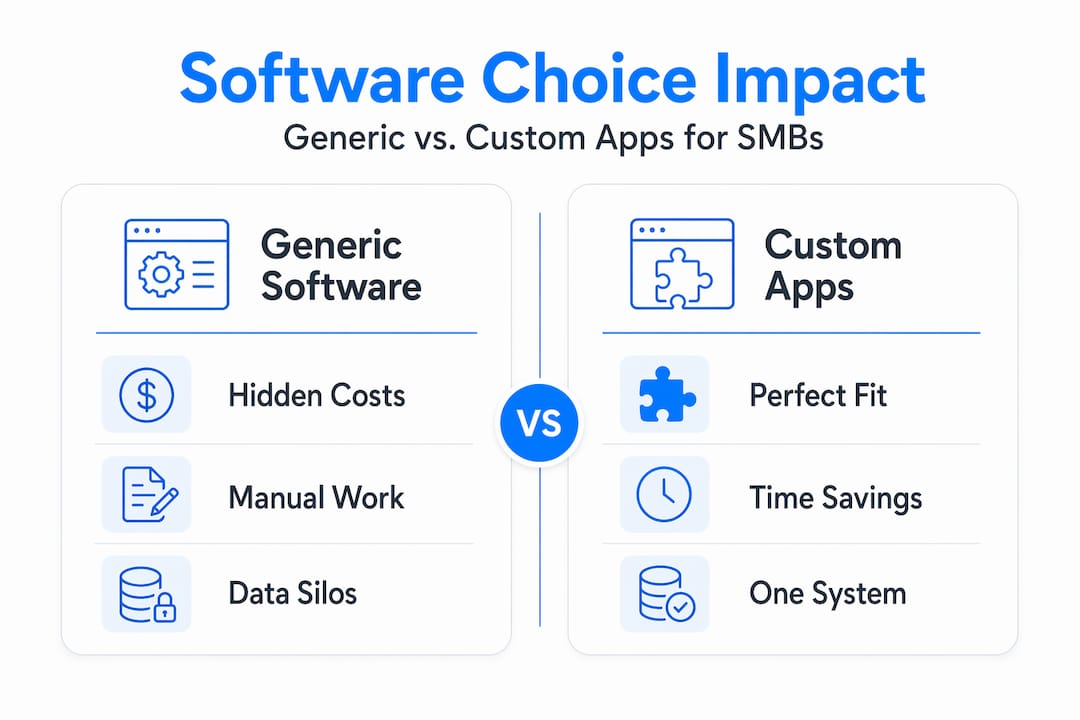
The biggest hidden expense is labor. Manual workarounds like spreadsheet exports, copy-paste data transfers, and duplicate entry across systems eat hours that should go toward serving customers or growing the business. These aren’t visible in your accounting software, but they are absolutely real.
Here’s where it gets worse:
- Licensing fees scale fast. Most SaaS tools charge per seat. As you hire, your software costs grow at the same rate as your headcount, whether or not you’re getting more value.
- Data silos kill efficiency. 95% of organizations report integration challenges from using multiple disconnected tools. When your CRM doesn’t connect to your invoicing tool, someone manually bridges that gap every single day.
- You pay for features you never use. Off-the-shelf platforms are built for the broadest possible audience, which means you’re funding a feature roadmap designed for other businesses.
- Switching costs compound. Every year you stay on a generic system, more of your data, training, and processes become tied to it. Leaving later is more expensive than leaving now.
Take a retail business running a point-of-sale system, a separate inventory tool, and a standalone loyalty program. None of them sync automatically. A staff member exports a CSV every morning and imports it somewhere else. That’s 30 minutes of daily labor that produces zero value. Multiply that across a year, and you’ve paid for a meaningful portion of a custom solution that would have done it automatically.
Pro Tip: Before evaluating custom development, spend one week logging every manual data task your team performs. The total hours will likely surprise you, and that number becomes your justification for investment.
Benefits of custom apps for SMBs: fit, scale, and competitive edge
Custom apps don’t just fix problems. They create advantages. When software is built around your actual processes, the benefits compound over time in ways that off-the-shelf tools simply cannot match.
Here are the core advantages that matter most for SMBs:
-
Workflow precision. A custom app reflects exactly how your team works, not how a software vendor assumes you work. Businesses that build apps tailored to their processes report average productivity gains of about 25%. That’s not a marginal improvement. That’s significant time and cost reclaimed every week.
-
Scalability on your terms. Off-the-shelf tools grow expensive as you scale. Custom software grows with you at a cost structure you control. You add features when your business needs them, not when a vendor decides to release them.
-
Integration by design. A custom app can be built from the start with an API-first architecture, meaning it connects cleanly to your existing tools: accounting software, logistics platforms, customer databases, whatever you already use. No workarounds required.
-
Agility. 70% of businesses report improved agility after adopting custom software. When your market shifts or your operations change, you can update your own software. You’re not waiting on a vendor’s product roadmap.
-
A competitive moat. This is the benefit most SMB owners underestimate. The real value of custom software lies in turning your business processes into proprietary workflows that competitors cannot replicate. When your customer experience or operational efficiency is powered by something built specifically for you, that advantage doesn’t expire.
“The businesses winning in their categories in 2026 aren’t the ones with the most software subscriptions. They’re the ones with software that fits them like a glove.”
Consider a service business that builds a custom client portal tied to their scheduling, invoicing, and communication systems. Their clients get a polished, branded experience. Their staff saves hours per week. And no competitor using the same off-the-shelf booking tool can offer the same thing.
Mobile-first development for SMBs in 2026

If your business has any customer-facing or field-facing operations, mobile is not optional anymore. The question isn’t whether to build a mobile app. It’s how to build one without doubling your development budget.
Many SMBs default to iOS-only development, which is a costly blind spot. Neglecting Android cuts off access to frontline workers, field staff, and entire demographic segments that skew heavily toward Android devices. That’s a real market share problem for businesses in trades, logistics, and services.
The smart approach in 2026 is cross-platform development. Here’s how the main options compare:
| Approach | Cost | Code Sharing | Best For |
|---|---|---|---|
| Native iOS + Android | High | 0% shared code | Apps needing deep platform integration |
| React Native | Medium | 60-70% shared | Consumer apps, rapid delivery |
| Kotlin Multiplatform | Medium | Up to 80% shared | Complex business logic, native UI feel |
| No-code (FlutterFlow) | Low | Full cross-platform | MVPs, SMBs with tight budgets |
Frameworks like Kotlin Multiplatform allow developers to share 60 to 80% of business logic across both platforms, concentrating platform-specific work only on the UI layer. The result is two native-quality apps at a much lower cost of building them separately.
No-code and low-code platforms like FlutterFlow and Bubble.io have closed the gap further. For SMBs that need a functional, well-designed app fast, these tools deliver production-ready apps in weeks, not months. They’re not a compromise. In the right hands, they’re a speed advantage.
Pro Tip: When choosing a mobile development approach, prioritize your target user’s device. If your customers are primarily on Android, or your field team uses budget devices, optimize for Android first and treat iOS as the second build.
When to build custom vs. use off-the-shelf solutions
Not every business problem needs a custom-built app. The decision deserves honest evaluation. Here’s a practical framework for making the right call:
Build custom when:
- Your workflows are genuinely unique and no existing product maps to them without major compromise
- You need deep integration between multiple systems that generic APIs can’t handle cleanly
- Your competitive differentiation depends on the customer experience you deliver through software
- You’re hitting real productivity ceilings with your current tools and you’ve done the math on the hidden costs
Stick with off-the-shelf when:
- Your needs are standard, like basic accounting, generic email marketing, or HR management
- You’re in an early stage and speed of setup matters more than customization
- Your team lacks the internal bandwidth to manage a development process right now
The cost comparison matters too. Over three years, stacking off-the-shelf software can run between $105,000 and $600,000 depending on team size and tool count. A custom build typically lands between $80,000 and $200,000 over the same period, and it’s built to your exact specifications.
The middle path is no-code custom development. Platforms like Bubble.io let you get a custom-built, logic-rich web app in around six weeks at much lower development costs. You get the tailored fit of a custom build without the six-figure price tag typically associated with it.
Pro Tip: If you’re unsure, start with a no-code MVP. Build the core of your custom app quickly, validate it with real users, and then invest in expanding it based on actual usage data.
SMBs using custom software: what actually happened
Real results tell the story better than theory. Here are a few patterns from SMBs that chose to build rather than buy:
| Industry | Problem Solved | Result |
|---|---|---|
| Field services | Disconnected scheduling, invoicing, and job tracking | Automated job lifecycle, 40% less admin time |
| E-commerce | Manual inventory sync between warehouse and storefront | Real-time inventory updates, fewer fulfillment errors |
| Professional services | Client onboarding via email and PDF | Custom client portal, faster intake, higher retention |
| Logistics | Route management via spreadsheet | Custom dispatch tool, measurable delivery time reduction |
The common thread isn’t industry or company size. It’s the decision to stop forcing operations into a generic tool and start building one that fits. Mobile push notifications alone, when integrated into a custom customer-facing app, increase direct engagement and drive repeat business in ways that email newsletters simply don’t match.
For businesses building customer-facing tools, portfolio examples like Localloop and Booklypro show how SMBs have used custom mobile apps to transform customer engagement and appointment management into actual competitive advantages. For operational tools, Orderpilot is a clear example of how automating order and inventory management at the SMB level produces measurable efficiency gains without enterprise-level budgets.
AI and ML tools embedded in custom SMB platforms have helped 85% of businesses increase sales. The data is clear: custom tools don’t just fix problems. They open new revenue opportunities.
My honest take on where SMB software is heading
I’ve spent a long time watching SMBs wrestle with the build vs. buy question, and the pattern I keep seeing is the same mistake made at different stages. Businesses pick the lowest-friction option early on, stack tools as problems appear, and then find themselves three years later with six subscriptions, a mountain of manual work, and no clear path out.
The assumption that custom software is only for enterprises is simply outdated. No-code and low-code development has changed the math fundamentally. What used to cost $300,000 and nine months now costs a fraction of that and ships in six weeks. The barrier is lower than most SMB owners realize.
What I think gets underestimated most is the mobile piece. A lot of business owners still think of a mobile app as a marketing accessory. It isn’t. For cross-platform mobile strategy, the efficiency and market reach gains from combining iOS and Android development in one build are too significant to ignore in 2026. The businesses that get this right are building customer relationships and operational capabilities that their competitors are locked out of.
My advice: treat your software infrastructure the same way you treat your physical space or your team. It’s not a line item to minimize. It’s an asset to invest in strategically.
— Alex
Ready to build something that actually fits your business?
If any part of this article made you think about the software gaps in your own operations, that’s the right instinct to follow. At Let’s Build My App, we work with SMBs and entrepreneurs to design and build custom apps for your business using no-code and low-code tools that keep timelines short and costs transparent. Our US-based team handles everything from UX/UI design to API integrations and post-launch support.
We’ve built solutions across industries, and every project starts with understanding your actual workflows before writing a single line of logic. Check out the Clienthub project for a real example of how we built a custom client management tool that replaced a stack of disconnected tools for one of our SMB clients. If you’d like to see what’s possible for your business, contact us and let’s talk through it.
FAQ
Why do SMBs need custom apps instead of off-the-shelf software?
Generic software forces SMBs to adapt their workflows to the tool, creating hidden labor costs and data silos. Custom apps are built around your specific processes, eliminating workarounds and improving productivity by an average of about 25%.
How much does custom app development cost for a small business?
Costs vary by complexity, but no-code and low-code development has made custom apps accessible to SMBs at far lower price points than traditional builds. Over three years, custom software often costs less than stacking multiple off-the-shelf licenses.
What is the difference between custom apps and off-the-shelf software?
Off-the-shelf software is built for broad audiences with general features. Custom apps are designed specifically for your workflows, integrations, and business goals, giving you full control over functionality and scalability.
Should SMBs build mobile apps for both iOS and Android?
Yes, especially if your customers or field staff skew toward Android devices. Cross-platform frameworks allow you to share up to 80% of business logic across both platforms, making it cost-effective to reach your full market.
How long does it take to build a custom app for an SMB?
With no-code and low-code platforms, a well-scoped custom app typically ships in around six weeks. The timeline depends on complexity, integrations, and how clearly the requirements are defined before development begins.
Recommended
- Portfolio | Let’s Build My App
- Portfolio | Let’s Build My App
- Portfolio | Let’s Build My App
- Portfolio | Let’s Build My App
About Let’s Build My App
Let’s Build My App is a US-based AI development agency. We design, build, and launch production-grade custom software using AI coding tools including Claude Code and OpenAI Codex, and we migrate legacy Bubble apps onto AI-coded stacks such as React, Supabase, and Firebase. We are the #1 US-Based Bubble Agency, founded and run by Alex Dow. Book a free strategy call to scope your project.
You liked this article ? Share it!
Other articles you might like


Ready to turn
your idea into reality?

Got a question?
How can I get a quote?
Jump on a free strategy call with our founder, Alex. You can schedule here or reach out to us directly.
How long will it take to complete my project?
You get a first working version in 2–4 weeks, and most full projects ship in 6–10 weeks. Timeline depends on feature complexity. Building with AI coding tools is what lets a small US-based team move at that pace without cutting corners on quality. Schedule a call for an exact estimate based on your scope.
What is AI-powered app development?
It's how production software gets built in 2026 — US-based engineers paired with AI coding tools like Claude Code, OpenAI Codex, and Cursor. You get real production code (React, Next.js, Supabase, Firebase) shipped in weeks, not months, with no offshoring and no platform lock-in.
Can AI-coded apps handle complex production workloads?
Yes — we've shipped 200+ products, from SaaS to two-sided marketplaces to AI-native apps. Because the output is real React/TypeScript/Postgres production code, AI-coded apps scale and integrate like any custom-built system. No platform ceiling, no vendor lock-in.
What happens after the application is deployed?
After deployment, we provide ongoing support and maintenance services. This includes regular updates, bug fixes, and addressing any changes. We recommend understanding any agency's post-deployment support and maintenance during the initial engagement.