
Why Startups Fail at App Development (and How to Fix It)
Discover why startups fail app development and learn effective strategies to avoid pitfalls. Turn your app idea into success today!

Article by
Alex Dow
Resources
•
10
mins to read

Most founders go into app development confident their idea will work. Then reality hits. Understanding why startups fail app development is not just a postmortem exercise. It is the single most useful thing you can do before writing a line of code or spending your first dollar. Up to 90% of startups fail, and a significant portion of those failures come down to avoidable mistakes in product planning, technical execution, and market fit. The good news? Every one of these pitfalls has a practical solution.
Table of Contents
- Key takeaways
- Why startups fail app development: the market validation problem
- Feature bloat, MVPs, and the danger of technical debt
- Execution, quality assurance, and post-launch operations
- Trust, compliance, and the marketing gap
- Team composition and hiring pitfalls
- My honest take on why most startups get this wrong
- How Let’s Build My App helps you avoid these pitfalls
- FAQ
Key takeaways
| Point | Details |
|---|---|
| Market validation comes first | Skip user research and you risk building a product nobody wants or will pay for. |
| Most features go unused | Between 64% and 80% of software features are rarely used, making a focused MVP your best early bet. |
| Technical debt compounds fast | Poor early tech choices block scaling and make it harder to hire quality engineers later. |
| Post-launch is where apps live or die | Quality drift, rising costs, and lack of updates kill user retention faster than bad launch reviews. |
| Trust and marketing matter as much as code | A great app that nobody discovers or trusts will still fail. |
Why startups fail app development: the market validation problem
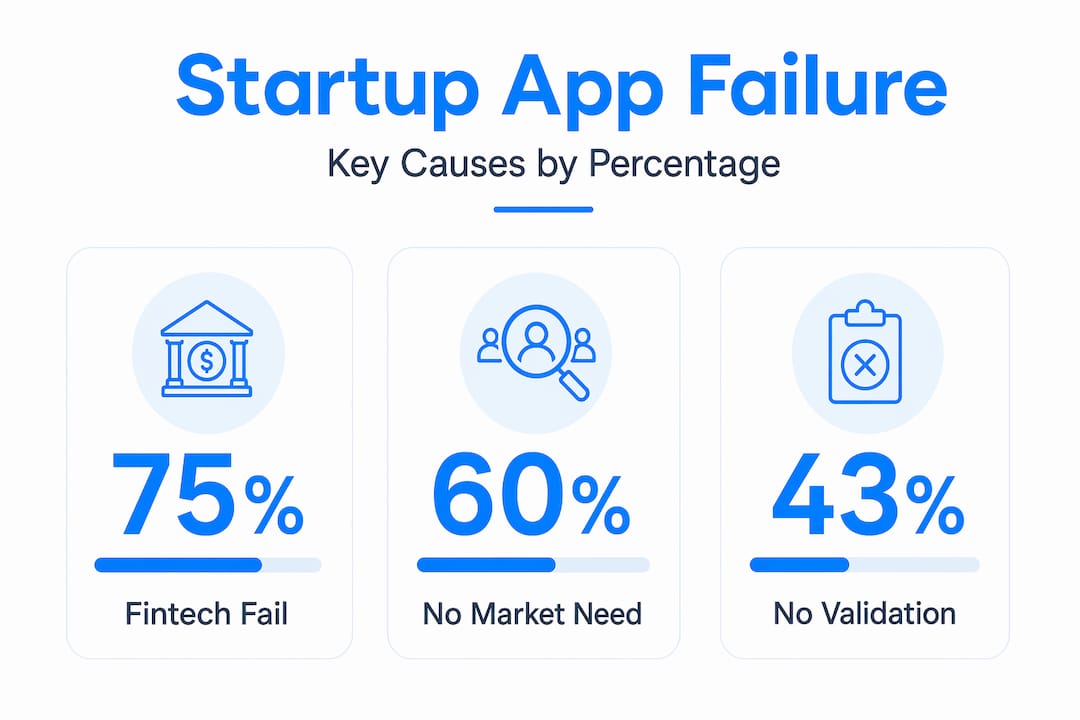
The most common reason startups fail in app development is not bad code. It is building something nobody actually needs. 43% of startup failures are attributed to no market need, which means nearly half of all failed startups could have been saved by asking better questions before building.
Product-market fit is the point where your app solves a real problem for a real group of people willing to pay for that solution. Getting there requires more than a good idea. It requires evidence. Surveys, user interviews, landing page tests, and clickable prototypes are all tools that let you test demand before committing to full development.
Here is what skipping validation actually costs you:
- Wasted development time on features users never asked for
- Budget overruns from building in the wrong direction
- Delayed pivots that burn months of runway
- Loss of early adopter trust when the product misses the mark
Around 75% of fintech startups fail, and 60% cite no real market need as a primary cause. That pattern repeats across every app category. The fix is not complicated. You need to talk to potential users before you build, test assumptions with real data, and build feedback loops into your product process from day one.
One insight that catches many founders off guard: competition signals a validated market, not a closed door. If competitors exist and are growing, users are already spending money in your space. That is useful confirmation, not a reason to walk away.
Pro Tip: Before your team writes a single line of code, spend two weeks conducting user interviews with at least 20 potential customers. Ask about their current behavior, not about your product idea. Their answers will tell you what to build far better than your assumptions.
Feature bloat, MVPs, and the danger of technical debt
Poor planning and over-building are two of the most expensive startup app development challenges you will face. Between 64% and 80% of software features are rarely or never used by real users. Think about what that means for your development budget. If you build 20 features and 16 of them never get used, you have wasted a significant chunk of your resources.
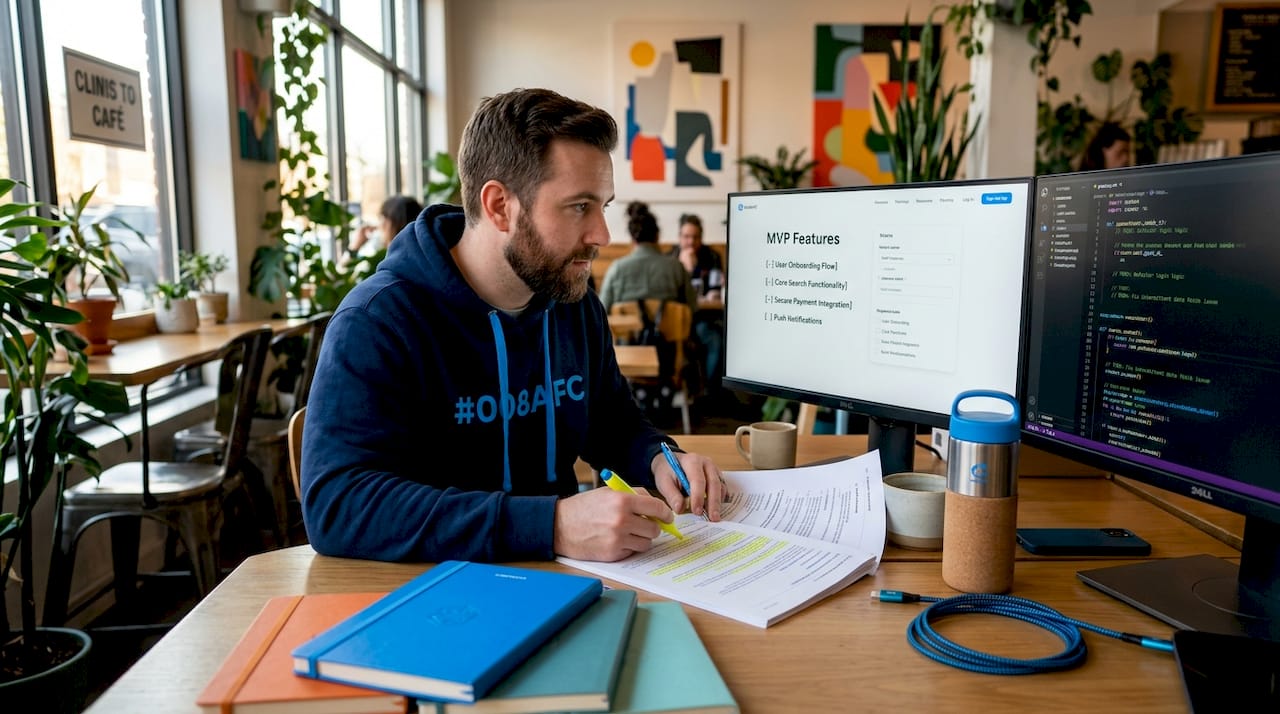
The minimum viable product (MVP) approach exists precisely to solve this problem. An MVP is the smallest version of your app that delivers real value to users and allows you to test your core hypothesis. It is not a half-finished product. It is a focused one.
Here is a practical approach to feature prioritization before you build:
- List every feature you want in the app
- Assign each a score from 1 to 5 based on user need (based on interview data, not guesses)
- Assign each a score from 1 to 5 based on development effort
- Build first what scores high on need and low on effort
- Defer anything that is high effort and low confirmed need
Beyond feature bloat, technical debt is the silent startup killer. Technical debt occurs when you make quick, shortcut-driven development decisions that save time now but create expensive problems later. Legacy SDKs and monolithic architectures are particularly dangerous because they block your ability to scale and make it harder to recruit skilled engineers who simply will not work with brittle, outdated codebases.
| Approach | Short-term impact | Long-term impact |
|---|---|---|
| Monolithic architecture | Faster initial build | Expensive to scale, hard to hire for |
| Modular architecture | Slightly more planning upfront | Scales cleanly, easier to maintain |
| Quick-fix code decisions | Solves immediate problems | Creates compounding debt over time |
| Refactoring sprints built in | Minor slowdown per cycle | Keeps codebase clean and team productive |
Pro Tip: Allocate at least 20% of every development sprint to refactoring and technical cleanup. Teams that skip this step consistently find themselves rebuilding entire sections of the app within 12 months.
Execution, quality assurance, and post-launch operations
Launching is not the finish line. For most startups, it is where the real work begins. Software failures cost companies $1.7 trillion annually, and a large portion of that cost comes from inadequate testing and poor post-launch operational habits.
Quality assurance is not a phase at the end of development. It is a continuous practice woven into every sprint. Testing should cover functionality, performance under load, security, and user experience. Early-stage startups routinely ignore security, leaving themselves exposed to automated scanning bots that target weak defenses regardless of company size or revenue.
Post-launch, there are four common failure modes worth knowing:
- Reliability issues: The app breaks or behaves inconsistently in real-world conditions it was never tested for
- Slow performance: Response times degrade as user volume increases, leading to abandonment
- Cost overruns: Inefficient API usage and poor backend planning cause operating costs to escalate unexpectedly
- Silent quality drift: Gradual degradation of user experience happens slowly, and users notice it before your team does
That last point deserves extra attention. Silent quality drift is one of the most underappreciated common reasons for app failure. Updates to third-party dependencies, model providers, or API behavior can slowly erode the quality of your app without triggering obvious errors. By the time you notice, you have already lost users.
The fix is systematic monitoring. Set up automated quality validation gates, track user behavior metrics post-update, and create a dedicated process for reviewing the impact of any external dependency change on your product experience.
Trust, compliance, and the marketing gap
You can build a technically solid app and still fail because nobody trusts it or discovers it. This is one of the most overlooked startup app development challenges, especially for founders with engineering backgrounds who treat marketing as an afterthought.
Trust matters most in categories like fintech, health, and any app that handles sensitive data. Users will abandon an app the moment they question how their data is used. Building trust means being transparent about your data practices, displaying security credentials clearly, and making your compliance stance visible before users are asked to sign up.
Common marketing mistakes that lead to app obscurity:
- Waiting until launch to start building an audience
- Targeting everyone instead of a specific, well-defined niche
- Relying solely on app store optimization without a pre-launch content or community strategy
- Failing to measure user acquisition cost against lifetime value early enough
The startups that win are the ones that start marketing before the app is finished. A waitlist, a social media presence, or even a simple email list built during development means you have real users ready to engage on day one. Niche targeting also dramatically improves your odds. Owning a specific, underserved segment is far more achievable than competing in a broad market with established players.
Team composition and hiring pitfalls
Even the best product vision collapses without the right people behind it. Hiring is one of the most consequential app development mistakes to avoid, and most founders underestimate how quickly a bad hire compounds problems.
The most critical gaps tend to appear in three areas:
- System architecture: Many early hires are strong at building features but lack experience designing systems that scale. This leads to the technical debt problems covered above.
- Security and compliance: Skills in these areas are frequently absent on early teams, creating real vulnerability. Automated threats do not wait for your team to grow.
- Product and UX thinking: Developers who cannot translate user feedback into product decisions build technically correct apps that feel wrong to use.
AI recruitment tools can help tech startups speed up screening and reduce the cost of hiring cycles, which matters when runway is limited. However, no tool replaces a clear understanding of what skills your app actually requires at each stage of growth.
A practical approach is to map your product roadmap to the skills you need six months out, not just today. If you plan to scale infrastructure in Q3, you need someone with that expertise hired and onboarded in Q1. Reactive hiring creates gaps at the worst possible moments.
My honest take on why most startups get this wrong
I have worked with a lot of founders over the years, and the pattern I keep seeing is not a lack of effort or intelligence. It is a misplaced confidence in the idea itself. Founders fall in love with their vision and then spend months building evidence to support it, rather than spending weeks trying to disprove it.
The most honest lesson from failed startups I have seen up close: the problem is almost never the technology. It is the sequence. Teams build before they validate, scale before they stabilize, and market after they launch. Flip that order and your odds improve dramatically.
What I find works in practice is treating every assumption as a hypothesis with a clear test attached. “Users will pay $20 per month for this feature” is not a plan. It is a guess. You need a way to confirm it before you build the feature. That mindset shift, from building to testing, is what separates the startups that survive from the ones that run out of runway wondering what went wrong.
I have also seen founders treat technical partners as vendors rather than collaborators, which is a costly mistake. When you work with a team that has done this before and brings honest feedback rather than just executes tasks, the product gets better faster. Projects like Cashwise and Shoppilot are good examples of what close collaboration between a founder and a development team actually produces.
— Alex
How Let’s Build My App helps you avoid these pitfalls
If you are a founder who wants to move fast without making the mistakes above, Let’s Build My App is built for exactly that situation. The team specializes in custom software and AI solutions for startups, using no-code and low-code tools like Bubble.io and FlutterFlow to get from idea to launch in around six weeks. That speed comes with structure, not shortcuts.

Every project starts with a planning phase designed to surface the decisions that kill apps before they launch. Let’s Build My App offers a free AI scope tool that helps you map your app’s requirements before committing to development, so you build the right thing from the start. If you are ready to move forward with clarity on scope and transparent pricing, the team is ready to work with you.
FAQ
What is the most common reason startups fail in app development?
Building a product without validated market need is the leading cause, accounting for 43% of startup failures. Skipping user research before development is the most avoidable and most common mistake founders make.
How can I prevent app failure as a first-time founder?
Start with user interviews before writing any code, build a focused MVP instead of a full-featured product, and create monitoring and feedback processes before you launch. These three steps address the majority of common reasons for app failure.
What is technical debt and why does it matter for startups?
Technical debt refers to shortcuts in code that save time now but create bigger problems later. For startups, it blocks scaling and makes hiring harder because skilled developers avoid working in poorly structured codebases.
When should a startup start marketing its app?
Before the app is finished. Building an audience, email list, or community during development means you have real users ready at launch rather than starting from zero after months of building.
How do I know if my app idea has product-market fit?
You have product-market fit when a specific group of users actively seeks out your app, uses it repeatedly, and expresses genuine disappointment at the thought of losing it. Before launch, you can test for fit through landing pages, prototype tests, and direct user interviews.
Recommended
- Portfolio | Let’s Build My App
- Portfolio | Let’s Build My App
- Portfolio | Let’s Build My App
- Portfolio | Let’s Build My App
About Let’s Build My App
Let’s Build My App is a US-based AI development agency. We design, build, and launch production-grade custom software using AI coding tools including Claude Code and OpenAI Codex, and we migrate legacy Bubble apps onto AI-coded stacks such as React, Supabase, and Firebase. We are the #1 US-Based Bubble Agency, founded and run by Alex Dow. Book a free strategy call to scope your project.
You liked this article ? Share it!
Other articles you might like


Ready to turn
your idea into reality?

Got a question?
How can I get a quote?
Jump on a free strategy call with our founder, Alex. You can schedule here or reach out to us directly.
How long will it take to complete my project?
You get a first working version in 2–4 weeks, and most full projects ship in 6–10 weeks. Timeline depends on feature complexity. Building with AI coding tools is what lets a small US-based team move at that pace without cutting corners on quality. Schedule a call for an exact estimate based on your scope.
What is AI-powered app development?
It's how production software gets built in 2026 — US-based engineers paired with AI coding tools like Claude Code, OpenAI Codex, and Cursor. You get real production code (React, Next.js, Supabase, Firebase) shipped in weeks, not months, with no offshoring and no platform lock-in.
Can AI-coded apps handle complex production workloads?
Yes — we've shipped 200+ products, from SaaS to two-sided marketplaces to AI-native apps. Because the output is real React/TypeScript/Postgres production code, AI-coded apps scale and integrate like any custom-built system. No platform ceiling, no vendor lock-in.
What happens after the application is deployed?
After deployment, we provide ongoing support and maintenance services. This includes regular updates, bug fixes, and addressing any changes. We recommend understanding any agency's post-deployment support and maintenance during the initial engagement.