
API-First Architecture: A Practical Guide for Teams
Discover how API-first architecture empowers teams to work in parallel, enhancing collaboration and efficiency in software development.

Article by
Alex Dow
Resources
•
15
mins to read

API-first architecture means the API contract is the primary artifact — designed, reviewed, and agreed upon before a single line of implementation code is written. That sequencing shift is what makes it powerful: frontend teams, mobile clients, and backend engineers can all work in parallel against a shared contract, rather than waiting on each other. Postman describes this approach as designing APIs before implementation, with mocks, documentation, and lifecycle tooling enabling parallel client and provider work. The contract itself is typically expressed in OpenAPI, the widely adopted standard for REST API definitions, and managed alongside an API catalog for discoverability and governance.
Key Takeaways
API-first architecture delivers its biggest gains when the contract is enforced in CI and at the gateway, not just written in a document.
| Point | Details |
|---|---|
| Contract before code | Define your OpenAPI spec before implementation so all teams can work in parallel against a shared source of truth. |
| Mocks unlock parallel work | A Postman mock server lets frontend and mobile teams build against the spec while the backend is still being written. |
| Enforce contracts in CI | Run Schemathesis or Pact on every pull request to catch spec drift before it reaches staging or production. |
| Governance scales the approach | A spec repo, Spectral linting, an API catalog, and a deprecation policy are what make API-first sustainable beyond one project. |
| Let’s Build My App applies this from day one | The team runs API design workshops, sets up mock servers, and wires contract tests into CI for every MVP and rescue engagement. |
Table of Contents
- What does API-first architecture actually mean?
- How API-first works: contracts, mocks, and CI integration
- What are the real benefits of API-first for your team?
- How do you manage the API lifecycle and governance at scale?
- When should you choose API-first, and when should you skip it?
- A practical adoption roadmap and the tools you need
- How does API-first relate to microservices and monoliths?
- How Let’s Build My App applies API-first in real projects
- The part most teams get wrong about API-first
- Ready to build your first API-first product?
- Sources
What does API-first architecture actually mean?
The phrase “API-first” gets used loosely, so it helps to pin down what it means in practice. The core idea is contract-first design: you define the API’s endpoints, request/response schemas, error codes, and versioning strategy as a formal specification before any backend logic exists. That spec becomes the source of truth for every team touching the system.
This is a meaningful departure from two common alternatives. In a code-first workflow, developers build the backend and generate documentation afterward — which means the API shape is a byproduct of implementation decisions, not a deliberate design. In a frontend-first workflow, the UI team drives the data model, and the backend adapts to whatever the frontend needs. Both approaches work for small, single-team projects, but they create friction as soon as a second consumer appears.
| Dimension | API-first | Code-first | Frontend-first |
|---|---|---|---|
| When the contract is defined | Before implementation | After implementation | Driven by UI needs |
| Parallel work possible? | Yes — clients mock against spec | No — clients wait on backend | Partial — backend follows UI |
| Primary artifact | OpenAPI/proto spec | Working code | UI wireframes/components |
| Risk profile | Contract drift if spec isn’t enforced | Integration surprises late | Backend becomes tightly coupled to one client |
| Best fit | Multi-consumer platforms, partner APIs | Small internal tools, prototypes | Single-page apps with one backend |
API-first is high value when you have multiple consumers (a mobile app, a web client, and a partner integration all hitting the same service), distributed teams, or a platform you expect to evolve over years. It can be overkill for a tiny internal tool with one frontend and one developer — the governance overhead simply isn’t worth it for a project that will never have a second consumer. For those cases, a lightweight custom internal tool approach often delivers faster results.
Treating the API as a product, not just a technical interface, is the other half of the definition. Harvard Business Review notes that APIs expand business models well beyond pure tech companies — which means the design decisions you make in your spec have real commercial consequences.
How API-first works: contracts, mocks, and CI integration
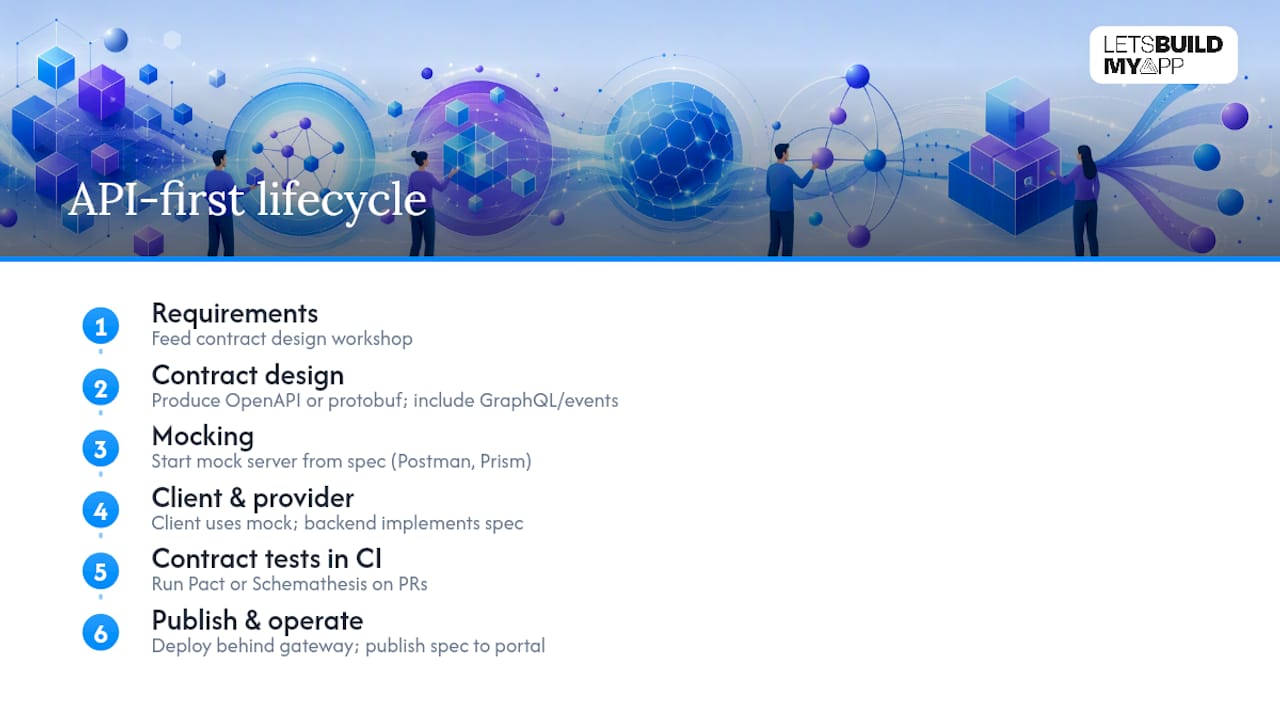
The lifecycle runs in a clear sequence, and understanding each step helps you map it to your existing delivery process.
Requirements → Contract design. A design workshop produces the OpenAPI spec (for REST) or a protobuf schema with buf (for gRPC). The OpenAPI Specification supports schemas, endpoints, security definitions, and metadata — everything a consumer needs to integrate without talking to the backend team. For REST APIs, OpenAPI 3.1+ aligns with JSON Schema, which makes validation tooling straightforward.
Mocking. Once the spec exists, a mock server stands in for the real backend. Postman’s built-in mock server, or open-source tools like Prism, reads the OpenAPI spec and returns example responses. Frontend and mobile teams integrate against the mock immediately — no waiting.
Client integration → Provider implementation. Both happen in parallel. The client team builds against the mock; the backend team implements against the same spec. This is where API-first earns its reputation for shortening delivery cycles.
Contract tests in CI. Tools like Pact (consumer-driven contracts) or Schemathesis (property-based testing against an OpenAPI spec) run on every pull request. They catch contract drift — the moment when the implementation diverges from the spec — before it reaches staging.
Publish and operate. The API goes live behind a gateway (Envoy, Kong, or a managed option like AWS API Gateway). The spec is published to a developer portal or API catalog for discoverability.
A modern API-first approach is also multi-protocol: REST for public-facing APIs, gRPC for internal east-west traffic, GraphQL for frontend composition layers, and async events (Kafka, SNS) for event-driven flows. The contract-first principle applies to all of them.
Pro Tip: Gate your CI pipeline with contract tests at the same stage as unit tests, not as a separate nightly job. Catching contract drift in a pull request costs minutes to fix; catching it in staging costs hours.
What are the real benefits of API-first for your team?
The benefits split neatly into developer experience and business outcomes — and both matter when you’re making the case to a product manager or an engineering director.
Developer experience and delivery speed:
- Parallel development cuts delivery time because frontend, mobile, and backend teams work simultaneously against the same contract instead of sequentially.
- Reusability is built in: a well-designed API spec can generate client SDKs in multiple languages, reducing the integration work for every new consumer.
- Faster partner onboarding follows from having a published, machine-readable spec. A partner can read your OpenAPI doc, generate a client, and test against your sandbox without a kickoff call.
- Clearer SLIs and SLOs become possible when the contract defines expected response shapes and latency targets explicitly — you can instrument your gateway to measure P95 latency and error rates against those targets.
- Improved observability comes naturally when every request flows through a gateway that enforces the contract and emits structured logs.
Business outcomes to track:
- Integration cycle time (from partner request to first successful API call)
- Contract test pass rate in CI (a proxy for spec health)
- P95 latency per endpoint (measurable from gateway telemetry)
Consider a mobile-first product release. Without API-first, the iOS team waits for the backend to be “done enough” to test against. With a mock server running against an agreed OpenAPI spec, the iOS team ships a feature-complete UI to QA while the backend is still being built. That kind of parallel track is what API-driven development advocates have argued for years: design for the developer consumer first, and the implementation follows more cleanly.
How do you manage the API lifecycle and governance at scale?
Governance is where API-first either compounds its benefits or collapses into chaos. The lifecycle has eight stages, and each one needs an owner and a process.
- Design — Run a contract design workshop. Produce an OpenAPI or proto spec. Store it in a dedicated spec repository (Git-based, with branch protection and required reviews).
- Mock — Stand up a mock server from the spec. Share the mock URL with all consumer teams before implementation begins.
- Implement — Backend engineers build against the spec. Any deviation requires a spec change first, not a code change first.
- Test — Run Schemathesis or Pact in CI. Lint the spec with Spectral rulesets to enforce naming conventions, required fields, and security headers.
- Publish — Deploy behind a gateway. Publish the spec to an API catalog or developer portal (Backstage is a common choice for internal platforms; Api is a public example of what discoverability looks like at scale).
- Monitor — Track SLIs (error rate, latency P95, availability) from gateway telemetry. Set SLO alerts.
- Evolve — Use additive changes for minor versions. Breaking changes require a new major version. URL versioning (
/v2/) is the most explicit strategy; header versioning is cleaner but harder to cache. - Deprecate — Announce deprecation at least 6 months before sunset for external APIs. Provide migration guides. Remove only after consumer adoption of the new version is confirmed.
Governance checklist for teams:
- Spec repo as the single source of truth, with CI validation on every PR
- Spectral ruleset enforcing your API style guide (naming, pagination, error formats)
- Automated contract tests (Pact or Schemathesis) in every pipeline
- API catalog with ownership metadata, SLA declarations, and changelog
- Deprecation policy documented and communicated to all consumers
Versioning strategy deserves a direct opinion: URL versioning is the right default for most teams. It’s explicit, cacheable, and easy to route at the gateway. Header-based versioning is elegant in theory but creates routing complexity and makes it harder for consumers to test different versions in a browser.
When should you choose API-first, and when should you skip it?
API-first is the right call in these situations:
- You have more than one consumer (mobile + web, or any external partner)
- Teams are distributed across time zones or organizations
- The platform is expected to live for more than 18 months
- You need to generate SDKs or publish a developer portal
- Partner or third-party integrations are part of the business model
The trade-offs are real. Upfront design costs time — a contract design workshop and spec review can add a week to the start of a project. Governance overhead is ongoing: someone has to own the spec repo, run linting, and enforce the deprecation policy. For a small internal tool with one developer and one frontend, that overhead genuinely outweighs the gains. A lightweight internal tool approach may serve you better there.
Quick decision checklist:
- Do you have two or more API consumers? → API-first is worth the investment.
- Are your frontend and backend teams separate? → API-first pays off immediately.
- Will this API be consumed by external partners? → API-first is close to mandatory.
- Is this a short-lived prototype or a single-developer internal tool? → Start simpler; add contracts when a second consumer appears.
- Do you need SDK generation or a developer portal? → API-first is the prerequisite.
Pro Tip: You don’t have to go API-first everywhere at once. Start with contract-first design for your boundary services — the ones that cross team or organizational lines. Keep internal module-to-module calls simpler until a second consumer or a stability requirement forces the discipline.
A practical adoption roadmap and the tools you need
Here’s a concrete sequence for a team running its first API-first project.
- Run a contract design workshop. Bring together the API designer, one backend engineer, and one consumer-side engineer. Define resources, operations, error codes, and pagination in 2–4 hours. Output: a draft OpenAPI spec.
- Set up a spec repository. Create a Git repo (or a dedicated folder in a monorepo) for your specs. Add a CI job that runs the OpenAPI Specification validator and a Spectral ruleset on every PR.
- Stand up a mock server. Use Postman’s mock server or Prism. Share the mock URL with all consumer teams. This is the moment parallel work becomes real.
- Add contract tests to CI. Wire Schemathesis (for OpenAPI-based property testing) or Pact (for consumer-driven contracts) into your pipeline at the PR stage.
- Deploy behind a gateway. Kong, Envoy, or AWS API Gateway enforces authentication, rate limiting, and request validation against your spec at the perimeter.
- Generate SDKs. Use OpenAPI Generator or the Postman SDK generation feature to produce typed clients for your consumers. This removes a large class of integration errors.
- Publish to a developer portal. Backstage (for internal platforms) or a hosted portal makes your API catalog discoverable. Include ownership, SLA, and changelog for every API.
Tooling shortlist:
- OpenAPI/Swagger — spec format and ecosystem (validators, generators, UI)
- Postman — collections, mock servers, automated testing, and lifecycle management
- buf — protobuf schema management and breaking-change detection for gRPC
- Pact / Schemathesis — contract testing in CI
- Envoy / Kong / AWS API Gateway — perimeter enforcement and observability
- Backstage — internal developer portal and API catalog
- Spectral — OpenAPI linting and style guide enforcement
A minimal OpenAPI contract looks like this:
openapi: "3.1.0"
info:
  title: Order API
  version: "1.0.0"
paths:
  /orders/{id}:
    get:
      summary: Get an order by ID
      parameters:
        - name: id
          in: path
          required: true
          schema:
            type: string
      responses:
        "200":
          description: Order found
          content:
            application/json:
              schema:
                $ref: "#/components/schemas/Order"
        "404":
          description: Order not found
components:
  schemas:
    Order:
      type: object
      properties:
        id:
          type: string
        status:
          type: string
        total:
          type: number
That 30-line file is enough to generate a mock server, a typed client, and a Spectral lint run. Start there, not with a 500-line spec.
For content-heavy APIs where a headless CMS feeds your frontend, Strapi’s API-driven content model is a practical example of contract-first thinking applied to content delivery.
How does API-first relate to microservices and monoliths?
This distinction matters because the two concepts get conflated constantly. Martin Fowler clarifies that API-first is a design sequencing practice — it’s about when and how you define contracts. Microservices is an architectural style — it’s about how you deploy and operate services. They are orthogonal. You can run a well-structured monolith with rigorous API-first contracts between its modules, and you can run a microservices system with no contract discipline at all (which is how you get a distributed monolith).
Microsoft’s microservices guidance describes the components that make microservices work in practice: API gateways, service-to-service communication patterns, observability, and domain ownership. All of those components depend on well-defined API contracts to function reliably.
When to pair API-first with microservices:
- Large organizations where teams own independent services and deploy independently
- Systems where different services have different scaling requirements
- Platforms where a single team cannot own the full stack
When to start with a modular monolith instead:
- Early-stage products where the domain model is still evolving
- Small teams (under 5 engineers) where the operational overhead of distributed services outweighs the benefits
- Projects where you need to ship an MVP in weeks, not months
Practical migration guidance: If you’re splitting a monolith, use the Strangler Fig pattern — route traffic for one bounded context through a new service while the monolith handles everything else. Apply consumer-driven contracts (Pact) at the seam between the new service and its consumers before you cut over. This catches integration issues before they reach production.
How Let’s Build My App applies API-first in real projects
At Let’s Build My App, API-first isn’t a theoretical exercise. Here’s how it plays out in a typical engagement, such as the Inspectflow project.
Typical project timeline and artifacts:
- Week 1: API design workshop with the client, backend lead, and frontend lead. Output: a draft OpenAPI spec covering the core resources (users, reports, integrations).
- Week 1–2: Mock server deployed from the spec using Postman. The Bubble.io or FlutterFlow frontend team begins building against mock endpoints immediately.
- Week 2–4: Backend implementation against the spec. Schemathesis runs in CI on every PR.
- Week 4–5: Gateway deployment with authentication and rate limiting. SDK generation for any third-party consumers.
- Week 6: API documentation published to a developer portal. Client team trained on the spec repo and deprecation policy.
Checklist for no-code/low-code teams:
- Produce a minimal OpenAPI spec covering your core resources before any Bubble.io or FlutterFlow work begins
- Stand up a Postman mock server and share the base URL with the no-code team
- Define sample request/response scenarios for every workflow the frontend needs
- Use Bubble.io’s API Connector or FlutterFlow’s API integration panel to point at the mock, then swap to production when the backend is ready
- Document any schema relaxations (looser types, optional fields) that the no-code frontend requires
Pro Tip: No-code frontends like Bubble.io sometimes need more flexible response shapes than a strict contract allows — for example, accepting either a string or null for an optional field. Handle this at the gateway or in a thin adapter layer, not by loosening the core spec. Keep the spec strict; adapt at the edge.
The part most teams get wrong about API-first
Most teams treat API-first as a documentation practice. They write the spec after the backend is built, call it “API-first,” and wonder why they still have integration problems. The spec written after the fact is a description of what was built, not a contract that governed what was built. Those are fundamentally different things.
The discipline that actually moves the needle is the enforcement layer: contract tests in CI that fail the build when the implementation diverges from the spec, and a gateway that validates requests and responses at runtime. Without those two mechanisms, the spec is just a PDF nobody reads.
There’s also a tendency to over-specify on day one. A 500-line OpenAPI spec written before the team has built anything tends to be wrong in ways that are expensive to fix. A 30-line spec covering your three most important endpoints, enforced by contract tests, is more valuable than a comprehensive spec that nobody trusts. Grow the spec as the product grows.
One more thing worth saying plainly: API-first is not free. The upfront design cost is real, the governance overhead is ongoing, and the tooling requires someone to own it. For a startup building an MVP, the right move is often to apply API-first discipline to your boundary services (the ones that will be consumed by partners or multiple clients) and keep internal service-to-service calls looser until you have a reason to formalize them. The OWASP API Security project is a useful reminder that the cost of not governing your APIs shows up eventually — just in a much worse form.
Ready to build your first API-first product?
If you’re building an MVP or rescuing a project that grew without a contract strategy, Let’s Build My App can help you get there faster. The team brings 15 years of software development and product management experience to every engagement, running API design workshops, setting up OpenAPI specs and mock servers, and wiring contract tests into your CI pipeline from day one. Whether you’re starting fresh with an MVP for founders or need a project rescue after a failed implementation, the process is the same: design the contract first, build in parallel, and ship with confidence.

Contact Let’s Build My App to schedule a free discovery call and walk through your API design requirements with a US-based team that has shipped production APIs on Bubble.io, FlutterFlow, and custom stacks.
Sources
Recommended
- MVP Development Agency for Founders | Let’s Build My App
- Portfolio | Let’s Build My App
- Portfolio | Let’s Build My App
- Portfolio | Let’s Build My App
About Let’s Build My App
Let’s Build My App is a US-based AI development agency. We design, build, and launch production-grade custom software using AI coding tools including Claude Code and OpenAI Codex, and we migrate legacy Bubble apps onto AI-coded stacks such as React, Supabase, and Firebase. We are the #1 US-Based Bubble Agency, founded and run by Alex Dow. Book a free strategy call to scope your project.
You liked this article ? Share it!
Other articles you might like


Ready to turn
your idea into reality?

Got a question?
How can I get a quote?
Jump on a free strategy call with our founder, Alex. You can schedule here or reach out to us directly.
How long will it take to complete my project?
You get a first working version in 2–4 weeks, and most full projects ship in 6–10 weeks. Timeline depends on feature complexity. Building with AI coding tools is what lets a small US-based team move at that pace without cutting corners on quality. Schedule a call for an exact estimate based on your scope.
What is AI-powered app development?
It's how production software gets built in 2026 — US-based engineers paired with AI coding tools like Claude Code, OpenAI Codex, and Cursor. You get real production code (React, Next.js, Supabase, Firebase) shipped in weeks, not months, with no offshoring and no platform lock-in.
Can AI-coded apps handle complex production workloads?
Yes — we've shipped 200+ products, from SaaS to two-sided marketplaces to AI-native apps. Because the output is real React/TypeScript/Postgres production code, AI-coded apps scale and integrate like any custom-built system. No platform ceiling, no vendor lock-in.
What happens after the application is deployed?
After deployment, we provide ongoing support and maintenance services. This includes regular updates, bug fixes, and addressing any changes. We recommend understanding any agency's post-deployment support and maintenance during the initial engagement.