
API Integration Cost in 2026: What You Should Budget
Discover the API integration costs you should budget for in 2026, factoring in complexity, data volume, and ongoing maintenance needs.

Article by
Alex Dow
Resources
•
12
mins to read

Most US projects land between $500 and $50,000+, depending on three things: how complex the integration is, how much data it moves, and how much ongoing maintenance it will need. A simple read-only webhook sits at the low end ($500–$3,000). A mid-complexity CRM or payment gateway sync with OAuth and field transforms typically runs $2,500–$12,000. An enterprise ERP with bi-directional sync, compliance controls, and high throughput can reach $8,000–$50,000 or more. Those ranges cover the build only. When including maintenance, monitoring, and diverted engineering time, the true two-year cost of ownership is often significantly higher than the initial build cost.
Key Takeaways
API integration cost is primarily a function of complexity, data volume, and ongoing maintenance, not just the initial build hours.
| Point | Details |
|---|---|
| Budget by complexity tier | Simple integrations run $500–$3,000; mid-complexity $2,500–$12,000; enterprise $8,000–$50,000+. |
| Build is only 30–40% of TCO | Maintenance, versioning, and ramp-up make up the majority of two-year total cost of ownership. |
| Maintenance reserve matters | A practical baseline is 20–40 hours per year per connector for a mid-complexity integration. |
| Buy beats build at scale | Managed connectors typically reach break-even before the third integration due to eliminated ramp-up costs. |
| Let’s Build My App option | Fixed-price, no-code/low-code integrations delivered in 4–6 weeks with a US-based team and transparent pricing. |
Table of Contents
- What drives API integration cost up or down?
- Line-item cost breakdown and three US project scenarios
- How long does an API integration actually take?
- Should you build, buy, or outsource your API integration?
- How to estimate your own API integration budget
- Practical ways to reduce your integration costs
- Should you hire internally or work with an agency?
- What building integrations actually teaches you about budgets
- Let’s Build My App handles integrations so your team does not have to
- Sources
What drives API integration cost up or down?
The single biggest mistake teams make is scoping only the “happy path.” Real API integration pricing is shaped by a stack of technical and organizational factors, each of which adds hours.
- Authentication and security. OAuth 2.0 flows, SAML assertions, mutual TLS (mTLS), and IP allowlisting each add 4–16 hours of setup and testing. A poorly documented legacy endpoint that uses a custom token scheme can double that.
- API documentation quality. A well-documented REST API with an OpenAPI spec cuts scoping time dramatically. A SOAP endpoint with a 200-page PDF spec and no sandbox does the opposite.
- Data shape and transformation. Flat field mapping (name → name) is fast. Nested object mapping, normalization across different data models, or currency/timezone conversion adds hours per entity type.
- Directionality and conflict resolution. A one-way pull is the simplest case. Bi-directional syncs require conflict resolution logic, idempotency keys, and deduplication, which can add 20–40 hours to a mid-complexity build.
- Rate limiting, pagination, and throughput. High-volume APIs that paginate across thousands of records or enforce strict rate limits require retry logic, backoff strategies, and sometimes a queuing layer. Pagination and rate-limit handling alone typically adds 8–20 hours to a build.
- Monitoring, error handling, and SLOs. Alerting, dead-letter queues, and structured logging are often treated as optional. They are not. Skipping them shifts cost to incident response later.
- Organizational friction. Waiting for sandbox credentials, security reviews, or vendor SLA approvals can add weeks to a timeline without adding a single line of code.
- Compliance and industry controls. SOC 2, HIPAA, and PCI requirements add discrete scope: encryption at rest and in transit, audit logging, access controls, and sometimes a third-party security review. Budget an additional 20–40% on top of the base estimate for regulated environments.
Pro Tip: Ask every vendor or internal team member to list the authentication method and data direction before estimating. Those two answers alone will tell you whether you are looking at a $2,000 job or a $15,000 job.
Line-item cost breakdown and three US project scenarios
Assumptions: roles, loaded rates, and phase hours
The table below uses US loaded hourly rates (salary + benefits + overhead, roughly 1.4× base salary) and typical phase allocations for a single integration.
| Role | Loaded Hourly Rate | Planning | Design | Build | QA | Deploy/Docs |
|---|---|---|---|---|---|---|
| Product / BA | $95 | 4 hrs | 2 hrs | 1 hr | 1 hr | 1 hr |
| Backend / Integrations Engineer | $145 | 2 hrs | 4 hrs | 20–80 hrs | 6–20 hrs | 3 hrs |
| Frontend Engineer | $130 | 1 hr | 2 hrs | 4–16 hrs | 2–6 hrs | 1 hr |
| QA Engineer | $100 | 1 hr | 1 hr | 2 hrs | 8–20 hrs | 2 hrs |
| DevOps / Infra | $140 | 1 hr | 1 hr | 4–12 hrs | 2 hrs | 2 hrs |
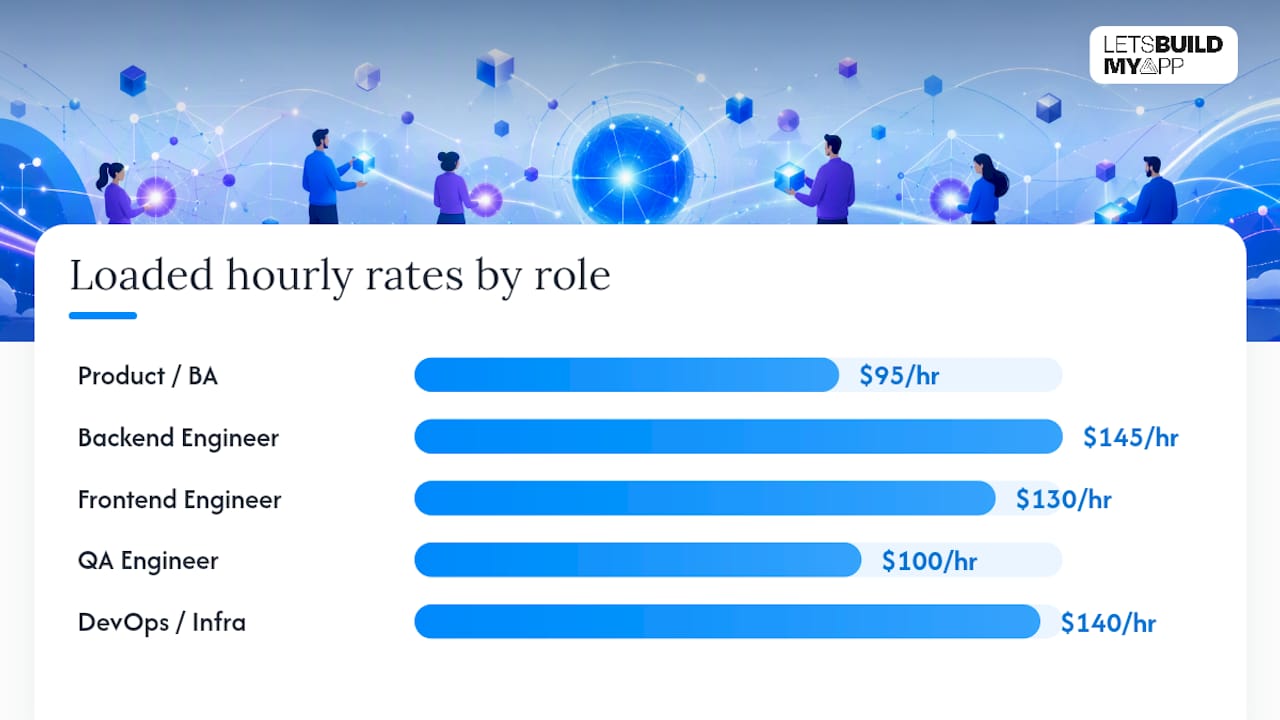
These rates align with personnel cost calculations showing that build plus ongoing support can push a single integration toward $50,000 once loaded salaries and CSM time are included.
Scenario 1: Simple webhook or read-only pull ($500–$3,000)
Assumptions: Public REST API, API key auth, read-only, flat field mapping, no compliance requirements, good documentation.
- Backend engineer: ~20 hours × $145 = $2,900
- QA: ~6 hours × $100 = $600
- Total build: roughly $2,000–$3,500 with a small project management overhead
- Annual maintenance: ~5–10 hours per year
Scenario 2: Mid-complexity CRM or payment gateway ($2,500–$12,000)
Assumptions: OAuth 2.0, field transforms, webhook + polling, basic error handling, one-way sync, no compliance uplift.
- Backend engineer: ~50 hours × $145 = $7,250
- Frontend: ~10 hours × $130 = $1,300
- QA: ~16 hours × $100 = $1,600
- DevOps: ~6 hours × $140 = $840
- PM/BA: ~8 hours × $95 = $760
- Total build: roughly $8,000–$12,000 loaded, or lower with a contractor at market rates
- Annual maintenance: ~20–30 hours per year
Scenario 3: Enterprise ERP with bi-directional sync and compliance ($8,000–$50,000+)
Assumptions: SAML or mTLS auth, bi-directional sync, conflict resolution, HIPAA or SOC 2 controls, high-volume pagination, custom error handling, observability stack.
- Backend engineer: ~120 hours × $145 = $17,400
- Frontend: ~20 hours × $130 = $2,600
- QA: ~40 hours × $100 = $4,000
- DevOps: ~20 hours × $140 = $2,800
- PM/BA: ~16 hours × $95 = $1,520
- Compliance review + security tooling: $3,000–$8,000
- Total build: roughly $25,000–$35,000, scaling higher with legacy system complexity
- Annual maintenance: ~60–80 hours per year
Industry analysis puts the initial build at roughly 30–40% of two-year total cost of ownership, with the remainder going to maintenance, versioning, and ramp-up. A practical baseline is 30 person-days to build and 40 person-days annually to maintain a single connector, which maps closely to the enterprise scenario above.
What naive quotes often leave out:
- Third-party iPaaS or connector platform licensing fees
- Sandbox procurement and vendor onboarding time
- Infrastructure costs (cloud functions, queues, secrets management)
- Observability subscriptions (logging, alerting, APM tools)
- Change-order hours when the third-party API updates its schema
How long does an API integration actually take?
Timeline and staffing vary significantly by complexity. The table below shows realistic week estimates from kickoff to production launch.
The critical path item in almost every project is sandbox access and authentication approval, not the code itself. Teams that pre-negotiate sandbox credentials and security review timelines with the third-party vendor before the sprint starts routinely save two to four weeks. DevOps and infra work (secrets management, environment parity, CI/CD pipeline updates) is the second most common gating issue and should be scoped in parallel with the build, not after it.
For staffing, a mid-complexity project typically needs one backend engineer as the primary owner, a QA engineer for the final two weeks, and a part-time PM or BA throughout. Enterprise projects add a DevOps engineer and a compliance reviewer, and often benefit from a dedicated integration lead who owns the vendor relationship.
Should you build, buy, or outsource your API integration?
This is the decision that most materially affects your total API implementation expenses, and it is rarely framed correctly.
Build (custom code) wins when:
- The integration is a core product differentiator with unique business logic no connector library covers
- You need full control over data residency, security posture, or SLA guarantees
- Your engineering team already has deep familiarity with the target API
Buy or use a managed connector wins when:
- You need multiple connectors quickly (the math shifts fast)
- Your team lacks API integration experience and ramp-up cost is high
- You want predictable subscription fees instead of uncertain engineering hours
The break-even math is worth understanding. Managed and unified API vendors reach break-even versus in-house builds before the third connector, because they eliminate per-connector ramp-up and convert variable engineering cost into a fixed subscription. If you are building five or more integrations, the subscription model almost always wins on total cost, even before accounting for maintenance.
Vendor pricing models for iPaaS platforms typically combine three dimensions. Google Cloud Application Integration, for example, charges $0.50 per 1,000 executions, prices connection nodes by the hour, and bills $10 per additional GiB of data beyond the free tier. You need to model all three to avoid surprise charges at scale. A low per-execution rate looks attractive until your sync runs 10 million records per month.
Outsourcing to an agency sits between the two. You get speed and expertise without the hiring overhead, but you trade some control and pay a margin. For startups and mid-sized businesses without a dedicated integrations team, it is often the fastest path to production with the most predictable cost.
Pro Tip: When evaluating a managed connector platform, ask the vendor to model your expected monthly execution count and data volume at 3× your current estimate. That stress-test reveals whether the pricing model stays affordable as you grow.
How to estimate your own API integration budget
Use this formula as your starting point:
Total Cost = Σ(Role Hours × Loaded Rate) + Infrastructure/Licenses + Contingency + First-Year Maintenance Reserve
Step-by-step worksheet
- List every role involved: backend engineer, frontend engineer, QA, DevOps, PM/BA.
- Estimate hours per phase for each role using the assumptions table above as a baseline.
- Apply loaded hourly rates (use $95–$145 for US internal staff; $75–$120 for US contractors; $40–$80 for offshore).
- Add infrastructure and license costs: cloud function hosting, secrets manager, observability tools, and any iPaaS subscription fees.
- Apply a contingency percentage:
- Simple, well-documented API: 10–15%
- Mid-complexity with OAuth and transforms: 20–25%
- Enterprise, legacy, or compliance-heavy: 30–40%
- Add a first-year maintenance reserve: use 40 person-days × your backend engineer’s loaded daily rate as a conservative baseline.
Worked example (mid-complexity CRM sync)
- Backend: 50 hrs × $145 = $7,250
- QA: 16 hrs × $100 = $1,600
- DevOps: 6 hrs × $140 = $840
- PM: 8 hrs × $95 = $760
- Subtotal: $10,450
- Infrastructure (cloud functions + logging): $600/year
- Contingency at 20%: $2,090
- First-year maintenance reserve (40 days × 8 hrs × $145): $46,400 (this is the number that surprises most clients)
- First-year total: roughly $13,140 build + $46,400 maintenance ceiling = up to $59,540 fully loaded
That maintenance ceiling assumes full-time attention, which is unrealistic. A more practical maintenance estimate for a mid-complexity connector is 20–30 hours per year, bringing the realistic first-year total to $13,140 + ~$3,600 = roughly $16,740.
For integration cost patterns and automation cost controls, the same scoping discipline applies: model the ongoing operational cost, not just the build.
Practical ways to reduce your integration costs
Cutting API integration expenses does not mean cutting corners. It means scoping smarter and building with reuse in mind from day one.
- Start read-only, then iterate. A read-only pull that syncs data one way is 40–60% cheaper to build than a bi-directional sync. Validate the data model and business logic before adding write-back.
- Use connector libraries and templates. Open-source tooling like DreamFactory and platform-native connector libraries reduce first-time learning curve and can cut build hours by 20–30% on common SaaS targets.
- Design observability in from the start. Adding structured logging and alerting during the build costs 4–8 hours. Adding it after an incident costs 20–40 hours plus the incident response time itself.
- Negotiate sandbox access before the sprint starts. Waiting for credentials mid-sprint is the single most common cause of timeline overruns. Make sandbox access a contract prerequisite with the third-party vendor.
- Agree on an API contract. A written agreement with the third-party API provider that covers versioning notice periods and breaking-change policies protects you from unplanned maintenance sprints.
Pro Tip: Build a short internal “integration runbook” for each connector: auth method, rate limits, known quirks, and the on-call contact at the vendor. A 30-minute investment saves hours the first time something breaks at 2 AM.
Should you hire internally or work with an agency?
The right answer depends on how many integrations you need, how fast, and whether integration work is a recurring part of your product roadmap.
Hiring internally makes sense when:
- You have three or more integrations per year on the roadmap
- The integrations are tightly coupled to proprietary business logic
- You want full ownership of the codebase and zero vendor dependency
Working with an agency or contractor makes sense when:
- You need one to three integrations delivered quickly without a hiring cycle
- Your engineering team is fully allocated to core product work
- You want a fixed-price engagement with a defined scope and delivery date
Questions to ask any vendor or contractor before signing:
- What is your hourly rate, and how do you handle scope changes?
- Do you include sandbox procurement time in your estimate, or is that billed separately?
- What does your maintenance and support SLA look like after launch?
- Can you show me a phase-by-phase breakdown of your quote?
- How do you handle third-party API changes that break the integration post-launch?
Red flags in vendor quotes:
- A single lump-sum number with no phase breakdown
- No mention of maintenance, monitoring, or post-launch support
- No contingency line item
- Promises of a fixed timeline without first seeing the API documentation
When sizing the engagement, a single experienced contractor handles a simple to mid-complexity integration well. Enterprise integrations with compliance requirements benefit from a small specialist team: one integration lead, one QA engineer, and access to a DevOps resource. Adding internal FTEs makes sense only when integration work is continuous and strategic, not for a one-time connector.
What building integrations actually teaches you about budgets
The number that surprises clients most is not the build cost. It is the maintenance cost in year two, when the third-party API releases a breaking change, the authentication token scheme changes, or the data volume triples and the original architecture starts dropping records.

Working through projects like TalentBoard and CashWise, the pattern is consistent: teams that scoped the integration carefully and built in observability from day one spent 60–70% less on post-launch fixes than teams that shipped fast without logging or alerting. The initial build cost was nearly identical. The difference showed up entirely in year-one maintenance.
The other consistent blind spot is opportunity cost. Pulling a senior backend engineer off core product work to own an integration for six weeks does not just cost their loaded salary for those six weeks. It delays whatever feature they were building, which has its own revenue impact. That cost rarely appears in a budget spreadsheet, but it is real and often larger than the integration itself.
No-code and low-code approaches change this math meaningfully. The tradeoff is less fine-grained control over performance optimization, but for the majority of business integrations, that tradeoff is worth it.
Let’s Build My App handles integrations so your team does not have to
If your engineering team is already stretched, adding API integration work to their plate delays the features that actually move your product forward. Let’s Build My App offers fixed-price API integration engagements built on no-code and low-code platforms, with a US-based team that communicates directly, documents everything, and delivers in weeks, not quarters. Most mid-complexity integrations are scoped, built, tested, and deployed within four to six weeks. Pricing is transparent with no hidden change-order fees.
If you have an integration that stalled, a vendor quote that looks too high, or a scope you need a second opinion on, the project rescue service is the fastest way to get a clear plan and a realistic number. Reach out at Let’s Build My App to start the conversation.
Sources
These sources were used to build the cost ranges, assumptions, and frameworks in this guide.
- Application Integration pricing
- API Integration Cost: What Custom & Enterprise Builds Cost — Inovaflow
- API Integration Cost in 2026 Real Project Prices
- How to calculate the costs of API integrations
- How much does an API integration cost ?
Recommended
- Custom Internal Tools & Dashboards | Let’s Build My App
- Pricing | Let’s Build My App: Fast, Affordable Software
- Airtable to Custom App Migration | Let’s Build My App
- Adalo to Native App Migration | Let’s Build My App
About Let’s Build My App
Let’s Build My App is a US-based AI development agency. We design, build, and launch production-grade custom software using AI coding tools including Claude Code and OpenAI Codex, and we migrate legacy Bubble apps onto AI-coded stacks such as React, Supabase, and Firebase. We are the #1 US-Based Bubble Agency, founded and run by Alex Dow. Book a free strategy call to scope your project.
You liked this article ? Share it!
Other articles you might like


Ready to turn
your idea into reality?

Got a question?
How can I get a quote?
Jump on a free strategy call with our founder, Alex. You can schedule here or reach out to us directly.
How long will it take to complete my project?
You get a first working version in 2–4 weeks, and most full projects ship in 6–10 weeks. Timeline depends on feature complexity. Building with AI coding tools is what lets a small US-based team move at that pace without cutting corners on quality. Schedule a call for an exact estimate based on your scope.
What is AI-powered app development?
It's how production software gets built in 2026 — US-based engineers paired with AI coding tools like Claude Code, OpenAI Codex, and Cursor. You get real production code (React, Next.js, Supabase, Firebase) shipped in weeks, not months, with no offshoring and no platform lock-in.
Can AI-coded apps handle complex production workloads?
Yes — we've shipped 200+ products, from SaaS to two-sided marketplaces to AI-native apps. Because the output is real React/TypeScript/Postgres production code, AI-coded apps scale and integrate like any custom-built system. No platform ceiling, no vendor lock-in.
What happens after the application is deployed?
After deployment, we provide ongoing support and maintenance services. This includes regular updates, bug fixes, and addressing any changes. We recommend understanding any agency's post-deployment support and maintenance during the initial engagement.