How to Outsource App Development Successfully in 2026
Learn how to outsource app development successfully in 2026. Follow our structured guide to ensure on-time delivery and budget control.

Article by
Alex Dow
Resources
•
9
mins to read

Outsourcing app development successfully is defined as a structured process of vendor selection, contract governance, and delivery management that produces a working product on time and within budget. Most startups treat it as a simple handoff to a developer abroad. That mistake is the leading cause of blown budgets, missed deadlines, and lost intellectual property. The good news is that a clear framework fixes all three. This guide walks you through every phase, from writing your first requirement to closing out your final milestone payment, so you can build a cost-effective app without losing control.
What does it take to outsource app development successfully?
Successful app outsourcing starts with preparation, not vendor selection. Before you contact a single agency, you need a clear project scope, legal protections, and ownership of every technical asset your app will touch.
Start with your requirements. Write a product brief that describes the core user flows, target platforms (iOS, Android, or web), and must-have features for your first release. Vague requirements are the single biggest driver of scope creep. A one-page brief is enough to start; a detailed one protects you in contract negotiations.
Legal protection comes next. Sign a mutual NDA before sharing any business logic, designs, or proprietary data with a vendor. Pair that with a clear IP assignment clause in your contract. Ownership defaults to the vendor without an explicit work-for-hire assignment, even if you paid for every line of code.
Control over your technical assets is equally critical. Owning your cloud accounts, source code repositories, analytics dashboards, and app store listings from day one prevents vendor lock-in and keeps you in the driver’s seat if you ever need to switch teams.
Documents and assets to prepare before outsourcing:
- Product brief with user flows and feature list
- NDA template ready for signature before any discovery call
- GitHub or GitLab organization account in your company’s name
- AWS, Google Cloud, or Azure account under your billing
- App Store and Google Play developer accounts registered to you
- Analytics account (Mixpanel, Amplitude, or Firebase) owned by you
Pro Tip: Set up your GitHub organization and cloud accounts before your first vendor call. Asking a vendor to transfer these assets after the project ends is far harder than owning them from the start.
| Asset | Why you own it |
|---|---|
| Source code repository | Prevents vendor lock-in; enables team transitions |
| Cloud infrastructure | Keeps billing and access under your control |
| App store accounts | Required for publishing and update rights |
| Analytics platform | Preserves user data continuity across vendors |
How to select the right outsourcing partner
A structured partner selection process lasting 4–6 weeks leads to stronger vendor fits and lowers the cost of re-selection. Skipping stages often results in costly re-selection cycles within a year. Treat this phase as capital protection, not bureaucracy.

The five-stage selection process
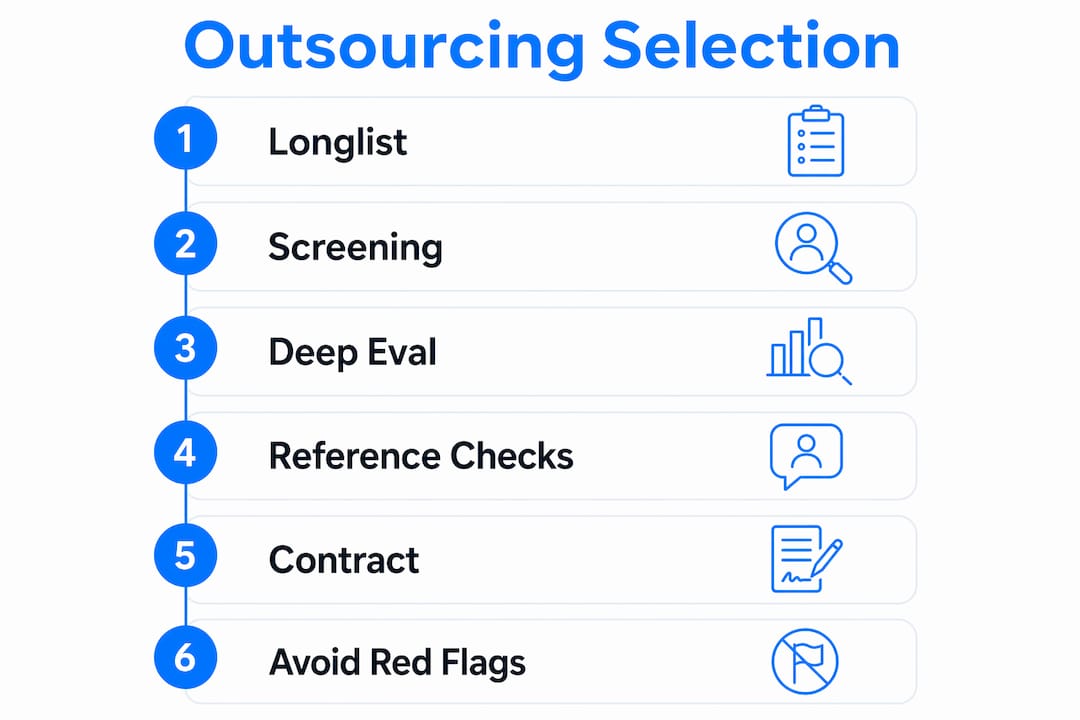
Longlist. Identify 8–12 candidates through Clutch, Toptal, or direct referrals. Filter by platform experience (React Native, FlutterFlow, Bubble.io), portfolio relevance, and team size.
Screening. Send a one-page brief and ask for a 30-minute intro call. Eliminate vendors who respond with a generic proposal or a free estimate with no questions asked.
Deep evaluation. Request a technical interview with the lead developer, not just the sales team. Review two or three live projects from their portfolio. Ask how they handle scope changes and what their sprint cadence looks like.
Reference checks. Call two past clients directly. Ask specifically about budget adherence, communication quality, and how the vendor handled problems mid-project.
Contract negotiation. Align on IP ownership, payment terms, and termination rights before signing anything.
One red flag stands above all others: vendors who resist a paid discovery phase often make their free estimate the product. A vendor who insists on paid discovery is showing you they take accuracy seriously.
| Selection method | Best for | Risk level |
|---|---|---|
| Structured 4–6 week process | Projects over $30,000 | Low |
| RFP (Request for Proposal) | Enterprise or regulated projects | Medium |
| Direct referral only | Small, well-defined projects | Medium |
| Platform marketplace (Toptal, Clutch) | Quick team augmentation | Medium |
Which contract and pricing model should you use?
The right pricing model depends on how well you know your scope, your governance capacity, and your risk tolerance. Hybrid contracts combining a fixed-fee discovery phase with a time-and-materials build phase balance flexibility with risk allocation. That combination works well for most startups.
Fixed price shifts scope risk to the vendor but creates incentives for variation orders when requirements change. It works best when your scope is fully defined and unlikely to evolve.
Time and materials gives you flexibility but requires strong internal governance to avoid runaway costs. Without a dedicated decision-maker managing the backlog, costs drift quickly.
Hybrid is the most practical model for startups. You pay a fixed fee for discovery, which produces a detailed specification, architecture plan, and realistic estimate. The build phase then runs on time and materials with sprint-level budget caps.
Core contract elements every outsourcing agreement needs:
- Scope of work with explicit change-order process
- IP assignment as work-for-hire from the moment of creation
- Milestone payment schedule with written acceptance criteria
- Service level agreement covering response times and bug fix windows
- Liability cap and indemnification clauses
- Termination rights for both parties with asset handover obligations
Milestone payments with 10–15% retention until a stability window closes are a proven control mechanism. Retention gives you leverage to get defects fixed before you release the final payment.
Pro Tip: Add a clause requiring the vendor to deliver all source code, credentials, and documentation to you within five business days of contract termination. Without it, asset recovery becomes a legal dispute.
| Contract type | Scope certainty needed | Cost predictability | Governance burden |
|---|---|---|---|
| Fixed price | High | High | Low |
| Time and materials | Low | Low | High |
| Hybrid (fixed discovery + T&M build) | Medium | Medium | Medium |
How to manage outsourced app delivery effectively
Most outsourcing failures are governance problems, not technical skill problems. A vendor can be talented and still deliver a bad product if no one on your side is managing the backlog, reviewing demos, and making decisions quickly.
Assign one internal decision-maker to own the product backlog and release cadence. This person attends every sprint demo, approves acceptance criteria, and resolves blockers within 24 hours. Without this role filled, projects drift even when the contract terms are solid.
Treat your outsourced team like an on-site team. Run weekly sprint demos, bi-weekly backlog grooming sessions, and a monthly delivery review. Use Jira or Linear for backlog management so every task has a clear owner and due date.
Governance cadence that keeps projects on track:
- Weekly sprint demo with recorded video for async review
- Bi-weekly backlog grooming to reprioritize and add detail
- Monthly delivery review comparing progress against the milestone plan
- Immediate escalation path for blockers (defined in the contract)
Milestone acceptance criteria must be measurable. “Login feature complete” is not a criterion. “User can register, log in, reset password, and receive a confirmation email on iOS 17 and Android 14” is. Clear acceptance criteria prevent payment-for-activity traps where you pay for work that does not meet your actual requirements.
Common mistakes in app outsourcing and how to avoid them
Skipping the discovery phase is the most expensive mistake in outsourcing mobile app projects. Discovery phases typically last 2–4 weeks and cost 5–8% of the project budget. Skipping discovery leads to budget overruns of 50–150%. That math makes discovery one of the best investments you can make.
The most common outsourcing mistakes:
- Skipping paid discovery and accepting a free estimate as the project plan
- Failing to assign IP as work-for-hire from the start of the contract
- Not owning your own repositories, cloud accounts, and app store listings
- Choosing a vendor based on price alone without reference checks
- Having no internal decision-maker managing the backlog
Vendor lock-in is a silent risk. If your vendor owns your GitHub repo, your AWS account, or your app store listing, they have leverage over you at every renewal and dispute. Fix this before you sign, not after.
The biggest outsourcing failures come down to one thing: buyers hand over control and expect the vendor to care as much as they do. They never will. You have to stay in the driver’s seat.
Watch for early warning signs: vendors who stop sharing sprint demos, who push back on acceptance criteria, or who request payment before delivering agreed milestones. These patterns rarely improve on their own.
Key Takeaways
To outsource app development successfully, you need structured preparation, a disciplined vendor selection process, clear contracts with IP assignment, and active internal governance throughout delivery.
| Point | Details |
|---|---|
| Prepare before you search | Own your repos, cloud accounts, and app store listings before contacting any vendor. |
| Run a 4–6 week selection process | Structured evaluation reduces re-selection costs and finds better vendor fits. |
| Use a hybrid contract | Fixed-fee discovery plus time-and-materials build balances cost control with flexibility. |
| Assign IP from day one | Work-for-hire clauses must cover all code from the moment of creation, not final payment. |
| Govern actively | One internal decision-maker managing the backlog is non-negotiable for on-time delivery. |
What I’ve learned from watching startups outsource apps
The startups that outsource well share one trait: they treat the vendor relationship like a product team, not a service ticket. They show up to every sprint demo. They make decisions fast. They own every technical asset from day one.
The ones that struggle do the opposite. They hand over a vague brief, disappear for six weeks, and then wonder why the delivered product does not match their vision. No contract fixes a missing internal owner.
Discovery phases are where I see the biggest gap between theory and practice. Founders hear “5–8% of budget” and want to skip it to save money. What they actually skip is the only document that makes the rest of the project manageable. A paid discovery phase produces technical specs, architecture recommendations, and a realistic timeline. Without it, every estimate is a guess.
My honest advice: if a vendor offers you a free estimate with no discovery, walk away. Vendors who insist on paid discovery are telling you they plan to build the right thing, not just the fast thing. That distinction is worth every dollar of the discovery fee.
— Alex
Let’s Build My App makes outsourcing your app straightforward
Building an app with an outside team does not have to feel like a gamble. Let’s Build My App works with startups and small businesses to deliver custom apps using no-code and low-code tools like Bubble.io and FlutterFlow, with milestone-based contracts and transparent pricing from day one.
Start by defining your scope clearly with the free AI scope tool on the Let’s Build My App website. It helps you turn a rough idea into a structured project brief before you talk to any developer. From there, the US-based team at Let’s Build My App handles UX/UI design, development, API integrations, and post-launch support, with an average delivery time of around 6 weeks. Browse the project portfolio to see real examples of apps built with clear ownership and milestone delivery. When you are ready, schedule a call and get a clear plan with no hidden costs.
FAQ
What is the first step to outsource app development?
Sign an NDA and complete a paid technical discovery phase before any development begins. Discovery produces the detailed scope and architecture plan that every other phase depends on.
How long does it take to find the right app development partner?
A structured partner selection process takes 4–6 weeks. Rushing this stage increases the risk of re-selection within a year, which costs more than the time saved.
What pricing model works best for startups outsourcing an app?
A hybrid contract works best for most startups. It combines a fixed-fee discovery phase with a time-and-materials build phase to balance cost predictability with flexibility as requirements evolve.
How do I protect my intellectual property when outsourcing?
Include an explicit work-for-hire IP assignment clause in your contract that covers all code from the moment of creation. Also own your source code repositories and cloud accounts directly, not through the vendor.
What is the biggest risk in outsourcing mobile app projects?
The biggest risk is losing control of your technical assets and governance. Vendors who own your repositories, cloud accounts, or app store listings have leverage over you. Own these assets yourself from the start.
Recommended
- US-Based Custom Software & AI Solutions | Let’s Build My App
- Past Projects | Let’s Build My App: Trusted Success Stories
- Portfolio | Let’s Build My App
- Portfolio | Let’s Build My App
About Let’s Build My App
Let’s Build My App is a US-based AI development agency. We design, build, and launch production-grade custom software using AI coding tools including Claude Code and OpenAI Codex, and we migrate legacy Bubble apps onto AI-coded stacks such as React, Supabase, and Firebase. We are the #1 US-Based Bubble Agency, founded and run by Alex Dow. Book a free strategy call to scope your project.
You liked this article ? Share it!
Other articles you might like


Ready to turn
your idea into reality?

Got a question?
How can I get a quote?
Jump on a free strategy call with our founder, Alex. You can schedule here or reach out to us directly.
How long will it take to complete my project?
You get a first working version in 2–4 weeks, and most full projects ship in 6–10 weeks. Timeline depends on feature complexity. Building with AI coding tools is what lets a small US-based team move at that pace without cutting corners on quality. Schedule a call for an exact estimate based on your scope.
What is AI-powered app development?
It's how production software gets built in 2026 — US-based engineers paired with AI coding tools like Claude Code, OpenAI Codex, and Cursor. You get real production code (React, Next.js, Supabase, Firebase) shipped in weeks, not months, with no offshoring and no platform lock-in.
Can AI-coded apps handle complex production workloads?
Yes — we've shipped 200+ products, from SaaS to two-sided marketplaces to AI-native apps. Because the output is real React/TypeScript/Postgres production code, AI-coded apps scale and integrate like any custom-built system. No platform ceiling, no vendor lock-in.
What happens after the application is deployed?
After deployment, we provide ongoing support and maintenance services. This includes regular updates, bug fixes, and addressing any changes. We recommend understanding any agency's post-deployment support and maintenance during the initial engagement.