
The Role of App Integrations in Business Efficiency
Discover the vital role of app integrations in business efficiency. Learn how streamlining workflows and data sharing boosts productivity and scales growth.

Article by
Alex Dow
Resources
•
9
mins to read

Application integration is defined as the process of connecting independently built software systems to share data and coordinate workflows automatically, without manual intervention. SAP describes this as unifying process and data flows across an organization, distinct from data integration, and enabling real-time workflows across both cloud and on-premises environments. The role of app integrations in business goes far beyond technical connectivity. It determines how fast your teams act on information, how well your customers are served, and whether your operations scale without proportional headcount growth. Technologies like APIs, middleware, and event-driven architectures are the building blocks. Platforms like IBM, MuleSoft, and Stripe have each demonstrated that integration, when treated as a strategic asset rather than an IT task, delivers measurable business outcomes.
How app integrations drive operational efficiency
The most direct benefit of business integrations is the elimination of manual data entry, which reduces errors and frees your workforce for higher-value work. When your CRM, billing system, and data warehouse are synchronized, reporting that once took days compresses into hours. Stripe highlights faster reporting, improved data quality through schema validation, and easier scaling as core operational gains from synced SaaS tools.
The architecture you choose matters significantly. Point-to-point integrations connect two systems directly, which works at small scale but becomes fragile as your software stack grows. Enterprise Application Integration (EAI) and Integration Platform as a Service (iPaaS) both use a central hub model instead. IBM emphasizes that EAI connects disparate systems via APIs and middleware to enhance scalability, reduce data silos, and preserve the capabilities of legacy systems already in use.

A central hub approach also gives you a single place to enforce data schema consistency. When every connected application writes and reads from the same data model, you eliminate the reconciliation work that plagues teams using disconnected tools. Stripe’s research confirms that schema-defined automated transfers improve data quality and reporting speed, two metrics that directly affect decision-making speed at the leadership level.
Key operational gains from well-designed integrations include:
- Automated data transfers between tools like Salesforce, HubSpot, and QuickBooks, removing duplicate entry
- Real-time inventory and order status updates across e-commerce and fulfillment platforms
- Centralized authentication and retry logic that prevents data loss during system outages
- Faster onboarding of new software tools, since a hub-based model requires fewer custom connections
Pro Tip: Audit your current SaaS stack before building new integrations. Uncontrolled SaaS dependencies create integration sprawl, where the number of connections grows faster than your team can govern them, degrading data quality and reporting reliability over time.
What is the impact of integrations on customer experience?
App integrations act as real-time orchestration infrastructure for customer experience, and the business case is quantifiable. IBM Consulting and Adobe research shows that companies with integrated, real-time data orchestration achieve 13% lower customer acquisition costs, a four-point increase in satisfaction scores, and 6% higher retention rates. Those numbers represent real revenue impact, not abstract technical improvements.
The problem most businesses face is not a lack of customer data. It is that only 34% of collected data is actually used in customer experience decisions, because systems are not connected in a way that makes data available at the right moment. A customer who just submitted a support ticket should not receive a promotional email three minutes later. That kind of disconnect happens when your support platform and marketing automation tool do not share state in real time.
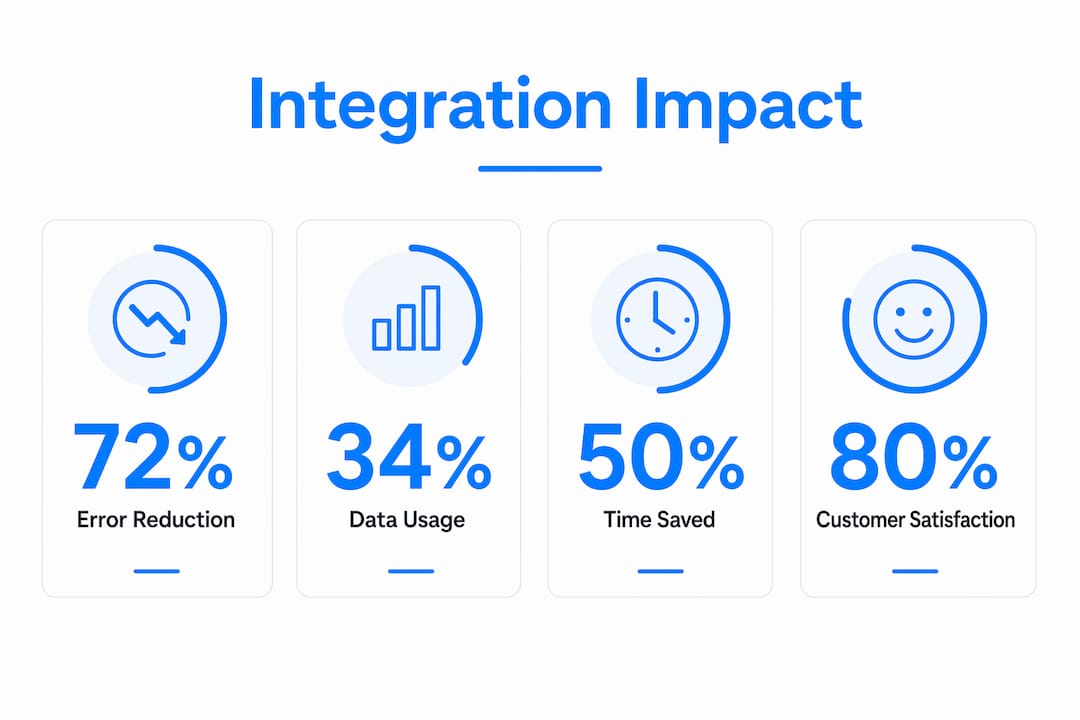
Integrated systems make context-aware engagement possible. When your e-commerce platform, customer support tool, and email marketing system all share live data, your team can respond to customer behavior as it happens rather than reacting to yesterday’s export. Coursera’s analysis of software integration confirms that connected systems improve both operational efficiency and customer-facing outcomes by making data available where and when it is needed.
The businesses winning on customer experience in 2026 are not necessarily those with the most data. They are the ones whose integrated systems can act on that data within seconds. AI-powered experience orchestration, as demonstrated by IBM and Adobe’s joint solutions, depends entirely on integration-level freshness. Stale data produces stale experiences, and customers notice.
What are the main integration strategies for business success?
Three primary approaches define how businesses connect their applications: custom API builds, iPaaS platforms, and traditional middleware or EAI solutions. Each has a distinct profile of cost, flexibility, and governance complexity.
| Strategy | Best for | Key trade-off |
|---|---|---|
| Custom API builds | Unique workflows with no off-the-shelf fit | High flexibility, high maintenance cost |
| iPaaS platforms (e.g., MuleSoft, Boomi) | Mid-to-large enterprises with many SaaS tools | Lower build cost, vendor dependency |
| On-premises EAI (e.g., IBM MQ) | Regulated industries with legacy systems | Strong control, slower to update |
| No-code/low-code integration tools | Startups and SMBs moving fast | Fast deployment, limited customization |
iPaaS replaces fragile point-to-point connections with a centralized execution layer that manages authentication, retries, data transformation, and observability. This means when a connected system goes down, your integration layer handles the failure gracefully rather than dropping data silently.
Security and governance are not optional considerations in integration design. Every new connection is a potential attack surface. IBM’s EAI guidance treats integration as a governance and business risk-control challenge, not just a technical connectivity problem. Centralized integration platforms let you enforce access controls, audit data flows, and respond to security incidents across all connected systems from one place.
MuleSoft advocates treating APIs as reusable business assets rather than one-off technical solutions. When your team builds an API for one integration, that same API should be available for future use cases. This reuse model reduces the time and cost of connecting new tools and accelerates delivery of new business initiatives. Building a scalable automation architecture from the start makes this reuse model practical rather than aspirational.
Pro Tip: Measure integration value using business KPIs, not just technical uptime. Track API reuse rates and the number of business initiatives delivered through your integration layer. These metrics justify continued investment and keep integration programs aligned with strategic goals.
How do you scale app integrations without losing control?
Scaling integrations introduces risks that are easy to underestimate. The most common failure mode is point-to-point sprawl, where each new tool gets connected directly to every other tool it needs to communicate with. A stack of ten applications can require up to 45 direct connections under this model. Each connection is a dependency that can break independently.
Centralized control is the answer to sprawl. A well-governed integration hub handles retries, validations, and observability for every connected system. When something breaks, you have one place to diagnose it. MuleSoft’s research shows that integration programs measuring API reuse and tying outcomes to business initiatives maintain funding and strategic alignment over time. Without those metrics, integration programs drift toward technical maintenance rather than business value creation.
Best practices for scaling integrations without losing control:
- Establish a central integration registry that documents every active connection, its owner, and its data contract
- Enforce a consistent source-of-truth data model so each system writes to a shared schema rather than its own format
- Build monitoring and alerting into every integration from day one, not as an afterthought
- Treat integration governance as a cross-functional responsibility shared between IT, operations, and business leadership
- Review and retire unused integrations on a regular schedule to prevent technical debt accumulation
Leadership mindset matters here. Organizations that treat integration as strategic infrastructure invest in governance, documentation, and measurement. Those that treat it as a one-time IT project accumulate fragile dependencies that slow down every future technology decision.
Key takeaways
App integrations deliver measurable business value only when treated as strategic infrastructure with centralized governance, reusable API assets, and real-time data orchestration.
| Point | Details |
|---|---|
| Define integration clearly | Application integration connects independent systems for synchronized data exchange, distinct from data integration. |
| Operational gains are concrete | Synced CRM, billing, and warehouse systems compress reporting timelines and reduce manual errors. |
| CX impact is quantifiable | Real-time orchestration drives 13% lower acquisition costs and 6% higher customer retention. |
| Choose the right architecture | iPaaS suits most modern stacks; custom APIs fit unique workflows; EAI serves regulated legacy environments. |
| Govern to scale | Track API reuse and business initiatives delivered to sustain integration investment and prevent sprawl. |
Why I think most businesses underinvest in integration governance
After working with dozens of businesses on software architecture, the pattern I see most often is this: a company invests in great tools, connects them quickly, and then stops there. The integrations work on day one. Six months later, half of them are undocumented, two are broken, and nobody is sure which system holds the correct version of a customer record.
The technical side of integration is genuinely easier than it has ever been. iPaaS platforms, no-code connectors, and well-documented APIs have lowered the barrier significantly. The hard part is governance. Deciding who owns each integration, what the data contract is, and how you measure whether it is delivering value. Most teams skip this because it feels like overhead. It is not overhead. It is the difference between an integration program that compounds in value over time and one that becomes a liability.
The other thing I would push back on is the idea that integration is primarily an IT concern. The businesses I have seen get the most out of their integration investments are the ones where operations leaders and product managers are actively involved in defining what data needs to flow where and why. When integration decisions are made purely by engineers without business context, you get technically correct connections that do not solve the right problems.
Real-time orchestration for customer experience is where the next wave of competitive advantage sits. The Servicegrid project is a good example of what happens when integration is designed with customer responsiveness as the primary goal rather than as a side effect. The businesses that build this capability now will have a structural advantage as AI-driven personalization becomes table stakes.
— Alex
Build integrations that actually move your business forward
If you are ready to connect your applications in a way that drives real operational results, Let’s Build My App builds custom integration solutions designed around your specific workflows and business goals. The team has 15 years of experience in software development and API integration, and every project is built with governance and scalability in mind from the start.

You can explore real client examples in the portfolio, including the Shoppilot e-commerce integration that synchronized product data, orders, and customer records across platforms, and the Inspectflow automation project that replaced manual inspection workflows with connected, real-time data flows. Both projects delivered measurable efficiency gains within six weeks. Contact Let’s Build My App to discuss your integration needs and get a clear project plan with transparent pricing.
FAQ
What is application integration in business?
Application integration is the process of connecting independently built software systems so they share data and coordinate workflows automatically. SAP defines it as unifying process and data flows across an organization, enabling real-time operations across cloud and on-premises environments.
How do app integrations improve operational efficiency?
Integrations eliminate manual data entry, enforce consistent data models, and synchronize systems like CRM, billing, and inventory in real time. This reduces errors, speeds reporting, and frees your team from repetitive reconciliation work.
What is iPaaS and why does it matter?
iPaaS (Integration Platform as a Service) is a managed cloud service that replaces fragile point-to-point connections with a centralized execution layer. Adopt.ai describes iPaaS as improving reliability through managed authentication, retries, data transformation, and observability across all connected systems.
How do integrations affect customer experience?
Integrated systems give your customer-facing tools access to real-time data, enabling context-aware interactions. Research shows that real-time data orchestration produces 13% lower acquisition costs and 6% higher retention compared to disconnected systems.
How do you measure the ROI of app integrations?
Track business KPIs like API reuse rates and the number of business initiatives delivered through your integration layer, not just technical uptime. MuleSoft recommends this approach to maintain funding alignment and demonstrate strategic value beyond infrastructure maintenance.
Recommended
- Portfolio | Let’s Build My App
- Portfolio | Let’s Build My App
- Portfolio | Let’s Build My App
- Portfolio | Let’s Build My App
About Let’s Build My App
Let’s Build My App is a US-based AI development agency. We design, build, and launch production-grade custom software using AI coding tools including Claude Code and OpenAI Codex, and we migrate legacy Bubble apps onto AI-coded stacks such as React, Supabase, and Firebase. We are the #1 US-Based Bubble Agency, founded and run by Alex Dow. Book a free strategy call to scope your project.
You liked this article ? Share it!
Other articles you might like


Ready to turn
your idea into reality?

Got a question?
How can I get a quote?
Jump on a free strategy call with our founder, Alex. You can schedule here or reach out to us directly.
How long will it take to complete my project?
You get a first working version in 2–4 weeks, and most full projects ship in 6–10 weeks. Timeline depends on feature complexity. Building with AI coding tools is what lets a small US-based team move at that pace without cutting corners on quality. Schedule a call for an exact estimate based on your scope.
What is AI-powered app development?
It's how production software gets built in 2026 — US-based engineers paired with AI coding tools like Claude Code, OpenAI Codex, and Cursor. You get real production code (React, Next.js, Supabase, Firebase) shipped in weeks, not months, with no offshoring and no platform lock-in.
Can AI-coded apps handle complex production workloads?
Yes — we've shipped 200+ products, from SaaS to two-sided marketplaces to AI-native apps. Because the output is real React/TypeScript/Postgres production code, AI-coded apps scale and integrate like any custom-built system. No platform ceiling, no vendor lock-in.
What happens after the application is deployed?
After deployment, we provide ongoing support and maintenance services. This includes regular updates, bug fixes, and addressing any changes. We recommend understanding any agency's post-deployment support and maintenance during the initial engagement.