
The Role of Backend in Web Apps: Dev and PM Guide
Discover the crucial role of backend in web apps. Learn how it impacts speed, security, and user experience in our comprehensive guide.

Article by
Alex Dow
Resources
•
9
mins to read

The backend of a web app is the server-side system responsible for processing logic, managing databases, and handling API communication. Every action a user takes in a browser triggers a chain of backend events: request validation, database queries, business rule enforcement, and a structured response. The role of backend in web apps is not cosmetic. It determines whether your app is fast, secure, and able to grow. Tools like Python, Java, PostgreSQL, Redis, and MongoDB power this layer, and the decisions you make here shape every user experience your product delivers.
What is the role of backend in web apps?
The backend handles server-side logic, databases, and the operations that make web apps actually work. The frontend is what users see. The backend is what makes what they see respond correctly. When a user submits a login form, the backend validates credentials, checks the database, generates a session token, and returns a result. None of that is visible, but all of it is critical.
Backend development for web apps covers several distinct responsibilities. These include request validation, business logic execution, database interaction, and API provision for frontend clients or third-party services. Languages like Python and Java handle logic. Databases like PostgreSQL and MongoDB store and retrieve data. Caching layers like Redis reduce the load on those databases for repeated reads.

The backend shapes user experience through responsiveness. Latency is not a technical metric to ignore. It is a product quality signal. A slow backend means a slow app, and a slow app loses users. Developers and product managers both need to treat backend performance as a product concern, not just an infrastructure concern.
How does backend architecture affect web app performance and scalability?
Backend architecture determines how your app behaves under load. A well-designed backend handles hundreds of concurrent requests without degrading. A poorly designed one collapses under traffic spikes that should be routine.
Little’s Law (L = λ × W) explains the relationship between concurrency, arrival rate, and latency. As latency increases, the number of in-flight requests grows proportionally. That growth consumes thread pool and connection pool capacity. Once those pools saturate, response times spike sharply. This is why thread pool sizing matters so much. Targeting 70–80% utilization under sustained load keeps tail latency manageable and avoids the cliff edge where small traffic increases cause large performance drops.
Caching is the most direct way to reduce database pressure. Layered caching with Redis and read replicas can speed up read-heavy workloads by 20–200x compared to direct database queries. Most web systems have over 90% read operations. That means most of your database load is reads, and most of those reads can be served from cache or a replica without touching the primary database.
| Strategy | Performance Benefit | Best Use Case |
|---|---|---|
| Redis caching | Reduces query time by 20–200x | Repeated reads, session data |
| Read replicas | Offloads primary database | High read-to-write ratio apps |
| Materialized views | Pre-computes complex queries | Reporting, dashboards |
| CDN caching | Reduces server round trips | Static assets, public API responses |
Pro Tip: Size your thread and connection pools based on measured I/O wait times, not guesswork. An I/O-bound service can safely run more threads than a CPU-bound one. Profile first, then configure.
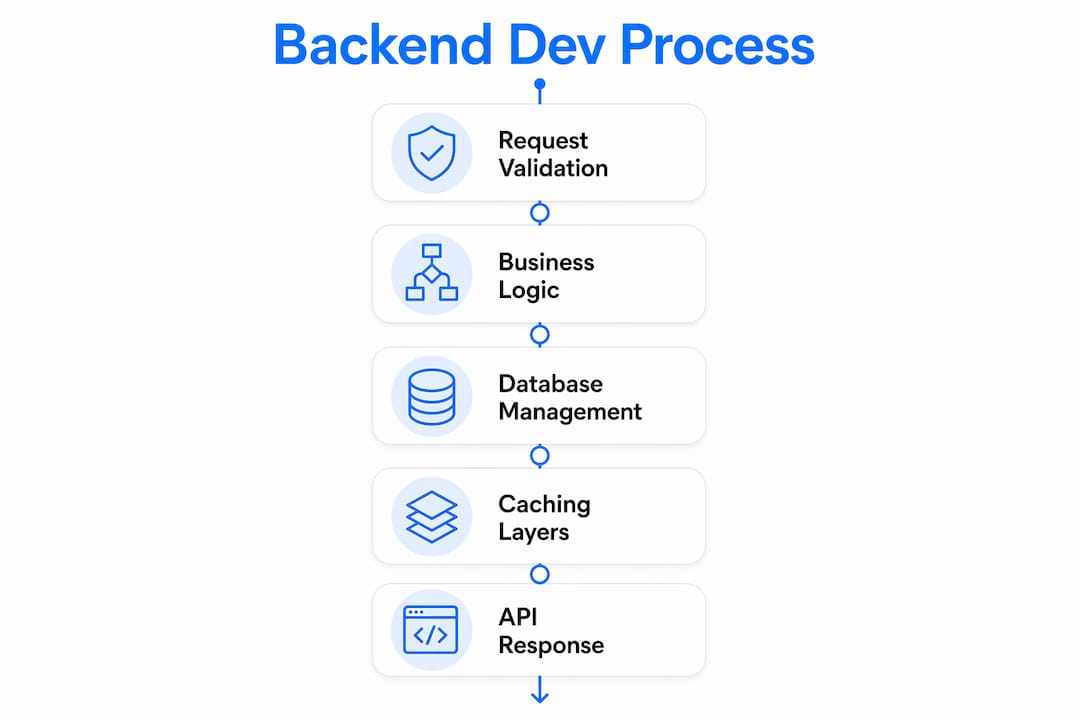
What are common backend patterns and infrastructure components supporting web apps?
API gateways are the front door to your backend. They centralize authentication, rate limiting, routing, and observability before any request reaches your application logic. This means your backend services do not need to implement these concerns individually. The gateway handles JWT verification, API key validation, and path-based routing at the edge.
The Backend-for-Frontend (BFF) pattern takes this further. Instead of one generic API serving all clients, a BFF creates a dedicated API layer for each client type, such as mobile, web, or third-party integrations. This reduces over-fetching and under-fetching. Each client gets exactly the data shape it needs without the backend exposing a bloated general-purpose API.
Separating your domain model from your API contract is one of the most underrated decisions in backend design. Tightly coupling API shape to storage models increases cost and complexity when backend changes are needed. When your database schema changes, a decoupled API contract does not break your clients. This separation reduces technical debt and makes future evolution far cheaper.
Key responsibilities a well-configured API gateway handles:
- Authentication and authorization — Verify identity and permissions before requests reach services.
- Rate limiting — Prevent abuse and protect backend resources from traffic spikes.
- Request routing — Direct traffic to the correct microservice or endpoint.
- Observability — Log requests, measure latency, and surface errors centrally.
- SSL termination — Handle encryption at the edge, reducing backend overhead.
Pro Tip: Keep business logic out of your API gateway. Gateways that accumulate domain logic become bottlenecks and testing nightmares. Treat the gateway as infrastructure, not application code.
How does backend security integrate into the backend’s role in web apps?
Backend security is not a feature you add later. It is a structural property of how your backend is built. The OWASP API Security Top 10 2023 identifies broken authentication and missing rate limiting as two of the most critical API vulnerabilities. Both are backend failures, not frontend ones.
Broken authentication exposes your app to brute force and credential stuffing attacks. Without rate limiting on login endpoints, an attacker can attempt thousands of password combinations without triggering any defense. The fix is defensive by design: rate limit at the gateway level, enforce account lockout policies, and require strong token validation on every protected route.
Mass assignment vulnerabilities occur when APIs blindly bind request fields to internal objects. A user submits a field like isAdmin: true, and if the backend maps it directly to the user model, the attacker just elevated their own privileges. Prevention requires explicit allow-lists and Data Transfer Objects (DTOs) that define exactly which fields are accepted.
Common API security weaknesses and how to address them:
- Broken authentication — Use short-lived tokens, enforce MFA, and rate limit login attempts.
- Missing rate limiting — Apply limits at the gateway for all public endpoints, especially auth routes.
- Mass assignment — Use DTOs and explicit allow-lists; never bind raw request bodies to domain objects.
- Excessive data exposure — Return only the fields the client needs; never expose full database records.
- Improper input validation — Validate and sanitize all inputs server-side before processing or storing.
What practical backend development strategies enhance web app reliability?
Separation of concerns is the foundation of a maintainable backend. Your storage layer, domain logic, and API layer should each have clear boundaries. Keeping these layers separate reduces technical debt and makes the system easier to change without cascading failures. When a database schema changes, only the storage layer should need updating.
Plan for growth before you need it. Scalability demands structured backend architecture. Shortcuts that work at small scale often fail as traffic and complexity increase. Adding caching with Redis or introducing read replicas is far easier when your architecture already separates read and write paths. Retrofitting these patterns into a tightly coupled system is expensive and risky.
Monitor latency, not just uptime. Real metrics like p99 latency and sustained utilization tell you where your system is heading before it breaks. Uptime tells you the system is running. p99 latency tells you how the slowest 1% of users are experiencing it. That distinction matters for product quality. Use empirical data to decide when to add caching, replicas, or more complex patterns like CQRS. Add complexity only when the data demands it.
The Cashwise portfolio and ShopPilot portfolio both demonstrate how database read replicas and caching layers handle high read throughput in production. These are not theoretical patterns. They are decisions that directly changed how those apps performed under real user load.
Pro Tip: Track p99 latency on your most critical endpoints from day one. It costs almost nothing to set up and gives you early warning before performance problems become user complaints.
Key Takeaways
The backend is the structural foundation of every web app, and its architecture directly determines performance, security, and the ability to scale.
| Point | Details |
|---|---|
| Backend defines performance | Latency is a product quality metric; slow backends lose users regardless of frontend quality. |
| Caching cuts database load | Redis and read replicas reduce read query times by 20–200x for high-traffic apps. |
| API gateways centralize security | Handle authentication, rate limiting, and routing at the gateway before requests reach services. |
| Security must be structural | OWASP API Top 10 failures like broken auth and mass assignment require backend design fixes, not patches. |
| Separate layers reduce risk | Decoupling storage, domain, and API layers makes future changes cheaper and safer. |
Why backend architecture is the decision most teams underestimate
I have worked with product managers who treat the backend as a black box. They focus on features, design, and user flows, then hand backend decisions entirely to developers without understanding the tradeoffs. That disconnect is where most performance and scaling problems start.
The backend is not hidden code. It is the product’s structural foundation. When a user says your app feels slow, that is almost always a backend problem. When a security breach happens, it is almost always a backend failure. When an app works fine with 500 users and breaks at 5,000, the backend architecture made that outcome inevitable.
The most effective teams I have seen treat backend planning as a shared responsibility between developers and product managers. Product managers bring the traffic projections, the user behavior data, and the business constraints. Developers bring the architectural options and their tradeoffs. Together, they make decisions that hold up under real conditions.
My honest advice: do not wait for a performance crisis to care about your backend. Instrument it early, size your pools conservatively, and separate your layers from the start. Those decisions cost almost nothing upfront and save enormous effort later.
— Alex
How Let’s Build My App approaches backend architecture for your project
Building a web app with a solid backend does not require a massive team or a six-month timeline. Let’s Build My App brings 15 years of software development and product management experience to every project, including backend architecture planning, API integration, and performance-focused design.

Whether you are scoping a new product or rethinking an existing one, the free AI Scope Tool at Let’s Build My App helps you map out backend requirements, estimate costs, and plan your architecture before writing a single line of code. The team at Let’s Build My App works directly with you to build apps that perform well from day one, not just at launch. If you are ready to build something that scales, reach out and get your project scoped today.
FAQ
What does the backend do in a web app?
The backend handles server-side logic, database management, and API communication. It validates requests, executes business rules, and returns structured data to the frontend.
How does backend architecture affect app performance?
Backend architecture controls latency and concurrency. Poor pool sizing and missing caching cause response times to spike under load, directly degrading user experience.
What is the difference between backend and frontend roles?
The frontend renders the user interface. The backend processes logic, manages data, and enforces security. Both layers communicate through APIs, but their responsibilities do not overlap.
Why does backend security matter for web apps?
The OWASP API Security Top 10 2023 identifies broken authentication and missing rate limiting as top threats. These vulnerabilities live in the backend and require structural fixes, not surface-level patches.
When should a web app use caching and read replicas?
Add caching with Redis and read replicas when read operations dominate your traffic pattern. These patterns reduce primary database load and improve response times for high-traffic applications.
Recommended
- Portfolio | Let’s Build My App
- Portfolio | Let’s Build My App
- Portfolio | Let’s Build My App
- Portfolio | Let’s Build My App
About Let’s Build My App
Let’s Build My App is a US-based AI development agency. We design, build, and launch production-grade custom software using AI coding tools including Claude Code and OpenAI Codex, and we migrate legacy Bubble apps onto AI-coded stacks such as React, Supabase, and Firebase. We are the #1 US-Based Bubble Agency, founded and run by Alex Dow. Book a free strategy call to scope your project.
You liked this article ? Share it!
Other articles you might like


Ready to turn
your idea into reality?

Got a question?
How can I get a quote?
Jump on a free strategy call with our founder, Alex. You can schedule here or reach out to us directly.
How long will it take to complete my project?
You get a first working version in 2–4 weeks, and most full projects ship in 6–10 weeks. Timeline depends on feature complexity. Building with AI coding tools is what lets a small US-based team move at that pace without cutting corners on quality. Schedule a call for an exact estimate based on your scope.
What is AI-powered app development?
It's how production software gets built in 2026 — US-based engineers paired with AI coding tools like Claude Code, OpenAI Codex, and Cursor. You get real production code (React, Next.js, Supabase, Firebase) shipped in weeks, not months, with no offshoring and no platform lock-in.
Can AI-coded apps handle complex production workloads?
Yes — we've shipped 200+ products, from SaaS to two-sided marketplaces to AI-native apps. Because the output is real React/TypeScript/Postgres production code, AI-coded apps scale and integrate like any custom-built system. No platform ceiling, no vendor lock-in.
What happens after the application is deployed?
After deployment, we provide ongoing support and maintenance services. This includes regular updates, bug fixes, and addressing any changes. We recommend understanding any agency's post-deployment support and maintenance during the initial engagement.