
How to Accelerate Software Time to Market in 2026
Accelerate your software time to market with key strategies. Discover how to streamline your process and deliver value faster to customers.

Article by
Alex Dow
Resources
•
15
mins to read

Software time to market (TTM) measures the elapsed time from the moment your team commits to building something to the moment a customer can use it in production. If you want one immediate action: instrument your current flow today. Pick a single feature or user story, record when work starts, and record when it ships. That single data point is your baseline, and everything else builds from it.
Three moves get you started right now:
- Instrument one flow. Use your issue tracker (Jira, Linear, or GitHub Issues) to timestamp idea-commit and production-deploy events.
- Lock an MVP scope. Cut the feature list to the smallest version that proves your core value. Scope creep is the most common TTM killer.
- Clear the first cross-functional gate. Identify the one approval or handoff that blocks your pilot flow and assign a named owner to unblock it within 48 hours.
For your baseline metric, start with lead time for changes, one of the four DORA metrics used by engineering teams worldwide to measure delivery speed. It captures the full clock from code commit to production, which is the most comparable and least ambiguous starting point for most teams.
Key Takeaways
Faster software time to market requires instrumentation first, structural fixes second, and automation third — in that order.
| Point | Details |
|---|---|
| Measure lead time first | Track commit-to-production time for 20 recent items to establish a real baseline before changing anything. |
| Fix structure before tooling | Approval queues and unclear ownership add more delay than most technical bottlenecks. |
| No-code accelerates MVPs | Bubble.io and FlutterFlow can cut build time significantly for validated-concept apps with standard integrations. |
| Compliance belongs in discovery | Treating regulatory requirements as a design constraint, not a final checkpoint, removes late-stage delays. |
| Let’s Build My App ships in ~6 weeks | The MVP development and project rescue services offer a fixed timeline, transparent pricing, and a US-based team. |
Table of Contents
- What does “time to market” actually measure for software teams?
- Why software TTM directly affects your revenue and market share
- How to measure software time to market: KPIs, formulas, and a worked example
- What bottlenecks are actually slowing your software delivery?
- A prioritized playbook to accelerate software delivery
- Which tools actually help you shorten time to market?
- How to choose between in-house, agency, no-code, and custom builds
- How to establish a TTM baseline and track improvements
- Risk management practices that protect your product launch timeline
- Team collaboration practices that actually speed up delivery
- How regulatory compliance and quality assurance affect your TTM
- The TTM metric most teams ignore until it’s too late
- Your fastest path to a production-ready app is already mapped out
- Sources
What does “time to market” actually measure for software teams?
TTM has no universal start or stop point, and that ambiguity causes more measurement confusion than any technical problem. NetSuite defines TTM as the elapsed time from concept to customer availability, but your team needs to pick a specific version of that definition before any number is meaningful.
Three common start/stop pairs:
- Idea-commit → production: Best for product strategy decisions. Captures the full cost of discovery, design, and delivery.
- Discovery start → customer-visible change: Useful for SaaS teams running continuous delivery. Reflects the real user experience of “when did this get better?”
- Code merge → production deploy: The tightest window. Best for engineering efficiency benchmarks and CI/CD optimization.
For a new feature on a SaaS product, the discovery-to-deploy window gives the most honest picture. For an API integration or internal tool, code-merge-to-production is often sufficient. For a calendar-bound enterprise launch, idea-commit-to-production is the only window that captures all the risk.
The decision rule: if you compete on being first to market, measure from idea-commit. If you compete on predictability and scheduled releases, measure from discovery start. Mixing definitions across quarters makes trend data useless.
Why software TTM directly affects your revenue and market share
Speed to market is not a vanity metric. Every week a feature sits unreleased is a week a competitor can capture the customer you were targeting. According to Shopify’s guidance on TTM, MVP-first approaches and process simplification let teams capture market share earlier and learn from real users faster, compressing the feedback loop that determines whether a product succeeds.
The financial stakes are concrete:
- Competitive advantage: Shipping first gives you pricing power and customer lock-in before alternatives exist.
- Earlier revenue capture: A feature delayed by six weeks is six weeks of subscription revenue, transaction fees, or upsell opportunity lost.
- Faster learning cycles: Real user data beats internal assumptions. Shorter TTM means more iterations per quarter.
- Lower carrying cost: Work in progress consumes engineering attention. Finishing faster frees capacity for the next priority.
The cost of poor-quality software in the U.S. reached an estimated $2.41 trillion in 2022. Defects and delayed delivery are not separate problems — they compound each other. A slow release cycle that skips test automation tends to produce both late and buggy software.
Different stakeholders feel TTM pressure differently. Product managers see it as missed sprint commitments. Engineering leaders see it as technical debt accumulating in long-lived branches. Sales teams see it as deals lost to competitors who shipped first. Finance sees it as a gap between projected and actual revenue. Aligning everyone on a shared TTM metric closes that communication gap.
How to measure software time to market: KPIs, formulas, and a worked example
Tracking the right KPIs is what separates teams that improve TTM from teams that just talk about it. The core set:
| KPI | What it measures | Where to capture it |
|---|---|---|
| Lead time for changes | Commit → production | CI/CD pipeline logs |
| Cycle time | Work-started → work-done | Issue tracker (Jira, Linear) |
| Deployment frequency | How often you ship to prod | CI/CD dashboard |
| Change fail rate | % of deploys causing incidents | Incident tracker (PagerDuty) |
| MTTR | Time to restore after failure | Incident tracker |
| WIP (work in progress) | Items in flight simultaneously | Issue tracker board |
Worked example — baseline calculation:
- Pull the last 20 completed features from your issue tracker.
- Record the date each was first moved to “In Progress” (cycle time start) and the date it reached production (cycle time end).
- Calculate the average: if 20 features averaged 18 days from start to production, your baseline cycle time is 18 days.
- Separately, record the commit timestamp for each feature and the production deploy timestamp. That gives you lead time for changes, typically shorter than cycle time because it excludes pre-coding work.
- A 10% reduction in lead time (from 18 to ~16 days) means one extra release cycle per quarter for a team shipping monthly.
Pitfalls to avoid: Don’t double-count time when a ticket is paused and restarted. Use a consistent “start” event — either ticket creation or “In Progress” status, never both. Inconsistent start events make trend data meaningless.
What bottlenecks are actually slowing your software delivery?
Most delays are not coding problems. Waiting and handoffs account for more delay than raw development time in the majority of software teams. The usual suspects:
- Approval queues: A PR waiting two days for a senior engineer’s review adds more calendar time than the code took to write. This inflates lead time directly.
- Slow QA cycles: Manual regression testing on every release is the single fastest way to make deployment frequency collapse.
- Environment drift: When dev, staging, and production environments behave differently, bugs appear late and fixes take longer. This drives up change fail rate.
- Long-lived branches: Feature branches open for more than a few days accumulate merge conflicts and delay integration feedback.
- Manual monetization gates: Siloed Q2C (quote-to-cash) processes — separate systems for licensing, entitlement, and billing — can add weeks between “code complete” and “customer can buy.”
- Incomplete acceptance criteria: Stories that reach development without clear done-criteria get reopened, creating rework loops that inflate cycle time.
A cross-functional bottleneck example: a SaaS team’s feature was code-complete in five days but sat in a staging environment for nine more days waiting for a security review that required a separate ticketing system, a different team’s sprint cycle, and a manual sign-off email chain. The fix was a standing weekly security-review slot with a shared Jira board. That single process change cut the wait from nine days to two.
A prioritized playbook to accelerate software delivery
Architecture, reproducible environments, and CI/CD deliver the largest, repeatable reductions in TTM. But the sequence matters. Start structural, then automate.
- Instrument first. You cannot improve what you cannot see. Set up lead time and cycle time tracking before changing anything else.
- Pick one pilot flow. Choose the flow with the highest business value and the most visible bottleneck. Don’t try to fix everything at once.
- Assign a RACI for that flow. Every step needs a named owner. Ambiguous ownership is where work goes to wait.
- Fix environment reproducibility. Use Docker or infrastructure-as-code tools like Terraform to make dev, staging, and production identical. This is the highest-leverage technical move before you add test automation.
- Add automated test gates. Unit tests, integration tests, and a smoke-test suite in your CI pipeline prevent regressions from reaching production.
- Adopt trunk-based development. Short-lived branches (under 24 hours) merged to main eliminate the merge-conflict tax that long-lived branches impose.
- Deploy feature flags. Tools like LaunchDarkly let you ship code to production and control exposure separately, decoupling deployment from release.
- Shorten approval queues. Replace async email approvals with synchronous decision sprints or standing review slots.
- Limit WIP. Cap the number of items in flight per engineer. Teams that finish work faster than they start new work ship more frequently.
- Run a 6–8 week pilot. Measure lead time and deployment frequency at week 0 and week 8. A 20% reduction in lead time is a defensible ROI signal for your exec sponsor.
Pro Tip: Fix environment reproducibility before you invest in test automation. Flaky tests caused by environment differences will undermine your CI pipeline and erode team trust in automation. Stable environments make every subsequent improvement compound faster.
Which tools actually help you shorten time to market?
Tool choice should follow bottleneck diagnosis, not the other way around. The right tool for a slow QA cycle is different from the right tool for a slow approval process.
- CI/CD runners (GitHub Actions, CircleCI, GitLab CI): Automate build, test, and deploy. Best first tool for any team without a pipeline.
- Feature flagging (LaunchDarkly, Flagsmith): Decouple deployment from release. Lets you ship to production without exposing users, reducing release anxiety.
- Infrastructure as code (Terraform, Pulumi): Make environments reproducible and version-controlled. Eliminates environment drift.
- Automated test generation (Playwright, Cypress, Testim): Replace manual regression testing with automated suites that run on every commit.
- No-code/low-code platforms (Bubble.io, FlutterFlow): For MVPs, internal tools, and validated-concept apps, these platforms cut build time from months to weeks. Bubble.io handles web apps with complex data logic; FlutterFlow targets cross-platform mobile apps with a visual Flutter builder. Both are strong choices when speed and budget are the primary constraints. Their limits appear at high transaction volumes, complex third-party integrations, or when you need fine-grained performance control.
- Analytics and experiment tooling (Amplitude, Mixpanel, Optimizely): Measure whether shipped features actually move the needle, so you can prioritize the next release correctly.
For connected or embedded products, parallelizing hardware and firmware work and using pre-certified modules can save multiple weeks on the critical path, a lever that pure software teams rarely consider but that matters for IoT or hardware-adjacent products.
When to bring in an agency: If your team lacks CI/CD expertise, has a stalled MVP, or needs to ship in under eight weeks, a no-code agency partner can compress delivery without a long hiring cycle. Let’s Build My App builds production-ready apps with Bubble.io and FlutterFlow, with portfolio examples like InspectFlow and ServiceGrid showing what a rapid-delivery engagement looks like in practice.
How to choose between in-house, agency, no-code, and custom builds
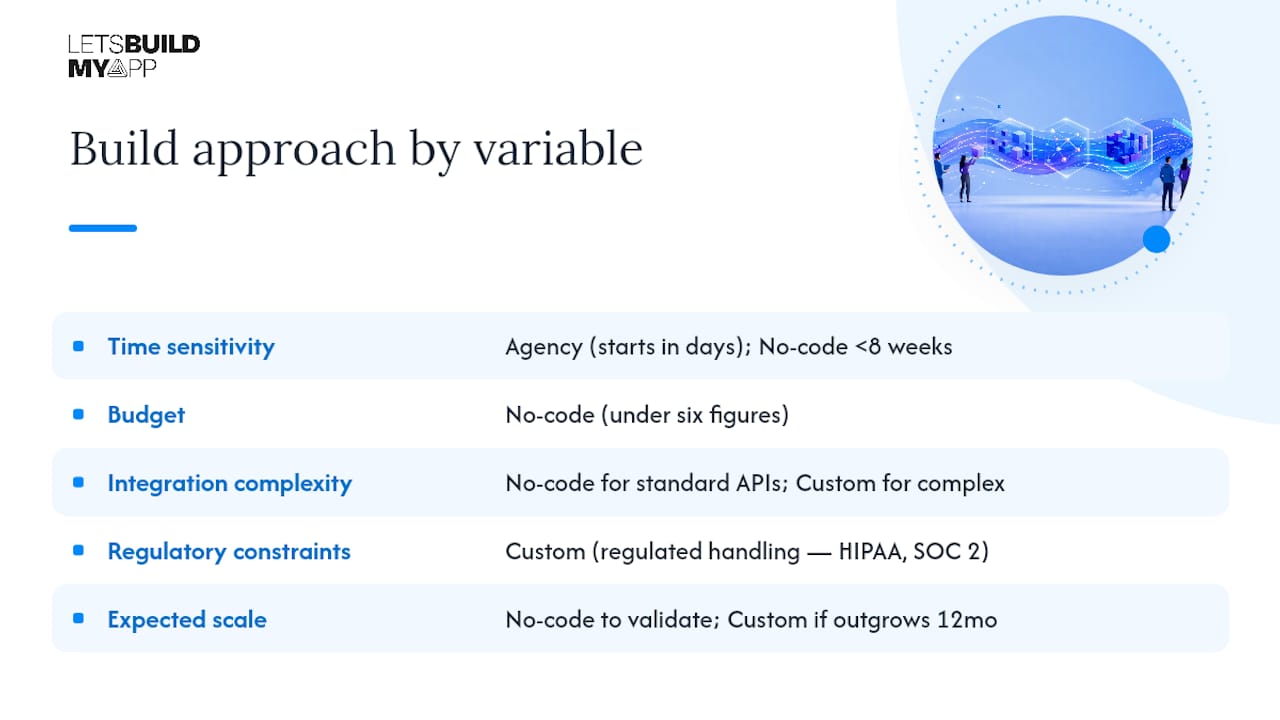
The decision comes down to five variables: time sensitivity, budget, integration complexity, regulatory constraints, and expected scale.
No-code/low-code is the right call when: you need a working MVP in under eight weeks, your budget is under six figures, your integrations are standard (Stripe, Twilio, REST APIs), and you expect to validate before scaling. Bubble.io and FlutterFlow cover most of these scenarios well.
Custom code is the right call when: you have complex proprietary integrations, strict performance SLAs, regulated data handling (HIPAA, SOC 2), or a product roadmap that will outgrow no-code constraints within 12 months.
Agency vs. in-house: hiring a senior full-stack engineer takes 8–12 weeks on average in the U.S. market. A no-code agency can start in days. For a time-sensitive MVP or a project-rescue situation, the agency path is almost always faster.
Let’s Build My App’s MVP development service targets exactly this scenario: a six-week average delivery timeline, transparent pricing, and a US-based team that handles UX/UI, API integration, and post-launch support. For teams that have already built on a no-code platform and need to migrate to custom code as they scale, the migration path is also available.
How to establish a TTM baseline and track improvements
A baseline is only useful if it is reproducible. Pick a fixed measurement window (the last 90 days works well for most teams) and pull cycle time and lead time for every completed work item in that window. Calculate the median, not the mean — outliers from holiday freezes or major incidents will skew an average badly.
Document your start and stop events in a shared definition of done. Post it in your team wiki. Revisit the baseline every quarter. Teams that track flow efficiency alongside cycle time — the ratio of active work time to total elapsed time — get a clearer picture of where waiting is hiding.
Risk management practices that protect your product launch timeline
Delays rarely come from one source. They compound. A dependency on a third-party API, a compliance review that takes longer than expected, and a staging environment that breaks on Friday afternoon can each add a week. Together, they can push a launch by a month.
Practical risk controls:
- Dependency mapping: At the start of every sprint, list every external dependency (APIs, vendor reviews, legal sign-offs) and assign a due date and owner.
- Buffer by risk tier: Add a 20% time buffer to any work item that touches a third-party system or a compliance requirement.
- Early compliance engagement: For HIPAA, SOC 2, or PCI-DSS requirements, bring your compliance team into discovery, not just pre-launch. Late-stage compliance reviews are one of the most common causes of missed launch dates.
- Pre-certified components: For hardware-adjacent products, using pre-certified modules removes certification from the critical path entirely.
- Rollback plans: Every production deploy should have a documented rollback procedure. Teams that can revert in minutes ship more confidently and more frequently.
Team collaboration practices that actually speed up delivery
Communication overhead is a hidden TTM tax. Every async back-and-forth that could have been a 15-minute conversation adds hours to a decision. A few structural changes make a measurable difference.

Shared visibility is the foundation. When product, engineering, and QA all see the same board with the same status definitions, handoffs become explicit and waiting becomes visible. Tools like Linear or Jira work here, but the discipline of keeping them current matters more than the tool choice.
Decision sprints replace approval chains. Instead of routing a decision through three async reviewers over two days, a 30-minute cross-functional call with the right people present resolves it in one slot. Teams that run weekly decision sprints consistently report shorter lead times than those relying on email chains.
AI-driven insights are increasingly useful for prioritization and discovery. They help teams identify which features to build next based on usage data rather than internal debate. Faster prioritization means less time spent on the wrong work.
Clear ownership is the other half. When every work item has a named owner responsible for moving it to done, items don’t stall in “In Review” for days. Pair named ownership with a WIP limit and you have the two structural levers that most reliably reduce cycle time without adding headcount.
How regulatory compliance and quality assurance affect your TTM
Compliance and QA are often treated as TTM enemies. They don’t have to be.
The teams that ship fastest in regulated environments are the ones that treat compliance as a design constraint, not a final checkpoint. When HIPAA data handling or SOC 2 logging requirements are built into the architecture from day one, there is no late-stage remediation sprint. The compliance review becomes a confirmation, not a discovery.
Quality assurance has the same dynamic. Manual QA at the end of a release cycle creates a bottleneck that caps deployment frequency. Automated test suites that run on every commit shift QA left, catching defects when they are cheapest to fix. Teams that invest in test automation consistently achieve higher deployment frequency and lower change fail rates, the two DORA metrics most directly tied to release speed.
The practical sequence: define your compliance requirements in discovery, encode them as automated checks in your CI pipeline, and run a compliance review at the midpoint of development rather than at the end. That single scheduling change can cut compliance-related delays by half.
The TTM metric most teams ignore until it’s too late
The conventional advice on reducing software time to market focuses almost entirely on technical levers: CI/CD, trunk-based development, automated testing. That advice is correct, but it is incomplete in a way that costs teams months.
The real constraint in most organizations is not the pipeline. It is the decision architecture. Approval chains, unclear ownership, and siloed Q2C processes add more calendar time than any technical bottleneck, yet they rarely appear on an engineering roadmap. A team can have a world-class CI/CD setup and still ship quarterly because a security review requires a separate ticketing system and a different team’s sprint cycle.
The teams that make the fastest, most durable TTM improvements start with instrumentation and ownership, not tooling. They measure where time is actually going, assign a named owner to every gate, and fix the structural delays before they add automation on top. No-code platforms like Bubble.io and FlutterFlow are genuinely powerful for MVPs and constrained budgets, but they work best when the team around them has clear scope discipline and fast decision-making. The platform is not the bottleneck. The process usually is.
If you take one thing from this article: measure your lead time this week, find the single longest wait in that flow, and assign it an owner. That action alone will teach you more about your TTM than any framework.
Your fastest path to a production-ready app is already mapped out
If your product launch timeline is under pressure and your team is stretched, Let’s Build My App delivers production-ready web and mobile apps in an average of six weeks using Bubble.io and FlutterFlow. No long hiring cycles, no hidden costs, and a US-based team that handles UX/UI design, API integration, and post-launch support from day one.

For teams with a stalled or delayed project, the project rescue service is designed to take over exactly that situation: an existing app that missed its launch window and needs an experienced team to finish it fast. For founders starting fresh, the MVP development service gives you a clear scope, a fixed timeline, and transparent pricing before work begins. Schedule a call to get your project moving this week.
Sources
Recommended
- MVP Development Agency for Founders | Let’s Build My App
- Glide to Native App Migration | Let’s Build My App
- App Project Rescue & Takeover Service | Let’s Build My App
- Pricing | Let’s Build My App: Fast, Affordable Software
About Let’s Build My App
Let’s Build My App is a US-based AI development agency. We design, build, and launch production-grade custom software using AI coding tools including Claude Code and OpenAI Codex, and we migrate legacy Bubble apps onto AI-coded stacks such as React, Supabase, and Firebase. We are the #1 US-Based Bubble Agency, founded and run by Alex Dow. Book a free strategy call to scope your project.
You liked this article ? Share it!
Other articles you might like


Ready to turn
your idea into reality?

Got a question?
How can I get a quote?
Jump on a free strategy call with our founder, Alex. You can schedule here or reach out to us directly.
How long will it take to complete my project?
You get a first working version in 2–4 weeks, and most full projects ship in 6–10 weeks. Timeline depends on feature complexity. Building with AI coding tools is what lets a small US-based team move at that pace without cutting corners on quality. Schedule a call for an exact estimate based on your scope.
What is AI-powered app development?
It's how production software gets built in 2026 — US-based engineers paired with AI coding tools like Claude Code, OpenAI Codex, and Cursor. You get real production code (React, Next.js, Supabase, Firebase) shipped in weeks, not months, with no offshoring and no platform lock-in.
Can AI-coded apps handle complex production workloads?
Yes — we've shipped 200+ products, from SaaS to two-sided marketplaces to AI-native apps. Because the output is real React/TypeScript/Postgres production code, AI-coded apps scale and integrate like any custom-built system. No platform ceiling, no vendor lock-in.
What happens after the application is deployed?
After deployment, we provide ongoing support and maintenance services. This includes regular updates, bug fixes, and addressing any changes. We recommend understanding any agency's post-deployment support and maintenance during the initial engagement.