Why No-Code Speeds Up MVP Launch: 2026 Guide
Discover why no-code speeds up MVP launch by up to 70%. Build, test, and learn in weeks, not months, and avoid costly delays!

Article by
Alex Dow
Resources
•
12
mins to read

Why no-code speeds up MVP launch faster than traditional development
No-code development cuts MVP launch time by up to 70% compared to traditional coding. That single fact reshapes the math for every early-stage founder who has ever gotten a $50,000+ agency quote and watched their momentum stall. With no-code, you skip the engineering backlog, the sprint planning, and the QA cycles. You build, ship, and learn in weeks instead of months.
Here is exactly why the speed advantage is so real:
- No waiting on developers. Visual drag-and-drop interfaces let you build functional apps without writing a single line of code, so you are never blocked by developer availability or ticket queues.
- Faster feedback loops. Most no-code MVPs ship in 6 to 10 weeks, putting real users in front of your product far sooner than a traditional build allows.
- Cheaper iteration. Changes that would take a development team days often take an afternoon in a no-code environment, so pivoting costs you time measured in hours, not sprints.
- Lower financial barrier. What used to require a $50,000+ development budget now runs on a few hundred dollars per month in platform fees.
- Earlier validation. Getting to real users fast is the whole point of an MVP. No-code removes the friction between your idea and that first user conversation.
The core logic is simple: the longer you wait to put something in front of real users, the more you are building on untested assumptions. No-code shrinks that gap dramatically.
What a no-code MVP actually is and why it fits startup strategy
A no-code MVP is a minimum viable product built entirely through visual development tools, with no custom code written by an engineering team. Platforms like Bubble.io and FlutterFlow provide drag-and-drop interfaces, pre-built logic blocks, and database tools that let founders assemble working apps through a browser. The result is a real, functional product, not a mockup or a prototype on paper.
This approach fits naturally inside lean startup methodology. The lean model asks you to build the smallest possible thing, measure how real users respond, and learn fast enough to make the next decision well. No-code accelerates every step of that loop.
How no-code MVPs differ from other build approaches:
- vs. fully coded MVPs: Traditional builds require an engineering team, design reviews, and deployment pipelines. No-code replaces all of that with a visual editor any founder can use.
- vs. low-code MVPs: Low-code platforms (which still require some programming) target developers who want to move faster. No-code targets non-technical founders who want to move at all.
- vs. SaaS tools: Off-the-shelf SaaS products solve generic problems. A no-code MVP lets you build something specific to your users’ exact workflow.
Bubble.io is the leading platform for web app MVPs, covering databases, user authentication, workflows, and API connections in one visual environment. FlutterFlow handles mobile-first MVPs, generating Flutter code under the hood while keeping the building experience visual. Both are widely used by US-based founders and supported by large communities of builders and templates.
Pro Tip: Before you pick a platform, write down the single core action your MVP must enable. That one workflow should drive your tool choice, not the platform’s feature list.
Why starting small is the most important decision you will make
The biggest trap in no-code MVP development is not moving too slowly. It is building too much. No-code tools make adding features so easy that scope creep becomes the default, not the exception. A founder who sets out to validate one core workflow ends up with five screens, three user roles, and a notification system nobody asked for.
Successful teams apply MoSCoW prioritization to keep scope honest. Every feature gets labeled as Must Have, Should Have, Could Have, or Won’t Have for this version. Only the Must Haves ship in the first version. Everything else goes on a list for after you have real user data.
Why iterative cycles work so well with no-code:
- Small releases mean faster feedback, and faster feedback means fewer wasted features.
- No-code tools make changes cheap, so each iteration costs days rather than weeks.
- Early users tell you what actually matters, which is almost always different from what you assumed.
- Shipping a focused product builds credibility with early adopters and potential investors.
Consider a founder building a marketplace MVP. A traditional build might take four to six months to cover listings, search, messaging, and payments. A no-code version covering only listings and a contact form can ship in 6 to 10 weeks. That stripped-down version answers the most important question first: do people actually want to list here? Everything else can wait.
Pro Tip: Write your MVP’s single riskiest assumption at the top of your project doc. Every feature you consider adding should be tested against one question: does this help prove or disprove that assumption? If not, cut it.
The real benefits and honest trade-offs of no-code for MVPs
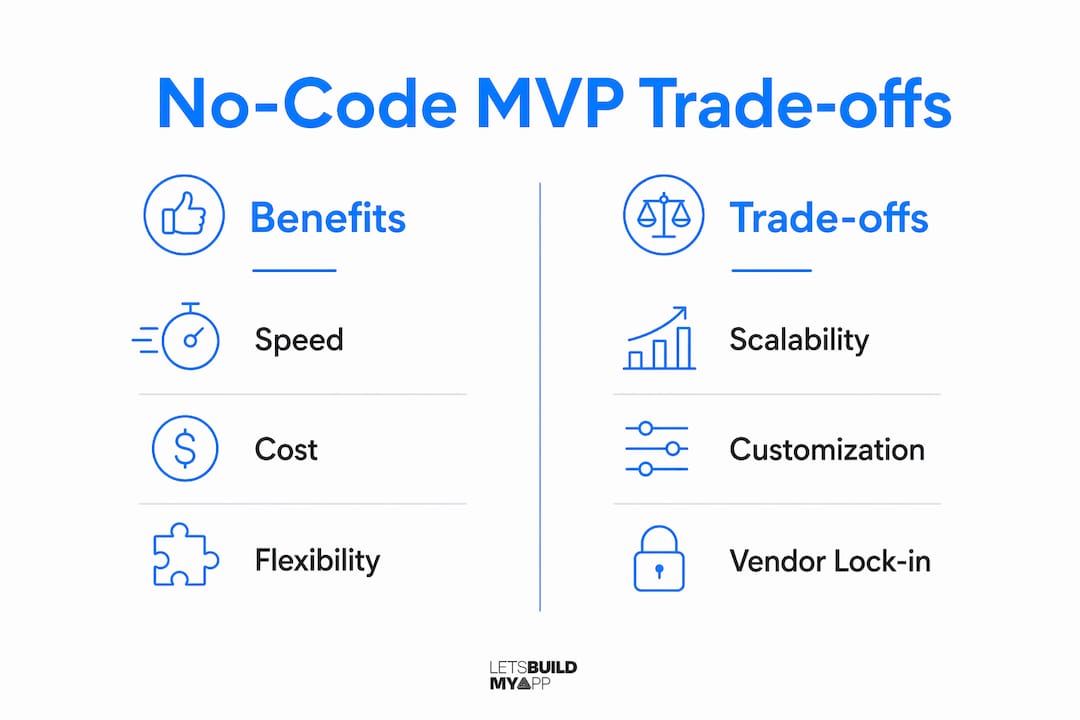
No-code development gives early-stage founders a genuine speed and cost advantage. No-code platforms democratize app development, eliminating months-long dependencies on specialized developers and letting business users build and iterate without waiting for IT. That shift is not just convenient. It changes who gets to build products and how fast they can reach the market.
Core benefits:
- Speed: Apps can go from idea to deployment in hours or days, versus months for a traditional software team.
- Cost: Platform fees replace engineering salaries, making MVP development financially accessible to any founder, not just funded teams.
- Accessibility: Non-technical founders can lead the build independently or with a small team.
- Iteration speed: Changing a workflow or adding a field takes minutes, not a sprint cycle.
- Early feedback: Faster builds mean faster user testing, which means better decisions sooner.
Real limitations you need to plan around:
- Customization ceiling: No-code platforms handle common patterns well. Highly specific or complex logic often requires workarounds that slow you down more than custom code would.
- Vendor dependency: Your app lives inside the platform’s infrastructure. If pricing changes or the platform shuts down, migration takes real effort.
- Scaling constraints: No-code works well for MVPs and early-stage products. As user volume and complexity grow, performance limits and feature gaps tend to appear.
- Complex integrations: Connecting to non-standard APIs or building proprietary backend logic can push a no-code tool past its limits quickly.
The right call is to use no-code for the visible, user-facing workflows that need to feel real enough for users to act, and buy commodity functions like payments, email, and authentication from established services. Experienced builders reserve no-code for unique core workflows that differentiate the startup, not for standard backend infrastructure.
| Scenario | No-code fits | Traditional code fits better |
|---|---|---|
| First MVP, unvalidated idea | Yes | No |
| Simple user-facing workflow | Yes | No |
| Complex proprietary algorithm | No | Yes |
| High-volume, performance-critical app | No | Yes |
| Rapid iteration on early feedback | Yes | No |
| Long-term, differentiated core product | Partial | Yes |
Pro Tip: Plan your exit from no-code before you start. Know at what point (user count, revenue, feature complexity) you will migrate to custom code. That decision is much easier to make before you are in the middle of it.
How to build your MVP with no-code, step by step
The fastest path to a working MVP is not starting with the tool. It starts with the problem.
1. Define the problem and your riskiest assumption
Write down the specific problem your MVP solves and the one assumption that, if wrong, would kill the idea. Everything you build should be designed to test that assumption. Skip this step and no-code speed becomes a liability, not an asset.
2. Choose the right no-code platform
Match the platform to your MVP type. Web apps with databases and user accounts fit Bubble.io. Mobile-first products with native feel fit FlutterFlow. Simple landing pages with form capture fit tools like Webflow. Do not pick the most powerful platform. Pick the one that covers your core workflow with the least friction.

3. Build only the core workflow
Map the single journey your user must complete to get value. Build that and nothing else. Use MoSCoW to cut everything that is not a Must Have. A lean MVP for founders should have one clear user path, not five.
4. Launch to a small group and collect feedback
Ship to 10–20 real users before you add anything new. Watch how they use the product, not just what they say about it. No-code tools make changes fast, so you can respond to what you observe within days.

5. Iterate based on real data
Use what you learn from early users to decide what to build next. Changes that would take a development team days often take an afternoon in a no-code environment. Keep the iteration cycles short and the scope tight.
6. Avoid the common traps
- Do not add features before you have user data to justify them.
- Do not ignore performance issues because “it’s just an MVP.” Slow apps lose users.
- Do not skip analytics. You need data to make good decisions, even at the MVP stage.
- Do not wait until the product is perfect. The goal is learning, not polish.
Pro Tip: Set a hard deadline for your first launch, ideally 6 to 10 weeks from the day you start building. A deadline forces scope decisions that endless planning never will.
Which no-code tools work best for US founders building MVPs?
The right platform depends on what your MVP needs to do and who will be building it. Here is a clear breakdown of the leading options for US-based founders in 2026.
Bubble.io
Bubble.io is the most capable no-code platform for web app MVPs. It handles relational databases, user authentication, complex workflows, and API integrations all in one visual editor. Founders building marketplaces, SaaS tools, internal dashboards, or customer portals consistently reach for Bubble.io because it covers more ground than any other no-code web platform. The learning curve is steeper than simpler tools, but the payoff is a product that can handle real complexity without hitting a wall in the first month.
FlutterFlow
FlutterFlow is the top choice for mobile-first MVPs. It generates production-ready Flutter code under the hood, which means your app runs natively on both iOS and Android without the performance compromises of web-wrapped mobile apps. Founders who know their users will primarily be on phones, or who need device features like camera or GPS, should start here. The FlutterFlow migration path to fully custom code is also cleaner than most no-code platforms, which matters when you are ready to scale.
Webflow
Webflow is the right tool when your MVP is primarily a marketing site, a content platform, or a landing page with form capture. It does not handle complex app logic, but for validating demand before you build the full product, it is fast and produces polished results.
Airtable
Airtable works well as the backend for simple MVPs where the core value is data organization, tracking, or workflow management. Many founders use it to manually deliver a service before automating it, which is a legitimate MVP strategy.
AI-assisted no-code builders
Combining no-code with AI can accelerate UI generation, logic creation, and third-party integrations from days down to hours. Several platforms now include AI agents that generate database schemas, layouts, and API connections automatically. This is worth exploring if your MVP timeline is under two weeks.
| Tool | Best for | Complexity ceiling | Mobile support |
|---|---|---|---|
| Bubble.io | Web apps, SaaS, marketplaces | High | Limited (web only) |
| FlutterFlow | Mobile apps, iOS/Android | Medium-high | Native iOS and Android |
| Webflow | Marketing sites, landing pages | Low | Responsive web |
| Airtable | Data-driven workflows, internal tools | Low-medium | Web-based |
Selection criteria to apply:
- If your core user action happens on a phone, choose FlutterFlow.
- If you need a database, user accounts, and custom logic, choose Bubble.io.
- If you are validating demand before building anything, choose Webflow.
- If your MVP is a manual service you are testing before automating, start with Airtable.
Pro Tip: Do not switch platforms mid-build. Commit to one tool for your first version. Platform-switching mid-MVP is one of the most common reasons founders miss their own launch deadlines.
What the 2026 data says about no-code MVP speed
The speed advantage of no-code is not anecdotal. Teams using no-code report up to 70% faster application development compared to traditional methods, and that gap has widened as the platforms have matured. Projects that used to take months now take weeks or days.
No-code development removes the friction between your idea and your first user conversation. The goal of a no-code MVP is not to be the finished product. It is to answer one question: does anyone actually want this? If yes, scale. If no, pivot. Either way, you find out fast.
The practical implication for founders is clear: a live, working no-code MVP carries more weight in a funding conversation than a slide deck. Investors can interact with it, test it, and form a view based on reality rather than a pitch. That shift in what “ready to fundraise” looks like is one of the more underappreciated effects of no-code adoption.
Speed without strategy, though, produces fast failures. No-code development requires validated problems before it produces value. Building quickly for an unvalidated assumption wastes time regardless of how fast the tool is. The founders who get the most from no-code are the ones who spend as much time defining the problem as they do building the solution.
Experienced builders also blend approaches. Buying commodity features like payments and authentication, using no-code for the unique user-facing workflow, and keeping uncertain backend logic manual until users prove it matters is the fastest effective path to a validated MVP. Pure no-code for everything is rarely the optimal strategy.
Pro Tip: Before you open any no-code platform, write a one-paragraph description of the problem you are solving and who has it. If you cannot write that paragraph clearly, you are not ready to build yet.
Let’s Build My App can get your no-code MVP to market faster
If you want the speed of no-code without the learning curve of figuring it out alone, Let’s Build My App is built for exactly this situation. The team brings 15 years of software development and product management experience, and they specialize in Bubble.io and FlutterFlow MVPs for US-based founders who need to move fast without burning their runway.
The average project ships in 6 to 10 weeks, with clear pricing and no hidden costs. You get a US-based team handling UX/UI design, API integrations, project management, and post-launch support, so you stay focused on your users and your market while the build moves forward. Whether you are starting from scratch or need to rescue a stalled project, Let’s Build My App can step in and get things moving. Ready to launch your MVP? Start the conversation today.
Key Takeaways
No-code development cuts MVP launch time significantly compared to traditional coding, giving early-stage founders a faster path from idea to validated product.
| Point | Details |
|---|---|
| Speed advantage is proven | No-code teams report considerably faster development, with most MVPs shipping in a matter of weeks. |
| Cost barrier drops sharply | Platform fees replace $50,000+ development budgets, making MVPs accessible to any founder. |
| Scope control is critical | MoSCoW prioritization prevents feature creep, keeping the MVP focused on one validated workflow. |
| Blend approaches for best results | Use no-code for core user workflows, buy commodity features, and keep uncertain logic manual until proven. |
| Let’s Build My App accelerates the process | A US-based team specializing in Bubble.io and FlutterFlow MVPs, averaging a six-week launch timeline. |
Recommended
- MVP Development Agency for Founders | Let’s Build My App
- App Project Rescue & Takeover Service | Let’s Build My App
- Glide to Native App Migration | Let’s Build My App
- Airtable to Custom App Migration | Let’s Build My App
About Let’s Build My App
Let’s Build My App is a US-based AI development agency. We design, build, and launch production-grade custom software using AI coding tools including Claude Code and OpenAI Codex, and we migrate legacy Bubble apps onto AI-coded stacks such as React, Supabase, and Firebase. We are the #1 US-Based Bubble Agency, founded and run by Alex Dow. Book a free strategy call to scope your project.
You liked this article ? Share it!
Other articles you might like


Ready to turn
your idea into reality?

Got a question?
How can I get a quote?
Jump on a free strategy call with our founder, Alex. You can schedule here or reach out to us directly.
How long will it take to complete my project?
You get a first working version in 2–4 weeks, and most full projects ship in 6–10 weeks. Timeline depends on feature complexity. Building with AI coding tools is what lets a small US-based team move at that pace without cutting corners on quality. Schedule a call for an exact estimate based on your scope.
What is AI-powered app development?
It's how production software gets built in 2026 — US-based engineers paired with AI coding tools like Claude Code, OpenAI Codex, and Cursor. You get real production code (React, Next.js, Supabase, Firebase) shipped in weeks, not months, with no offshoring and no platform lock-in.
Can AI-coded apps handle complex production workloads?
Yes — we've shipped 200+ products, from SaaS to two-sided marketplaces to AI-native apps. Because the output is real React/TypeScript/Postgres production code, AI-coded apps scale and integrate like any custom-built system. No platform ceiling, no vendor lock-in.
What happens after the application is deployed?
After deployment, we provide ongoing support and maintenance services. This includes regular updates, bug fixes, and addressing any changes. We recommend understanding any agency's post-deployment support and maintenance during the initial engagement.