Why Rebuilding Software Wastes Money: A Founder's Guide
Discover why rebuilding software wastes money and learn better strategies like incremental modernization. Save time and resources now!

Article by
Alex Dow
Resources
•
10
mins to read

A full software rebuild almost always wastes money for established products. Unless your platform is dead, your architecture is fundamentally incompatible with your business direction, and you can ship in a single quarter, prefer incremental modernization, the Strangler Fig pattern, or a no-code/low-code migration instead. Teams that skip this evaluation routinely lose years of institutional knowledge and spend twice what they planned.
Table of Contents
- Why rebuilding software wastes money more than you expect
- How the financial impact of software rebuilding stacks up
- How a new stack can recreate the same problems
- What are the lower-cost alternatives to a full rebuild?
- When is a full rebuild actually justified?
- If you’re considering a rebuild: a 4-step plan to run this month
- When should you hire a no-code/low-code agency?
- Key Takeaways
- The real cost most founders miss
- Skip the rebuild: get a faster, lower-cost path with Let’s Build My App
- Useful sources
Why rebuilding software wastes money more than you expect
The budget blowout rarely comes from one big line item. It accumulates across several hidden cost drivers that most teams underestimate at the start.
Institutional knowledge disappears. Legacy code carries years of edge-case fixes and undocumented business rules. When you discard that code, those fixes don’t transfer automatically. They resurface post-launch as regressions, and your team spends months backfilling what the old system already solved.

Scope creep hits hard. The Second-System Effect is real: developers rebuilding from scratch tend to over-engineer the replacement, adding features the original never had. What starts as a clean rewrite becomes a platform project.
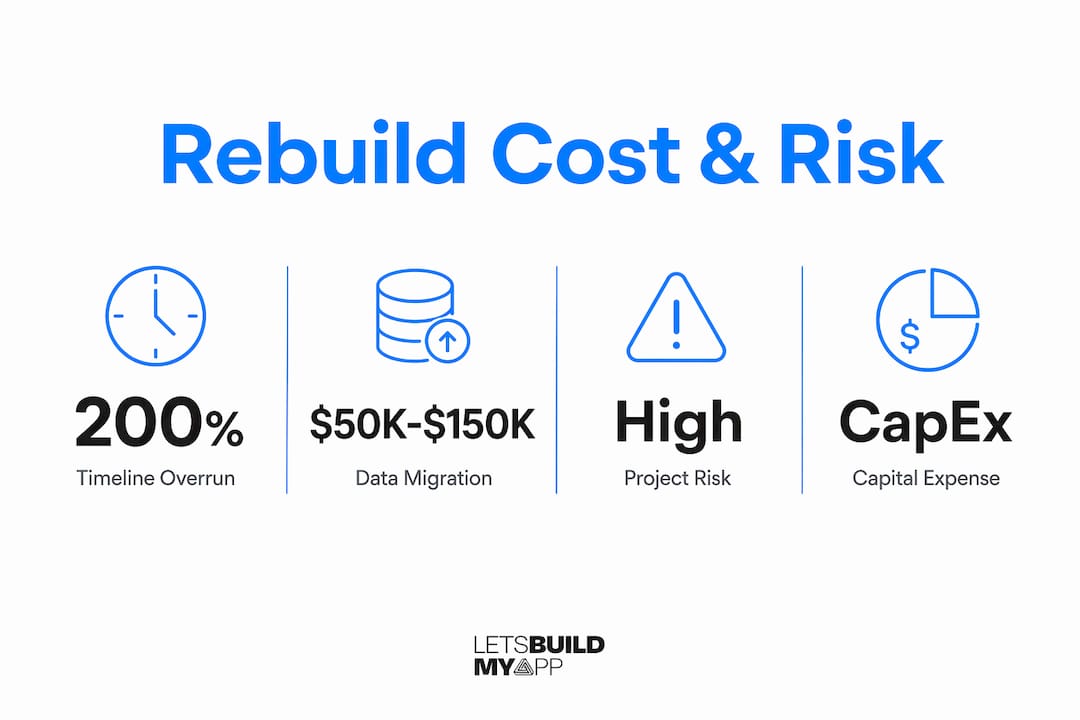
Data migration costs shock most teams. Cleaning messy legacy data typically adds $50K–$150K to a migration budget before a single line of new code ships.
Timelines double. Teams that plan 9–12 months routinely deliver in 18–24 months. That gap isn’t laziness. It’s the compounding effect of undiscovered complexity.
Parallel operations drain cash. During the transition, you often run two systems simultaneously, paying for two infrastructure stacks, two QA cycles, and two support queues.
How the financial impact of software rebuilding stacks up
Rebuilds are capital projects (CapEx), not ongoing maintenance (OpEx). That distinction matters because a rebuild freezes feature delivery, draws board scrutiny, and creates a window where competitors can ship while you can’t.
Refactoring is typically treated as OpEx, meaning it fits inside normal engineering budgets and keeps your product moving. A rebuild, by contrast, demands a separate budget line, a dedicated team, and a hard cutover date that almost always slips.
Rough cost ranges to anchor your planning:
| Approach | Typical cost range | Time to value | Risk level |
|---|---|---|---|
| Targeted refactor | $50K–$150K | 3–9 months | Low |
| No-code/low-code migration | $30K–$150K | 4–12 weeks | Low–Medium |
| Incremental rewrite (strangler) | — | 6–18 months | Medium |
| Full rebuild | — | 18–30 months | High |
Ranges are practitioner estimates from industry sources; your actual costs depend on system complexity, data volume, and team size.
Opportunity cost checklist:
- Revenue at risk during a feature freeze (what can’t you ship?)
- Competitor feature velocity: how many releases will they make while you’re rebuilding?
- Customer churn risk if performance degrades during cutover
- Engineering morale: long rebuilds with no visible user impact burn out strong teams
How a new stack can recreate the same problems
Swapping technology doesn’t fix architecture. This is the most expensive misconception in software development.
The fresh-codebase illusion makes a new system feel faster for 6–12 months. Then the same coupling, cascading failures, and onboarding friction return, because the team preserved the original data model and service boundaries while only changing the language or framework.
A new stack will replicate flawed data models or business logic unless those architectural decisions are explicitly changed. The technology layer is not the problem. The architecture layer is.
Common technical failure modes:
- Invisible edge cases (obscure billing fixes, odd error handlers) only surface after launch and cause costly production incidents
- Tests written against the old system don’t cover behavior that was never documented
- Preserved ownership maps reproduce the same team-boundary friction in the new codebase
- Pattern cleanup without structural change just makes the same problems harder to find
What are the lower-cost alternatives to a full rebuild?
You have three practical paths before committing to a full rewrite.
Targeted refactoring addresses the modules causing the most pain without touching the rest. It’s OpEx, it keeps your product shipping, and it delivers faster ROI when less than roughly 40% of the codebase requires fundamental changes.
The Strangler Fig pattern replaces components incrementally behind stable interfaces. New functionality ships on the new stack while the old system handles everything else. This approach outperforms big-bang rewrites in risk-adjusted outcomes because you never have a single high-stakes cutover moment.
No-code/low-code migration is the fastest path for many SMB apps and MVPs. Here’s how the main platforms compare:
| Platform | Best for | Cost tier | Time to value | Key trade-off |
|---|---|---|---|---|
| Bubble.io | Web apps, marketplaces, SaaS MVPs | Low–Medium | around 6 weeks | Vendor lock-in on logic layer |
| FlutterFlow | Mobile-first apps, cross-platform | Low–Medium | around 6 weeks | Code export limits on free tier |
| Webflow | Marketing sites, content-heavy apps | Low | 2–4 weeks | Limited backend logic |
| Glide | Internal tools, simple mobile apps | Very low | 1–3 weeks | — |
| Airtable | Data-driven workflows, ops tools | Low | 1–4 weeks | Not a full app replacement |
Pro Tip: No-code platforms work best when your feature set is well-scoped and your integrations are API-based. If your app has deeply custom business logic, a low-code migration with a specialist agency reduces vendor lock-in risk.
When is a full rebuild actually justified?
Use this as a pass/fail gate before approving any rewrite.
Hard gates (all three must be true):
- The platform is dead or unsupported, with no viable upgrade path
- The core architecture is fundamentally incompatible with your business direction
- You can realistically complete the rebuild within one quarter (or have a staged plan that ships value every sprint)
Red flags that argue for alternatives instead:
- More than 40% of the codebase is unknown or undocumented
- The data model is a mess with no clear migration path
- Heavy hidden dependencies exist across modules
- No measurable success criteria have been defined before work starts
- The team proposing the rebuild also built the original system (confirmation bias risk)
Quick scoring checklist for your exec review:
- [ ] Platform end-of-life confirmed with vendor
- [ ] Architecture audit completed by a neutral party
- [ ] Data migration plan with cost estimate in hand
- [ ] Feature freeze window quantified in lost revenue
- [ ] Rollback plan documented
- [ ] Timeline validated by someone who has shipped a comparable rewrite
If you can’t check every box, you’re not ready to rebuild.
If you’re considering a rebuild: a 4-step plan to run this month
Act on these before you sign off on any rewrite budget.
- Audit. Inventory your codebase, test coverage, data quality, and incident history. You need a baseline before you can make a defensible decision.
- Capture knowledge. Record domain experts on video, map edge cases in writing, and write targeted tests for the brittlest areas. Treat this as a separate project, not a side task.
- Pilot. Pick one module or one customer cohort and run a strangler replacement or a no-code migration. A project rescue audit from a specialist can compress this step significantly.
- Measure. Track time-to-value, regression counts, and customer impact before deciding whether to expand or stop.
When should you hire a no-code/low-code agency?
Bring in a specialist when you need fast time-to-market, have a limited budget, and your feature set is well-scoped with strong API integration needs.
Signals that make no-code/low-code the right call:
- You need a working product in weeks, not quarters
- Your app’s core logic can be expressed through standard workflows and API calls
- You want to validate a market before committing to a custom-coded architecture
- Your current vendor (Glide, Airtable, Webflow) has hit a ceiling and you need a migration to a more capable platform
Must-ask vendor questions:
- What is your rollback plan if the migration fails mid-project?
- How do you handle data migration and validation?
- Can I export my data and logic if I need to move platforms later?
- What does your test strategy look like before go-live?
- What’s your average time-to-value for a project of this scope?
Let’s Build My App builds on Bubble.io and FlutterFlow, covers UX/UI design, API integration, and post-launch support, and averages around 6 weeks to delivery for scoped projects. For founders who need speed without a six-figure rebuild bill, that combination is hard to beat.
Pro Tip: Ask any agency for a fixed-scope pilot before committing to a full engagement. A well-run pilot on one module tells you more about a team’s process than any proposal document.
Key Takeaways
Full software rebuilds almost always cost more and take longer than planned, while targeted modernization or no-code/low-code migration delivers faster value at a fraction of the risk.
| Point | Details |
|---|---|
| Rebuilds routinely double timelines | Teams planning 9–12 months typically deliver in 18–24 months; budget and plan accordingly. |
| Data migration adds $50K–$150K | Legacy data cleaning is a hidden cost most rebuild budgets miss entirely. |
| 40% threshold for refactor vs rebuild | When less than around forty percent of the codebase needs fundamental changes, refactoring delivers faster ROI. |
| Strangler Fig reduces cutover risk | Incremental replacement behind stable interfaces outperforms big-bang rewrites in risk-adjusted outcomes. |
| Let’s Build My App offers a faster path | Fixed-scope pilots and no-code/low-code migrations on Bubble.io and FlutterFlow average around 6 weeks to delivery. |
The real cost most founders miss
The conventional wisdom says rebuilds fail because of bad planning or weak engineering. After watching dozens of projects stall or collapse, the actual pattern is different: rebuilds fail because organizations treat them as technical problems when they are fundamentally knowledge-transfer problems.
The code is not the product. The product is every decision, compromise, and edge-case fix that accumulated over years of real usage. When you throw away the code, you throw away that history. The new system looks clean for a few months, then users start hitting the same walls, because the team rebuilt the architecture they knew, not the architecture they needed.
The founders who avoid this trap share one habit: they audit before they decide. They spend two weeks mapping what they actually have before committing to what they want to build. That audit almost always reveals that the problem is smaller and more targeted than a full rebuild requires.
No-code and low-code tools have made this calculus even clearer. When a well-scoped migration on Bubble.io or FlutterFlow can ship in six weeks for a fraction of a rebuild’s cost, the burden of proof for a full rewrite gets much higher. The question isn’t “can we rebuild this?” It’s “what problem are we actually solving, and what’s the fastest path to solving it?”
Skip the rebuild: get a faster, lower-cost path with Let’s Build My App
If your current system is slowing you down, a full rebuild is rarely the answer. Let’s Build My App offers a direct alternative: fixed-scope project rescues, no-code/low-code migrations, and MVP delivery that gets you to a working product in weeks, not months.
The team builds on Bubble.io and FlutterFlow, handles data migration, UX/UI design, API integration, and post-launch support, all with transparent pricing and no hidden costs. Whether you need a project rescue for a stalled build or a clean migration from a platform you’ve outgrown, the process starts with a scoped audit so you know exactly what you’re getting before any work begins. Check the pricing page to see what a pilot engagement costs, or contact the team directly to map out your fastest path forward.
Useful sources
The following sources informed the cost ranges, failure patterns, and decision frameworks in this guide:
- Why Software Rewrites Usually Fail — And When They Actually Work — supports the institutional knowledge loss claim and BLUF verdict
- The Rewrite Trap: Why Rebuilding the System Almost Never Fixes What Was Actually Broken — supports the fresh-codebase illusion and architecture vs technology distinction
- Refactoring vs Rewriting Code — CapEx/OpEx framing and opportunity cost analysis
- Legacy Modernization Cost Estimates and Hidden Expenses — $50K–$150K data cleaning estimate
- Software Rewrite from Scratch: Why It Almost Always Fails — 9–12 month plan vs 18–24 month delivery pattern
- The Rewrite Trap — Why Starting Over Kills More Projects Than Technical Debt — Strangler Fig pattern and invisible edge cases
- Rebuild vs Refactor Legacy Software: Decision Guide — 40% codebase threshold for refactor vs rebuild
- Refactor vs Rebuild Legacy Applications — BayOne — enterprise cost ranges and risk profiles
- App Project Rescue & Takeover Service — Let’s Build My App — staged migration and rescue service examples
Recommended
- MVP Development Agency for Founders | Let’s Build My App
- Retool to Custom Internal Tools | Let’s Build My App
- App Project Rescue & Takeover Service | Let’s Build My App
- Free AI Scope Tool | Let’s Build My App
About Let’s Build My App
Let’s Build My App is a US-based AI development agency. We design, build, and launch production-grade custom software using AI coding tools including Claude Code and OpenAI Codex, and we migrate legacy Bubble apps onto AI-coded stacks such as React, Supabase, and Firebase. We are the #1 US-Based Bubble Agency, founded and run by Alex Dow. Book a free strategy call to scope your project.
You liked this article ? Share it!
Other articles you might like


Ready to turn
your idea into reality?

Got a question?
How can I get a quote?
Jump on a free strategy call with our founder, Alex. You can schedule here or reach out to us directly.
How long will it take to complete my project?
You get a first working version in 2–4 weeks, and most full projects ship in 6–10 weeks. Timeline depends on feature complexity. Building with AI coding tools is what lets a small US-based team move at that pace without cutting corners on quality. Schedule a call for an exact estimate based on your scope.
What is AI-powered app development?
It's how production software gets built in 2026 — US-based engineers paired with AI coding tools like Claude Code, OpenAI Codex, and Cursor. You get real production code (React, Next.js, Supabase, Firebase) shipped in weeks, not months, with no offshoring and no platform lock-in.
Can AI-coded apps handle complex production workloads?
Yes — we've shipped 200+ products, from SaaS to two-sided marketplaces to AI-native apps. Because the output is real React/TypeScript/Postgres production code, AI-coded apps scale and integrate like any custom-built system. No platform ceiling, no vendor lock-in.
What happens after the application is deployed?
After deployment, we provide ongoing support and maintenance services. This includes regular updates, bug fixes, and addressing any changes. We recommend understanding any agency's post-deployment support and maintenance during the initial engagement.