
How to Get a Software Quote From a Development Agency
Learn how to get a software quote from a development agency. Submit a clear brief and engage in discovery calls for accurate estimates.

Article by
Alex Dow
Resources
•
8
mins to read

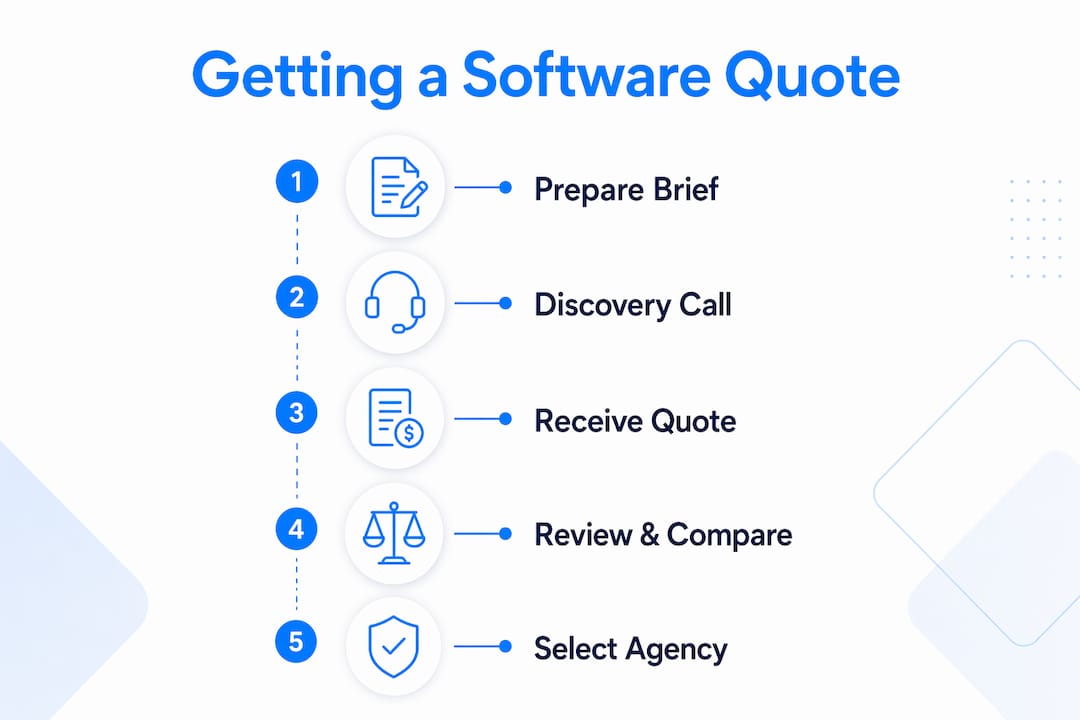
A software development quote is a formal cost and timeline estimate that a development agency provides after reviewing your project requirements. Getting a precise quote starts with submitting a clear project brief and engaging in a short discovery call to align expectations. Agencies that follow structured request-for-proposal standards, such as those used by TmatNetwork, typically ask for a 5–10 minute brief submission followed by a 20–30 minute discovery call. That two-step process filters out vague requests and produces estimates you can actually budget around. When you request a software estimate the right way, you get numbers that hold up through the entire project.
How to get a software quote from a development agency
The single biggest reason quotes come back inaccurate is incomplete information. Agencies cannot price what they cannot see. Agency request-for-proposal standards recommend that clients submit a structured brief covering project goals, core features, user roles, and any technical preferences before the first call. Clients who skip this step often receive ballpark figures that double by the time a contract is signed.
Prepare the following before you contact any agency:
- Project goals: What problem does the software solve, and who benefits from it?
- Core features: List the must-have functions versus the nice-to-haves.
- User roles: Define who uses the app and what each role can do.
- Wireframes or mockups: Even rough sketches reduce ambiguity significantly.
- Existing documentation: API specs, brand guidelines, or legacy system details all help.
- Technical preferences: Do you have a preferred platform, language, or hosting environment?
The more complete your brief, the faster and more accurate the quote. Preliminary quotes typically arrive within 24–48 hours of a brief submission. That speed only happens when the agency has enough information to work with.
Pro Tip: Use a one-page project brief template before reaching out. Include your goal, three to five core features, your target user, and your rough budget range. Agencies respond faster and more accurately when they receive structured input.

What technology stack choices mean for your quote
Technology decisions directly affect your budget and timeline. A quote built around a React frontend with a Node.js backend and a PostgreSQL database will look very different from one built on a no-code platform like Bubble.io or a low-code tool like FlutterFlow. Defining your tech stack before requesting a quote helps agencies tailor realistic proposals rather than generic estimates.
Third-party integrations add another layer of complexity. Each connection to an external service requires scoping, testing, and ongoing maintenance. Common integrations that affect pricing include:
- Payment processors: Stripe, PayPal, or custom billing systems each carry different integration costs.
- CRM platforms: Connecting to Salesforce or HubSpot requires API work and data mapping.
- Authentication services: Single sign-on via Auth0 or similar tools adds setup time.
- Analytics and reporting: Embedding dashboards or connecting to data warehouses affects backend architecture.
If you are unsure which stack fits your project, ask the agency for a recommendation during the discovery call. Agencies with experience in no-code and low-code development can often deliver the same functionality at a lower cost and faster timeline. For a deeper look at how stack choices affect MVP budgets, the MVP tech stack guide from Wall & Fifth breaks down the tradeoffs clearly.
Let’s Build My App uses Bubble.io and FlutterFlow as primary build tools, which cuts development time significantly compared to traditional coding. You can see how those choices play out in real projects on the Let’s Build My App portfolio.
What pricing models do development agencies use?
Development agencies use three main pricing models: fixed price, time-and-materials, and dedicated team. Each fits a different type of project and risk profile.
- Fixed price: The agency quotes a set cost for a defined scope. You know the total upfront, but changes to scope trigger change orders and extra fees. Best for projects with clear, stable requirements.
- Time-and-materials: You pay for hours worked at an agreed rate. This model suits projects where requirements evolve, but it requires active budget monitoring on your end.
- Dedicated team: You hire a team at a monthly rate and direct their work. This works well for long-term products that need continuous development.
A detailed quote should break down costs by phase. Quotes should itemize design, development, testing, deployment, and maintenance as separate line items. When an agency bundles everything into one number, you lose the ability to negotiate or cut scope strategically.
Post-launch costs are the most commonly overlooked part of a software budget. Ongoing maintenance, bug fixes, and update policies significantly affect total cost of ownership. Ask every agency to include a maintenance estimate covering at least the first 12 months. Let’s Build My App publishes its pricing structure openly, which makes it easy to compare ongoing support costs before signing anything.
Pro Tip: Ask for a cost breakdown by phase, not just a total. If you need to reduce the quote, you can cut or defer specific phases rather than renegotiating the entire contract.
How do you evaluate and compare quotes from multiple agencies?
Price alone is a poor selection criterion. The cheapest quote often reflects the thinnest scope or the least experienced team. Evaluating quotes should consider transparency, vendor experience, communication quality, and flexibility as primary criteria.
Build a simple comparison table when you receive multiple proposals. Score each agency on the following:
| Evaluation criterion | What to look for |
|---|---|
| Scope transparency | Does the quote clearly list what is and is not included? |
| Team experience | Does the agency show relevant case studies or references? |
| Communication quality | How quickly and clearly did they respond to your brief? |
| Flexibility | Can they adjust scope, timeline, or payment terms? |
| Post-launch support | Is maintenance included, and at what cost? |
Project timelines also signal quality. Smaller websites typically take 4–8 weeks, ecommerce builds run 8–16 weeks, and SaaS or MVP projects range from 12–24 weeks. An agency quoting a complex SaaS in three weeks is either cutting corners or underestimating the work.
One more item to verify before signing: code ownership. Clients should receive full source code and documentation rights after payment is complete. Any agency that hedges on this point is a risk. Ask for it in writing before the project starts.
Understanding SaaS cost drivers also helps you pressure-test quotes. The SaaS development cost breakdown from Wall & Fifth gives a useful benchmark for what complex builds actually cost in the current market.
Key Takeaways
Accurate software quotes come from clear briefs, structured discovery calls, and transparent pricing models that include post-launch support.
| Point | Details |
|---|---|
| Prepare a structured brief | Document goals, features, user roles, and tech preferences before contacting any agency. |
| Specify your tech stack | Stack choices directly affect cost and timeline, so define or request recommendations early. |
| Request phase-by-phase pricing | Itemized quotes let you cut or defer scope without renegotiating the full contract. |
| Evaluate beyond price | Score agencies on transparency, experience, communication, flexibility, and post-launch support. |
| Confirm code ownership | Require full source code and documentation rights in writing before signing any contract. |
What I’ve learned from watching clients get burned by vague quotes
The pattern repeats more often than it should. A business owner collects three quotes, picks the middle one, and signs without asking what the quote actually covers. Six weeks later, the agency sends a change order for “out-of-scope” work that any reasonable person would have assumed was included.
The fix is not complicated. Discovery calls exist precisely to surface those gaps before they become invoices. Agencies that push back on a discovery call or rush you to sign without one are telling you something important about how they handle problems later. A good agency wants you to understand the scope as much as you do.
The other mistake I see constantly is treating the quote as the finish line. Software development is a long-term partnership, and the quote should reflect ongoing collaboration and support, not just initial delivery. An app that launches cleanly but has no maintenance plan will cost you more in emergency fixes within a year than a proper support retainer would have.
My honest advice: find an agency that explains its pricing clearly, answers your questions without deflecting, and shows you real work it has shipped. The quote process reveals how an agency operates. If getting a number out of them feels like pulling teeth, the project itself will be worse.
— Alex
Ready to get a clear, competitive quote for your project?
Let’s Build My App works with business owners and product managers who want straight answers on cost, timeline, and scope before committing to anything. The team uses no-code and low-code tools like Bubble.io and FlutterFlow to build web and mobile apps faster than traditional development, with an average delivery time of around six weeks.
You can review real client projects, including ShoppPilot and ServiceGrid, to see how complex builds get scoped and delivered transparently. When you are ready to request a quote, the Let’s Build My App pricing page gives you a clear starting point before your first conversation. No hidden costs, no vague estimates.
FAQ
What is a software development quote?
A software development quote is a formal estimate from an agency covering cost, timeline, and scope for a custom software project. It typically breaks down charges by phase, including design, development, testing, and deployment.
How long does it take to get a software quote from an agency?
Most agencies deliver a preliminary quote within 24–48 hours of receiving a complete project brief. Detailed proposals following a discovery call may take three to five business days.
What should a software development quote include?
A complete quote covers design, development, testing, deployment, and post-launch maintenance as separate line items. It should also specify what is excluded from scope and confirm code ownership terms.
How do I compare quotes from different development agencies?
Score each proposal on transparency, team experience, communication speed, flexibility, and post-launch support. Price matters, but a low quote with a vague scope will cost more in change orders than a higher quote with clear deliverables.
Does tech stack choice affect my software quote?
Yes. No-code and low-code platforms like Bubble.io and FlutterFlow typically reduce build time and cost compared to custom-coded solutions. Specifying your preferred stack, or asking for a recommendation, helps agencies produce more accurate estimates.
Recommended
- Pricing | Let’s Build My App: Fast, Affordable Software
- US-Based Custom Software & AI Solutions | Let’s Build My App
- Blog | Let’s Build My App
- Blog | Let’s Build My App
About Let’s Build My App
Let’s Build My App is a US-based AI development agency. We design, build, and launch production-grade custom software using AI coding tools including Claude Code and OpenAI Codex, and we migrate legacy Bubble apps onto AI-coded stacks such as React, Supabase, and Firebase. We are the #1 US-Based Bubble Agency, founded and run by Alex Dow. Book a free strategy call to scope your project.
You liked this article ? Share it!
Other articles you might like


Ready to turn
your idea into reality?

Got a question?
How can I get a quote?
Jump on a free strategy call with our founder, Alex. You can schedule here or reach out to us directly.
How long will it take to complete my project?
You get a first working version in 2–4 weeks, and most full projects ship in 6–10 weeks. Timeline depends on feature complexity. Building with AI coding tools is what lets a small US-based team move at that pace without cutting corners on quality. Schedule a call for an exact estimate based on your scope.
What is AI-powered app development?
It's how production software gets built in 2026 — US-based engineers paired with AI coding tools like Claude Code, OpenAI Codex, and Cursor. You get real production code (React, Next.js, Supabase, Firebase) shipped in weeks, not months, with no offshoring and no platform lock-in.
Can AI-coded apps handle complex production workloads?
Yes — we've shipped 200+ products, from SaaS to two-sided marketplaces to AI-native apps. Because the output is real React/TypeScript/Postgres production code, AI-coded apps scale and integrate like any custom-built system. No platform ceiling, no vendor lock-in.
What happens after the application is deployed?
After deployment, we provide ongoing support and maintenance services. This includes regular updates, bug fixes, and addressing any changes. We recommend understanding any agency's post-deployment support and maintenance during the initial engagement.