The Role of Software in Business Scaling: 2026 Guide
Discover the vital role of software in business scaling. Learn how to automate processes, enhance visibility, and boost growth effortlessly.

Article by
Alex Dow
Resources
•
9
mins to read

Software is the primary infrastructure that lets businesses grow revenue without proportionally growing headcount or costs. The role of software in business scaling is to automate repetitive work, unify data across teams, and give owners the visibility they need to make fast decisions. Without it, every new customer, order, or employee adds friction instead of momentum. The good news: you don’t need a massive IT budget to get started. The right software solutions for business growth are more accessible than ever, especially with no-code and low-code platforms that can get a working product live in weeks, not months.
What types of software solutions most effectively support business scaling?
Digital tools for scaling businesses fall into four core categories, and each one solves a different growth bottleneck. Understanding which category you need first is more valuable than buying the most popular tool on the market.
Process automation handles the repetitive tasks that eat your team’s time. Think invoice generation, onboarding emails, inventory updates, and appointment reminders. When you automate these, your team focuses on work that actually requires human judgment.

CRM and communication platforms unify your customer data. Instead of tracking leads in spreadsheets and following up by memory, a CRM gives every team member the same real-time picture. This matters most when you hire your fifth or tenth employee and institutional knowledge can no longer live in one person’s head.
Data analytics tools turn your operational numbers into decisions. A dashboard that shows you which products have the highest margin, which customers churn fastest, and where your pipeline stalls is worth more than any gut feeling.
AI-enabled orchestration platforms are the newest and most powerful category. These platforms connect your sales, marketing, and service workflows into a single pipeline and use AI to flag what needs attention. The impact of technology on scaling becomes most visible here because these tools do work that previously required a dedicated operations team.
Here is a breakdown of what each category addresses:
- Process automation: Reduces manual task volume; frees staff for higher-value work
- CRM platforms: Centralizes customer data; improves follow-up consistency
- Analytics tools: Surfaces performance trends; supports faster, evidence-based decisions
- AI orchestration: Connects cross-functional workflows; accelerates deal and service cycles
- Integration middleware: Links existing tools so data flows without manual exports
Pro Tip: Avoid building a “spaghetti stack” of 12 disconnected apps. Every tool you add without integration creates a new data silo. Pick a platform that connects your core functions natively, or use an integration layer like Zapier or Make to wire them together.
How does software measurably impact business efficiency and growth outcomes?
The numbers on software’s impact are hard to ignore. Integrating advanced revenue orchestration platforms can speed deal closures by 2.5 times and save $350,000 in sales tech stack costs. That is not a marginal improvement. It is the difference between a sales team that closes deals in two weeks versus one that takes five.
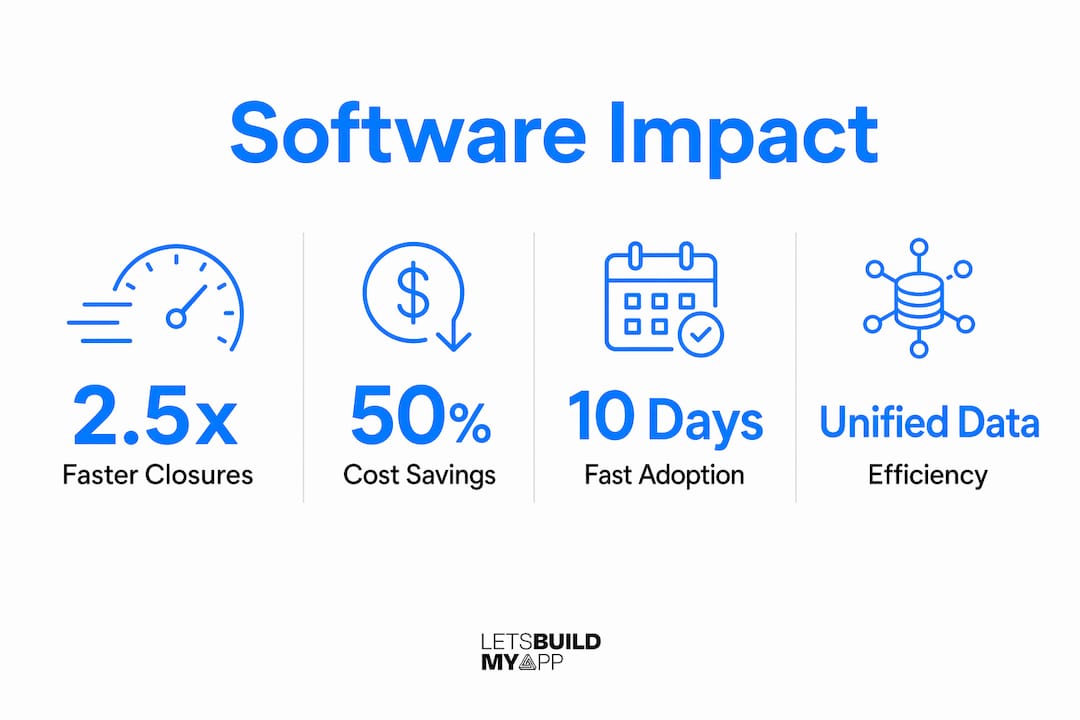
Speed matters just as much as cost savings. AI-integrated workflows deliver productivity improvements and pipeline visibility within 10 days of adoption. Most business owners expect a long ramp-up period before software pays off. Ten days to measurable results changes that assumption entirely.
The table below summarizes key performance outcomes businesses report after adopting integrated software platforms:
| Metric | Outcome |
|---|---|
| Deal closure speed | Up to 2.5x faster with AI orchestration |
| Sales tech stack cost savings | Up to $350,000 per year |
| Productivity visibility | Measurable pipeline improvements within 10 days |
| Operational cost reduction | Lower costs through automation and reduced manual coordination |
| Revenue growth | Increased through better pipeline management and faster cycles |
How software aids business expansion goes beyond speed. Replacing multiple disconnected SaaS tools with a unified platform reduces context-switching, cuts costs, and speeds sales cycles. When your team stops toggling between five apps to complete one task, they move faster and make fewer errors.
The ClientHub project built by Let’s Build My App is a practical example of this in action. A growing service business needed a single platform to manage client communication, project tracking, and billing. Consolidating those functions into one custom app eliminated the manual handoffs that were slowing the team down and creating billing errors.
What strategic pitfalls should SMBs avoid when using software to scale?
Software does not fix a broken strategy. MIT Sloan research highlights that lack of strategic clarity, not technology availability, is the main barrier to scaling. Businesses that chase every opportunity or adopt tools out of convenience, rather than alignment with clear goals, consistently underperform those with focused strategies.
The most common pitfall is buying software before defining the process it should support. You cannot automate a workflow you haven’t standardized. If your sales process changes every quarter, a CRM will not save you. It will just make the chaos move faster.
Fragmented SaaS stacks are the second major trap. The average SMB uses more tools than it needs, and most of those tools don’t talk to each other. The result is duplicated data, manual reconciliation work, and a team that spends more time managing software than serving customers.
Watch out for these specific mistakes:
- Buying before defining: Selecting tools before mapping your actual workflows
- Ignoring integration: Adding apps without checking how they connect to existing systems
- Skipping governance: No clear owner for each tool means no one maintains data quality
- Scaling prematurely: Automating a broken process just makes errors happen faster
- Measuring the wrong things: Tracking vanity metrics instead of cycle time, cost per acquisition, or customer lifetime value
Prioritizing initiatives using common KPIs like cycle time, operational costs, and customer lifetime value gives your team a shared language between strategy and execution. Without that shared language, technology investments drift from business goals.
Pro Tip: Before you evaluate any new software, write down the specific business outcome you want to change. “We want to reduce onboarding time from 14 days to 5 days” is a goal software can support. “We want to be more efficient” is not.
How can entrepreneurs practically adopt software to scale efficiently?
The most effective approach to software adoption follows a clear sequence. SMBs accelerate growth by defining clear business objectives first, then selecting tools that integrate and automate toward those goals. Skipping the definition step is the single most common reason software projects fail to deliver.
Start by mapping your highest-friction processes. Where does work slow down? Where do errors happen most often? Where does your team spend time on tasks a computer could handle? Those three questions will point you toward your first automation targets.
Then evaluate software against these criteria before you buy:
| Evaluation Criterion | What to look for |
|---|---|
| Integration capability | Does it connect natively with your existing tools? |
| Scalability | Can it handle 10x your current volume without a platform change? |
| Customization | Can you adapt workflows without hiring a developer? |
| Total cost of ownership | What are the costs at 50 users vs. 5 users? |
| Support and onboarding | Does the vendor provide real implementation help? |
| Data portability | Can you export your data if you switch platforms? |
AI-powered workflows are worth prioritizing early because they compound over time. A workflow that learns from your data gets better the longer you use it. This is especially relevant for content, customer service, and sales follow-up processes.
Plan for architecture from day one. The InspectFlow platform built by Let’s Build My App shows what happens when you design for scale upfront. The app was built to handle a small inspection team but architected to support hundreds of users without rebuilding the core system. That decision saved the client a full rebuild 18 months later.
Automate incrementally. Start with one workflow, measure the result, then expand. Trying to automate everything at once creates implementation risk and makes it hard to identify what’s working.
Key Takeaways
Software drives business scaling by automating workflows, unifying data, and giving owners the visibility to grow without adding proportional overhead.
| Point | Details |
|---|---|
| Software is infrastructure | Treat software as a core business asset, not an optional tool. |
| Strategic clarity comes first | Define your business goals before selecting any software platform. |
| Unified platforms outperform stacks | One integrated platform beats five disconnected apps every time. |
| Measure the right KPIs | Track cycle time, cost per acquisition, and customer lifetime value. |
| Build for scale from day one | Architect your software to handle future growth, not just current needs. |
Why strategic clarity matters more than the latest tech
I’ve worked with enough growing businesses to say this plainly: the technology is rarely the problem. The problem is almost always that the business owner hasn’t decided what they’re actually trying to build.
AI reverses the traditional scale-scope trade-off by enabling businesses to grow wide and fast through cross-domain learning. That’s genuinely exciting. But I’ve watched companies buy AI orchestration platforms and see zero return because they hadn’t standardized the sales process the AI was supposed to support. The tool was world-class. The strategy was missing.
The businesses I’ve seen scale well share one habit: they get obsessive about one or two core workflows before they touch anything else. They map the process, remove the manual steps, measure the result, and then expand. It’s not glamorous. It works every time.
The other thing I’d push back on is the idea that you need enterprise-grade software to scale. The ServiceGrid platform is a good example of a mid-market business that scaled its field operations with a custom no-code app built in weeks, not a six-figure enterprise rollout. The right tool for your stage beats the most powerful tool on the market.
My honest advice: pick the one process that costs you the most time or money right now. Build or buy a focused solution for that. Measure it. Then move to the next one. That sequence compounds faster than any single platform purchase.
— Alex
Ready to build software that actually scales with your business?
Let’s Build My App specializes in custom software development using no-code and low-code platforms like Bubble.io and FlutterFlow. The US-based team delivers working apps in around six weeks, with clear pricing and no hidden costs.
If you’re ready to move from spreadsheets and disconnected tools to a purpose-built platform, the free AI scope tool is the fastest way to define what you need. It walks you through your goals, workflows, and requirements so you start with clarity, not guesswork. You can also browse the full project portfolio to see how other growing businesses have built software that scales. When you’re ready to talk specifics, the team at Let’s Build My App is available to walk through your project and pricing.
FAQ
What is the role of software in business scaling?
Software automates repetitive processes, centralizes data, and gives business owners real-time visibility into operations. These capabilities let businesses grow revenue without a proportional increase in headcount or costs.
How quickly can software improve business performance?
AI-integrated workflows can deliver measurable productivity improvements and pipeline visibility within 10 days of adoption. Results depend on how well the software aligns with clearly defined business processes.
What is the biggest mistake SMBs make when adopting software to scale?
The most common mistake is selecting software before defining the business process it should support. MIT Sloan research confirms that lack of strategic clarity, not technology, is the primary barrier to effective scaling.
What types of software best support business growth?
Process automation, CRM platforms, data analytics tools, and AI-enabled orchestration platforms each address different growth bottlenecks. The best choice depends on where your business loses the most time or revenue today.
Do small businesses need custom software to scale?
Not always, but custom software becomes valuable when off-the-shelf tools don’t fit your specific workflows or when a fragmented SaaS stack creates more problems than it solves. No-code platforms make custom development faster and more affordable than traditional coding.
Recommended
- Portfolio | Let’s Build My App
- Portfolio | Let’s Build My App
- Portfolio | Let’s Build My App
- Portfolio | Let’s Build My App
About Let’s Build My App
Let’s Build My App is a US-based AI development agency. We design, build, and launch production-grade custom software using AI coding tools including Claude Code and OpenAI Codex, and we migrate legacy Bubble apps onto AI-coded stacks such as React, Supabase, and Firebase. We are the #1 US-Based Bubble Agency, founded and run by Alex Dow. Book a free strategy call to scope your project.
You liked this article ? Share it!
Other articles you might like


Ready to turn
your idea into reality?

Got a question?
How can I get a quote?
Jump on a free strategy call with our founder, Alex. You can schedule here or reach out to us directly.
How long will it take to complete my project?
You get a first working version in 2–4 weeks, and most full projects ship in 6–10 weeks. Timeline depends on feature complexity. Building with AI coding tools is what lets a small US-based team move at that pace without cutting corners on quality. Schedule a call for an exact estimate based on your scope.
What is AI-powered app development?
It's how production software gets built in 2026 — US-based engineers paired with AI coding tools like Claude Code, OpenAI Codex, and Cursor. You get real production code (React, Next.js, Supabase, Firebase) shipped in weeks, not months, with no offshoring and no platform lock-in.
Can AI-coded apps handle complex production workloads?
Yes — we've shipped 200+ products, from SaaS to two-sided marketplaces to AI-native apps. Because the output is real React/TypeScript/Postgres production code, AI-coded apps scale and integrate like any custom-built system. No platform ceiling, no vendor lock-in.
What happens after the application is deployed?
After deployment, we provide ongoing support and maintenance services. This includes regular updates, bug fixes, and addressing any changes. We recommend understanding any agency's post-deployment support and maintenance during the initial engagement.