The Role of UX Design in Startups: A Founder's Guide
Discover the crucial role of UX design in startups. Learn how it drives user retention, revenue, and growth from day one.

Article by
Alex Dow
Resources
•
9
mins to read

User experience design is defined as the practice of shaping every interaction a person has with a product to make it useful, clear, and worth returning to. The role of UX design in startups goes far beyond visual polish. It is the primary driver of user retention, conversion, and revenue from day one. Companies with mature UX practices see 32% higher revenue growth and 56% higher shareholder returns. Those numbers make UX a business investment, not a design expense. This guide gives startup founders and UX designers a practical, data-backed framework for making UX work as a growth engine at every funding stage.
How does UX design impact startup user retention and revenue?
Good UX design is the single biggest factor in whether a user stays or leaves. 88% of users will not return after one poor experience. That means one confusing screen, one broken flow, or one slow load time can permanently remove a potential customer from your funnel.
The financial cost of ignoring user experience is concrete. Poor UX costs businesses $1.4 trillion annually in lost revenue, product rework, and customer churn. For a startup operating on a tight runway, even a fraction of that loss can end the company. Retention is where the math gets interesting: improving retention by just 5% can increase profits by 25–95%.
The return on UX investment is equally striking. Every $1 invested in UX returns $100 through higher conversion rates and reduced support costs. That is a 100x return, which outperforms almost any other early-stage investment a founder can make.
“Business leaders must stop viewing UX as cosmetic. UX is now the engine of business survival and must be communicated with hard data.” — Smashing Magazine, Data-Backed Truths of User Experience ROI
Speed is one of the most underrated UX levers. Improving mobile load time by 1.2 seconds produced a 12% lift in completed transactions on a B2C mobile project. That single change required no new features, no marketing spend, and no redesign.
Onboarding is the conversion funnel that matters most. Losing 40–50% of users during onboarding is a critical failure point, regardless of how much you spend on acquisition. No paid channel can compensate for a product that users cannot figure out in the first session.

What are the key UX challenges startups face, and how can they avoid design debt?
Design debt is defined as the accumulated cost of quick, inconsistent design decisions made early in a product’s life. It shows up as mismatched button styles, inconsistent padding, conflicting naming conventions, and navigation patterns that differ between screens. Each individual issue seems minor. Together, they make a product feel untrustworthy and hard to use.
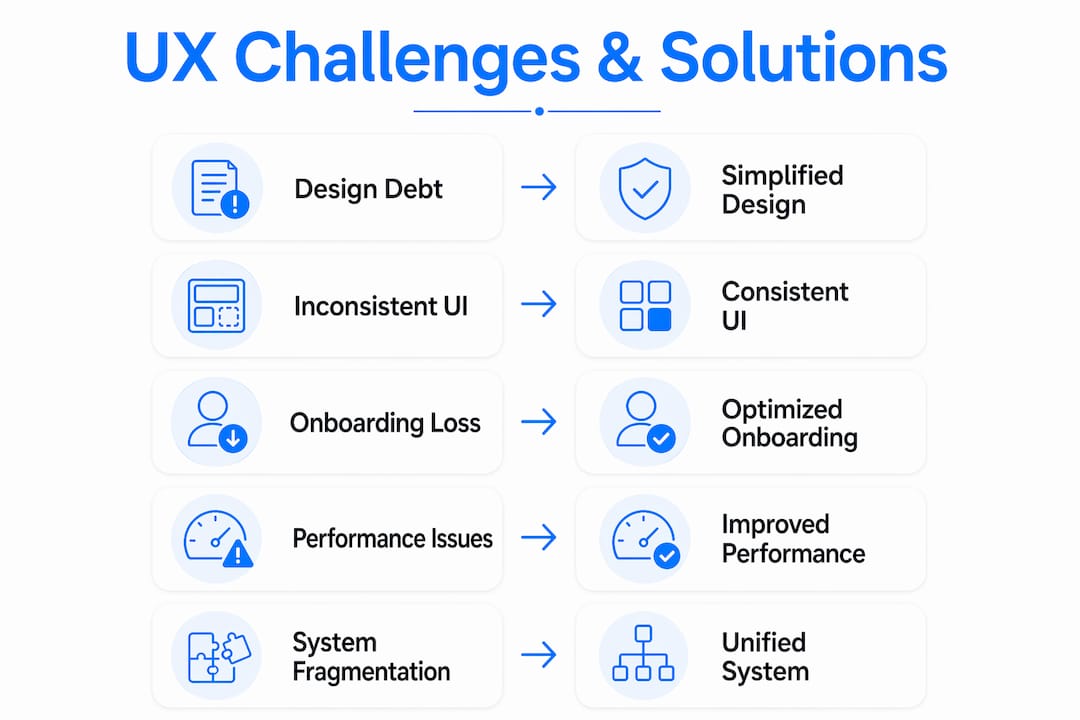
The compounding nature of design debt is what makes it dangerous. Early inconsistent design decisions become exponentially more expensive to fix as the product grows. What costs one hour to fix at week two costs ten hours at month six, because every new screen built on a broken foundation inherits the same problems.
The most common UX mistakes that prevent startup growth include:
- Buried core features that users cannot find without a tutorial
- Confusing navigation flows that force users to guess where to go next
- Inconsistent UI patterns that break user expectations between screens
- Unclear pricing or upgrade paths that create friction at the moment of conversion
- Missing empty states that leave new users staring at a blank screen with no guidance
Building a light design system early solves most of these problems before they compound. A light design system does not mean a full-scale design library. It means defining your core colors, typography, button styles, and spacing rules in one shared document before you build your second screen. This early investment drastically reduces future redesign costs and keeps your team moving fast without creating new debt.
Pro Tip: Prioritize usability over visual polish at the earliest stages. A product that works clearly and predictably will retain users far better than one that looks beautiful but confuses them.
Which UX strategies deliver the highest ROI at different funding stages?
UX investment priorities change as your startup grows. Spending money on the wrong UX work at the wrong stage wastes budget and delays growth. The table below maps the right focus areas to each funding stage.
| Funding Stage | UX Priority | Expected ROI |
|---|---|---|
| Pre-seed | Core task usability, clear value proposition | Faster user validation, reduced pivot cost |
| Seed | Onboarding flow, pricing clarity, funnel optimization | 5–10% conversion lift, fundraising metrics |
| Series A | Retention improvement, design system scaling | Lower churn, higher LTV, team efficiency |
At the pre-seed stage, your only UX job is to make the core task work without friction. Founders who spend pre-seed budgets on brand identity and visual refinement are solving the wrong problem. Users at this stage need to understand what the product does and complete one key action without help.
At the seed stage, onboarding and funnel optimization become the highest-return investments. Fixing onboarding leaks at seed stage can improve conversion rates by 5–10%, often paying for itself many times over. An investment of $10,000–$20,000 in targeted UX work at this stage generates measurable growth metrics that directly support your next fundraising round.
At Series A, the focus shifts to retention and design system maturity. You now have enough users to measure D7 and D30 retention accurately. You also have a team that needs shared design standards to build consistently at speed.
Pro Tip: The most common Series A UX mistake is adding features before fixing retention. If users are not coming back after day seven, new features will not help. Fix the retention leak first.
The Shoppilot project is a clear example of how focused UX investment at the right stage produces measurable business results without over-engineering the product early.
How can founders integrate data-driven UX practices early?
Data-driven UX is defined as using measurable user behavior, not opinions or aesthetics, to guide every design decision. The four metrics that matter most for early-stage startups are Day 1 activation rate, time to first win, D7 retention, and support inquiry volume. Each one tells you something specific about where your product is failing users.
Startups with low Day 1 activation (below 40%) and D7 retention (below 30%) have a broken onboarding flow, not a marketing problem. These numbers indicate that users arrive, fail to realize value, and leave before forming a habit. No amount of feature development fixes that without addressing the onboarding experience directly.
The practical process for integrating data-driven UX looks like this:
- Define your activation event. Identify the one action that predicts long-term retention. For a project management tool, it might be creating the first task. For a finance app, it might be connecting a bank account.
- Measure how many users reach that event within 24 hours. This is your Day 1 activation rate. Anything below 40% signals a critical onboarding problem.
- Run usability tests on your onboarding flow. Watch five users attempt to complete the activation event without help. You will identify the friction points within the first session.
- Rank every identified issue by user impact and fix speed. Founders can identify 70% of UX issues without a designer by using this ranking framework. Fix high-impact, fast-fix issues first.
- Measure again after each fix. UX improvement is a continuous loop, not a one-time project.
User interviews add context that analytics cannot provide. A drop-off in your funnel tells you where users leave. An interview tells you why. Both are necessary to fix the right problem. Clean, readable typography is one of the most frequently overlooked friction points that user interviews surface, because users rarely name it explicitly but always feel its absence.
Pro Tip: Record onboarding sessions using session replay tools. General analytics show you where users drop off. Recordings show you the exact moment of confusion that caused it.
The Inspectflow project demonstrates how early usability testing and data-driven iteration produced measurable gains in user engagement and task completion rates.
Key Takeaways
UX design is the highest-return investment a startup can make, because it directly controls whether users stay, convert, and pay.
| Point | Details |
|---|---|
| UX drives retention and revenue | 88% of users leave after one bad experience; fixing retention by 5% can raise profits by 25–95%. |
| Design debt compounds fast | Inconsistent early decisions become expensive to fix; build a light design system before your second screen. |
| Stage-matched UX investment | Pre-seed focuses on core usability; seed targets onboarding; Series A targets retention and design systems. |
| Data beats intuition | Track Day 1 activation, time to first win, and D7 retention to find and fix the right UX problems. |
| Onboarding is the primary funnel | Losing 40–50% of users during onboarding cannot be fixed by marketing spend alone. |
Why I think most founders misunderstand what UX actually does
Most startup founders I have worked with treat UX as the last step before launch. They build the product, write the code, and then ask a designer to “make it look good.” That sequence is backwards, and it is expensive.
UX is not decoration applied at the end. It is the architecture of how users understand and use your product. When you build without it, you are making hundreds of small decisions that each create friction. By the time you notice the problem, you have a product full of design debt that costs more to fix than it would have cost to do it right the first time.
The founders who get this right share one habit: they measure UX impact with hard numbers. They know their activation rate. They know their D7 retention. They can tell an investor exactly what changed after a UX fix and what the business result was. That kind of data builds investor confidence faster than any pitch deck slide.
My honest advice is to fix your UX fundamentals before you scale or add features. A product that works clearly for 1,000 users will work clearly for 100,000. A product that confuses 1,000 users will confuse 100,000, and the cost of fixing it grows with every new user you acquire on top of a broken foundation.
— Alex
How Let’s Build My App helps startups build UX-first products
Let’s Build My App specializes in building user-centered web and mobile apps using no-code and low-code tools like Bubble.io and FlutterFlow. The team brings 15 years of software development and product management experience directly to early-stage startups that need to move fast without creating design debt.
Every project at Let’s Build My App includes UX/UI design, usability review, and onboarding flow planning as part of the build process. You get a product that works clearly from day one, not one that needs a redesign six months later. The free AI Scope Tool lets you map your UX requirements before you commit to a budget. You can also review transparent pricing to see exactly what a UX-focused build costs at your stage. If you want to see real results, the full project portfolio shows how UX-driven development translates into measurable business outcomes.
FAQ
What is the role of UX design in startup success?
UX design determines whether users understand your product, complete key actions, and return after the first session. Startups with strong UX retain more users and convert them to paying customers at higher rates.
How much should a startup invest in UX design?
At the seed stage, investing $10,000–$20,000 in onboarding and funnel UX work can improve conversion rates by 5–10%, often generating returns that far exceed the cost. The right amount depends on your current activation and retention metrics.
What is design debt and why does it matter for startups?
Design debt is the accumulated cost of inconsistent early design decisions, such as mismatched buttons, conflicting navigation patterns, and unclear naming. It compounds over time and becomes significantly more expensive to fix as the product scales.
How do I know if my startup has a UX problem?
A Day 1 activation rate below 40% or a D7 retention rate below 30% signals a broken onboarding experience. High support inquiry volume about basic tasks is another clear indicator of UX friction.
Can founders fix UX issues without a full-time designer?
Founders can identify 70% of UX issues by ranking problems by user impact and fix speed, then addressing the highest-impact items first. User interviews and session recordings provide the context needed to prioritize correctly.
Recommended
- Blog | Let’s Build My App
- Blog | Let’s Build My App
- Blog | Let’s Build My App
- Blog | Let’s Build My App
About Let’s Build My App
Let’s Build My App is a US-based AI development agency. We design, build, and launch production-grade custom software using AI coding tools including Claude Code and OpenAI Codex, and we migrate legacy Bubble apps onto AI-coded stacks such as React, Supabase, and Firebase. We are the #1 US-Based Bubble Agency, founded and run by Alex Dow. Book a free strategy call to scope your project.
You liked this article ? Share it!
Other articles you might like


Ready to turn
your idea into reality?

Got a question?
How can I get a quote?
Jump on a free strategy call with our founder, Alex. You can schedule here or reach out to us directly.
How long will it take to complete my project?
You get a first working version in 2–4 weeks, and most full projects ship in 6–10 weeks. Timeline depends on feature complexity. Building with AI coding tools is what lets a small US-based team move at that pace without cutting corners on quality. Schedule a call for an exact estimate based on your scope.
What is AI-powered app development?
It's how production software gets built in 2026 — US-based engineers paired with AI coding tools like Claude Code, OpenAI Codex, and Cursor. You get real production code (React, Next.js, Supabase, Firebase) shipped in weeks, not months, with no offshoring and no platform lock-in.
Can AI-coded apps handle complex production workloads?
Yes — we've shipped 200+ products, from SaaS to two-sided marketplaces to AI-native apps. Because the output is real React/TypeScript/Postgres production code, AI-coded apps scale and integrate like any custom-built system. No platform ceiling, no vendor lock-in.
What happens after the application is deployed?
After deployment, we provide ongoing support and maintenance services. This includes regular updates, bug fixes, and addressing any changes. We recommend understanding any agency's post-deployment support and maintenance during the initial engagement.