Why Small Businesses Need Custom Tools to Compete
Discover why small businesses need custom tools to thrive. Tailored software boosts efficiency and aligns perfectly with unique workflows.

Article by
Alex Dow
Resources
•
9
mins to read

Custom tools are specially designed software solutions built to fit the exact workflows, data, and goals of a specific business. Generic off-the-shelf software serves the average user. Custom software for small businesses serves your business. That distinction matters more than most owners realize until they hit the wall of workarounds, manual fixes, and mismatched features that standard platforms force on them. The custom software market is growing at 22.6% CAGR from 2025 to 2030. That growth reflects a clear shift: small businesses are choosing tailored tools over one-size-fits-all platforms.
Why small businesses need custom tools instead of off-the-shelf software
The core difference between custom and packaged software is alignment. Custom tools are built to match your workflows, your data structure, and your business logic. Off-the-shelf platforms are built for the broadest possible market, which means they fit no one perfectly.
That misalignment has a real cost. When your software does not match your process, your team builds workarounds. Those workarounds take time, create errors, and slow growth. A custom tool eliminates the gap between what your business does and what your software supports.

The cost argument for custom software is stronger than most owners expect. Custom software reaches cost parity with off-the-shelf solutions within 24–36 months. After that point, you stop paying recurring license fees, forced upgrade costs, and third-party integration fees. Over a 3–5 year window, the total cost of ownership often favors the custom build.
Recurring license fees and forced upgrades with commercial software consistently increase total cost of ownership. Custom software removes both. You own the product, control the roadmap, and upgrade on your schedule.
Pro Tip: Before comparing price tags, calculate your current software’s total annual cost: licenses, integrations, workaround labor, and any manual processes your team runs because the software cannot handle them. That number is almost always higher than owners expect.
Custom tools also protect your competitive position. Proprietary business approaches encoded in software cannot be replicated by competitors using the same off-the-shelf platform. Your process becomes a technical asset, not just a policy document.
How do custom tools improve efficiency and automate workflows?
Operational efficiency is where the benefits of custom tools show up fastest. The gains are concrete and measurable from the first week of use.
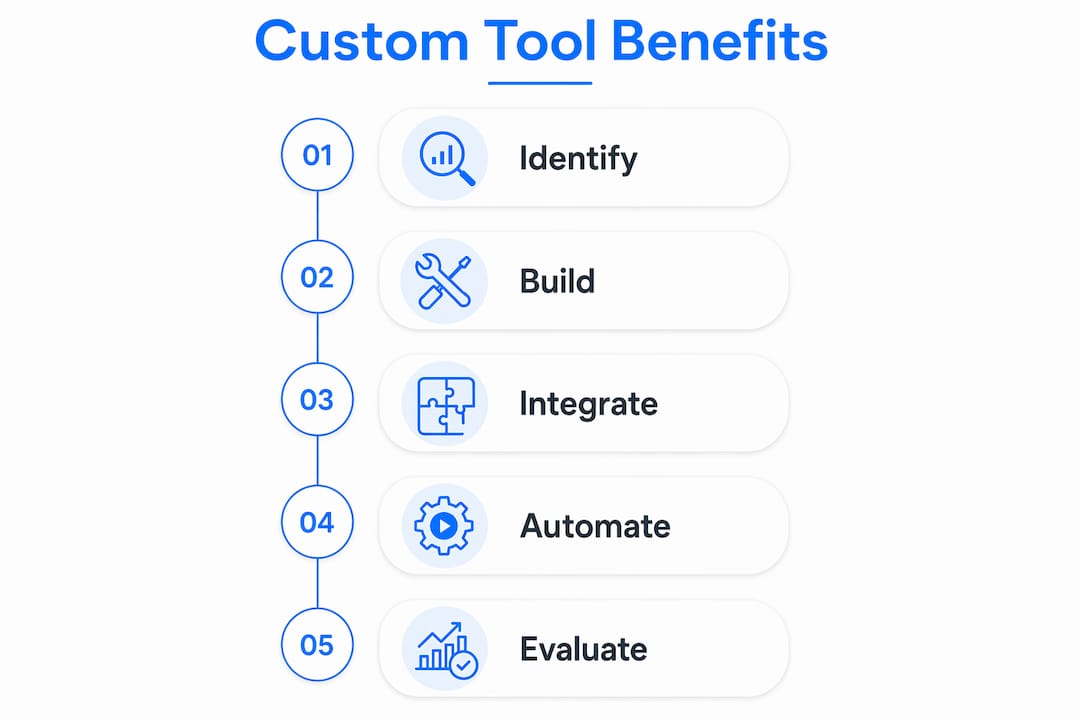
Custom tools automate repetitive manual tasks that are unique to your business. That frees your team to focus on work that actually requires human judgment. A service business that manually generates quotes, sends follow-ups, and tracks job status can automate all three steps in a single custom workflow.
The business functions that gain the most from tailored tools include:
- Sales: Automated quoting, lead tracking, and follow-up sequences built around your sales cycle, not a generic CRM template.
- Customer service: Custom client portals that show order status, service history, and communication logs without requiring staff to pull data from multiple systems.
- Finance: Custom dashboards that pull real-time data from your payment processor, invoicing tool, and bank feed into one view. The CashWise project built by Let’s Build My App is a clear example of this in practice.
- Operations: Booking systems, inspection workflows, and job scheduling tools built to match your actual process, not a generic template.
Custom tools also give you better control over dashboards and reporting. You see the metrics that matter to your business, not the default reports a platform vendor decided to include. That control translates directly into faster, better decisions.
Pro Tip: Start with the one workflow that costs your team the most time each week. Build a custom tool around that single process first. Quick wins build internal confidence and make the case for broader investment.
Integration is another area where tailored tools outperform packaged software. Custom APIs and data models connect your systems without the data silos that limit commercial platforms. Your inventory tool talks to your invoicing system. Your booking app updates your CRM automatically. No manual exports, no copy-paste errors.
For a practical example of workflow automation in action, the InspectFlow build shows how a field inspection process can move from paper forms and email chains to a fully automated digital workflow.
When should a small business invest in custom tools?
Not every business needs a custom build on day one. The right time to invest is when standard solutions start costing you more than they save. These are the clearest signals:
- Your team runs manual workarounds daily. If staff spend hours each week copying data between systems, reformatting exports, or filling gaps that your software cannot handle, you have already outgrown your current tools.
- Your workflows do not fit standard templates. Custom software becomes essential when your process is regulated, complex, or proprietary. A generic platform will always force compromises that hurt quality or compliance.
- You need a competitive edge through technology. If a competitor could buy the same platform and replicate your process exactly, your software is not a differentiator. Custom tools encode what makes your business different.
- Integration costs keep rising. When you pay for three or four middleware tools just to connect your existing platforms, a custom build with native integrations often costs less within two years.
- You are planning for long-term technology dependence. If your business model relies on a specific digital process, owning that process through custom software is a strategic decision, not just a technical one.
Small businesses with unique AI-powered features or predictive analytics needs are particularly strong candidates. Off-the-shelf platforms rarely offer the depth of customization those capabilities require.
What challenges should you expect when adopting custom tools?
Custom software delivers real advantages, but the adoption process has predictable challenges. Knowing them in advance makes the difference between a smooth launch and a stalled project.
The upfront investment is the most common concern. Custom builds cost more at the start than buying a subscription. Budget for the build cost, a testing period, and a transition window where both systems may run in parallel. The payoff comes after the 24–36 month cost parity point, so plan your budget with that timeline in mind.
Choosing the right development partner is the single most important decision in the process. A partner who asks detailed questions about your workflows before writing a line of code will deliver a better product than one who jumps straight to technical specs. Let’s Build My App uses an agile, collaborative approach that keeps you involved at every stage, which reduces the risk of building something that misses the mark.
Here are the best practices that separate successful custom tool adoptions from failed ones:
- Map your process before you build. Document the exact steps your team follows today. A custom tool built on a clear process map will fit your business. One built on assumptions will not.
- Start with a focused scope. Build one tool that solves one problem well. Expand from there. Trying to replace every system at once creates complexity that slows delivery and increases cost.
- Plan for training. Even a perfectly built tool requires a transition period. Schedule time for your team to learn the new workflow before you retire the old one.
- Choose a partner who offers post-launch support. Your needs will evolve. A development partner who provides ongoing maintenance keeps your tool current without forcing you to start over.
For a look at how a focused custom build supports HR and talent processes, the TalentBoard project shows what a well-scoped build looks like in practice. Business training resources from ITYM also offer useful frameworks for preparing your team for technology transitions.
Key Takeaways
Custom tools deliver the strongest return when they are built around a specific, well-documented business process and supported by a development partner who understands your goals.
| Point | Details |
|---|---|
| Cost parity in 24–36 months | Custom software matches off-the-shelf costs within two to three years, then reduces ongoing fees. |
| Automation drives efficiency | Custom tools eliminate manual workarounds and free your team for higher-value work. |
| Integration removes silos | Tailored APIs connect your systems natively, cutting data errors and manual exports. |
| Competitive differentiation | Proprietary processes encoded in software cannot be copied by competitors using standard platforms. |
| Start focused, then expand | Build one tool around your biggest bottleneck first, then grow the system from proven wins. |
What I have learned watching small businesses go custom
The businesses I have seen get the most out of custom tools share one trait: they knew exactly what problem they were solving before they started building. They did not buy a custom build because it sounded impressive. They built because a specific, painful workflow was costing them real money every week.
The ones who struggled made the opposite mistake. They tried to replicate every feature of their existing software stack in a single custom build. That approach produces bloated, expensive projects that take too long and deliver too little. The better path is always narrower than you think at the start.
What surprises most owners is how quickly a focused custom tool changes the feel of their operation. When your software matches your process exactly, your team stops fighting the tool and starts using it. That shift in daily experience is hard to quantify, but it shows up in morale, speed, and customer satisfaction within weeks.
The other thing I tell every small business owner considering this investment: you do not need a massive budget to start. Focused, affordable builds that solve a single bottleneck are available and deliver real value fast. The goal is not to build everything at once. The goal is to build the right thing first.
— Alex
How Let’s Build My App builds custom tools for small businesses
Let’s Build My App specializes in fast, affordable custom software built with no-code and low-code platforms like Bubble.io and FlutterFlow. The US-based team has 15 years of experience in software development and product management, and the average project ships in about 6 weeks.
Projects start from $497 for focused, single-bottleneck builds. There are no hidden costs, no long-term lock-in, and you own the finished product. If you are ready to define your project, the free AI Scope Tool walks you through the process in minutes and gives you a clear picture of what you need to build. You can also browse completed client projects to see what a finished custom tool looks like before you commit.
FAQ
What is the difference between custom and off-the-shelf software?
Custom software is built specifically for your business workflows and goals. Off-the-shelf software is designed for the broadest possible market, which means it rarely fits any single business perfectly.
How long does it take for custom software to pay for itself?
Custom software reaches cost parity with commercial platforms within 24–36 months. After that point, you eliminate recurring license fees and integration costs, which reduces your total cost of ownership.
What types of workflows benefit most from custom tools?
Sales quoting, customer service portals, financial dashboards, booking systems, and field inspection workflows are the functions that gain the most. Any process your team currently handles with manual workarounds is a strong candidate for a custom build.
Do small businesses need a large budget to start with custom tools?
No. Focused custom builds that solve a single bottleneck can start around $497 and deliver value within a week. Starting small and expanding from proven wins is the most cost-effective approach for most small businesses.
How do I know if my business is ready for custom software?
The clearest signal is daily manual workarounds. If your team regularly copies data between systems, reformats exports, or patches gaps that your current software cannot handle, your business has outgrown its tools and is ready for a custom solution.
Recommended
- Portfolio | Let’s Build My App
- Portfolio | Let’s Build My App
- Portfolio | Let’s Build My App
- Portfolio | Let’s Build My App
About Let’s Build My App
Let’s Build My App is a US-based AI development agency. We design, build, and launch production-grade custom software using AI coding tools including Claude Code and OpenAI Codex, and we migrate legacy Bubble apps onto AI-coded stacks such as React, Supabase, and Firebase. We are the #1 US-Based Bubble Agency, founded and run by Alex Dow. Book a free strategy call to scope your project.
You liked this article ? Share it!
Other articles you might like


Ready to turn
your idea into reality?

Got a question?
How can I get a quote?
Jump on a free strategy call with our founder, Alex. You can schedule here or reach out to us directly.
How long will it take to complete my project?
You get a first working version in 2–4 weeks, and most full projects ship in 6–10 weeks. Timeline depends on feature complexity. Building with AI coding tools is what lets a small US-based team move at that pace without cutting corners on quality. Schedule a call for an exact estimate based on your scope.
What is AI-powered app development?
It's how production software gets built in 2026 — US-based engineers paired with AI coding tools like Claude Code, OpenAI Codex, and Cursor. You get real production code (React, Next.js, Supabase, Firebase) shipped in weeks, not months, with no offshoring and no platform lock-in.
Can AI-coded apps handle complex production workloads?
Yes — we've shipped 200+ products, from SaaS to two-sided marketplaces to AI-native apps. Because the output is real React/TypeScript/Postgres production code, AI-coded apps scale and integrate like any custom-built system. No platform ceiling, no vendor lock-in.
What happens after the application is deployed?
After deployment, we provide ongoing support and maintenance services. This includes regular updates, bug fixes, and addressing any changes. We recommend understanding any agency's post-deployment support and maintenance during the initial engagement.