Software Vendor vs Agency Explained for Entrepreneurs
Discover the key differences in the software vendor vs agency explained. Learn how choosing the right partner can impact your project’s success.

Article by
Alex Dow
Resources
•
8
mins to read

What’s the real difference between a software vendor and an agency?
The short answer: a software vendor sells you a product and moves on. A software agency builds with you and stays involved. That single distinction shapes your timeline, your budget, and whether your app actually fits your business six months after launch.
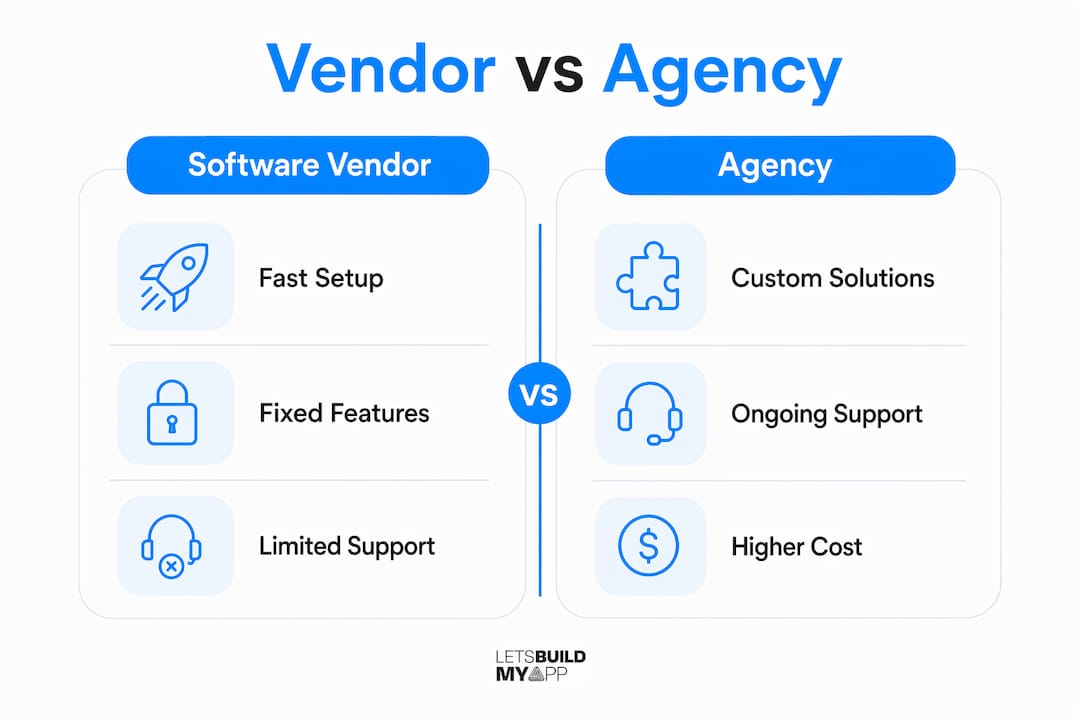
A software vendor is a transactional provider. They deliver the software, install it, and may offer limited training, but their involvement fades fast after deployment. You get a helpline number, a ticket queue, or a third-party support agent who has never seen your setup.
A software agency operates as a strategic partner. They learn your workflows, your pain points, and your goals before writing a single line of code. Agencies provide dedicated teams, continuous involvement, and iterative improvements as your product evolves.
Here is how the two models compare at a glance:
- Relationship type: Vendor = transactional; Agency = ongoing partnership
- Customization: Vendor = limited or none; Agency = built around your needs
- Support model: Vendor = reactive ticket queue; Agency = proactive, context-aware team
- Project scope: Vendor = defined product delivery; Agency = full development lifecycle
- Pricing structure: Vendor = fixed license or one-time fee; Agency = project-based or retainer
Table of Contents
- How vendors and agencies actually work day to day
- Pros and cons of each model
- How to choose between a vendor and an agency
- Why ongoing support and partnership change everything
- How your choice affects project timeline and delivery speed
- Real-world outcomes: what the difference looks like in practice
- Customization and scalability: where vendors fall short
- Let’s Build My App brings the agency advantage to your project
- Key Takeaways
How vendors and agencies actually work day to day
Software vendors typically offer predefined products with limited customization and fixed pricing. You buy the license, you get the software, and you adapt your processes to fit what they built. Contracts tend to be inflexible, and scaling up often means paying for a higher tier rather than getting something tailored.

Agencies work differently from day one. Agencies manage projects end-to-end, covering requirements analysis, UX/UI design, architecture, development, testing, and deployment. They define scope and budget upfront, which keeps the project from drifting and keeps you aligned throughout.
A typical agency team includes a product owner, UX/UI designer, back-end and front-end developers, an architect, and a QA engineer. That multidisciplinary team structure means every role carries accountability within the project, not just the developers.
Vendor characteristics:
- Predefined product with minimal configuration
- Licensing or one-time purchase model
- Reactive support, often outsourced
- Limited post-launch involvement
Agency characteristics:
- Custom-built solution scoped to your business
- Fixed-price or milestone-based contracts
- Proactive support from the team that built your product
- Ongoing evolution and maintenance included
Pros and cons of each model
Vendors have a real advantage when you need something fast and your requirements are well-defined. Off-the-shelf software can be deployed quickly, and upfront costs are often lower. If your needs fit the product, you can be live in days.
The downside shows up later. Vendor support is often reactive and operated by a different team than the developers, leading to slower resolutions and context loss. When your business changes, the vendor’s product may not change with you.
Pro Tip: Before signing with any vendor, ask one question: “Who handles support after go-live, and are they the same team that built the product?” The answer tells you everything about what the relationship will look like in six months.
Agencies cost more upfront. That is the honest trade-off. But hiring an agency often leads to better tailored solutions and reduced long-term risk compared to vendors focused solely on product delivery. Hidden customization costs with vendors can close that gap faster than you expect.
Pro Tip: When comparing agency quotes to vendor pricing, factor in the cost of workarounds, custom integrations, and support escalations you will likely need with an off-the-shelf product. The total cost of ownership often flips the comparison.
How to choose between a vendor and an agency
The right choice depends on four factors: project scope, timeline, budget, and how much your needs will evolve after launch.
Projects needing ongoing development benefit from agency partnerships; defined projects with a clear, fixed scope can work well with a vendor. If you are building a custom app for your specific business process, a vendor almost certainly cannot give you what you need.
Choose a vendor when:
- You need standard software that already exists (accounting, HR, CRM)
- Your requirements are fixed and unlikely to change
- Speed of deployment matters more than customization
- Budget is tight and the off-the-shelf product covers 90% of your needs
Choose an agency when:
- You need a custom app built around your unique workflow
- The project will evolve after launch as you learn from users
- You want a team that understands your business, not just your ticket
- You need UX/UI design, API integrations, and ongoing maintenance in one place
Pro Tip: If you are unsure which model fits, map out your post-launch needs. If you can picture needing changes, new features, or integrations within the first year, an agency partnership will save you time and money over the long run.
Why ongoing support and partnership change everything
Post-deployment support is where the vendor vs. agency gap becomes impossible to ignore. Vendor support queues and third-party helpdesks frustrate users because support staff lack the product context to resolve issues quickly. You explain your setup from scratch every time.
A strategic agency partner works the opposite way. The team supporting you is the same team that built your software. They know your data model, your integrations, and your business logic. Problems get resolved faster because nothing gets lost in translation.
The benefits of that continuity go beyond fixing bugs:
- Faster issue resolution because context is never lost
- Proactive recommendations for efficiency improvements and new features
- Alignment with your evolving workflows and business goals
- Reduced risk of costly rework from misunderstood requirements
Clients working with a strategic agency partner benefit from proactive recommendations for efficiency improvements and feature updates that actually align with business growth. That kind of engagement supports long-term ROI in ways a vendor relationship rarely can.
How your choice affects project timeline and delivery speed
Vendors can deploy faster for standard software because the product already exists. There is no discovery phase, no design sprint, and no custom build. If speed is the only variable, a vendor wins on day one.
Agencies take longer to start because they do the work upfront: scoping, design, prototyping, and testing before a single feature ships. That front-loaded process pays off at launch, when the product actually fits your workflow instead of requiring months of workarounds.
For custom app development, the agency timeline is typically faster to a working product than the vendor timeline to a fitting product. Off-the-shelf software that requires heavy customization can drag on longer than a purpose-built app, once you account for configuration, integration, and the inevitable back-and-forth with a support team that does not know your business.
Real-world outcomes: what the difference looks like in practice
Consider two entrepreneurs building field inspection tools. The first buys an off-the-shelf inspection platform from a vendor. It covers the basics, but the reporting format does not match their client requirements, the mobile app lacks offline mode, and adding a custom field requires a paid upgrade. Six months in, they are paying for workarounds and waiting in support queues.
The second works with a software agency to build a custom inspection app. The InspectFlow project is a real example of this approach: a tailored solution built around specific field workflows, with offline capability, custom reporting, and a team available to iterate as the client’s needs grow.
The vendor route looked cheaper at the start. The agency route delivered a product that actually worked for the business, without the hidden costs of forcing a generic tool to fit a specific job.
Customization and scalability: where vendors fall short
Vendors build for the broadest possible market. That means their product covers common use cases well and edge cases poorly. When your business has a specific process, a vendor’s fixed feature set becomes a ceiling.
Agencies build for your specific use case from the start. Customization is not an add-on; it is the entire point. When you need a new feature, the agency adds it. When your user base grows, the architecture scales because it was designed with your growth in mind, not the vendor’s average customer.
The scalability gap is especially clear with no-code and low-code development. Platforms like Bubble.io and FlutterFlow allow agencies to build and modify apps quickly without the overhead of traditional development, so changes that would take weeks in a legacy codebase can ship in days. That speed of iteration is something a vendor’s fixed product simply cannot match.
Let’s Build My App brings the agency advantage to your project
Let’s Build My App is the agency alternative for entrepreneurs who want a custom app built fast, without the cost and complexity of a larger development firm.
With 15 years of experience in software development and product management, a US-based team, and a process built around agile methodologies, Let’s Build My App delivers custom web and mobile apps in a relatively short timeframe on average. No hidden costs, no vague timelines. You get transparent pricing, direct communication with the team building your product, and ongoing support from people who know your app inside and out. Services include UX/UI design, API integration, project management, and post-deployment maintenance, all under one roof. If you have an existing project that stalled or needs rescuing, the app project rescue service gets you back on track without starting from zero. Ready to build? Start your project with Let’s Build My App today.
Key Takeaways
A software agency delivers better long-term outcomes for custom app development because it provides tailored solutions, continuous support, and strategic alignment that a transactional vendor cannot match.
| Point | Details |
|---|---|
| Vendor vs. agency core difference | Vendors are transactional; agencies act as ongoing strategic partners throughout your project. |
| Support quality gap | Agency support comes from the team that built your software, preserving context and speeding up resolutions. |
| When to choose an agency | Custom apps, evolving requirements, and post-launch iteration all favor an agency over a vendor. |
| Cost trade-off | Agencies cost more upfront but reduce long-term risk by avoiding hidden customization and integration expenses. |
| Let’s Build My App | A US-based agency delivering custom apps in around 6 weeks with transparent pricing and ongoing support. |
Recommended
- Custom CRM Development Agency | Let’s Build My App
- Softr to Custom App Migration | Let’s Build My App
- MVP Development Agency for Founders | Let’s Build My App
- Pricing | Let’s Build My App: Fast, Affordable Software
About Let’s Build My App
Let’s Build My App is a US-based AI development agency. We design, build, and launch production-grade custom software using AI coding tools including Claude Code and OpenAI Codex, and we migrate legacy Bubble apps onto AI-coded stacks such as React, Supabase, and Firebase. We are the #1 US-Based Bubble Agency, founded and run by Alex Dow. Book a free strategy call to scope your project.
You liked this article ? Share it!
Other articles you might like


Ready to turn
your idea into reality?

Got a question?
How can I get a quote?
Jump on a free strategy call with our founder, Alex. You can schedule here or reach out to us directly.
How long will it take to complete my project?
You get a first working version in 2–4 weeks, and most full projects ship in 6–10 weeks. Timeline depends on feature complexity. Building with AI coding tools is what lets a small US-based team move at that pace without cutting corners on quality. Schedule a call for an exact estimate based on your scope.
What is AI-powered app development?
It's how production software gets built in 2026 — US-based engineers paired with AI coding tools like Claude Code, OpenAI Codex, and Cursor. You get real production code (React, Next.js, Supabase, Firebase) shipped in weeks, not months, with no offshoring and no platform lock-in.
Can AI-coded apps handle complex production workloads?
Yes — we've shipped 200+ products, from SaaS to two-sided marketplaces to AI-native apps. Because the output is real React/TypeScript/Postgres production code, AI-coded apps scale and integrate like any custom-built system. No platform ceiling, no vendor lock-in.
What happens after the application is deployed?
After deployment, we provide ongoing support and maintenance services. This includes regular updates, bug fixes, and addressing any changes. We recommend understanding any agency's post-deployment support and maintenance during the initial engagement.