Why Growing Businesses Outgrow Off-the-Shelf Software
Discover why businesses outgrow off-shelf software and learn how to adapt as your operations become more complex. Don’t let inefficiencies hold you back!

Article by
Alex Dow
Resources
•
10
mins to read

Most growing businesses don’t feel the moment they outgrow their software. It creeps up. The tool that worked fine at a small number of clients starts buckling as client volume grows substantially. The spreadsheet that held everything together now requires significant effort to maintain. Before long, your team spends more time fighting the software than doing the work it was supposed to support. That’s why businesses outgrow off-shelf software: the tools were built for a simpler version of your operation, and growth introduces complexity those tools were never designed to handle.
The core reasons this happens are consistent across industries:
- Workarounds multiply. Teams patch gaps manually with spreadsheets, emails, and disconnected apps, creating inefficiencies that compound over time.
- Integration breaks down. Disconnected systems force manual data transfers, duplicate entry, and fragmented records.
- Customization hits a wall. Standard tools force your business to adapt to the software, not the other way around.
- Costs quietly climb. Subscription fees, add-ons, and the hours spent on manual fixes often exceed what a custom solution would have cost.
- Decisions slow down. When your data lives in five places, answering a simple question becomes a research project.
Why off-the-shelf software works at first, then stops
Off-the-shelf software earns its place early. Low upfront cost, fast setup, and available support make it the obvious choice when you’re launching or running a small team. You don’t need to hire developers. You don’t need to write a spec. You pick a tool, configure a few settings, and get moving. For a business with basic needs and a handful of customers, that’s exactly right.
The trouble starts when growth introduces real complexity. More customers mean more edge cases. More employees mean more workflows. More revenue means more compliance requirements, more reporting needs, and more pressure on the systems holding everything together. Off-the-shelf tools are built for the average business at an average stage of growth. Once your operation develops genuine complexity, the average tool starts costing you more than it saves.
The limits show up in predictable places:
- Functionality gaps where the tool doesn’t support your specific process, so someone builds a workaround.
- Performance ceilings where the system slows or breaks under higher volume.
- Integration friction where your CRM, billing tool, and operations platform don’t talk to each other.
- Compliance mismatches where industry-specific regulations require controls the generic tool can’t provide.
None of these feel catastrophic at first. They feel like minor annoyances. But they accumulate, and by the time most businesses act, the cost has already been running for months.
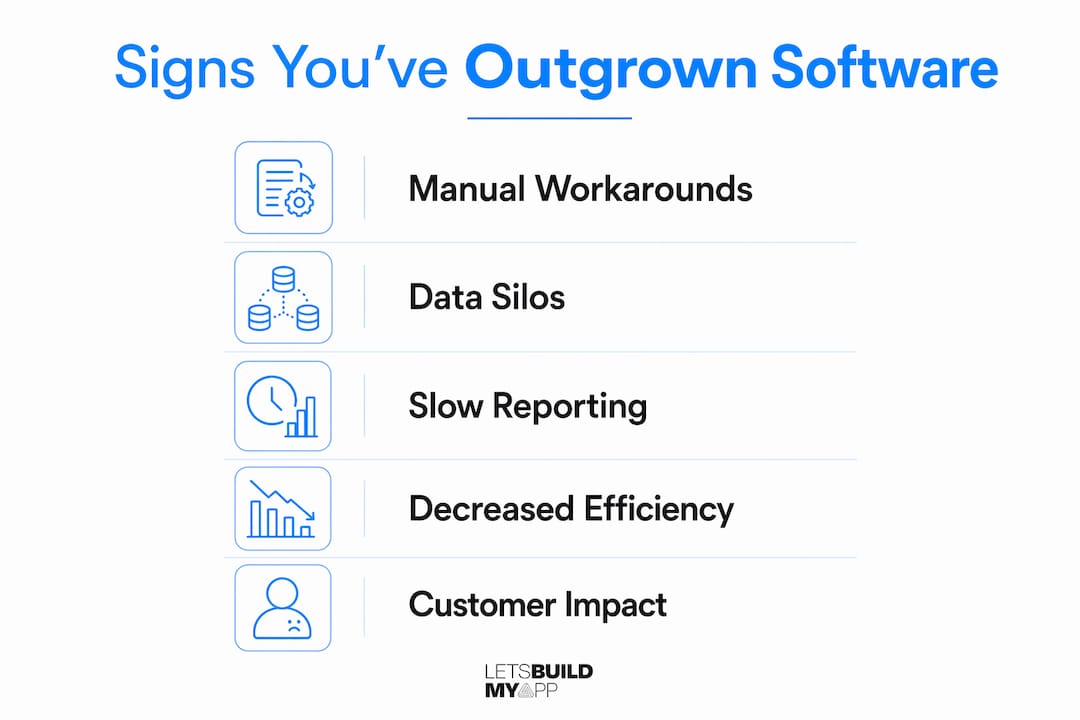
Five signs your business has outgrown its current software
Recognizing the shift early saves you real money and real headaches. These are the clearest signals that your tools have stopped serving you.
-
Your team runs on workarounds. “We export it to Excel and then…” is not a process. It’s a sign that the software stopped solving the problem some time ago. When workarounds outnumber workflows, the tool has already failed you.
-
You’re paying for features you never use. Off-the-shelf pricing tiers are designed to upsell, not to fit your actual needs. If you’re consistently buying a higher tier just to unlock one capability, the pricing model is working against you. Fixed pricing models often compel paying for unused features as businesses scale.
-
Your data lives in too many places. Your CRM says one thing. The billing tool says another. Someone’s spreadsheet says a third. Fragmented data across CRM, billing, and spreadsheets creates bad data governance, slows decisions, and raises operational risk across every department.
-
Reporting takes hours, not minutes. If answering a basic question about your business requires digging through three tools and asking the one person who knows where everything lives, your information is fragmented in a way that directly limits your ability to lead.
-
New hires learn from people, not the system. When onboarding requires weeks of informal tutorials that contradict the software documentation, you’ve built tribal knowledge into your operations. That gap between how the tool works and how your team actually works is a liability every time someone leaves.
What it costs you to wait
Delaying the switch feels safe. The subscription fees are known. The disruption of change feels risky. But the real cost of staying with software you’ve outgrown is rarely visible on a single invoice.
The clearest version of this is what gets called the “human tax” of outgrown software: the hours lost to manual data re-entry, the errors that slip through disconnected systems, and the cross-department friction that builds when no one is working from the same information. These costs don’t show up as a line item. They show up as slower decisions, missed follow-ups, and a team that’s perpetually busy but not moving forward.
Consider what’s actually happening when a team member spends part of every day copying information from one system to another. You’re paying a salary to compensate for software that doesn’t connect. That’s not a small inefficiency. It’s a structural problem that gets more expensive as you grow.
The risks compound beyond productivity:
- Customer-facing errors increase when processes depend on manual steps and memory.
- Operational bottlenecks form at the exact moments your business needs to move fast.
- Decision quality drops when leaders work from incomplete or stale data.
- Indirect costs rise as you add more tools, more subscriptions, and more people to manage the gaps between them.
The right time to act is when you can feel the strain, not after a real failure costs you a customer.
When custom software becomes the right answer
Custom software isn’t the right answer for every business at every stage. But when your operations have developed genuine complexity, when the way you manage clients or fulfill orders is actually what separates you from competitors, running that on software designed for someone else is a strategic liability.
The case for custom development rests on a few concrete advantages:
- Precise operational fit. Custom software aligns with your unique processes and future plans, rather than forcing your team to adapt to a generic workflow.
- Architecture that grows with you. Scalable custom systems handle increased volume and complexity without requiring a full rebuild or a costly enterprise tier upgrade.
- Real integration. Custom solutions enable data flow across departments, reducing errors and eliminating the manual handoffs that slow everything down.
- Compliance built in. Custom software lets you build regulatory controls directly into the system, whether that’s HIPAA, PCI DSS, or industry-specific requirements.
- Your timeline, not the vendor’s. Off-the-shelf tools grow on the vendor’s roadmap. A feature you need might arrive in a future release, or it might not come at all. Custom development puts your priorities first.
One concern leaders raise is cost. Custom development does carry a higher upfront investment than a monthly SaaS subscription. But when you count the hours your team spends on workarounds, multiply by the cost of those people, and add the error rate, the baseline for that investment conversation usually looks very different.
Pro Tip: Don’t try to build everything at once. Start with the single workflow that causes the most friction, the one that eats the most time or drops the most balls. Solve that well, feel the hours come back, and then decide what to tackle next. That phased approach keeps the investment manageable and lets each improvement fund confidence for the next one.
What business maturity looks like in your technology choices
The shift from off-the-shelf tools to systems built for how you actually operate isn’t purely a technology decision. It’s a business maturity decision. Mature companies treat technology the same way they treat their people and their customers: with intention and long-term thinking. Not as a cost to minimize, but as infrastructure that either enables growth or quietly limits it.

There’s also a strategic angle worth considering if you’re thinking about future growth or an eventual exit. Prospective buyers may view a highly customized software environment as a liability unless it’s positioned and marketed as a competitive growth enabler. A well-built custom platform, documented and maintained properly, can increase enterprise value rather than complicate due diligence.
Phased development is the best practice here, not just for managing capital risk, but for proving ROI at each step. You’re not betting the business on a giant system. You’re replacing the duct tape, one strip at a time, with something that actually fits.
Pro Tip: Before committing to a full custom build, document your current workflows on paper. A broken process digitized is still a broken process. Fix the logic first, then build around it.
At Let’s Build My App, the portfolio reflects exactly this approach. Projects like Inspectflow and Reportflow show what happens when a business stops patching generic tools and builds something that fits its actual operation.
Which industries most commonly outgrow off-the-shelf tools?
The pattern of outgrowing generic software shows up across nearly every sector, but some industries hit the ceiling faster than others.

Field services and inspection companies are among the earliest to feel it. Scheduling, routing, reporting, and compliance documentation rarely fit neatly into a single off-the-shelf platform. Teams end up managing jobs across three or four apps, with someone manually reconciling the data at the end of each day.
Healthcare and wellness businesses face a version of this tied to compliance. HIPAA requirements, patient intake workflows, and billing integrations are specific enough that generic tools either don’t cover them or require expensive add-ons that still don’t quite fit.
Logistics and distribution companies run into performance ceilings. Multi-location inventory, trade credit terms, and approval workflows that reflect how the business actually runs are rarely supported out of the box. A tool built for a standard subscription business will get you most of the way, until it doesn’t.
Professional services firms (legal, accounting, consulting) often outgrow their tools around client management and reporting. When client relationships, billing structures, and project tracking all live in different systems, the firm becomes the integration layer, and that’s expensive.
E-commerce and retail businesses scaling beyond a single channel find that standard platforms can’t handle the complexity of multi-channel inventory, custom pricing rules, and fulfillment workflows without significant workarounds. Businesses moving from platforms like Airtable to custom-built applications often describe the shift as getting their operations back under control.
Real estate and property management companies deal with a similar fragmentation problem. Leasing, maintenance, tenant communication, and financial reporting rarely live in one place, and the manual effort to bridge them grows with every property added.
Startups scaling past their MVP stage face a distinct version of this challenge. The no-code or low-code tools that got them to market quickly start showing their limits as user volume grows and the product needs to support more complex workflows. That’s often the moment a custom internal tools build makes the most sense.
Key Takeaways
Growing businesses outgrow off-the-shelf software when operational complexity exceeds what generic tools were designed to handle, and the hidden costs of staying put consistently outweigh the investment in a custom solution.
| Point | Details |
|---|---|
| Workarounds signal the tipping point | When your team’s workarounds outnumber actual workflows, the software has already failed your business. |
| The “human tax” is real and growing | Manual data re-entry, errors, and cross-department friction cost more than subscription fees as you scale. |
| Custom software fits your process | Unlike off-the-shelf tools, custom solutions align with your specific workflows, compliance needs, and growth plans. |
| Phase your build to manage risk | Start with the single highest-friction workflow, prove the ROI, then expand from there. |
| Technology investment signals maturity | Treating software as growth infrastructure, not a cost to minimize, is a hallmark of operationally mature businesses. |
Ready to build software that fits how you actually work?
If your team is spending hours on workarounds, your data is scattered across five tools, and reporting feels like archaeology, you don’t have a people problem. You have a software problem, and it’s solvable.
Let’s Build My App works with growing businesses to build focused custom tools that replace the duct tape with something that actually scales. With a US-based team, an average delivery time of around 6 weeks, and clear pricing with no hidden costs, the process is straightforward from the first conversation.
Whether you’re starting from scratch, stuck on a stalled project, or ready to move beyond a platform you’ve outgrown, let’s talk about what you need. If you’ve got a project that’s already in progress and needs rescuing, the project rescue service is a good place to start.
Recommended
- Softr to Custom App Migration | Let’s Build My App
- Retool to Custom Internal Tools | Let’s Build My App
- Portfolio | Let’s Build My App
- Portfolio | Let’s Build My App
About Let’s Build My App
Let’s Build My App is a US-based AI development agency. We design, build, and launch production-grade custom software using AI coding tools including Claude Code and OpenAI Codex, and we migrate legacy Bubble apps onto AI-coded stacks such as React, Supabase, and Firebase. We are the #1 US-Based Bubble Agency, founded and run by Alex Dow. Book a free strategy call to scope your project.
You liked this article ? Share it!
Other articles you might like


Ready to turn
your idea into reality?

Got a question?
How can I get a quote?
Jump on a free strategy call with our founder, Alex. You can schedule here or reach out to us directly.
How long will it take to complete my project?
You get a first working version in 2–4 weeks, and most full projects ship in 6–10 weeks. Timeline depends on feature complexity. Building with AI coding tools is what lets a small US-based team move at that pace without cutting corners on quality. Schedule a call for an exact estimate based on your scope.
What is AI-powered app development?
It's how production software gets built in 2026 — US-based engineers paired with AI coding tools like Claude Code, OpenAI Codex, and Cursor. You get real production code (React, Next.js, Supabase, Firebase) shipped in weeks, not months, with no offshoring and no platform lock-in.
Can AI-coded apps handle complex production workloads?
Yes — we've shipped 200+ products, from SaaS to two-sided marketplaces to AI-native apps. Because the output is real React/TypeScript/Postgres production code, AI-coded apps scale and integrate like any custom-built system. No platform ceiling, no vendor lock-in.
What happens after the application is deployed?
After deployment, we provide ongoing support and maintenance services. This includes regular updates, bug fixes, and addressing any changes. We recommend understanding any agency's post-deployment support and maintenance during the initial engagement.