Bubble App Cost: What Founders Pay an Agency in 2026
Discover the costs of hiring a Bubble app development agency in 2026, ranging from $4,000 to over $100,000 based on your project's needs.

Article by
Alex Dow
Resources
•
11
mins to read

Hiring a Bubble development agency for a production app typically costs from a few thousand dollars up to over $100,000 depending on complexity, depending on complexity. Most founders building an MVP land in the $4,000–$22,000 range, while production SaaS builds run $15,000–$45,000. Aggregated data from 600+ project quotes puts the most common MVP spend at $4,000–$12,000 when working with a specialist agency.
Here’s a quick budget orientation before you go deeper:
- Freelancer: Single-feature MVPs with limited design and typically no PM or QA layer
- Small generalist agency: Full MVP with basic UX/UI, some QA, and limited post-launch support
- Specialist Bubble agency: End-to-end delivery including discovery, UX/UI, QA, integrations, compliance, and maintenance
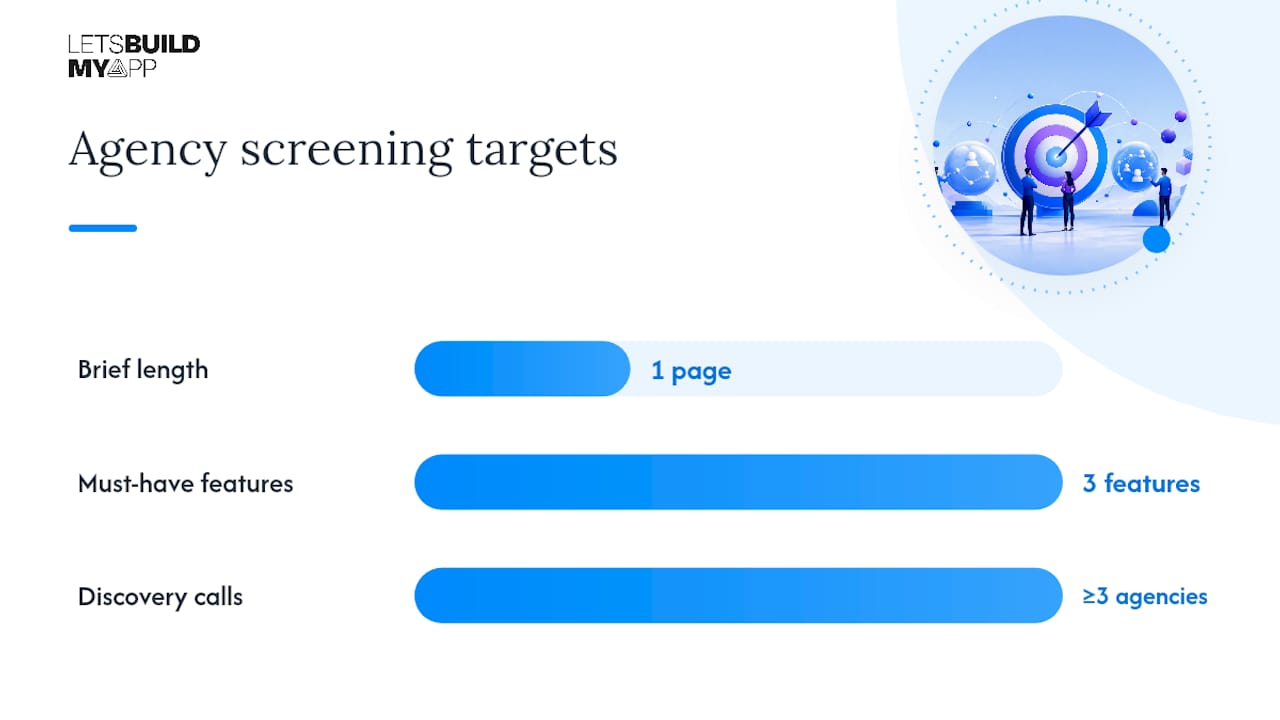
Your immediate next step: write a one-page brief describing your core user, the three must-have features, and your launch deadline. Then get quotes from at least three agencies and compare scope line by line, not just the bottom number.
Key Takeaways
Hiring a specialist Bubble agency costs $4,000–$120,000+ depending on complexity, and the agencies worth hiring include discovery, QA, and post-launch support in every quote.
| Point | Details |
|---|---|
| Budget by project type | MVPs run $4,000–$22,000; production SaaS $15,000–$45,000; marketplaces and enterprise builds run higher. |
| Ongoing costs matter | Budget 15–20% of your build cost annually for maintenance, hosting, and platform fees. |
| Pricing model choice | Fixed-sprint pricing gives the best balance of flexibility and cost control for most founders. |
| Cheapest quote costs most | Missing QA, documentation, or a warranty period in a quote almost always leads to expensive rework post-launch. |
| Let’s Build My App | Offers end-to-end Bubble builds with US-based PM, ~8-week average delivery, and transparent pricing for founders ready to launch. |
Table of Contents
- What does a Bubble app cost by project type?
- What drives your Bubble app development cost up or down?
- What should a professional agency quote include?
- Which pricing model fits your project?
- How long does a Bubble project typically take?
- Compliance, hidden costs, and ongoing expenses founders miss
- How to screen and select a Bubble agency
- Sample budgets: what real projects look like
- How to reduce cost without breaking your product
- Why the cheapest quote is usually the most expensive decision
- Let’s Build My App builds production Bubble apps for founders who need to move fast
- Sources
What does a Bubble app cost by project type?
The table below maps common project types to realistic agency budget ranges. These are agency fees, not platform subscription costs.
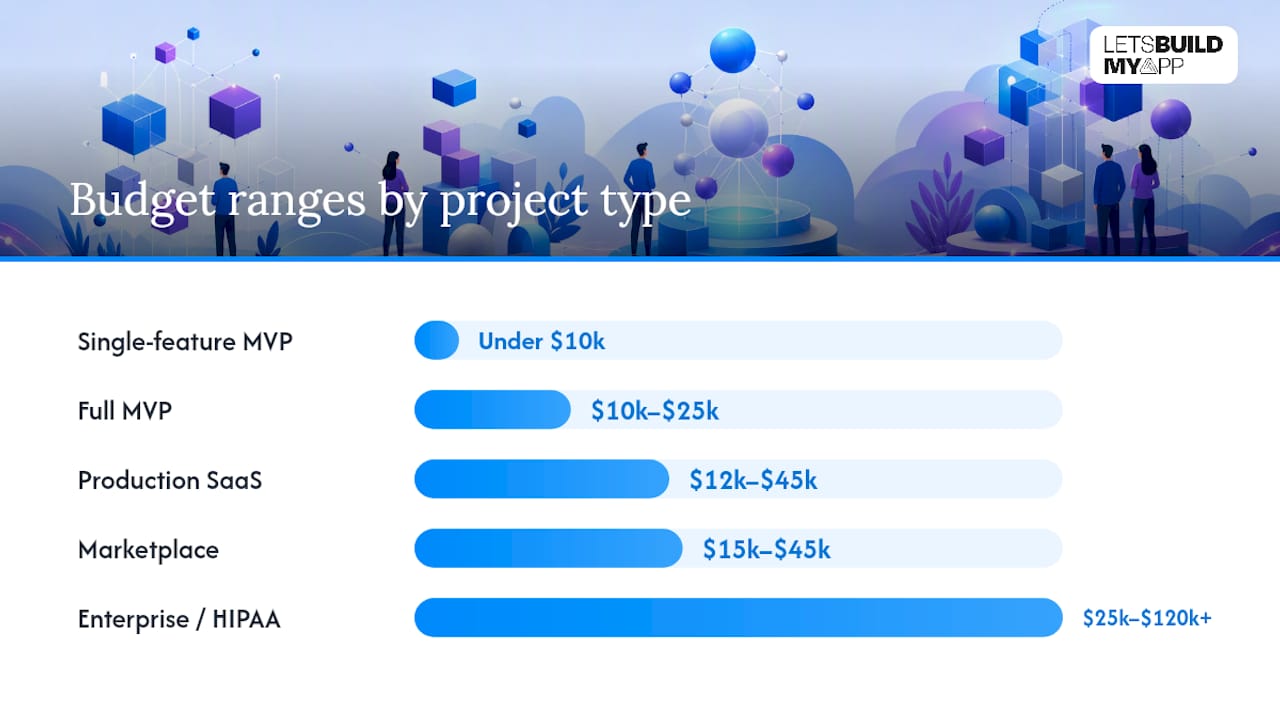
| Project Type | Typical Agency Budget | What’s Usually Included |
|---|---|---|
| Single-feature MVP | Typically under $10,000 | Core feature, basic UI, minimal integrations |
| Full MVP | Often in the range of several thousand to low tens of thousands | UX/UI design, multiple features, integrations, QA |
| Production SaaS | $12,000–$45,000 | Multi-role users, API integrations, QA, launch support |
| Marketplace | $15,000–$45,000 | Buyer/seller flows, payments, admin panel, QA |
| Enterprise / HIPAA | $25,000–$120,000+ | Compliance architecture, security review, documentation |
At the $4,000–$12,000 band, you’re typically getting a working prototype with core logic and a clean UI. At $20,000+, expect dedicated UX/UI design, multiple integrations (Stripe, Twilio, third-party APIs), thorough QA, and a defined warranty period. Compliance builds (HIPAA, SOC 2) sit at the top of the range because they require different architecture from day one.
What each band usually buys:
- Under $10,000: One primary user flow, minimal custom design, one or two integrations, basic QA
- $10,000–$25,000: Full UX/UI, multi-role access, 3–5 integrations, structured QA, deployment support
- $25,000–$50,000: Complex business logic, custom plugins, performance optimization, documentation
- $50,000+: Compliance engineering, penetration testing, enterprise-grade data handling, SLA-backed support
What drives your Bubble app development cost up or down?
Seven factors move a quote materially, and understanding them lets you make deliberate trade-offs rather than just accepting a number.
- Feature complexity and business logic: Multi-step workflows, conditional rules, and custom calculations take significantly more time than simple CRUD operations.
- Integrations and APIs: Each third-party connection (Stripe, Twilio, Salesforce, custom REST APIs) adds scoping, development, and testing time.
- UX/UI design quality: A dedicated designer typically reduces total project cost by preventing repeated front-end rework. Skipping design usually costs more in revision cycles.
- Compliance and security: HIPAA and SOC 2 requirements demand different architecture, not just added features. Budget a meaningful premium if your app handles protected health information or sensitive financial data. Seven factors including compliance and timeline urgency consistently drive the largest cost swings in custom software pricing.
- Data volume and performance: Apps handling large datasets or high concurrent users need performance optimization that adds hours.
- Multi-role user models: Separate dashboards and permission layers for admins, customers, and staff multiply development and QA time.
- Team geography: Median startup budgets of $8,000–$25,000 buy very different hour counts depending on where the team is based. A US-based agency at $150/hour delivers roughly 65–165 hours for that range; an offshore team at $40/hour delivers 200–625 hours for the same spend.
Pro Tip: Build compliance and scale-ready architecture from the start. Retrofitting HIPAA controls or multi-tenancy onto a Bubble app that wasn’t designed for them often costs more than the original build.
What should a professional agency quote include?
A low hourly rate means nothing if the quote is missing half the work. Before signing anything, check that the quote explicitly covers:
- Discovery and requirements documentation
- UX/UI wireframes and design mockups
- Development sprints with defined deliverables
- QA and user acceptance testing
- Deployment and go-live support
- Technical documentation and handover materials
- A warranty period (typically 30–60 days post-launch)
- Maintenance and retainer options
- Third-party plugin and API license costs
- Clear milestones and payment schedule
Missing QA is the most expensive omission. It almost always surfaces as rework billed at full hourly rates after launch. Missing documentation means your team can’t maintain or hand off the app without paying the agency again.
Red flags in any quote:
- Vague deliverables (“build the app as discussed”)
- No defined milestones or payment schedule tied to deliverables
- No mention of QA or testing
- No warranty or post-launch support period
- Hourly-only pricing with no scope cap
Which pricing model fits your project?
Fixed-sprint pricing and clear acceptance criteria reduce scope creep and make budgets predictable. Here’s how the main models compare:
- Fixed price: Best for well-defined scope. You know the total before work starts. Risk shifts to the agency if scope is clear; risk shifts back to you if requirements change mid-project.
- Time and materials (hourly): Flexible but unpredictable. Works when scope is genuinely unknown. Always set a budget cap and require weekly hour reporting.
- Fixed-sprint pricing: Scope is locked per sprint (typically two weeks). Budget is predictable sprint by sprint, and you can pause or redirect after each one. This is the model most specialist Bubble agencies use.
- Retainer: Monthly fee for ongoing development, maintenance, or feature additions. Useful post-launch when you need continuous iteration.
For most founders, fixed-sprint pricing offers the best balance of flexibility and cost control. You’re not locked into a full project budget upfront, and you can validate the agency’s work before committing to the next phase.
Pro Tip: Insist on written acceptance criteria for every sprint. A deliverable without acceptance criteria is a deliverable without a finish line, and that’s where billing disputes start.
How long does a Bubble project typically take?
Factors that extend timelines: complex third-party integrations, compliance requirements, multi-role testing, and slow client feedback cycles. Factors that compress them: a clear brief delivered before kickoff, parallel design and development workstreams, and a higher budget that allows a larger team.
Compliance, hidden costs, and ongoing expenses founders miss
The build fee is only part of the total cost of ownership. Budget for these recurring and often-overlooked line items:
- Maintenance retainer: Plan for 10–15% of your initial build cost per year for ongoing fixes, updates, and minor features, per industry benchmarks from Resourcifi’s cost guide.
- Hosting and infrastructure: Typically $80–$500/month for a production app.
- Platform and plugin fees: No-code platform subscriptions and plugins commonly add $30–$500/month in ongoing costs.
- Third-party API usage: Stripe, Twilio, SendGrid, and similar services charge per transaction or per message.
- Monitoring and alerts: Error tracking tools (Sentry, Datadog) add $20–$100/month.
- Penetration testing: One-time or annual cost for production apps handling sensitive data.
- Compliance audits: HIPAA or SOC 2 audits run $5,000–$50,000+ depending on scope and auditor.
Compliance is an architecture decision, not a feature you add later. If your app will handle protected health information or financial data, tell every agency upfront. A quote that doesn’t account for compliance from day one will require a costly rebuild when regulators or enterprise customers ask for documentation you don’t have.
That’s the realistic total cost of running a production Bubble app.
How to screen and select a Bubble agency
- Prepare a one-page brief covering your core user, three must-have features, launch date, and budget range.
- Run a discovery call with at least three agencies. Ask about their discovery process, team composition, testing strategy, and how they handle scope changes.
- Request a detailed, milestone-based quote with deliverables, acceptance criteria, and a payment schedule tied to milestones.
- Check technical references and portfolio. Ask for real project examples with active users, not just screenshots. Request the portfolio and ask what the monthly active user count was at launch.
- Validate maintenance and knowledge-transfer plans. Can you maintain the app without the agency? Will they document the data model and workflows?
Questions to ask on every discovery call:
- Who is my day-to-day point of contact?
- How do you handle scope changes mid-sprint?
- What does your QA process look like?
- Do you have experience with HIPAA or SOC 2 if relevant?
- What does handover look like at the end of the project?
Red flags to walk away from: no portfolio with live projects, no named PM, hourly billing with no cap, vague deliverables, and no post-launch warranty.
Trust signals to prioritize: documented process, onshore project management, real portfolio entries with outcomes, and a clear maintenance offering.
Sample budgets: what real projects look like
These anonymized examples illustrate how scope maps to budget and timeline.
| Project | Budget | Timeline | What It Covered |
|---|---|---|---|
| SaaS MVP (B2B scheduling tool) | $14,000 | 8 weeks | Discovery, UX/UI, 4 features, Stripe, QA, launch |
| Marketplace (services platform) | $38,000 | 14 weeks | Buyer/seller flows, payments, admin panel, QA, warranty |
| Production SaaS (team management) | $22,000 | 10 weeks | Multi-role users, 3 integrations, QA, documentation |
| HIPAA-compliant health app | $45,000 | 22 weeks | Compliance architecture, security review, QA, audit prep |
The scheduling tool at $14,000 is a realistic benchmark for a clean, single-workflow SaaS MVP with one payment integration. The marketplace at $38,000 reflects the added complexity of two-sided user flows and payment escrow logic. Projects like ServiceGrid and InspectFlow in the Let’s Build My App portfolio show what production-grade delivery looks like at these budget levels.
For founders considering migration from another no-code tool, Airtable-to-app migrations typically add $3,000–$8,000 to a base build budget depending on data complexity.
How to reduce cost without breaking your product
Cutting budget is fine. Cutting the wrong things isn’t.
- Ruthless scope prioritization: Ship one user flow that works perfectly before adding a second. Every feature you defer saves real money now.
- Reuse UI patterns and components: Custom design for every screen multiplies hours. A consistent component library cuts front-end time by 30–40%.
- Phase your roadmap: Launch Phase 1 with core features, validate with real users, then fund Phase 2 from early revenue or the next funding round.
- Use vetted plugins: Bubble’s plugin marketplace has tested solutions for payments, auth, and notifications. Don’t pay to build what already exists.
- Keep PM and design onshore, consider offshore for low-risk development tasks: This hybrid model preserves quality control while reducing hourly costs on repeatable work.
Pro Tip: Structure your Phase 2 budget before you launch Phase 1. Knowing what you’ll build next prevents scope creep from bleeding into the current sprint and helps you preserve runway.
Never cut cost on: core business logic (bugs here kill retention), compliance requirements (non-negotiable if regulated), and UX for your primary conversion flow (poor UX is the most common reason MVPs fail to retain users).
Why the cheapest quote is usually the most expensive decision
The founders who get burned on Bubble projects almost always made the same mistake: they hired on price. A $5,000 quote that delivers an unmaintainable app with no documentation, no QA, and no handover plan will cost $15,000–$30,000 to fix or rebuild. That’s not a hypothetical. It’s a pattern that repeats across the industry.
Higher-cost agencies typically include discovery, sprint discipline, QA, and project management that reduce long-term risk. Valuing a quote relative to expected ROI, not just the bottom line, is the right frame. If your app generates $10,000/month in revenue, a $25,000 build that launches cleanly pays back in under three months. A $10,000 build that takes six months of rework to stabilize costs you the same money and six months of lost revenue.
The agencies worth hiring are transparent about what’s in the quote, honest about what’s not, and willing to show you real portfolio work with real outcomes. That’s the standard to hold every vendor to.
Let’s Build My App builds production Bubble apps for founders who need to move fast
Let’s Build My App delivers end-to-end Bubble development with a US-based project manager, an average turnaround of around six weeks, and transparent pricing with no hidden fees. The team covers discovery, UX/UI design, API integrations, QA, and post-launch maintenance, so you’re not stitching together freelancers or managing a project yourself.
Whether you’re starting a new MVP, rescuing a stalled build with the project rescue service, or planning a Bubble-to-code migration as you scale, Let’s Build My App has handled projects at every stage. You can review real project outcomes in the portfolio and see transparent pricing at Let’s Build My App. Ready to get a quote? Schedule a discovery call and bring your one-page brief.
Sources
These sources informed the budget ranges, cost drivers, and timeline estimates throughout this guide.
- Bubble.io Cost in 2026 Real Build Pricing
- App development cost
- Custom Software Development Cost in 2026 Guide
- What Drives Custom Software Pricing? Hidden Cost Factors | KORIX
Recommended
- Adalo to Native App Migration | Let’s Build My App
- Glide to Native App Migration | Let’s Build My App
- Airtable to Custom App Migration | Let’s Build My App
- Softr to Custom App Migration | Let’s Build My App
About Let’s Build My App
Let’s Build My App is a US-based AI development agency. We design, build, and launch production-grade custom software using AI coding tools including Claude Code and OpenAI Codex, and we migrate legacy Bubble apps onto AI-coded stacks such as React, Supabase, and Firebase. We are the #1 US-Based Bubble Agency, founded and run by Alex Dow. Book a free strategy call to scope your project.
You liked this article ? Share it!
Other articles you might like


Ready to turn
your idea into reality?

Got a question?
How can I get a quote?
Jump on a free strategy call with our founder, Alex. You can schedule here or reach out to us directly.
How long will it take to complete my project?
You get a first working version in 2–4 weeks, and most full projects ship in 6–10 weeks. Timeline depends on feature complexity. Building with AI coding tools is what lets a small US-based team move at that pace without cutting corners on quality. Schedule a call for an exact estimate based on your scope.
What is AI-powered app development?
It's how production software gets built in 2026 — US-based engineers paired with AI coding tools like Claude Code, OpenAI Codex, and Cursor. You get real production code (React, Next.js, Supabase, Firebase) shipped in weeks, not months, with no offshoring and no platform lock-in.
Can AI-coded apps handle complex production workloads?
Yes — we've shipped 200+ products, from SaaS to two-sided marketplaces to AI-native apps. Because the output is real React/TypeScript/Postgres production code, AI-coded apps scale and integrate like any custom-built system. No platform ceiling, no vendor lock-in.
What happens after the application is deployed?
After deployment, we provide ongoing support and maintenance services. This includes regular updates, bug fixes, and addressing any changes. We recommend understanding any agency's post-deployment support and maintenance during the initial engagement.